Utah
Wild West booze: 150-year-old bottle unearthed in historic Utah mining town

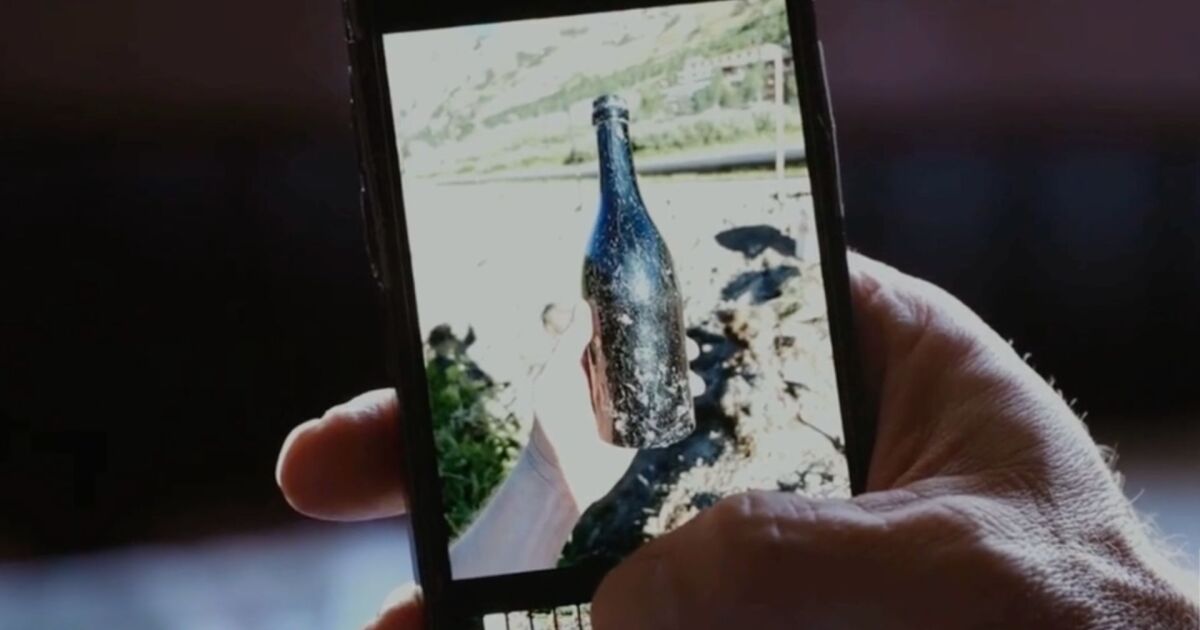
An archaeological team in Utah has discovered a literal time capsule from the state’s Wild West past: a bottle of alcohol that had been buried for over a century at the historic mining town of Alta.
Local distillers at High West Saloon are now working to identify the mysterious liquid and unlock the secrets it might hold from the frontier days. Archaeologist Ian Wright has been leading the excavation.
“We have found a 150-year-old bottle of alcohol. So we thought, hey, let’s take it to the experts and see if we can find out what exactly is in it,” said Wright.
RELATED STORY | Breweries are using artificial intelligence to create new beers
The discovery is particularly significant because it’s the only intact bottle of alcohol from this era ever found in Utah, according to Wright.
High West, Utah’s first legal distillery since 1870, seemed like the perfect place to analyze the historic find. According to their director of distilling, Isaac Winter, the company specializes in blending spirits and has deep roots in Utah’s distilling history.
“We started off as a blending house,” said Winter. “We’re always looking for beautiful spirits across the country, across the world sometimes, to create blends that are something more than the sum of their parts.”
When Wright brought the bottle to the distillery, the team was immediately intrigued by its condition.
“It’s in reasonably good shape, I would say, after sitting for 150 years,” Winter said.
The analysis began with careful examination of the bottle’s aroma and color. The team detected a slight vinegar smell from the cork, but they needed to extract some of the liquid to learn more.
“We weren’t sure if it was clear spirit, if it was aged spirit, if it was beer, if it was wine, if it was champagne,” Winter said.
FROM THE ARCHIVES | From monks to mixologists: A history of whiskey for World Whiskey Day
To preserve the historic bottle, they called in reinforcements from Old Town Cellars, just up the road, who brought a Coravin device that could extract liquid without breaking the cork.
“We’re being very careful with that sample,” Winter explained as they used the specialized tool.
When the liquid finally emerged, it revealed promising characteristics.
“To see the liquid come out and have a color and have a good smell,” Winter said, describing the moment.
Tara Lindley, director of sensory and product development at High West, noted the complex flavors: “First, there was some kind of a, kind of an oxidized fruit note.”
Winter added: “It’s fruity, there’s a little bit of leather, there’s quite a bit of age on it.”
The analysis revealed that yeast was used in the production, leading the team to believe it was likely some type of beer rather than distilled spirits.
RELATED STORY | 2026 trend: Alcohol out, THC drinks in
Despite some initial hesitation, Winter decided to taste the 150-year-old beverage.
“I had a little bit of trepidation going into it, but you have to try it,” Winter said. “It didn’t smell like gasoline, didn’t smell like tobacco spit.”
The discovery of what appears to be beer opened up an exciting possibility — the potential to recreate the historic beverage.
The team made the decision to fully uncork the bottle, despite concerns about damaging the antique container.
“It’s an old bottle, it’s a lot of pressure, you don’t want to damage the bottle,” Wright said.
Once opened, they carefully decanted the liquid and filtered it through a coffee filter to separate any sediment.
“Very exciting to see the liquid as it finally came out,” Winter said. “We put it through a coffee filter — very scientific way of separating the bits from the liquid.”
The sediment at the bottom of the bottle could hold the key to recreation.
“The very bottom of the bottle was sort of turbid — it was sort of milky. We’re going to take that back and hopefully plate it out and find some usable yeast on it,” Winter explained.
If they can successfully cultivate the historic yeast, it could allow them to recreate the exact beer that miners were drinking in Alta over a century ago.
“Science is really at the foundation of creating alcohol. That, and art,” Lindley said.
For Wright, the project represents something larger than just analyzing an old bottle.
“This is so cool because it’s taking history — it’s taking it off of an old dusty shelf,” Wright said. “Because history, it belongs to everybody.”
This story was originally published by Spencer Joseph with the Scripps News Group in Salt Lake City.



TE Dallen Bentley
- Height: 6’4”
- Weight: 253 lbs
- Class: Senior
- School: Utah
- Hands: 9 ¼”
- Arm length: 33 ⅛”
- 40-yard-dash: 4.62s
- 10-yard-split: 1.62s
- Vertical Jump: 35”
- Broad Jump: 9’10”
- Short-Shuttle: 4.42s
- Bench Press: 24 reps
- STATS
A former four star recruit out of Taylorsville High School in Taylorsville, Utah, where he was the number one recruit from his state and the number one JUCO tight end during the 2023 recruiting cycle.
Bentley caught eight passes for 112 yards with two touchdowns at Snow College, which earned him the NJCAA All-American, second team honors.
Bentley was Third-Team All Big-12 in 2025. He averaged 12.9 yards per catch with a 10.98 aDot in 2025, while taking 110 snaps (30.4%) out of the slot and securing just 26.7% of his contested catches (4 of 15).
He did have a fumble and he averaged 2.07 yards per route run. Bentley played 782 snaps in 2025 and 376 in 2024. He accepted an invite to the East-West Shrine Game.
Strengths
- Good size with excellent length length in a solid TE frame
- Good athlete with solid foot-speed and very good burst
- Long strider
- Some wiggle up his route stems
- Excellent adjustment on short throws away from his frame
- Fluid mover/adjuster to the football in the air near the sideline
- Good awareness in the flat near the sideline
- Excellent hands as a pass catcher
- Above average blocker on the LOS – loses slow enough!
- Solid COMBO blocks on the first level
- Does well to work up to the second level – good angles
- Very good play strength (when technique is dialed in)
- Generates good force on down/pin block
- Good get his hands on target quicker at the POA
- Solid YAC ability – runs through arm tackles
- Can align all over the formation: Y, slot, Wide
Weaknesses
- A bit lumbering as a deeper route runner
- Wish he was better at the catch point (low contested catch total)
- Must work back to the football more (deeper down the field)
- Must improve his catching through traffic
- Run game technique can improve
- Could sustain blocks a bit longer – bring his feet with him
- Only one year of production
- Is already 25 years old
Summary
Dallen Bentley is a controlled mover with excellent ball skills and a solid overall comprehension on how to execute blocks in the run game.
He smoothly adjusts to footballs around his wide catch radius and shows his natural athletic ability with those adjustments.
Bentley is a capable run blocker who needs to refine his technique, but he has the requisite play strength to execute most TE assignments, while being athletic enough to align in the slot and out wide.
Although older – and with just one year of production under his belt – Bentley is a well-rounded tight end who, with some refinement, can be a contributing tight end that will be available on day three.
GRADE: 6.10
Sign up for our free newsletter and follow us on Facebook and X for the latest news and send your mailbag questions to us.

Coming off a really solid sophomore season, Utah lineman Spencer Fano quickly became someone who NFL draft analysts believed could be the No. 1 offensive tackle prospect in the 2026 class.
That buzz only grew louder as the Spanish Fork, Utah, native followed up his 2024 campaign with an even more impressive showing in 2025, solidifying his reputation as one of the best offensive lineman in college football.
Fano, who started all 12 games at right tackle, earned unanimous first-team All-American honors and took home the Outland Trophy after allowing just five pressures, five hurries and no sacks in over 350 pass-blocking opportunities. In addition to keeping the Utes’ quarterbacks upright, he paved the way for an offense that rushed for 266.3 yards per contest (No. 1 among power conference teams) as Utah amassed a school-record 3,462 yards on the ground in across 13 games. The Utes also scored 41 rushing touchdowns, which was tied for the second-most in the Football Bowl Subdivision.
Fano did all that after garnering All-America recognition from Pro Football Focus, the Associated Press and Walter Camp in 2024.
Between all personal accolades and team stats Fano helped generate in the 37 games he played in, the Timpview High School (Utah) product compiled quite the résumé in his three seasons at Utah, the school he committed to as a four-star recruit in the class of 2023. Though, as far as his potential fit in the NFL is concerned, there’s still some debate among draft analysts centered around his size and skillset.
Here’s what a few NFL draft experts have said and written about Fano in the lead up to the 2026 NFL Draft (April 23-25).
Skillset Analysis
There’s a lot that goes into scouting offensive tackles — it’s much more than just ‘Hey, he pushes other guys around really well.” While strength is an important part of playing the position, there are several other athletic and physical traits that play a role, like hip movement, feet placement and core control, to name a few.
Arm length is another important characteristic for offensive lineman. Typically, the average tackle measures in with 34-inch arms. During the NFL combine in Indianapolis, Fano check in with 32 1/8-inch arms, sparking discussions in draft circles over whether he was a better fit at tackle or guard at the next level (more on that later).
What seems to be less of an argument, though, is just how gifted Fano is as an athlete. His athleticism score of 93, which ranked No. 1 among all tackle prospects at the combine, demonstrated as much.
“[Fano’s] really, really quick,” said NFL draft analyst Daniel Jeremiah during an appearance on Peter Shrager’s podcast. “He can really go out and pick off corners, he’s really, really athletic. There’s a lot to really like about him.”
One of the aspects of Fano’s game that stands out to The Ringer’s Mel Kiper Jr. is how technically-sound he was this past season.
“He has a rare ability to recover when he gets into a bad spot,” Kiper wrote in his evalutation of Fano for The Ringer. “He works his hands inside and anchors well enough. He can set high and his base narrows.”
Of course, Fano isn’t a perfect prospect (those just don’t exist). Because of his arm length, he isn’t always able to keep defensive ends at-length like some other top-notch prospects can.
“There’s just times because of his lack of length, you’ll see guys get into his chest a little bit,” Jeremiah said. “He might get bold at times, but he’s incredibly smart, aware. The character makeup stuff’s great.”
Tackle or Guard?
Fano’s arm length has some wondering if he’d be a better fit at guard or center in the NFL, as opposed to the position he spent his entire college career, tackle.
Perhaps wisely, Fano went through drills with both tackles and centers during the skills-testing portion of the combine, giving scouts even more opportunities to see his athleticism and potentially determine whether he’d be better served at tackle or guard at the next level.
“His athletic profile is designed for move-based blocking schemes where he can pull, reach and climb while beating opponents to the spot with quickness/feel for hitting landmarks on time,” wrote NFL analyst Lance Zierlein in his assessment of Fano. “He gives good effort as a downhill blocker but issues with pad level and core strength lead to him being overtaken as the rep progresses.”
By all accounts, Zierlein’s projection of Fano’s best scheme fit sounds like one that has him playing on the interior. Usually, it’s guards who are tasked with pulling and getting to the second level in the run game, especially if they’re particularly fast and athletic. And because Fano was open about moving to guard during combine interviews, the team that drafts him might be apt to playing him on the inside.
“Fano has the traditional athletic profile of a left tackle, with experience playing on the left side — but the bulk of his experience comes at right tackle, and his short arms could cause him to kick inside,” Kiper wrote. “While he didn’t play on the inside in college, Fano has the traits to develop into an excellent center in the NFL.”
As Kiper dutifully points out in his evaluation, there are several examples of players who started their careers at tackle moving inside to play guard. Perhaps the best comparison to Fano is Tampa Bay Buccaneers’ 2022 second round pick, Luke Goedecke, who began his collegiate career as a tight end at Wisconsin-Stevens Point before developing into a tackle at Central Michigan. He moved to left guard to start his NFL career, though he’s started at right tackle the past three seasons and has played at a high level.
NFL Draft Ranking
Regardless of the position Fano settles into at the next level, it’s a consensus that he’s a first-round talent. Draft analysts at ESPN, CBS and PFF tab him as a top-four tackle prospect and don’t have him lower than No. 19 on their respective big boards. Kiper ranks him as the No. 2 tackle and the No. 12 overall player on his draft board.
Interestingly, Jeremiah is one of the few mock draft creators who lists Fano as an “IOL” (interior offensive lineman). Even so, Fano is the No. 13 prospect on Jeremiah’s 50-player big board.
On the NFL’s official website, Fano checks in with a prospect grade of 6.44, which is deemed as a someone who will become a good starter within two years.
“Fano’s short arms raise questions about his position fit and might hurt his draft value, but he is one of the top offensive linemen in this class and a top 15-20 player overall,” Kiper wrote.

After helping expose Samuel Bateman’s abuse, Christine Marie reflects on the risks, the victims and what she hopes viewers learn from “Trust Me: The False Prophet.”
(Trent Nelson | The Salt Lake Tribune) Tolga Katas photographs Christine Marie with several fundamentalist women in Colorado City, Ariz. on May 3, 2025. A photograph from the session is the poster image for the upcoming documentary “Trust Me.”

Some famous Oregon pets from the past century

Jaime Lynne (McCabe) Roberts, Sharpsville, PA

High-capacity magazine cases rising in RI. What AG’s gun report shows

Calendar quirk and law change have South Dakota election officials worried about deadlines

A familiar crew fuels Jim Knowles’ defensive overhaul at Tennessee this spring

Florida High School Football Rankings: Top 25 teams – Oct. 21

How old is Bo Nix? What to know about Oregon quarterback ahead of 2024 NFL Draft

Cleary's 21 help Le Moyne down Central Connecticut State 69-64 in OT

99th annual Pony Swim held in Virginia

Indiana Members Credit Union announced as new anchor tenant at Bottleworks District

Rep Randy Fine joins House Freedom Caucus: ‘Strongest group of conservative patriots in Congress’

Trump issues NATO ultimatum to reopen Strait of Hormuz ‘within days’

Women are getting most of the new jobs. What’s going on with men?

Video: How Trump’s Advisers Felt About Going to War With Iran

Unearthed clip exposes shocking claim by Newsom’s wife about inmates at violent California prison
-

 Atlanta, GA5 days ago
1 teenage girl killed, another injured in shooting at Piedmont Park, police say
-

 Education1 week ago
Video: We Put Dyson’s $600 Vacuum to the Test
-

 Movie Reviews1 week ago
Vaazha 2 first half review: Hashir anchors a lively, chaos-filled teen tale
-

 Georgia3 days ago
Georgia House Special Runoff Election 2026 Live Results
-

 Education1 week ago
Video: YouTube’s C.E.O. on the Rise of Video and the Decline of Reading
-

 Pennsylvania4 days ago
Parents charged after toddler injured by wolf at Pennsylvania zoo
-

 Education1 week ago
Video: Toy Testing with a Discerning Bodega Cat
-
 Milwaukee, WI4 days ago
Potawatomi Casino Hotel evacuated after fire breaks out in rooftop HVAC system