Connect with us

West

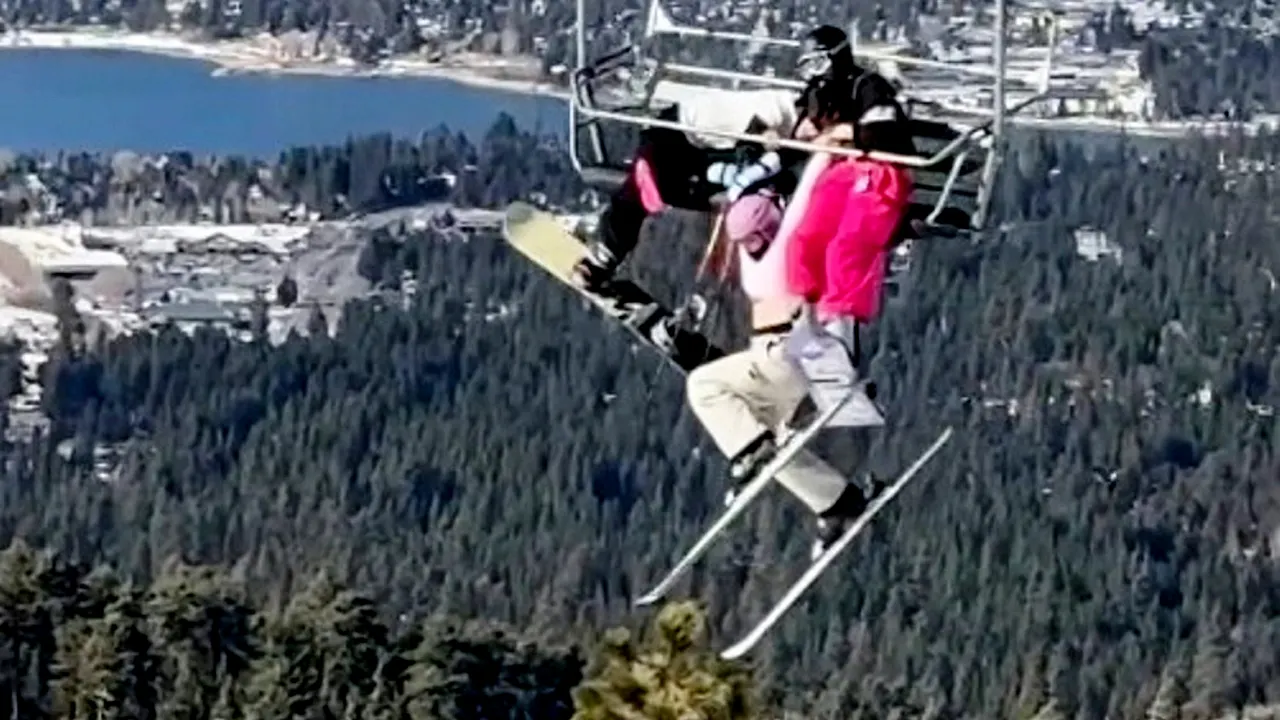
Skier’s prank backfires, leaving her dangling 65 feet in the air as twin desperately holds on

Published

on

Skier’s prank backfires, leaving her dangling 65 feet in the air as twin desperately holds on
NEWYou can now listen to Fox News articles!

A skier was left dangling 65 feet in the air after a prank on a chairlift went terribly wrong.

The incident happened Feb. 24 at Big Bear Lake in California, where Roula De Miranda-Arce, 21, was riding the lift with her twin sister and a friend, news agency SWNS reported.

Big Bear Mountain Resort confirmed the incident in a statement shared with Fox News Digital.

AIRLINES PREPARE FOR RECORD-BREAKING SPRING BREAK TRAVEL SURGE AS AMERICANS ‘PRIORITIZE EXPERIENCES’ 

Advertisement

“At approximately 2:45 p.m. on Tuesday, Feb. 24, a 21-year-old female skier safely loaded onto Chair 9 at Bear Mountain. At some point during her ride to the top, she failed to maintain proper safety protocols and became suspended from the carrier,” the resort said in its statement.

The organization added, “The guest and her sister, who was riding the carrier with her, admitted to horseplay as the reason for her becoming suspended. As soon as staff became aware of the situation, they took quick action to stop the carrier and unload everyone as soon as it reached the upper terminal.”

A 21-year-old skier was left suspended 65 feet in the air after a chairlift prank went wrong at Big Bear Lake, California, last week. (SWNS)

Officials said the skier was evaluated by ski patrol as a precaution and did not sustain significant injuries.

NEARLY 70 SKIERS STRANDED IN MIDAIR FOR HOURS AFTER GONDOLA MALFUNCTIONS AT POPULAR RESORT

Advertisement

In an attempt to jokingly scare her sister, De Miranda-Arce slid down from the moving chair, planning to hang briefly before pulling herself back up, SWNS reported.

The weight of her skis, however, made it impossible for her to lift herself back onto the seat — leaving her suspended as the chair continued uphill.

Video shows the young woman hanging in midair while her sister and friend cling tightly to her arms, preventing her from falling.

“I thought I was going to die or become a paraplegic,” she said.

Advertisement

Footage captures the prank gone terribly wrong in the air.  (SWNS)

The young woman said she began screaming as the strain on her arms intensified.

“I was screaming at one point, ‘Just let me go,’ because it felt like my arms were going to break,” she said. 

“And thank God my sister and my friend did not listen to me.”

CLICK HERE FOR MORE LIFESTYLE STORIES

Advertisement

The pair managed to hold her for roughly two minutes until the chairlift reached the top of the slope — where ski patrol members were waiting for her.

“It’s crazy what your body does in fight or flight,” she said.

De Miranda-Arce’s sister and friend managed to hold onto her for nearly two minutes until the chairlift reached the top of the slope — where members of the ski patrol were waiting to assist. (SWNS)

The resort said the incident serves as a reminder for guests to lower the safety bar and avoid potentially dangerous behavior while riding lifts.

Fox News Digital previously reported on another alarming chairlift incident in California earlier this year.

Advertisement

TEST YOURSELF WITH OUR LATEST LIFESTYLE QUIZ

A 12-year-old girl was left dangling from a ski lift at Mammoth Mountain Ski Resort before falling to the ground in a frightening moment captured on video.

Footage showed ski resort staff rushing to position padding and a safety net beneath her as she struggled to hold on, though she ultimately missed most of the net during the fall.

CLICK HERE TO DOWNLOAD THE FOX NEWS APP

Her mother later said the girl “miraculously walked away with no broken bones or major injuries” — calling it a traumatic but accidental event.

Advertisement

Bonny Chu of Fox News Digital contributed reporting. 

Related Article

Airlines prepare for record-breaking spring break travel surge as Americans 'prioritize experiences'

Read the full article from Here

Advertisement

Colorado

What Colorado’s mountain lakes can tell scientists about climate change 

Published

on

What Colorado’s mountain lakes can tell scientists about climate change 

Summit Lake, located in the Mount Blue Sky Wilderness in the Arapahoe National Forest, is among the lakes that have been sampled for over 40 years as part of a U.S. Forest Service program. High-altitude lakes are sensitive, making them a perfect testing ground for evaluating the impacts of climate change and pollutants on ecosystems.
Shelby Valicenti/Summit Daily News archive

For over 40 years, the U.S. Forest Service has been monitoring high-altitude mountain lakes in Colorado to track the environmental impacts of human-caused pollutants and climate changes in delicate wilderness areas and ecosystems. 

Mountain lakes are extremely sensitive, making them a perfect testing ground for measuring ecosystem changes in climate and the environment. 

Mary Jade Farruggia, a postdoctoral researcher at the University of Colorado Boulder’s mountain limnology lab, described them as a “canary in the coal mine” or an early warning system that can help guide which larger ecosystem changes researchers need to look out for. 


“They often show changes as a result of the environment early on, before less sensitive ecosystems might,” Farruggia said. “Understanding how the most sensitive ecosystem changes as a result of our changing environmental conditions provides important foresight for how less sensitive ecosystems may change in the future.”

Farruggia recently partnered with researchers from the Forest Service and University of Colorado Boulder to look at data from 35 southern Rocky Mountain lakes collected as part of the federal agency’s long-term air monitoring program. The study set out to determine whether environmental changes — including climate change and air pollution — have impacted the lakes’ chemistry and ecosystem over time. 

Advertisement


The program and samples collected support various federal efforts — including the National Atmospheric Deposition Program and the Interagency Monitoring of Protected Visual Environments program — created following the 1977 Clean Air Act to assess air and water quality in sensitive, high-elevation wilderness areas. 

Over the last 40 years, over 2,500 samples have been collected in these 35 lakes ranging from 9,600 feet of elevation to 13,000 feet, Farruggia said. All but two lakes, located in the Wind River Range in west central Wyoming, are in Colorado. They span six national forests, 11 wilderness areas and 14 ranger districts. 

Typically, samples are collected from each lake two times every summer. In the past, occasional samples were taken in the winter. With recent changes, Farruggia said the samples look at 19 different chemical parameters, an increase from the 13 it has historically tested for. 

This type of “large-scale, long-term monitoring” is extremely valuable, “particularly as our climate becomes more variable and extreme,” Farruggia said. 

“We cannot measure just one or two mountain lakes for a year or two and extrapolate to all other mountain lakes over decades. We need large programs like this one to capture the variability in lake responses to change over both space and time,” she added. 

Advertisement
For over 40 years, The U.S. Forest Service and partners have collected annual samples from 35 southern Rocky Mountain lakes as part of its long-term air monitoring program.
Courtesy Photo

According to Farruggia, this type of monitoring and data could help answer questions about how this winter’s historically low snowpack in Colorado could impact mountain lakes. 

“For example, we found that some lakes in this dataset are strongly influenced by precipitation, and will be especially sensitive to an extreme snowpack, meaning they will likely experience more change as a result of an extreme snowpack,” she said. “Insights like this can help natural resource managers understand which ecosystems may be most at risk and adapt their management for a changing climate.”

Many of these samples are collected by volunteers and nonprofits. In the Roaring Fork Valley and White River National Forest, Wilderness Workshop, a Carbondale-based conservation nonprofit, has supported the data collection since the late 1980s. The nonprofit has partnered with the national forest to fund a technician position that collects samples in 15 regional lakes. 

“These wilderness and high-mountain lake datasets represent some of the longest-term observations we have for these sensitive ecosystems across the central Rockies,” said Will Roush, executive director of the Wilderness Workshop. “These are the nation’s headwaters, everything else, across dozens of states, is downstream. The long-term monitoring of air and water quality provides a baseline we can use to understand the status of these lake resources and changes that could impact the health of people, wildlife and ecosystems.” 

Last year, after federal budget cuts hit the program, Pitkin County’s Healthy Rivers and Streams Program stepped up to fund and support the White River work in 2026. However, Roush warned that “federal funding is critical for the long-term continuation of the program.”

What is driving changes in mountain lake chemistry? 

Moon Lake, located in the Weminuche Wilderness of the San Juan National Forest, is among the lakes that have been sampled for over 40 years as part of a U.S. Forest Service program to understand environmental changes in high-altitude lakes.
Beau Toepfer/The Aspen Times archive

In a February webinar, Farruggia presented results from their study of the dataset. Isabella Oleksy, also with the University of Colorado Boulder’s mountain limnology lab, and Tim Fegel and Chuck Rhoades, with the U.S. Forest Service’s Rocky Mountain Research Station contributed to the study. 

“We went into it knowing that high elevation lakes such as these tend to be especially susceptible to environmental change due to their clear, dilute waters, small watersheds and sparse vegetation,” she said. “We didn’t know exactly if/how environmental change would affect the lakes, and how sensitive they might be.”

Advertisement

Specifically, the study set out to evaluate how changes in pollutants and emissions, drought conditions and warmer temperatures impacted levels of nitrogen and sulfate in the lakes. 

“Air pollution is the major source of nitrogen and sulfate in these systems,” Farruggia said. “Both nitrogen and sulfate contribute significantly to a lake’s acidity … An acidic lake can harm fish and wildlife, change the chemistry of the lake enough to promote reactions that release toxic metals into the water and make lakes less able to resist further additions of acid.” 

Both chemicals can travel long distances before depositing into these high-elevation lakes. 

Nitrogren, specifically, acts as a “MiracleGro” for lake algae, she added. 

“Lots of nitrogen can promote algal blooms, turning lakes green and less clear,” Farruggia said. “This is exacerbated by warming summer air temperatures due to climate change, since algae also grow better and faster in warmer temperatures.”

Advertisement

As the study set out to determine whether regional trends in air pollution or climate were impacting sulfate and nitrogen levels, they determined that these trends only served as an explanation for sulfate levels in around half the lakes and nitrogen levels in around 30% of the lakes, Farruggia said. 

While most lakes have experienced chemical changes in the past 40 years captured by the dataset, the magnitude and direction of the changes varied at each individual lake. Farruggia described it as “mosaic of regional to local factors” — erosion, drought, land cover, geography, size, elevation and more — that are all interacting to shape the chemical trends and changes at each location. 

“It’s clear that climate and or deposition matter to some lakes, but there isn’t one like golden variable that explains everything about how and why lake chemistry is changing,” Farruggia said. “It’s not quite as simple as being like, we’ve improved air pollution, and therefore, we’ve improved the same pollutants in lakes, unfortunately. So, we’ve just seen that it’s likely a combination of several factors driving change in these lakes.”

While the study is continuing to determine whether more “static” variables like soil and geology interact with pollution and climate, and how they impact levels of sulfate and nitrogen, Farruggia said the results really punctuate the need for this type of widespread, long-term monitoring.   

“Given that our future is not projected to be stationary, climate is projected to become more variable, more extreme,” she said. “We really need this continued monitoring for determining lake responses to ongoing change. We see that most of these relationships are not linear, a lot of them are squiggly.” 

Advertisement


Source link
Continue Reading

Hawaii

The Rally Point: Navy Leaders on the importance of Navy Week in Hawaii

Published

on

The Rally Point: Navy Leaders on the importance of Navy Week in Hawaii


HONOLULU (HawaiiNewsNow) – For the first time, Navy Week is being held in Hawaii. From March 9 – 15, Sailors (majority based on Oahu) and also abroad Hawaii namesake vessels will be here to learn more about the culture, the people, and the communities in which the are stationed at and ultimately, serve through service projects to education by visiting local schools to share more about the Navy resources and satellites, buoys and water currents, and speaking engagements with senior ranking Navy officers to include Rear Admiral Ryan Mahelona who is the third Native Hawaiian to reach this rank, a local boy, born and raised in Kaneohe who graduated from Kamehameha Schools – Kapalama Campus.

Commander Daniel Jones, commanding officer of the USS Hawaii and Commander David Taweel will join Jonathan on Wednesday, March 11, 2026 to talk about Navy Week in Hawaii.

The Rally Point is a new show that airs every other Wednesday at 12:30 p.m. on all of HNN’s platforms.

Host Jonathan Masaki, a retired Army lieutenant colonel, will focus on engaging conversations with military service members and defense department civilians and contractors on military-related issues that impact Hawaii and our community.

Watch a recap here:

Advertisement

Jonathan Masaki speaks to Maj. Gen. Stephen F. Logan on this inaugural episode of “The Rally Point.”


Source link

Continue Reading

Idaho

‘God is not silent,’ testifies Elder Clement M. Matswagothata to BYU–Idaho students

Published

on

‘God is not silent,’ testifies Elder Clement M. Matswagothata to BYU–Idaho students


Clinging to one’s faith in Jesus Christ — no matter how much or how little faith — can help weather questions and doubts, said Elder Clement M. Matswagothata, a General Authority Seventy, at a BYU–Idaho devotional Tuesday, March 10, in Rexburg, Idaho.

Elder Matswagothata shared his experiences, teachings and testimony about navigating doubts and questions while still continuing to build faith.

He also emphasized the importance of building upon one’s faith and taking questions and doubts to the Lord. With patience in the Lord’s timing, these questions will be answered because “God is not silent.”

“Do not let one unanswered question cancel a hundred answered prayers,” Elder Matswagothata said. In times of trouble, “keep walking with Christ.”

Advertisement

‘Does God still speak?’

Growing up in Botswana, Elder Matswagothata had been raised in a place where heaven had “often felt close.”

Though Elder Matswagothata was not born into the Church, his family members had always been committed to the Lord. Through their firm faith, he learned his own.

With this conviction, Elder Matswagothata sought to deepen his knowledge of God. Reading passages from the Bible about prophets that spoke to their people, he wondered, “Does God still speak?”

Students gather at the I-Center on BYU-Idaho campus in Rexburg, Idaho, to hear a devotional message from Elder Clement M. Matswagothata, General Authority Seventy, on Tuesday, March 10, 2026. | Hans Koepsell, BYU–Idaho

This questioning resulted in an urgent search, leading him to contend with religious leaders about personal belief. But his faith was not won with words. ”I always walked away feeling empty inside,” he recalled.

While Elder Matswagothata was warned against meeting with missionaries of The Church of Jesus Christ of Latter-day Saints, he saw an opportunity.

Advertisement

“I asked them the same question I had asked many in the past: ‘Do you believe in a God who speaks — like He spoke to Adam, to Moses, to Isaiah, to Elijah and to my favorite prophet, Samuel?’”

The missionaries then relayed the experience of Joseph Smith, another young boy who had the same question.

Elder Matswagothata received a “settled, confident, personal witness” that “God the Father and His Son, Jesus Christ, appeared to the boy Joseph Smith and called him to be a Prophet.”

Members of a student choir at BYU–Idaho sing at a devotional with Elder Clement M. Matswagothata, General Authority Seventy, in Rexburg, Idaho, on Tuesday, March 10, 2026
Members of a student choir at BYU–Idaho sing at a devotional with Elder Clement M. Matswagothata, General Authority Seventy, in Rexburg, Idaho, on Tuesday, March 10, 2026 | Hans Koepsell, BYU–Idaho

Learning by the Holy Ghost

Elder Matswagothata explained that testimony is “spiritual knowledge placed into a person’s heart and mind by God,” and it is not perfect knowledge.

“The Lord has never required omniscience as the price of discipleship,” he said.

To wondering disciples, he assured them that “faith and questions can coexist,” but they still require “some steps of faith.”

Advertisement

The real enemy to faith in Christ is not questioning, Elder Matswagothata said, but to “drift.”

This slow, turning away from the Savior happens when people “decide to skip once, then twice, then often — until what used to feel normal and natural, like praying daily and searching the scriptures, starts to feel distant,” he said.

To counter drift, covenants “keep us connected to Jesus Christ,” even when faced with spiritually turbulent times.

Elder Matswagothata then shared his own faith-testing experience.

Students leaving the I-Center at BYU-Idaho after a devotional message from Elder Clement M. Matswagothata, General Authority Seventy, in Rexburg, Idaho, on Tuesday, March 10, 2026.
Students leave the I-Center at BYU-Idaho after a devotional message from Elder Clement M. Matswagothata, General Authority Seventy, in Rexburg, Idaho, on Tuesday, March 10, 2026. | Hans Koepsell, BYU–Idaho

As a missionary, he met with a man that pressed him on the Church’s restriction on priesthood and temple blessings, noting that Elder Matswagothata was of African descent. He had never heard of the restrictions before.

“It felt as if everything I had known about God, His Son, Jesus Christ, and the witness of the Holy Ghost was suddenly harder to reach,” he said.

Advertisement

Seeking comfort, Elder Matswagothata met with his mission president, who invited him to return and bear testimony to the man. He did.

In that moment, “I felt the Lord’s reassurance fill me — almost from head to toe — with ‘peace … which passeth all understanding,’” he said, citing Philippians 4:7.

This experience taught him that unknowns should “not erase what the Holy Ghost had already taught.”

Anchoring faith

“The adversary will always raise questions faster than we can answer them,” said Elder Matswagothata.

“A resilient testimony isn’t built by collecting perfect answers — it’s built by staying with Christ” through study, prayer and acting in faith “and allowing Him to teach you according to His will and timing.”

Advertisement

Elder Matswagothata offered three “anchors” of faith in Christ.

First, stay close to the Savior.

Second, stay grounded in truth by looking for it in “trustworthy places,” such as teachings of living prophets and apostles and scriptures.

And third, stay with the Spirit by choosing “music, media, friendships and habits that invite the Spirit to be with you.”

BYU–Idaho President Alvin F. Meredith III, left, and Sister Novelty Busisiwe Buthelezi, right, wife of Elder Clement M. Matswagothata, General Authority Seventy, at a devotional offered by Elder Matswagothata in Rexburg, Idaho on Tuesday, March 10, 2026.
BYU–Idaho President Alvin F. Meredith III, left, and Sister Novelty Busisiwe Buthelezi, right, wife of Elder Clement M. Matswagothata, General Authority Seventy, speak with a student at a devotional offered by Elder Matswagothata in Rexburg, Idaho on Tuesday, March 10, 2026. | Hans Koepsell, BYU–Idaho

Elder Matswagothata cited Jesus’ words in John 6. When Jesus taught “a hard saying,” many disciples went away.

Jesus asked the twelve apostles, “Will ye also go away?”

Advertisement

“Everyone faces a ‘Will ye also go away?’ moment. How will you answer yours?” asked Elder Matswagothata.

God’s work will move forward–on a worldwide and personal level.

“Here I stand — a simple man from the African continent — bearing witness of eternal truths and watching that inspired prophecy unfold.”


Source link

Continue Reading

Trending

