Hawaii
Stay And Play: A Golf Jaunt To Hawaii’s Mauna Kea Resort


Hapuna Golf Course
About 10 years ago, I personally discovered that Hawaii’s Kohala Coast on the Big Island has to be one of America’s most-underrated golf destinations. The island seems to be the lesser-visited sibling to Maui, Oahu and Kauai for vacationers, yet there are so many really good golf courses here within a 30-minute drive from one another that I couldn’t wait to return. And last week, I finally did. Yes, the Big Island is a romantic getaway, but I can also picture it as an excellent golf buddy destination particularly for West Coasters who can jaunt over on a non-stop flight in five hours.
As part of a longer trip this time, I was able to experience two nights at the Mauna Kea Resort – located on the northwest part of the island – and play a round at its 6,895-yard, Arnold Palmer/Ed Seay-designed Hapuna Golf Course. It’s a 35-minute drive from the Kona Airport up the coast along the black lava rock-lined main strip called Highway 19.
View from our patio
We checked into the Mauna Kea Residences at the resort, and were incredibly happy to find the unit located down on the lowest floor, facing the Pacific (every room at the resort has a front row ocean view), and armed with every amenity I could hope for. The Residences are part of the hotel, so guests still have access to all of the hotel’s facilities. The family was with me, so we had a spacious three-bedroom unit. Our private patio even had its own hot tub, along with a full kitchen, upscale appliances, large-screen TV’s, laundry closet, bidets, and even our own private gate to the beach. There was also air conditioning, but we often found ourselves opening up the full-wall doors to get a great, cool breeze. Everyone was happy. Yes we took advantage of the beach and two of the restaurants in the hotel – Naupuka Beach Grill and Ikena Landing. We also took the shuttle to the sister Mauna Kea Hotel one night for dinner there. Part of that hotel is currently under renovation, and unfortunately so is its world-renowned Mauna Kea Golf Course — a Robert Trent Jones, Sr. design. But one of the hotel employees tells me that when they reopen the course in February, it will have eliminated several of the 99 bunkers. I understand that they’re making the layout more-resort-friendly and also completely replacing the turf. Can’t wait to come back and play it someday. Loved it when I played there on my previous trip.
Regardless, I was able to play the Hapuna Golf Course this time with my daughter. The course actually borders Mauna Kea Golf Course. But while Mauna Kea is situated close to the water, Hapuna plays up into the wild brush and hillside. Its entire front nine climbs up the hill – expect some amazingly refreshing breezes – and the back nine brings you back down. Yet every hole offers an ocean view and a photo opportunity. It’s very serene, with plenty of wildlife to keep you mesmerized – my daughter loved all of the goats we encountered during our round. The second cut of rough is essentially made up of tall straw that’s difficult to get out of. I blasted a shot from it once during the round that essentially went all of about 30 yards. Thankfully, the fairways are generously sized, making it easy to keep your ball in play. It’s a player-friendly, hilly course with few flat lies. But many holes are sculpted to bring your shots back toward the center. The greens are mostly flat and in amazing condition. And while many of the fairways were blemish-free, several candidly needed some TLC. There are many really good holes here, regardless. We seemingly had the course to ourselves for 10 holes – the only other human we saw was the very friendly beverage cart woman – before running into a slow group. We played through before landing behind another twosome for the last three holes. So I just played an extra ball for those holes. Despite all that, we still finished our round in less than 2.5 hours – giving us extra beach time for the afternoon. I highly recommend playing here to anyone visiting the island.
Sunset on the hotel terrace
Nightlife on the Big Island has a unique meaning. There aren’t a lot of bars, although we hung out at the open-air one on the terrace one night listening to a great guitar player/vocalist. The sunset watching is fantastic, and I’m told you can also go stargazing up at 11,000 feet on Mauna Kea – a mountain that does get snow (yes, even in Hawaii) and boasts one of the world’s largest telescopes. Also popular is the manta ray night snorkeling, in which the water is lit up for what I hear is a surreal experience. Our only side excursion besides desperately trying to find a local pizza place, was touring a local Kona coffee facility up in the mountains, which was really enlightening.
If you’re planning to visit the island — and especially if you want to play golf on your trip — Mauna Kea Resort is a nice option.



Hawaii
Magical Creatures Sanctuary looks to develop community, educational programs – West Hawaii Today


Here’s what you need to know about the University of Arizona
UA was established in 1885, and its main campus is in Tucson. The Wildcats once had a live bobcat named Rufus as a mascot.
The Republic
If point guard JJ Mandaquit’s job at Arizona next season looks tricky and challenging, having to glue together a lineup full of potential NBA draft picks under the pressure of playing for a returning Final Four team, it might be worth considering what his grandfather and father have been up to.
They’ve been running a roofing company … in Hilo, Hawaii. The rainiest city in the country, on the windward side of the Big Island. Where some 130 inches of rain hit buildings every year, creating slick working conditions, and where, even in drier moments, there’s high humidity and trade winds to deal with.
“I had to go on the roof a couple of times,” Mandaquit said, chuckling. “But not in the rain.”
He had other things to do. With his basketball skills overshadowing the local level of play since his elementary school years, Mandaquit left Hilo as a sixth-grader to begin a higher-level basketball journey that put him in Tucson this year.
His family came with him to Oahu, where he transferred to the Iolani School of Honolulu. His father, Jason Sr., commuted back and forth between Oahu and the Big Island while still roofing, though his mother was able to transfer from Hilo to Honolulu within her job at Hawaiian Electric.
Everyone thought that was the plan for a while.
“It was a better opportunity, better education and more opportunity,” Mandaquit said. “When we left from Big Island to Oahu, that was a huge move for my family, a lot of sacrifice that went into it. I’m super grateful to my parents. When we made that move in the sixth grade, we thought that was going to be the move, that it was just going to end there, I’d go to high school there.”
It still wasn’t enough. Mandaquit outgrew the basketball scene again. By ninth grade, he moved on to Real Salt Lake Academy, which turned into Utah Prep.
In Hawaii, he found players have also been kept from high-profile West Coast clubs because of a quirky club-ball residency rule in which players are typically allowed to play only for a club in their state or a bordering one — and Hawaii borders only an ocean. So Mandaquit said he and other locals started their own “Sons of Hawaii” club to play on the “MADE Hoops” circuit.
It still wasn’t enough. Utah was next.
“We felt it was best to get out of Hawaii and chase this dream,” Mandaquit said. “It wasn’t an easy choice to leave home, but we felt looking at the big picture, if I want to play at the high Division I level, we almost felt that it was a necessity to get out of the islands, surround myself with better competition, be somewhere that allows me to be more exposed.”
That move paid off. Mandaquit grew into a high-major prospect at Utah Prep and became a mainstay with USA Basketball junior teams. He won three gold medals at FIBA events: At the 2023 U16 AmeriCup, the 2024 U17 World Cup and, on a team led by UA coach Tommy Lloyd, the 2025 U19 World Cup.
Only a secondary recruiting target of Arizona’s before he committed to Washington in November 2024, Mandaquit jumped out at Lloyd while playing for USA Basketball last summer. Mandaquit averaged 6.1 points and 5.4 assists — with nearly a 4-to-1 assist-turnover ratio — while hitting 6 of 10 3-pointers over USA’s seven-game romp.
“I had only seen him play a few times before (last summer), but I was just so impressed with his character, but also his tenacity and the effort he played with. Just how he impacted winning,” Lloyd said. “So obviously, when we saw his name on the transfer portal, it piqued my interest right away.”
Lloyd said he considered Mandaquit out of high school, but the Wildcats were also pursuing Brayden Burries and had Jaden Bradley projected to stay through last season. Lloyd said he also took a cautious recruiting approach in 2025 because “you just didn’t know” how rev-share and NIL were going to work out, since 2025-26 was the first year schools could pay players.
So Mandaquit chose the Huskies over USC and Creighton. He started the Huskies’ first five games but wound up playing off the bench for most of his 22 appearances, averaging 5.2 points and 2.1 rebounds while shooting 28.2% from 3-point range.
Mandaquit struggled with a foot issue in the preseason and eventually missed the Huskies’ last 11 games because of it, though he has since had corrective surgery and returned to the court at Arizona.
“It was a great learning experience,” Mandaquit said of Washington. “I didn’t have the year that I wanted to have, but just going through that experience is gonna be huge for me and my future. I’ve got one year of college basketball under my belt, and the Big Ten was awesome last year.”
After he left Seattle, SI’s Huskies website wrote that UW coach Danny Sprinkle “has to be reeling by Mandaquit’s departure,” saying Mandaquit’s playing style “seemed to match Sprinkle’s hard-nosed personality.”
Instead, Mandaquit will be playing for the same coach he said he loved playing under last summer in Switzerland. Mandaquit joined a team that included former UA forward Koa Peat, incoming UA freshman Caleb Holt and No. 1 NBA Draft pick A.J. Dybantsa, among others.
They were all stars, forced together to play team ball during the world’s highest-profile junior tournament.
Gold was the expectation.
“What he was able to do with our group in such a short amount of time, I just loved,” Mandaquit said of Lloyd. It was “just the culture that he was able to build. Obviously, it’s not the easiest job as a coach to be able to manage all of the star players and egos that we had. It was just the way that he was able to get everyone to just buy in and focus on a common goal, and ultimately go and reach that goal.
“It was amazing. It was the most fun I ever had playing basketball.”
Despite their bond, Mandaquit said he couldn’t have a recruiting conversation with Lloyd until after he entered the portal this spring. But that might have been a formality anyway.
Both Lloyd and Mandaquit knew plenty about each other at that point.
“This time it was fast,” Lloyd said. “We both knew what we wanted on both sides.”
Lloyd needed a true point guard to join North Carolina transfer Derek Dixon and Holt in a reloaded backcourt that lost NBA Draft picks in Burries and Bradley.
Mandaquit wanted to be under Lloyd for more than a few weeks.
Official elapsed time between Mandaquit’s early April entry into the transfer portal and his commitment to Arizona: Ten days.
“When this opportunity came back around, I couldn’t pass it up,” Mandaquit said. “I knew this is the place that I wanted to be, and I knew I wanted to be coached by Tommy.”
During an interview at McKale Center last month, Mandaquit said he’s since arrived at Arizona to find high-character guys around him, and that coaches are pushing him the way he wants to be pushed.
“I’m loving it so far,” Mandaquit said.
As a bonus, Mandaquit’s first season with the Wildcats will also take him nearly full circle. Not to Hilo and the Big Island, but to the Maui Invitational, the prestigious early-season event that Mandaquit said he routinely watched on television even if the inter-island hop and high ticket prices kept him out of the Lahaina Civic Center to watch in person.
This time, he’ll be in the building — and soaking up the atmosphere outside it. His parents, now living back in Hilo, can make the easy flight over to watch, too.
It probably won’t rain much, if at all, Lahaina being on the leeward side of Maui and all.
But, for Mandaquit, it’s still home.
“Hawaii means everything to me,” Mandaquit said. “I try to get back there as much as possible, and I feel the support of the state behind me. I feel their love, so it pushes me to work harder.”

A 32-year-old Pahoa man on probation for auto theft pleaded not guilty Thursday to sex assault charges.
Hilo Circuit Judge Peter Kubota maintained Brandon K.C. Sanchez’s bail at $108,000 and ordered him to return to court for further proceedings on Oct. 9.
A Hilo grand jury on Wednesday returned a five-count indictment charging Sanchez with second-degree sexual assault and four counts of fourth-degree sexual assault. He was also charged with five counts of violating probation.
According to court documents filed by police, the alleged offenses took place on the evening of June 15 and the victim was a 21-year-old woman.
The woman reportedly told police she had just met Sanchez when he was a customer at the Hilo fast-food restaurant where she worked. She agreed to hang out with him and allowed him to drive her car.
Sanchez drove to Honolii, and at one point told the woman he had recently gotten out of jail and wanted to have sex with her, which led to her telling him no multiple times, according to the documents.
Sanchez allegedly then asked if she’d kiss him, to which she assented under the condition that he stop the pressure to have sex.
On the way back to Hilo, Sanchez reportedly touched the woman’s breast and genitals through her clothing, put his mouth on her breast, and slipped a finger inside her genitals — all against her will.
Documents state that Sanchez admitted to police that he touched the woman’s breast through her clothing once, but denied all other allegations.
Second-degree sexual assault is a Class B felony offense that carries a maximum sentence of 10 years imprisonment. Fourth-degree sexual assault is a misdemeanor that carries a potential one-year jail term.
Sanchez remains in custody at Hawaii Community Correctional Center in lieu of bail.
Email John Burnett at john.burnett@hawaiitribune-herald.com.
-

 New York57 minutes ago
How a Family of 5 Lives on $46,000 a Year in Wakefield
-

 Los Angeles, Ca1 hour ago
Southern California braces for 110-degree heat, thunderstorms this week
-
 Detroit, MI1 hour ago
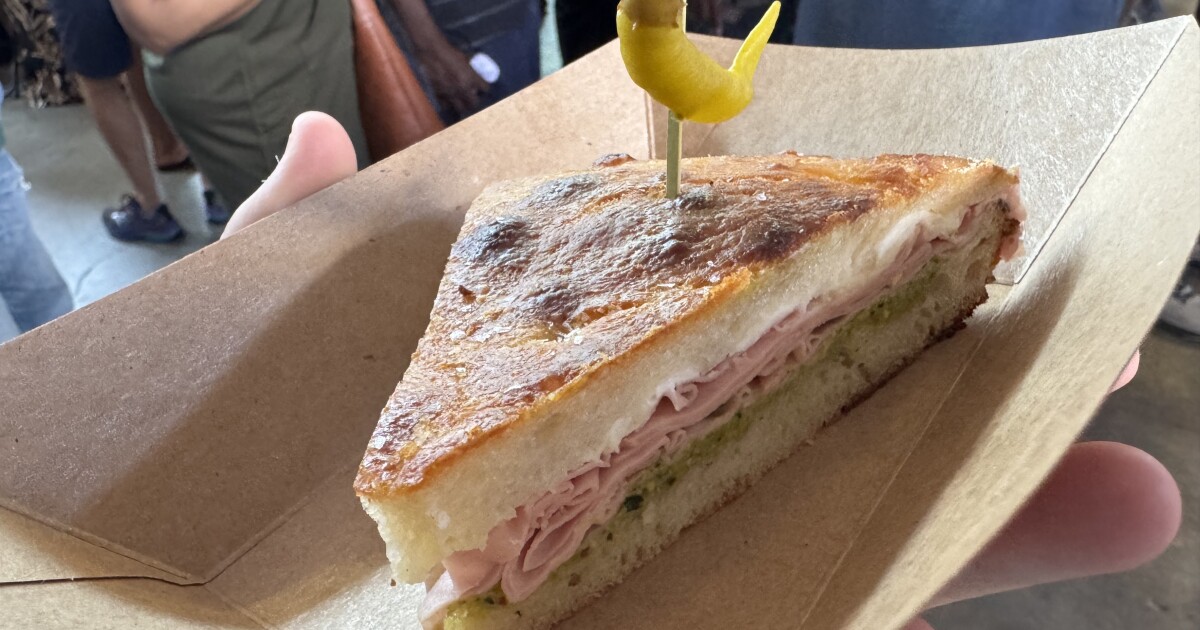
Detroit Sandwich Party returns to Eastern Market on Sept. 6
-

 San Francisco, CA2 hours ago
A Leak of San Francisco Police Drone Footage Exposes the New Reality of Urban Surveillance
-

 Dallas, TX2 hours ago
Viral East Dallas coffee shop fears major sales drop amid six-week road closure
-

 Miami, FL2 hours ago
3 hurt in fire on Lincoln Road that started underground
-

 Boston, MA2 hours ago
Rideshare driver charged in Logan airport passenger assault to appear in court
-

 Denver, CO2 hours ago
Denver area events for July 13

