Hawaii
An eclectic, off-grid Hawaii haven, 3 dead men and a suspect caught on surveillance video


HONOLULU (AP) — For residents of Puna, a remote and eclectic part of Hawaii’s Big Island, the killings of three men known for embracing the community’s off-grid, free-spirited lifestyle became a startling reminder of its struggles too.
Nearly 24 hours after Jacob Baker was arrested, residents were struggling to understand what happened and were eager for answers on why authorities zeroed in on the 36-year-old as their suspect in the killings of the men who were all nearing or in their 70s.
Baker remained jailed on suspicion of murder, burglary and other charges.
Court records show Baker having repeated run-ins with police for a variety of offenses. And people who live in Puna told The Associated Press that their concern about Baker in recent days accelerated, portraying him as increasingly threatening.
Baker is accused of being involved in the deaths of three men: a 69-year-old man found partially submerged in a cement pond, a 79-year-old man who was found just a few hundred feet (meters) away, and a third man, also 69, whose body was found about 19 miles (31 kilometers) away. As of Friday, prosecutors had not yet filed charges.
Police identified the first victim as Robert Shine and the third victim as John Carse. The name of the 79-year-old man was pending positive identification but friends identified him as Chitta Morse.
Hawaii Police Chief Reed Mahuna said investigators had not found any connections among the victims, other than two of them lived near each other.
Fixtures at drum circles
Friends of Shine and Morse say the men moved to Puna for its off-grid, tropical and communal lifestyle.
Shine enjoyed dancing and swaying to the beat at drum circles, usually on Sunday afternoons, said Donald Hyatt, a drummer.
Hyatt last saw Shine at a party last month. A local rock-and-roll band was playing and Shine was dancing around.
“He was dancing like he loved life,” Hyatt recalled. “Bob had a permanent smile. Always in good spirits.”
Morse moved from Van Nuys, California 40 years ago “to live off-grid and to live in a warm tropical place, and to eat fruit,” said friend Jezuz Cinderland. “For 40 years he only ate raw food. Since he got to the island he just went completely raw and this was just the right environment for him to do it.”
On land rich with volcanic soil on Papaya Farms Road, Morse had what Cinderland called a “fruit forest,” growing things like coconut, avocado and durian.
“He would just share all the fruit he had,” Cinderland said. “The most fabulous abundance that you can imagine.”
While Morse had previously been a member of the raw-food commune Cinderland moved to Puna to join, in recent years Morse was a loner, Cinderland said.
Shine was a member of Cinderland’s commune, which has been shuttered by the county for various code violations, Cinderland said.
Work-trade life
Janelle Honer, who also grew fruit on Papaya Farms Road, seems to be what connected Baker to the men, who often attended pot luck dinners and parties on Honer’s property.
Baker had been living on Honer’s property in exchange for climbing and trimming coconut trees, her ex-husband, Stephen Shaffer said. Trading work for living accommodations is common in Puna.
Hyatt said Baker left the cabin he was living in on Honer’s property months ago but returned recently claiming “squatter’s rights” and threatened Honer. Hyatt said he urged her to seek a restraining order.
The slayings happened just days after two women requested temporary restraining orders against Baker, saying he had threatened and harassed them at a farm. One woman was staying there and the other co-owned it. A judge denied both applications, saying there was not enough proof of harassment.
No attorney was listed for Baker, who had 20 other cases in the court record in the past two decades, many of them traffic infractions. In most of those cases, Baker represented himself.
Honer, who Shaffer said was traveling out of the country, couldn’t be reached for comment.
A memorial for the men was planned for Saturday next to Honer’s place.
Puna is one of the few places in Hawaii where there’s affordable land, and the area’s infrastructure hasn’t kept up with its growth, said Ashley Kierkiewicz, who represents Puna on the county council.
While Puna has a reputation as a quirky frontier, it’s also a place rich in culture where people are resilient and lean on each other, she said.
Puna, with its landscape that’s a mix of lush jungle and barren lava-rock fields, also struggles with drugs, poverty and limited resources, said longtime resident Tiffany Edwards Hunt.
“People have this mistaken impression that they can come to Hawaii and heal,” she said. “Hawaii can either really be kind to you or it can chew you up and spit you out.”
Surveillance cameras aid capture
Mark Wyatt and Richard Valdez played a key role in Baker’s capture, calling the police when their surveillance camera system pinged Valdez’s phone and it showed Baker on their property on Thursday. Their property is about a half-mile from Carse’s home, but they didn’t know him well.
The videos show Baker, shirtless and barefoot, with a dog walking near a road and getting down on the ground as cars went by, in an apparent attempt to avoid being seen.
“He was ducking from the traffic, so it was pretty obvious” that he was trying to avoid being found, Valdez said.
Authorities arrested Baker a short distance away after finding him in a small cave, police said.
Wyatt said he believed Baker had been hiding near his property in a small, makeshift camping spot over a bluff overlooking the ocean. He said Baker stole couch cushions from a container outside his home and some charcoal, and Baker used coconut tree palm fronds to cover the site.
Valdez said he hadn’t seen Baker in about two years. Back then, he said, Baker was living next door to them, renting space from their neighbor while trimming coconuts from trees and selling them just off the area’s main road. He lived next door for about six months, Valdez said.
“He told me he was from Maui and that he had just had a newborn baby and his girlfriend had left and that he was trying to get his life together,” Valdez said. “So he seemed pretty normal and conscientious, so it’s hard to fathom that this happened.”
___
Collins reported from Hartford, Connecticut.



Three convicted sex offenders were arrested on Hawaii Island last week for allegedly failing to comply with sex offender registry requirements.
Multiple law-enforcement agencies conducted checks in Kona on registered sex offenders who had been identified as potentially out of compliance with the state’s Sex Offender Registry laws, according the Department of the Attorney General.
As a result of the three-day operation, several individuals were brought back into compliance, and three West Hawaii men were arrested for allegedly failing to comply with the requirements.
The three men who were arrested are Joseph Debus, 56, of Kailua-Kona, Garth Coleman, 53, of Holualoa and Alexsandr Skelcey, 34, of Kailua-Kona.
Debus was convicted of second-degree sex assault in Hawaii in 1993 and sentenced to five years probation with a year in jail. Coleman was sentenced to 20 years in prison for first-degree assault in 2000 after a jury trial in Hawaii. And Skelcey was convicted in Michigan in 2012 of assault with intent to commit sex assault.
“Sex offender registration requirements exist to protect our communities and ensure law enforcement knows where convicted offenders are living,” Tom Alipio, chief of the AG department’s Investigations Division, said in a press release. “Compliance operations like this send a clear message that we will actively monitor the registry, investigate violations and work closely with our law enforcement partners to hold offenders accountable when they fail to meet their legal obligations.”
HPD Chief Reed Mahuna said, “Operations like this allow us to verify that offenders are maintaining strict compliance with registration laws and those who aren’t will be addressed immediately. We will continue to leverage these multi-agency partnerships to keep our island communities safe,”
Members of the public can look up publicly available offender information and subscribe to notifications at sexoffenders.ehawaii.gov/coveredoffender/.
Anyone with information regarding a registered sex offender who may be violating registration requirements is encouraged to contact the Department of the Attorney General’s Investigation Division at (808) 586-1240 or their local law enforcement.

A brush in North Kona, near the Ulu Wini Apartments, has closed a portion of Hina Lani Street, between Route 190 and Ane Keokalole Highway.
According to Hawai‘i Island police, the road is expected to be closed for the next three hours and motorists are advised to avoid the area.
Hawai‘i Fire Assistant Chief Chris Carvalho confirmed at least two engines, two brush trucks, Chopper 2 and a medic vehicle responded to the blaze that started in some bushes.
No evacuations or injuries have been reported at this time.
At 11:09 a.m., an AlertWest camera, installed by Hawaiian Electric in wildfire-prone areas, showed smoke billowing above the Keahuolu Courthouse. As of 12:06 p.m., that smoke appears to have dissipated.
This is a developing story. More information will be provided as it becomes available.
Hawaii
Chinese communist party member arrested in Hawaii on visa fraud charge | Honolulu Star-Advertiser

-

 Sports2 minutes ago
Pirates star pitcher makes unfortunate history after being taken out in middle of perfect game bid
-

 Technology7 minutes ago
Medical identity theft follows you into the doctor’s office
-
 Business14 minutes ago
California soccer fans sue StubHub after it fails to deliver expensive World Cup tickets
-
 Entertainment17 minutes ago
Lucas Museum to give free annual passes to South L.A. neighbors, host community preview day
-
 Lifestyle22 minutes ago
Meow Wolf taps famed L.A. animation house for its new Los Angeles venue
-
Politics29 minutes ago
Column: Trump decries ‘communism’ while his government takes ownership of companies
-
 Science32 minutes ago
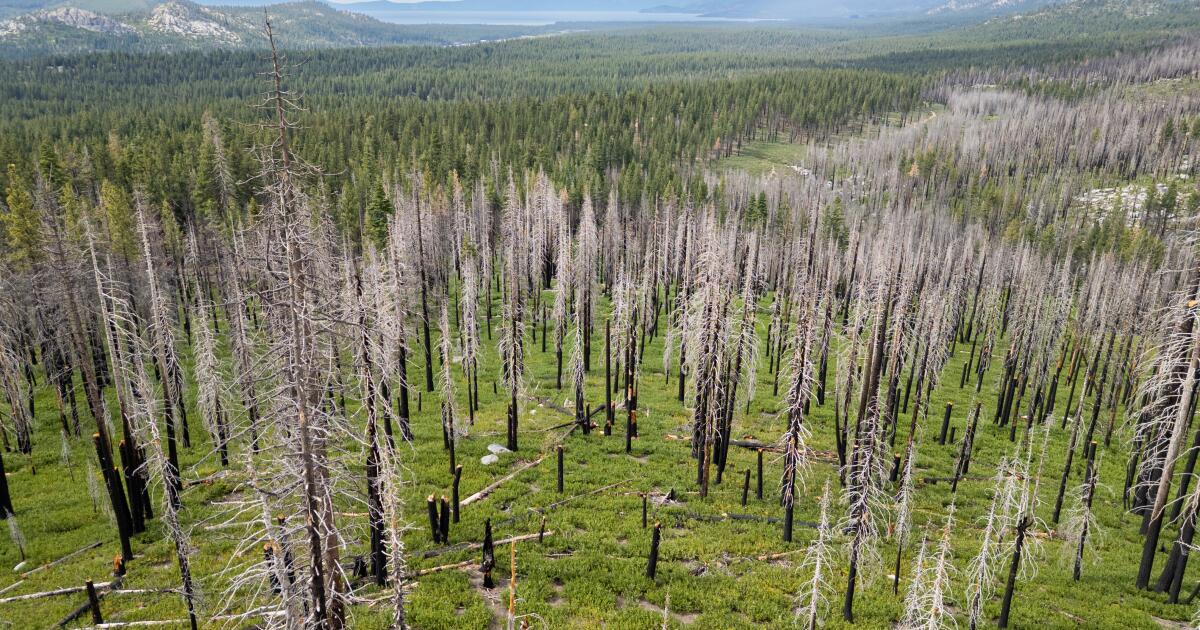
‘I’d rather my house burn down than get cancer’: Herbicide use upends California’s fight to save forests
-
 Sports37 minutes ago
Dodgers scheduled to visit White House in late July to celebrate 2025 World Series win


