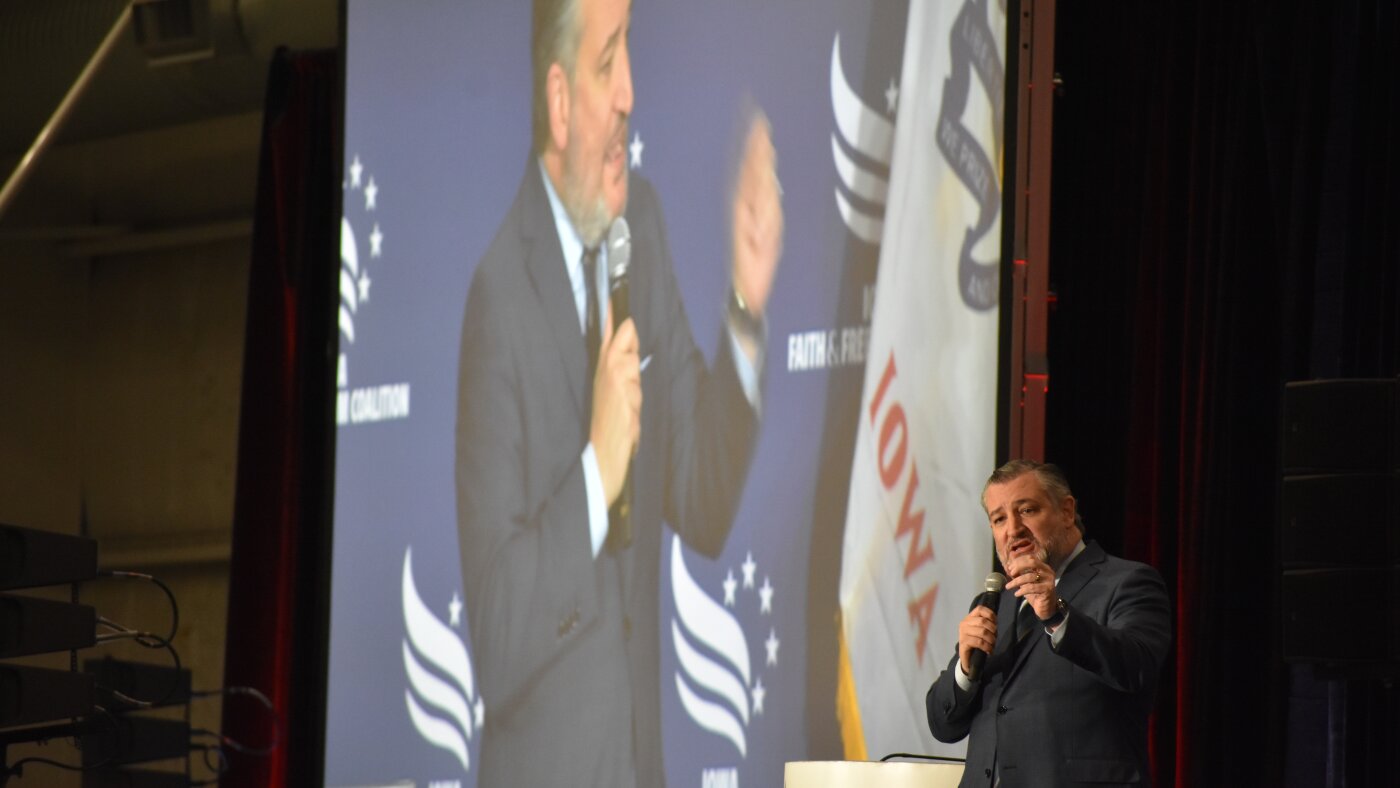
Republican Texas Sen. Ted Cruz speaks at the Iowa Faith and Freedom Coalition’s Spring Kickoff event May 1, 2026.
Stephen Fowler | NPR
hide caption
toggle caption
Stephen Fowler | NPR
CLIVE, Iowa — There’s very little Democrats and Republicans seem to agree on these days, but Iowa’s importance to their political futures is one exception.
Tuesday’s primary elections will kick off a sprint to November that includes three competitive House races and a Senate race that will help decide control of each chamber of Congress. The open governor’s race is one of a handful in the country that experts say could change hands this fall.
Iowa is a state where the institutional strengths and weaknesses of Democrats and Republicans alike are on heightened display in a midterm election year.
President Trump faces record-low approval ratings, rising gas prices, an unpopular war in Iran and affordability concerns. His grip on the Republican Party is stronger than ever, with the few remaining Congressional lawmakers that have notably crossed him ousted in recent primaries.
The national Democratic Party brand is also historically unpopular, even as Democrats continue to see rising enthusiasm in primary election turnout, overperformances in special elections and a polling advantage five months out from Election Day.
So how does the national mood map onto Iowa’s elections?
Republicans tout victories from governing
At the Iowa Faith and Freedom coalition’s spring kickoff event, a record crowd filled the Horizon Events center near Des Moines to hear from Texas Republican Sen. Ted Cruz.
“The last year and four months with President Trump in office, with a Republican Senate and Republican House, we have won more victories than at any time since we have been alive,” Cruz said.
Those victories, he said, include falling illegal immigration, drastic reductions in crime rates and the passage of the “One Big Beautiful Bill Act,” a sweeping measure full of tax cuts and spending priorities.
Outgoing Republican Gov. Kim Reynolds ticked through some of the accomplishments she said she and Iowa Republicans notched at the state level, like rising test scores, top rankings for affordability and wage growth and restricting access to abortion.
Reynolds said the policy accomplishments of the Republican-led state with two Republican Senators and all four House districts represented by Republicans show why electing more Republicans matters.
“It matters in Iowa, and it matters in D.C., where every single problem that President Trump is currently fixing — inflation, Iran, open borders, illegal immigration — was caused by the Biden administration,” she said.
But the crowd of about 1,100 conservative Christians also heard the flip side of that as a warning.
“The Democrats have put a bullseye on the state of Iowa,” Cruz said. “They’re coming after Iowa. They want to turn Iowa blue.”
In midterm elections, the party in power nationally usually struggles to convince voters they should keep control. This year is shaping up to be no different, said Republican Rep. Ashley Hinson, who is running for the open Senate seat on the ballot.
“Boy, do we have a lot of work to do,” she said. “And boy, do we have a lot at stake. This election this year is going to be about contrast, the good old contrast between common sense and crazy.”
Her message?
“Look, we know life is too expensive, but the Democrat agenda makes everything worse” she said. “It’s too expensive. And Democrats still want to spend more, they want to regulate more, they want to tax more.”
Calls for unity
Republican Iowa Rep. Randy Feenstra (left) speaks with Iowa Republican Party Chairman Jeff Kaufmann at the Iowa Faith and Freedom Coalition’s Spring Kickoff event May 1, 2026.
Stephen Fowler | NPR
hide caption
toggle caption
Stephen Fowler | NPR
The top race Republicans are watching Tuesday is the crowded contest for governor, where Trump made a last-minute endorsement of Rep. Randy Feenstra on Friday. But the fractious fights on the right — especially when the president wades into the races — may not be completely solved even when the nominee is selected.
Iowa Republican Party Chairman Jeff Kaufmann interviewed all of the gubernatorial candidates during the Faith and Freedom event and exhorted the crowd to embrace “unity after the primary.”
“If we don’t do that, then there could be consequences,” he said. “Let’s let the grassroots speak, that’s what the primary is.”
This year’s primary elections have shown it’s not the grassroots that Republicans have issues with — especially when it comes to backing Trump’s preferred policies and picks. In the month of May, Republicans in Indiana, Kentucky, Louisiana and Texas have ousted state and federal lawmakers that the president directly targeted.
But there are signs that for now at least, some primary voters want more out of their Republican leaders, like 87 year old Grant Gardner, who was selling customized hats at the Iowa event.
“I wish the Republican Party would swallow some of their pride and hold together, stick together,” he said. “If we’re going to be the conservative movement against the Democrats, it must be that. And let’s not play footsie with them being half way Democrat and half way conservative.”
Trump’s midterm message is garbled
The loyalty and enthusiasm on display from the Republican base seen in Iowa and elsewhere is a stark contrast to the decline in support from just about everyone else.
It’s also not clear at times what the Trump administration’s message to voters is, and, at a time when the party does not have a lot to point to that is going well, it brings to mind the famous words of Ronald Reagan, “if you’re explaining, you’re losing.”
In a cabinet meeting last week, for example, the president hyped a prescription drug savings program and said “on that alone, we should win the midterms.”
But later, when discussing the protracted war in Iran, said that “I don’t care about the midterms.”
Vice President Vance speaks during a visit Des Moines on May 5 with Rep. Zach Nunn.
Scott Olson/Getty Images
hide caption
toggle caption
Scott Olson/Getty Images
When Vice President Vance made a campaign stop for vulnerable Rep. Zach Nunn in Des Moines recently, he argued that the fundamental question for the election “is not actually any specific question of public policy” or “any particular issue.”
Democrats no longer in disarray?
But voters do have questions about public policy, especially in Iowa, an agriculture-heavy state that’s felt the pinch of tariffs and the war in Iran — especially through high fertilizer costs.
Iowa Democrats see an opening, especially as one of the states where recent special elections have seen notable shifts towards Democrats even as voters have soured on the national party’s brand.
At the Iowa Democratic Party’s 1st Congressional District Convention in Iowa City, volunteer Peter Flynn explained the disconnect.
“Those people who are voting actually go ahead and go, “Oh wait, yes, it’s not necessarily the lesser of two evils,’” he said. “Their situation is simply that, no, this is the better candidate. And so often that’s the Democrat nowadays.”
Flynn has worked with the Iowa Democrats for close to two decades, and seen the party’s fortunes rise and fall. But recently, he said things were “on the upward swing.”
“That may not be saying much because it’s been 15 years of complete Republican control of our state government,” he said. “And so there’s nowhere to go but up.”
Iowa Democratic Party Chair Rita Hart (left) speaks with volunteers at the 1st Congressional District Convention in Iowa City, Iowa May 2, 2026.
Stephen Fowler | NPR
hide caption
toggle caption
Stephen Fowler | NPR
Unlike the record crowd at the Faith and Freedom event across the state, the district convention saw a smaller crowd of dedicated volunteers who see a larger potential for convincing voters to give Democrats a chance this fall. Iowa Democratic Party chairwoman Rita Hart said it’s taken years of work to get the party into shape to take advantage of an environment like 2026 is shaping up to be.
“When I started, we only had enough money to keep the lights on and maintain two and a half staffers,” she said. “That’s not enough to do any kind of programming. That’s not enough to start the kind of organizational structure that we need to win races and to give people hope and to encourage people to run for office. “While some Democrats fret over the party’s future and insiders squabble over a botched 2024 autopsy commissioned by Democratic National Committee Chair Ken Martin, Hart sees the greatest value in what Iowa Democrats can do for Iowa voters.
“The national Democrats, we can’t look to them to come in on a white steed and save the day,” she said. “We’ve got to save our own day here.”
A different type of Democrat
What does saving their own day look like? Hart said emphasizing the way Trump administration policies like tariffs are hurting Iowa farmers and tying it to decisions Republicans have made locally.
“Well, if you look at everything that has happened in Iowa with Republicans in charge, education has gone down, health care is hard to get and too expensive,” she said.
There’s also a coordinated campaign strategy — the largest effort the state has seen in a decade — that will kick off in earnest once Tuesday’s primaries are over. In a virtual presentation to the convention, Frances Patano with the state party described the efforts to turn out reliable Democratic voters and reach those who could be open to voting for someone other than a Republican.
“I’m not making news for anyone in this room when I say that a path to victory in Iowa doesn’t solely include Democratic voters,” she said. “And so we know we need to go talk to our known party voters and anyone who is willing to take a chance and say, ‘Hey, the direction of the state, I want to try something different and I’m willing to vote for that.”
Much of the Iowa campaign strategy centers around strong candidates that fit the state’s profile more than a national Democratic ideal. In the governor’s race, current state auditor, Democrat Rob Sand is a fundraising juggernaut who has outraised the Republican field.
For Democrats, the main race to watch Tuesday, though, is the Senate primary between Josh Turek and Zach Wahls, as people try to parse what the results say about the party’s future direction.
Turek flipped a Republican-held seat in the state House and has the backing of establishment figures like Senate Minority Leader Chuck Schumer and former Sen. Tom Harkin, who held the seat until retiring in 2014.
Wahls represents a deep blue state senate seat and has endorsements from several labor unions, progressive organizations and Massachusetts Sen. Elizabeth Warren.
Both say they have the right strategy for winning in a state run by Republicans.
A look ahead to 2028
Iowa’s midterm elections could heavily influence the final two years of Trump’s second term in office, and both parties assert that this leads to even more importance in the first wide-open 2028 presidential contest since the 2016 cycle.
The Democratic National Committee is currently working its way through the rules and bylaws process for setting the presidential nominating calendar for 2028, and Iowa Democrats are making the pitch that they should stay at the front of the line.
“In 2028, no matter what your decision is regarding the nominating calendar, Iowa will be the center of politics because the Republicans will be here right along with scads of national reporters,” Hart, the Democratic state party chair, said in a video message. “And Democrats, we can’t afford to allow the Republicans to take center stage.”
Iowa’s pitch also notes the state’s compact geography, sizable rural population and the relatively inexpensive cost of campaigning, as well as a promise to overhaul the caucus process that has led to problems in the past. Ultimately, the presentation rested on the reality that Iowa’s a key piece of the ever-shrinking competitive political landscape.
“To put it simply, the path to a Democratic majority at all levels comes through Iowa,” Iowa DNC member Scott Brennan told the committee. “That is why this committee should also consider holding off making a decision about the calendar until after the midterms.”