Politics
Despite Trump’s recent insistence, in-person voting does exist in Los Angeles

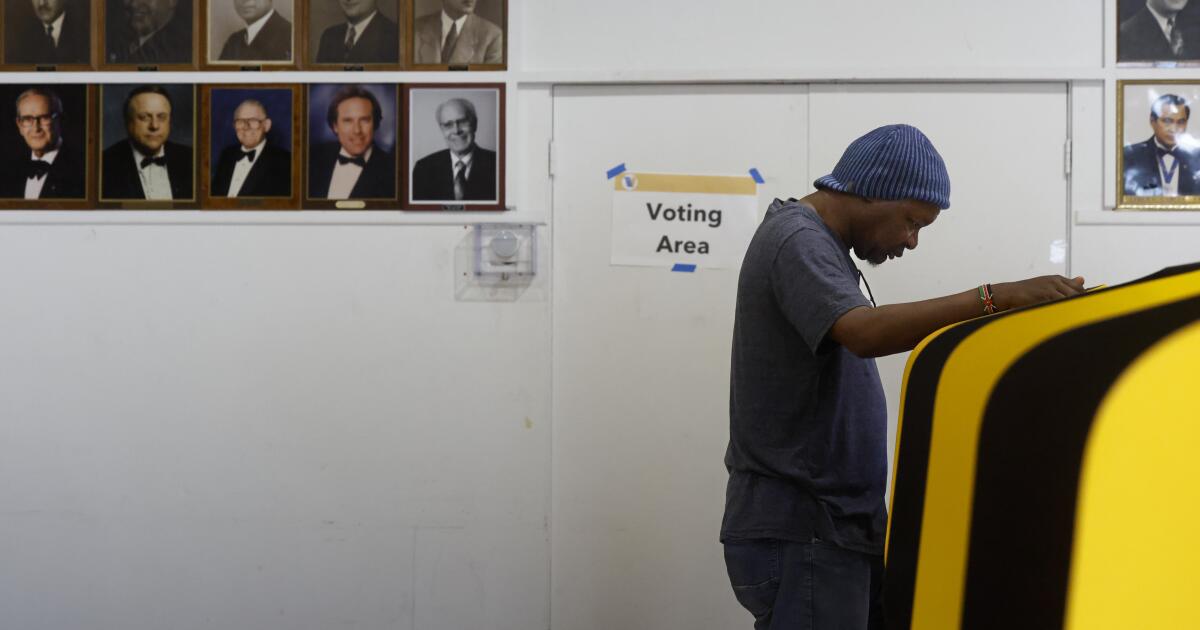
Yes, voting centers will be open across Los Angeles this week. And no, you don’t have to cast your ballot by mail.
With days left before the June 2 primary, President Trump made a round of misleading claims about the electoral process, this time falsely suggesting that the city was holding elections only by mail.
Trump’s comments came Saturday during an appearance on Fox News when he was asked by host Lara Trump — the president’s daughter-in-law — about his predictions for the upcoming primary.
“You know, they don’t have voting booths; everything’s by mail,” Trump responded. “I don’t think a Republican can win in California unless you pass the Save America Act — then they’re gonna have to show proof of citizenship, they’re going to have to get rid of mail-in voting.”
The L.A. County registrar-recorder moved to set the record straight in a tweet posted Sunday morning that read “MISINFORMATION ALERT.”
Noting that in-person voting was in fact allowed, the agency announced that it had 646 vote centers across the county — each with multiple voting booths. The centers will be open from 10 a.m. to 7 p.m. on Monday and Tuesday, the agency said in the posting, while tagging Fox News and the White House.
A map of polling locations featured on the agency’s website shows that there are dozens of voter centers available countywide. Mobile vote centers also were made available at various sites in the county. Mobile voting runs for the 10 days before election day and will not be available on June 2, according to the county registrar-recorder.
As of Friday morning, 333,000 mail-in votes had been cast in the June 2 primary for Los Angeles mayor, city attorney, city controller and eight of the 15 City Council seats. This was up from 321,000 at the same time in 2022, according to registrar-recorder.
Registered voters already should have received a ballot in the mail. Those who choose to vote in person can take their mail-in ballot to a vote center and ask to vote in person instead. Residents who haven’t yet registered to vote can still do so by requesting a conditional voter registration application at any voter center and filling out their ballot as they normally would.
Recent polling suggests that, ahead of Tuesday’s primary, incumbent Los Angeles Mayor Karen Bass has what pollsters deem a statistically insignificant lead in her bid for reelection as the city’s top executive. Bass is locked in a tight race with councilmember and former ally Nithya Raman and Spencer Pratt.
Trump has signaled his support for Pratt but hasn’t formally endorsed the former reality TV star and registered Republican. Former Trump advisor Steve Bannon said the president hadn’t done so out of the fear it would hurt Pratt’s chances in Democrat-dominant Los Angeles.
In 2020, during the outbreak of the COVID-19 pandemic, Gov. Gavin Newsom took the unprecedented step of issuing a statewide order for voting by mail for that year’s election in what he described as a necessary step to limit the virus’ spread.
A handful of rural counties had no in-person voting locations that March.
In 1979, the state eliminated the need for an excuse to receive an absentee ballot, and an option to choose permanent absentee voting was created in 2002. In the decades since, Californians have embraced the flexibility that voting away from a polling place offers. In nearly every statewide election since 2008, the majority of votes have not been cast at a traditional polling place.
Fourteen more counties — including Orange, Sacramento and Santa Clara — have adopted the state Voter’s Choice Act, an optional state law that requires them to mail every voter a ballot and to replace traditional neighborhood polling places with multipurpose vote centers. Those in-person locations offer multiple election services for up to 10 days before election day.
Los Angeles, the 15th county to adopt the new state law, was initially given special permission by the Legislature to implement it without mailing every voter a ballot.
Trump has for years repeated baseless claims that the 2020 election was stolen and that undocumented immigrants were swaying elections by voting illegally.
In light of these claims, Trump and some Republicans have pushed for new restrictions on voters. A federal proposal known as the Save America Act — which would require Americans to prove they are U.S. citizens before they register to vote and to show identification at the polls, among other things — cleared the U.S. House but stalled out in the Senate.
In November, California voters will weigh in on a similarly contentious ballot measure pushed by Republicans that would require all voters in future elections to show identification every time they vote in person or provide a special PIN when submitting mail-in ballots.
Under current state law, Californians are required to provide identification when registering to vote and must swear under penalty of perjury, a felony, that they are eligible to vote and are U.S. citizens. They are not required to show or provide identification when casting a ballot in person or by mail.
If passed, the California ballot measure would require voters to present government-issued identification, such as a state driver’s license, every time they vote. Voters mailing ballots would be required to write a four-digit number, essentially a PIN, on their ballot envelopes matching the one generated when they registered to vote.
Critics of California’s voter ID initiative, including many legal scholars, say the ballot measure addresses a problem that does not exist.
In May, a federal judge handed Trump a victory by declining to halt the president’s executive order creating a federal list of eligible voters and then directed the U.S. Postal Service to deliver mail ballots only to those on the list. Observers say the decision opens the door for potential sweeping changes in how American elections are run shortly before this year’s midterm elections.
The Associated Press contributed to this report.

Politics
Medical examiner releases preliminary findings in Lindsey Graham’s death as death certificate remains pending

Lindsey Graham’s sudden death prompts medical questions, political reactions
Fox News senior medical analyst Dr. Marc Siegel examines the shocking death of Sen. Lindsey Graham, R-S.C., at 71. Siegel discusses the emergency response, including chest pains and a delayed entry due to a deadbolt. He connects the death to a family history of heart attacks and considers how a long flight to Ukraine may have contributed to heart stress, dehydration, and a fatal arrhythmia.
NEWYou can now listen to Fox News articles!
The District of Columbia’s Office of the Chief Medical Examiner on Sunday released preliminary findings indicating Sen. Lindsey Graham suffered an aortic dissection due to arteriosclerotic cardiovascular disease before his death.
Graham, 71, was pronounced dead at George Washington University Hospital at 10:23 p.m. Saturday, according to a joint statement from the Metropolitan Police Department and the District of Columbia’s Office of the Chief Medical Examiner. An autopsy was performed Sunday.
The medical examiner emphasized that the findings are not final and that Graham’s death certificate will remain pending while toxicological and microscopic testing is completed.
“The preliminary examination findings were: Aortic Dissection due to Arteriosclerotic Cardiovascular Disease,” the medical examiner’s office said in a statement.
SEN. LINDSEY GRAHAM DEAD AT 71 AFTER ‘BRIEF AND SUDDEN’ ILLNESS, OFFICE SAYS
Sen. Lindsey Graham, R-S.C., speaks to reporters after a briefing by Trump administration officials on U.S. strikes on Iran at the U.S. Capitol in Washington, D.C., on March 3, 2026. (Nathan Posner/Anadolu)
The office emphasized that the findings are preliminary and that Graham’s death certificate remains pending. Officials said comprehensive toxicological and microscopic testing is routinely conducted when an autopsy is performed in the District and must be completed before the death certificate is updated with the cause and manner of death.
An aortic dissection is a tear in the inner layer of the aorta, the body’s largest artery, that allows blood to flow between the layers of the vessel wall, according to the Mayo Clinic. The condition is considered a life-threatening medical emergency that can lead to severe internal bleeding or organ damage.
Arteriosclerotic cardiovascular disease refers to the buildup of plaque inside the arteries, which can restrict blood flow and increase the risk of serious heart and vascular complications.
LINDSEY GRAHAM, SOUTH CAROLINA SENATOR WHO ROSE FROM SMALL-TOWN ROOTS TO GOP POWER BROKER, DIES AT 71
Sen. Lindsey Graham, Member of the US Senate, speaks to the people during the demonstration for human rights in Iran at Theresienwiese during the 62nd Munich Security Conference on February 14, 2026 in Munich, Germany. (Hannes Magerstaedt/Getty Images)
The release of the preliminary findings comes after Graham, 71, died Saturday night, shocking colleagues in Washington and across the nation.
Graham, a Republican who was first elected to the Senate in 2002 after serving four terms in the House of Representatives, became one of the chamber’s most influential voices on national security, foreign policy and the judiciary. He chaired the Senate Judiciary Committee during President Donald Trump’s first term and was one of the president’s closest allies on judicial nominations and defense policy.
A U.S. flag flies at half-staff over the Capitol on July 12, 2026, after the death of Sen. Lindsey Graham, R-S.C. Emergency dispatch audio reviewed by Fox News Digital documents the emergency response before his office announced his death. (Kevin Carter/Getty Images)
CLICK HERE TO DOWNLOAD THE FOX NEWS APP
Following news of Graham’s death, tributes poured in from lawmakers across the political spectrum, with colleagues remembering his decades of public service and his influence on some of the Senate’s most consequential debates.
The Office of the Chief Medical Examiner said it will update Graham’s death certificate after toxicological and microscopic testing is complete.

More than three dozen California legislators are calling for Gov. Gavin Newsom to exempt the state’s film and TV production incentive program from a recently approved cap on corporate tax credits, warning that without action it will be “significantly kneecapped.”
Though the state’s budget has already been approved, the legislators say a solution must be devised before the end of the year so that production companies do not lose the “full value of tax credits they earned in exchange for creating middle-class entertainment industry jobs,” according to a letter dated Friday and addressed to Newsom, State Senate President Pro Tempore Monique Limón and Assembly Speaker Robert Rivas.
“Tax credits earned for creating jobs in motion picture and television production are not the same as tax credits provided for research and development,” the letter states. The legislation “creates short-term budget savings by reneging on commitments made to the entertainment industry and the working families who depend upon it for their livelihoods.”
The letter comes shortly after Newsom signed his final state budget as California’s governor, a $351.7-billion spending plan that includes new limitations on corporate tax credits.
The budget includes a provision that restricts the maximum tax credit companies can claim in a given year to $5 million or 50% of a company’s tax state tax liability, whichever is greater.
Hollywood industry representatives had warned the governor’s office that the new restrictions could affect the state’s production incentive program, which was just bolstered last year to an annual cap of $750 million.
The film and TV industry in Southern California has struggled to rebound from the effects of the pandemic, the dual writers’ and actors’ strikes in 2023 and the exodus of production to other states and countries.
Members who voted for the budget bill had believed there was a carve-out for the film and TV tax credit program, said Assemblyman Rick Chavez Zbur (D-Los Angeles), chair of the Assembly Democratic Caucus.
“I don’t think that anyone understood what this cap was, what it did and that it effectively kneecapped and reverses the progress that we made last year,” Zbur, who co-authored last year’s bill, said in an interview. “We need to have people understand that these changes, which I think people believed were minor, are really significant and will result in significant job loss if we don’t fix them.”
The new changes to the state’s film and TV tax credit program, which included expanded eligibility for additional shows and films, came after intense lobbying from studios and industry workers, who argued that more funding was necessary to lure production back from other states and countries.
Last week, the California Film Commission said the expanded tax credit program was set to deliver $6.6 billion in direct production spending in-state and more than 34,000 cast and crew jobs across the 170 total film and TV shows that received production incentives this year.
Politics
Graham’s death ignites GOP scramble for Senate seat as Trump hints he already has a favorite

NEWYou can now listen to Fox News articles!
Sen. Lindsey Graham’s, R-S.C., sudden death from an undisclosed illness has triggered a two-pronged approach to replace him, and President Donald Trump will likely be a focal point in the process.
Graham’s passing overnight comes at a time when Republicans in the upper chamber need every vote they can get. The Senate GOP now holds a 52-seat majority, and with the timetable for Sen. Mitch McConnell’s, R-Ky., absence still unclear, that majority is now effectively 51 votes.
That will up the pressure, and drama, to find a replacement for the longtime South Carolina lawmaker.
LINDSEY GRAHAM, SOUTH CAROLINA SENATOR WHO ROSE FROM SMALL-TOWN ROOTS TO GOP POWER BROKER, DIES AT 71
Sen. Lindsey Graham speaks with reporters aboard Air Force One with President Donald Trump and Secretary of Commerce Howard Lutnick on the way back to Washington, D.C., on Jan. 4, 2026. (Jim Watson/AFP via Getty Images)
Trump, during an appearance on NBC’s “Meet the Press” on Sunday, said, “I have somebody that I think would be great.”
“But I don’t want to say it now because it’s just, it’s too soon with Lindsey,” Trump said. “I don’t wanna even talk about anybody, but I do have somebody that I think is really good.”
It’s a process guided by the Constitution and state law. The first step will require South Carolina Gov. Henry McMaster, a Republican, to appoint a replacement for Graham on a temporary basis.
McMaster, a close ally of Trump, can appoint a temporary replacement as soon as he wants. That pick will serve until the next special or general election.
MCCONNELL FACES FRESH CALLS TO COME CLEAN ABOUT HEALTH ISSUES
Fox News Digital did not immediately hear back from McMaster’s office on when he would make the announcement, or who he was considering for the seat.
Graham was already in-cycle running for a fifth term in the upper chamber, and he easily cruised to a primary victory early last month. That means that whoever McMaster taps would serve until the end of the year to finish off the remainder of Graham’s fourth term.
The second prong is finding his long-term successor.
The candidate filing period for that special election to win the GOP nomination opens July 21. The election is slated for Aug. 11, according to South Carolina law.
That race could see several familiar faces in South Carolina GOP politics jumping in, including McMaster himself, who is termed out as governor.
TRUMP’S ENDORSEMENT POWER FACES ANOTHER GOP TEST IN SOUTH CAROLINA AFTER ALAN WILSON ADVANCES
Rep. Nancy Mace, R-S.C., departs the U.S. Capitol after a series of House votes on funding for Homeland Security and a War Powers resolution on Iran on March 5, 2026, in Washington, D.C. (Andrew Harnik/Getty Images)
Trump heaped praise on McMaster, noting that he endorsed his first bid for the White House in 2016.
“Henry’s been a great governor, you know now he’s termed out, but he’s going to do the right thing,” Trump said. “I think Henry will be fantastic.”
There are six members of South Carolina’s GOP congressional delegation who could toss their hats into the mix. Rep. Nancy Mace, R-S.C., who recently lost a bid for the GOP gubernatorial nomination, is eyeing jumping into the special election.
A person familiar with Mace’s plans told Fox News Digital, “Congresswoman Mace is considering a bid to run.”
Then there’s Rep. Joe Wilson, R-S.C., the longest-serving Republican member of the Palmetto State’s delegation. He quickly snuffed speculation about whether he’d leap into the fray.
CLICK HERE TO DOWNLOAD THE FOX NEWS APP
“I was grateful to speak with President Trump today reminiscing about our mutual friend, Senator Lindsey Graham,” Wilson said on X. “I assured him my goal is to remain in the House to keep his two-vote majority for the American people!!!”
Then there’s the remaining four: South Carolina Republican Reps. Ralph Norman, who also lost out on scoring the GOP nomination for governor, Russell Fry, William Timmons and Sheri Biggs, none of whom, so far, have signaled that they would jump into the battle for Graham’s seat.
Meanwhile, South Carolina Lt. Gov. Pamela Evette could also be in the mix.
A source familiar told Fox News Digital that Evette is receiving “tons of encouragement from all across the state and from around the country” to serve as the temporary caretaker for Graham’s seat.
The source said that Evette is also being encouraged to run to seek a full six-year term in the Senate.
Evette, a top South Carolina ally of Trump’s and McMaster’s, was endorsed by both as she finished first in South Carolina’s Republican gubernatorial primary in this year’s race to succeed McMaster.
But after Trump also endorsed her GOP rival in the runoff, State Attorney General Alan Wilson, she was trounced by Wilson a few weeks ago in the runoff election
Fox News Digital did not immediately receive responses to requests for comment from possible contenders in the House.
-

 New Jersey4 minutes ago
New NJ businesses include non-alcoholic liquor store, art school
-

 New Mexico10 minutes ago
As New Mexico’s opioid settlement funds tickle in, they are tough to track
-

 North Carolina16 minutes ago
Town of Pine Knoll Shores announces Ryan Thompson to depart after 18 years
-

 North Dakota22 minutes ago
Wrestling: Yates, Raper excel in North Dakota – Salisbury Post
-

 Ohio28 minutes ago
Can Ohio State Survive Its Own Schedule? Inside the Buckeyes’ 2026 Playoff Math
-

 Oklahoma34 minutes ago
Oklahoma Ford Sports Blitz: July 12, 2026
-

 Oregon40 minutes ago
East Evans Creek Fire grows to 3,154 acres
-

 Pennsylvania46 minutes ago
Gov. Shapiro signs $50.8B Pa. budget with focus on education, public safety

