West
Conservative portion of blue state looking to break off and join neighboring red state

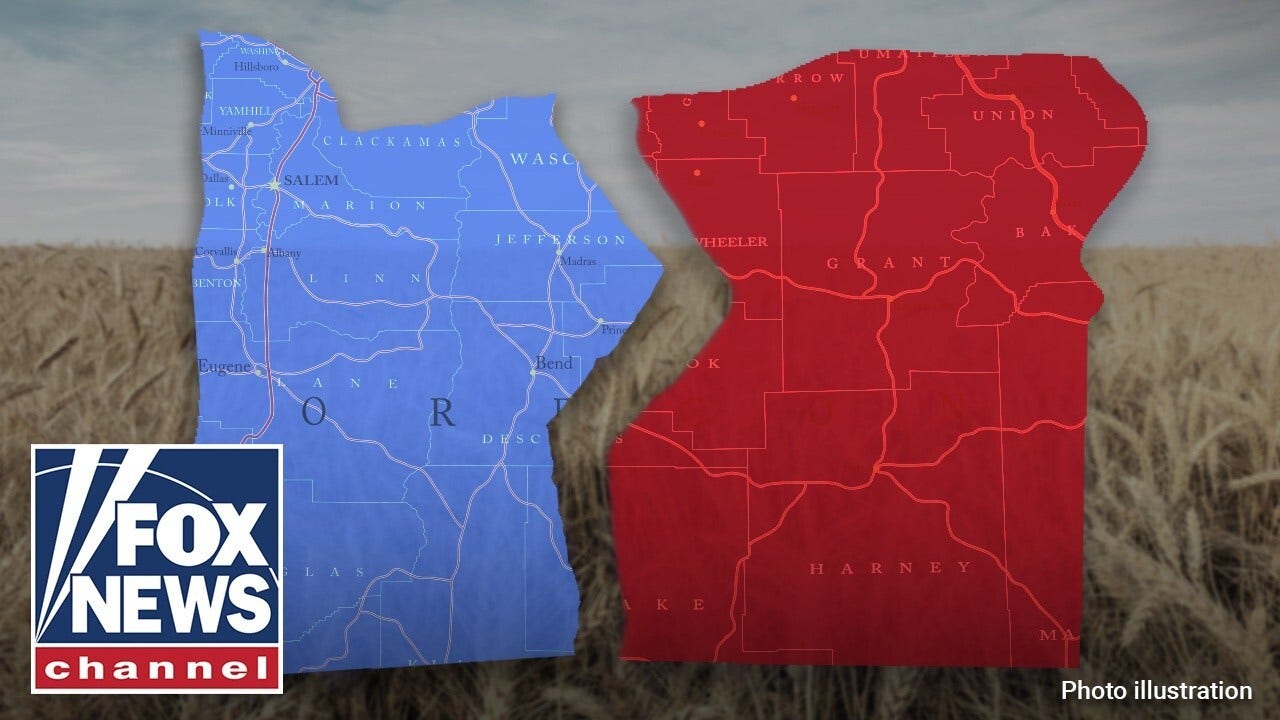
Oregon’s ideological fault lines exposed during the anti-police riots of 2020 are again coming to the fore, as the Greater Idaho movement looks to sever the conservative geographic majority of the state from the urban progressive movement.
“This movement has always been about the people of Eastern Oregon, getting their voice heard and helping those communities get the kind of state-level governance they actually want,” executive director Matt McCaw told Fox News Digital.
“If the Oregon Legislature truly believes in democracy, they will honor those voters’ wishes and move forward on making a border change happen.”
But similar attempts at secession have produced mixed results in U.S. history.
Earlier this month, state Rep. Mark Owens, R-Malheur, put forward HB 3844, the measure that creates and directs a task force to document the impacts of relocating the Idaho border to include about 13 eastern Oregon counties, and requires a report be presented to lawmakers in Salem. He did not respond to a request for comment.
GREATER IDAHO MOVEMENT GAINS MOMENTUM
The Greater Idaho movement began putting such measures up for votes in various localities in 2020, and efforts have intensified as several incidents and issues in the geographically smaller but denser-populated coastal region have caused political divisions.
During the anti-police riots of 2020, Oregon was front-and-center as protesters vandalized Portland and made a dayslong violent stand in front of the Mark Hatfield Federal Courthouse. But in the eastern two-thirds of Oregon, the conservative geographic majority of the state does not often ideologically align with their urban brethren.
Greater Idaho president Mike McCarter said of the new legislative development: “We are encouraged to see the representatives of Eastern Oregon coming together to advocate for their voters by bringing these bills to the Legislature. The people of Eastern Oregon have made clear they want to explore moving the border and joining Idaho.
“This movement has always been about the people of Eastern Oregon, getting their voice heard and helping those communities get the kind of state-level governance they actually want.”
By shifting the border, proponents believe both states have a “win-win” – in that the people living in each would better reflect the established political majority and lower political tension.
NY LAWMAKER CALLS FOR STATEN ISLAND TO SECEDE
In New York City’s Staten Island, there has been a movement afoot for decades seeking to break from the Big Apple. (AP Photo)
A report in the Central Oregonian noted an “interstate compact” is part of what is required to move the line, and cited other border-shifting bills in other states.
One would forward the cause of adding several rural Illinois counties that don’t see eye-to-eye with Springfield or Chicago to more closely aligned Indiana. Another in Iowa would allow the same movement for counties in the Land of Lincoln that are closer to the Hawkeye State line.
Idaho GOP Gov. Brad Little and Oregon Democratic Gov. Tina Kotek did not respond to requests for comment.
So far, only a few such movements regarding either secession or redrawing of state lines have been successful.
The now-55 counties of West Virginia voted to secede from the then-Confederate Virginia and independently ratified the U.S. Constitution on June 20, 1863.
A Washington Post story on the matter said Mountaineers split from Virginia as a way of “defending the ‘United States’… rather than the ‘seceded states’.”
In New York City’s Staten Island – the “forgotten borough” as many locals call it – there has been a movement afoot for decades seeking to break from the Big Apple.
Already geographically distant on the “New Jersey side” of the Hudson River, the borough is also separated from the Garden State by the Kill Van Kull and Arthur Kill.
Efforts to reestablish the reliably-red borough as the city of Richmond (after its coterminous county) or other names began with a favor from then-Gov. Mario Cuomo in the 1980s.
Cuomo enraged city leaders but endeared himself to the working-class voters on the island by approving state Sen. John J. Marchi’s push for a secession referendum.
Marchi, who died in 2006 and now has a Staten Island Ferry named in his honor, saw his borough vote nearly 2-1 to secede in 1993 – only to have their desires quashed by Albany’s Democratic majority.
And while the 1995 election of Mayor Rudy Giuliani calmed secession tensions, the drumbeat began anew in recent months.
“I think it’s time to secede,” Rep. Nicole Malliotakis, R-N.Y., told The New York Post as Gov. Kathy Hochul was touting her congestion-priced driving fee that now double-taxes Staten Island commuters.
“There’s no real value in being part of this city or the state. We didn’t vote for this mayor; we didn’t vote for this governor; and we didn’t vote for this president (then Joe Biden), but we’re always the ones getting screwed,” she said.
Read the full article from Here


COVE, Scotland – A Utah couple is renovating and restoring a castle in Scotland.
David and Chelom Leavitt are documenting this massive project on social media, which has attracted more than 1.4 million followers.
Now, after years of work, the finish line is in sight.
KSL recently traveled to Scotland to get a look at the renovation and talk to the Leavitts about their experience.
Historic castle
In a village called Cove, along a body of water known as Loch Long, sits Knockderry Castle.
The nearly 175-year-old structure stands out as a prominent feature of the Scottish peninsula.
Murdo MacLeod lives just beneath the castle.
“It sits on this outcrop of rock,” he said, looking up at the towering turrets, “and the views from the rooms up there would be absolutely stunning, looking down the loch on a windy night.”
The castle has quite a history. Built in the 1850s, it has been renovated many times. Knockderry Castle has been visited by some rich and famous people, including philanthropist Andrew Carnegie.
In 2023, the castle was sold to a couple from – of all places – Utah. Chelom and David Leavitt are now overseeing the castle’s complete renovation and restoration.
“We’re trying to find the balance,” said David, “between restoring what was and making it ours.”
Who are the Leavitts?
The Leavitts live in Orem, Utah. David is a former county attorney in Utah and Juab counties. Chelom is a family life professor at Brigham Young University.
“I have been looking at castles for decades, and just for fun,” Chelom said. “When this came up, we both thought this is the right thing to at least look into.”

The timing worked out. David was just out of office after losing his bid for reelection as Utah County Attorney; both he and Chelom said they were looking for something new and different.
They ended up buying the castle for a reported $1.4 million after the prior owner was evicted.
“Something kind of spoke to both of us,” Chelom said. “This is a really peaceful place.”
It was a dream come true – but also, sort of a nightmare.
“If we had any idea what we were getting ourselves into, there’s not a way in the world that we would have done it,” David said. “Not a chance.”
Major problems
The project quickly revealed problems, particularly with the wood inside the castle. Much of it had rotted.
“The fact that this castle is still standing is pretty amazing,” Chelom said. “Another 10 years and it would have been falling.”
That made the renovation much more complicated as workers needed to shore up the structure inside and out. David thinks of it like an Oreo cookie.
“We have completely restored both sides of the cookie,” he said, “and we’ve completely replaced the cream filling with 21st-century technology.”

That includes brand-new plumbing, heating and electrical. In the kitchen, a countertop charges cellphones. There’s also a very smart oven with many computerized features – and a faucet that instantly offers boiling, freezing or sparkling water.
When the renovation began more than three years ago, the Leavitts started a blog to chronicle their progress. But when they moved over to Instagram, things exploded. Knockderry Castle now has followers from around the world. The Leavitts post regular videos about the project, sharing their journey with strangers.
“Now we get stopped in stores and in airports” by fans who follow the castle renovation online, David Leavitt said. “That’s a really nice thing to be stopped for.”
Castle features
There’s a lot to see in the castle. Wood carvings are everywhere, along with roughly two dozen fireplaces. There are also little reminders of Utah, like a beehive on a stained-glass window.

Some rooms even have their own theme, such as the Japanese room or the Viking room.
There are also several rooms that would be difficult to find without knowing where to look. One of them is hidden behind a bookshelf. Another is secluded behind a bathroom mirror.
“Some are hidden, which means we’ll show those to people,” Chelom said. “But some are secret, and they won’t be shown.”
There’s something else that’s secret – how much this castle renovation costs.
“We get that question all the time,” David said.

The couple would only say they’ve spent more on the project than what they initially paid for the castle – and more than what they planned on.
The Leavitts acknowledge they’re in a unique position to be able to pay to restore a castle. They recognize many would love to do this – and they want to give something back to those who follow them.
“We feel this need to share it,” David said, “because we’re no different or better than anybody else that doesn’t have the ability to do that. We just … had the circumstances that would allow us to do that.”

The castle will be used as a family home, the Leavitts said, but they also plan to open it up to the public by hosting conferences, seminars or other events there. They hope the interior will all be finished by the end of this year.
This project hasn’t been easy. But the Leavitts say it’s kind of a metaphor for life.
“The person you want to be is on the other side of what you don’t want to face, and this is really what it was for us in this castle,” said Chelom. “Things that are worth doing in life, if you knew what you were getting into, you wouldn’t do them. But things that are worthwhile, they’re hard.”
‘A good thing’
Back below the castle, Murdo MacLeod looked up at the work in progress and called it a “good thing.”
He’ll be watching as Knockderry Castle enters the next chapter in its long history.
“At least it’ll be sound when it’s done,” MacLeod said, “and it’ll be here for, I think, quite a long time.”
He added, “I’m glad somebody’s come along and done it.”
PHOTO GALLERY


=htmlentities(get_the_title())?>%0D%0A%0D%0A=get_permalink()?>%0D%0A%0D%0A=htmlentities(‘For more stories like this one, be sure to visit https://www.eastidahonews.com/ for all of the latest news, community events and more.’)?>&subject=Check%20out%20this%20story%20from%20EastIdahoNews” class=”fa-stack jDialog”>
Washington
Supreme Court rules states can count late-arriving mailed ballots, rejecting Trump-led challenge

The Supreme Court ruled Monday that states should be allowed to count ballots that are mailed on time but arrive after Election Day.
In a 5-4 decision, the high court rejected a Republican-led attack on laws in more than half the states and the District of Columbia that permit mailed ballots to arrive and be counted some number of days after the election, provided they are postmarked by Election Day. The outcome spares officials the headache of changing their ballot rules just a few months before the 2026 midterm congressional elections.
The decision, written by Justice Amy Coney Barrett, is a defeat for President Donald Trump who has repeatedly claimed mail-in voting encourages fraud, an assertion not backed up by evidence. Chief Justice John G. Roberts Jr. also joined the court’s three liberals in the ruling.
The question before the court was whether Mississippi was acting legally when it permitted ballots postmarked by Election Day to be counted if they arrived within five business days of the election.
“The federal election-day statutes do not preempt Mississippi’s law because the defining element of an ‘election’ has always been the electorate’s choice of candidate,” the decision said.
A voter’s choice is made when voting is complete, not when ballots are received, it said.
Thirteen other states have grace periods for ballots cast by mail. Another 15 have longer deadlines for military and overseas voters.
Last year, Trump signed an executive order that would require votes to be “cast and received” by Election Day, but it has been blocked by court challenges.
Mississippi Solicitor General Scott Stewart noted during arguments before the Supreme Court in March that the Trump administration had failed to produce a single case of fraud due to mail ballots that arrived after Election Day.
Among the state with deadlines after Election Day are California, Texas, New York and Illinois. Rural areas of Alaska also allow post-Election Day ballots.
The Associated Press reported that four states dominated by Republican lawmakers, Kansas, North Dakota, Ohio and Utah, dropped their grace periods last year. That’s according to the National Conference of State Legislatures and Voting Rights Lab.
President Donald Trump said he voted by mail in a Florida election due to scheduling conflicts, explaining he could not be there in person. The remarks come as Palm Beach County records show Trump cast a mail ballot in an upcoming special election, despite his public criticism of the voting method as fraudulent.
During arguments, some of the conservative justices seemed skeptical of late-arriving mail ballots. Justice Samuel Alito for example asked about the appearance of fraud if ballots that arrived after Election Day flipped an election.
The liberal justices on the other hand indicated they would uphold the state laws and noted that federal law allows states to set their own regulations governing elections. Justice Sonia Sotomayor said the states and Congress should decide the issue, not the courts.
Federal law sets Election Day as “the Tuesday next after the first Monday in November.”
Mississippi passed its election law during the COVID-19 pandemic. It was challenged by the Republican National Committee, the Mississippi Republican Party and others.
An appellate court, the 5th U.S. Circuit Court of Appeals, struck down Mississippi’s grace period. Judge Andrew Oldham wrote that the state law allowing the late-arriving ballots to be counted violated federal law.
The three judges who decided Mississippi’s law was unconstitutional were all appointed by Trump during his first term.

-

 Pennsylvania2 minutes ago
Black Cap Brewing to halt happy hour specials due to Pennsylvania liquor code update
-

 Rhode Island7 minutes ago
State leaders announce millions in funding for road improvements in Aquidneck Island
-

 South-Carolina14 minutes ago
Recapping South Carolina’s Hot Start to Summer Recruiting As July Approaches
-

 South Dakota17 minutes ago
Norma Lindell, 93
-

 Tennessee22 minutes ago
Construction on state routes to be paused for 4th of July holiday: What to know
-

 Texas29 minutes ago
3 women charged in Texas killing; video shows suspects smiling
-

 Utah32 minutes ago
Why a Utah couple is renovating a castle in Scotland – East Idaho News
-

 Vermont37 minutes ago
Here are the details from the Vermont-New Hampshire All-Star Hockey Classic!

