Colorado
Watch a livestream of Colorado’s ‘mega den’ of pregnant rattlesnakes

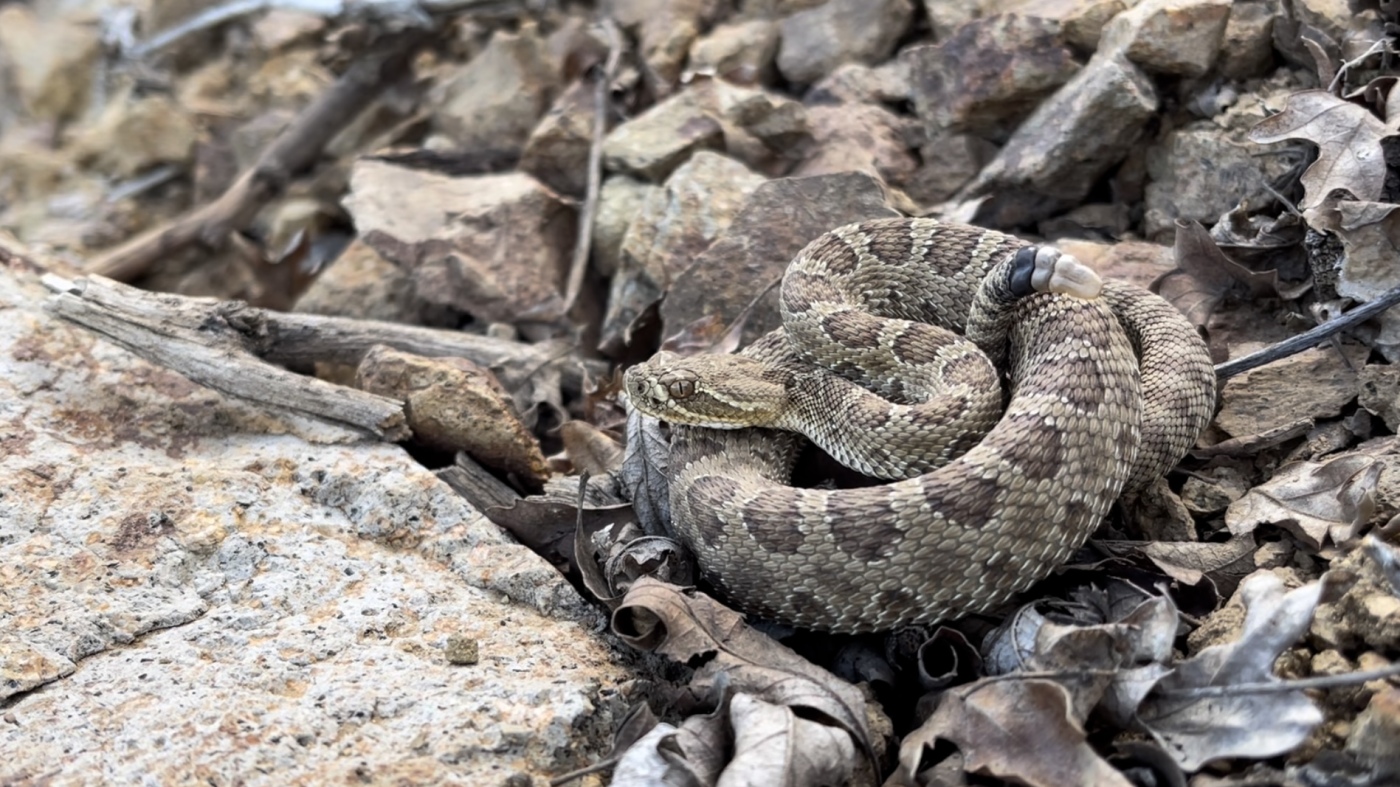
Project RattleCam lets people observe rattlesnakes with a live webcam.
Scott Boback
hide caption
toggle caption
Scott Boback
On a rocky hillside in Fort Collins, Colo., is a “mega den” of hundreds of rattlesnakes.
They live between the rocks year-round, but in the summer, the only snakes to remain in the area are preparing to give birth.

“So this is not quite what we might expect, like a black bear den or a grizzly bear den or something,” says Scott Boback, professor of biology at Dickinson College and co-leader of Project RattleCam.
“This is more like a rock face, where there’s a number of holes that go underground — crevices and cracks in between the rock — and you will see snakes go in and out of these holes. We don’t quite understand exactly what’s going on beneath the surface.”
YouTube
Project RattleCam, a research project based in California, is making it possible for people to observe the snakes with a live webcam. Cameras tucked away in the hillside livestream the snakes to their website.
Boback says this is an especially interesting time to watch the snakes because of their behavior during pregnancy.

A still from the livestream.
Scott Boback
hide caption
toggle caption
Scott Boback
Unlike other snakes, rattlesnakes give birth to live babies — or “pups” — and care for their young for a few weeks after birth. Typically, snakes live solitary lifestyles, but when they’re pregnant they coalesce around nurseries called “rookeries.”
“So when they are aggregated together, as scientists, you got to ask the question about why, what’s going on,” Boback says. “And so that’s one of the things that we’re doing with the camera, is we are interested in how these animals may be interacting with one another. Like, do they tolerate each other?”

Project RattleCam permits Boback and his colleagues to observe the snakes without disruption. It also allows the public to participate.
“We’re sort of right next to the general public who are helping us in that way by making certain observations,” he says. “They’re identifying individual snakes. They can go back and they can rewind the video and they can stop at certain frames, identify unique features on an individual and name the snake. And that allows us to sort of move forward in tracking individuals.”
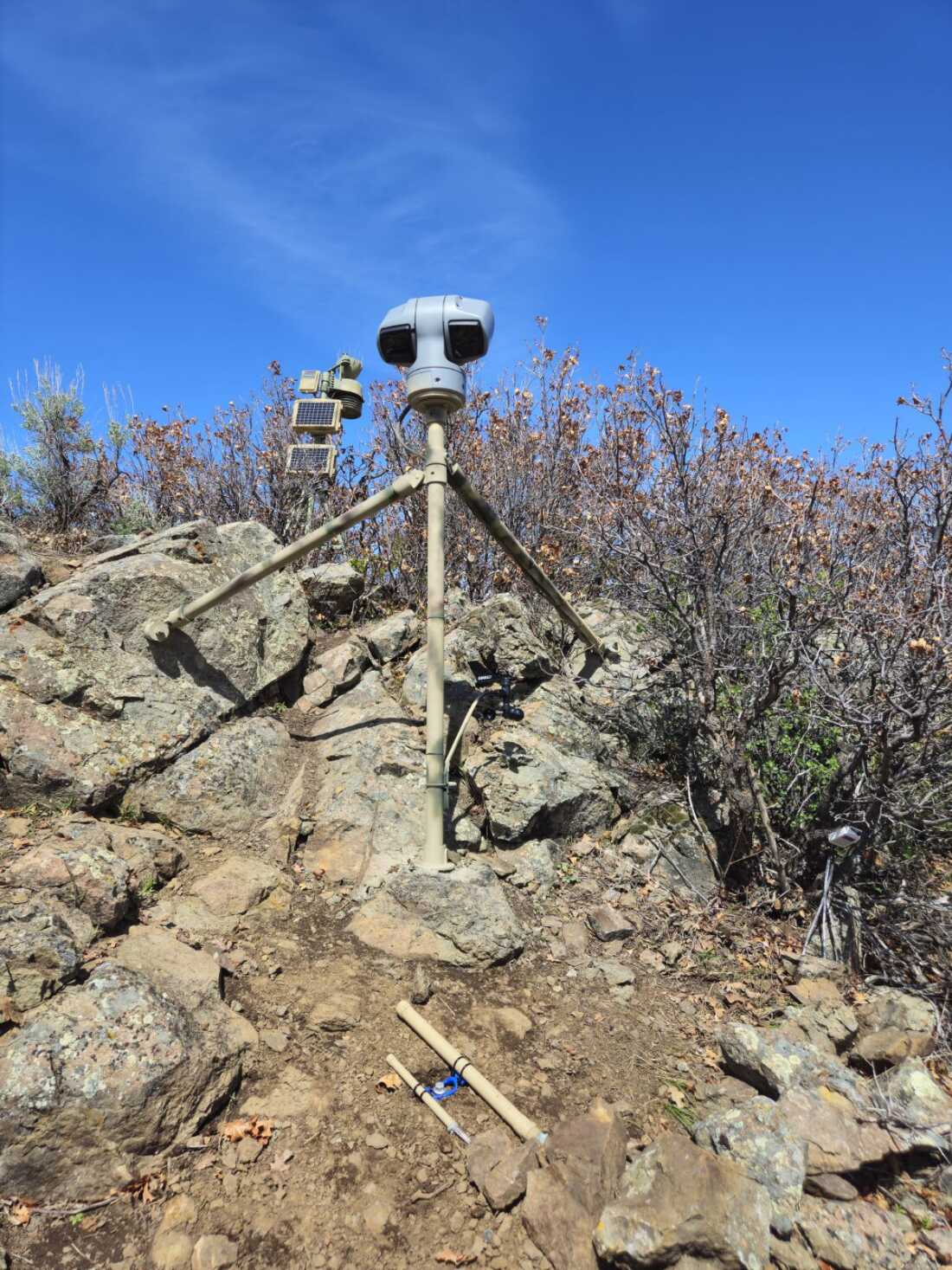
Cameras monitor the area around the den.
Emily Taylor
hide caption
toggle caption
Emily Taylor
Researchers from Project RattleCam understand some of the species’ strange behaviors, like rain harvesting, where the snakes coil up like a teacup and collect water in their body.
Other data is still being studied, but focuses towards the interactions of the mothers during their gestation period.
“If you have a whole bunch of expectant mothers together, they don’t all give birth exactly at the same time,” Boback says. “Essentially, what you have is the opportunity for other mothers to babysit for the mother that actually has given birth to those pups.”
Boback says that observing these traits helps correct wrongful assumptions about the species.
In a study published by the journal Biology of the Rattlesnakes, Cale Morris, a researcher and educator at the Phoenix Herpetological Sanctuary, used a fake leg to mimic stepping on 175 rattlesnakes. In the entire study, only six snakes struck back at the prop.

In May, NPR visited the rattlesnake training course taught by Morris in Scottsdale, Ariz. He told the class: “I just want you to look at this for what it is. This is not an aggressive animal. I see a shy, scared animal.”
Boback says there are many more mysteries to the social behavior of rattlesnakes, and RattleCam is adding insight to a neglected portion of zoology.
“The way that we have always measured sociality is often with primates,” he says. “Things like us, where we smile and we frown and we look at each other and have these very specific facial expressions.”
“Because a snake doesn’t do that, we maybe assumed that there is no socialization going on when, in fact, the snakes are getting a sense of smell from each other every time they stick their tongue out. And so there are chemicals in their skin that we believe they’re using to understand each other. Who is who? They have a way, perhaps, of detecting each individual. Is this my sister? Is this my aunt?”


COLORADO SPRINGS, Colo. (KKTV) – A Southern Colorado landscape photographer started a wildflower database for El Paso County.
Jason Fazio recently launched the El Paso County Wildflower Project.
It’s a community-built field guide designed to encourage people to get outside, explore local open spaces and trails and help document the wildflowers found throughout our county.
“A lot of what people post is stuff that I haven’t seen yet,” Flavio continued. “So it’s been really great to see people submit things.”
The project combines photography, local exploration and community participation.
Visitors can browse featured wildflowers and submit their own photographs for possible inclusion with photographer credit.
Fazio hopes the website becomes a growing resource that celebrates both Colorado’s natural beauty and the people who enjoy it.
Watch the full interview with Fazio at the top of this page!
Copyright 2026 KKTV. All rights reserved.
Colorado
Colorado neighbors lament likely closure of Roxborough library; $22 million regional library breaks ground nearby

For 22 years, the Roxborough library in Roxborough Village has served the entire Roxborough Park community. But that chapter might be coming to a close, as Douglas County Libraries prepares to break ground on a near-$22 million library in a growing master-planned Colorado community nearby.
A new regional library will be built near the intersection of West Titan Road and Taylor River Circle across from the incoming Douglas County School District elementary school in Sterling Ranch. It will also serve communities such as Louviers, Chatfield, Solstice and the greater Roxborough Park community.
“It’s an opportunity for this whole development to centralize a little bit,” said Alex Taylor, president for Sterling Ranch Community Board District No. 2
Taylor was among the first 100 residents to live in Sterling Ranch, and he can’t wait to take his two sons to the library when it opens near their home.
“Having an additional space for the kids to go and find the new set of books,” Taylor said. “Creating a centralized space for everybody in all of the various communities in this region to be able to congregate.”
The 18,000-square-foot library will break ground in Sterling Ranch this summer. But this developing situation does not satisfy everyone in the community.
“Don’t take ours to give them theirs,” community member Denise Martinez said.
Seven minutes away at the Roxborough library, some neighbors don’t want to say goodbye to their longstanding community hub. But the library board has set the lease to terminate next year.
“It would be devastating to this community on so many different levels,” Martinez said.
Martinez says the smaller Roxborough library is one of the only shared amenities in the community and is walkable for many.
“I truly believe that this is the hub of the community,” Martinez said. “This is the gathering spot.”
“Our community has been here for over 40 years, and people have paid into the library system for that amount of time,” said Ephram Glass, president of Roxborough Village Metropolitan District. They’ve been paying their property taxes. The library has been accumulating all this funding, so that they could build a new facility for Roxborough, and now for that money to then go to a brand new community that hasn’t been paying in for decades, I think a lot of people will be very pissed off.”
Glass and Martinez both enjoy taking their children to the library. They say it’s a close walk or bike ride from Roxborough Primary and Intermediate School and worry about children losing accessibility to the library.
“It would take an hour and 16 minutes walking to the new facility from this one, or a 25-minute bike ride. There’s really no shoulder,” Martinez said. “This doesn’t give our kids access at all. I mean, they will ultimately not be able to go to the library unless they have a ride.”
“I imagine some kids will take the e-bikes over. Many will just not go,” Glass said.
Glass is a member of the Roxborough Village HOA, which he says offered to donate a parcel of land near the existing Roxborough library with no strings attached.
“The board chose the Sterling Ranch site as the best site,” said Bob Pasicznyuk, executive director at Douglas County Libraries.
Pasicznyuk says there have long been plans to open a larger library in the area. He says DCL chose the other site, which was donated by the Sterling Ranch developer, partially because it was centrally located in northwest Douglas County.
“Ultimately around 35,000 people will live just in Sterling Ranch alone. The audience base would then go up to say (50,000) or 60,000. Right now it’s about half that many,” Pasicznyuk said.
Pasicznyuk says the all-in cost of the library in Sterling Ranch will be $21.6 million. That includes $250,000 for an outdoor porch, $200,000 for an outdoor children’s play area and $450,000 for other outdoor improvements, including a seating area, trellis and event and trail space.

Martinez is upset those outdoor amenities will come at the cost of the library and not the Sterling Ranch developer.
“I just think that it’s ridiculous to build a park and a veranda and even insist upon those things,” Martinez said. “I just do not understand what that really has to do with literacy or books or the library. I was kind of shocked by that actually.”
Despite terminating the lease, Pasicznyuk says the library board has not voted to close the Roxborough library just yet, but admits they have always consolidated smaller libraries when larger ones open.
“We’ve been 22 years in the second-floor strip mall rental, and while we’ve been glad for the opportunity, it’s going to be an amazing opportunity to move into a freestanding library with all the amenities that we have,” Pasicznyuk said.
“It isn’t good for this community. If you’re here to serve the community, why would you shut this down?” Martinez said.
Martinez started a Change.org petition to “Save Our Roxborough Library.” She now has more than 1,400 signatures.
“We need this. This is vital for our community,” Martinez said. “We just feel like we’re being absorbed.”
“It’s a prized amenity, so it makes sense that they want to keep it,” Pasicznyuk said. “I’ve never seen a reaction other than people love their library. So, even though you’re opening a new library, and I can describe 10 things about it that might be improvements over what we have today, people are going to, because they love their library, wish to keep what they have.”
Meanwhile, Taylor is excited for the library to open in Sterling Ranch next year.
“I’m absolutely empathetic to the fact that somebody might be disappointed that a library would move a few miles away from them versus where it’s historically been,” Taylor said. “The library will be something that everyone can enjoy. It’s going to be a library in Sterling Ranch, but not just for Sterling Ranch.”
Taylor says he’s been working with Sterling Ranch’s developers and the library on a partnership with the nearby Lamb Spring Archaeological Preserve. They are hoping to bring some artifacts or replicas into the library and use a mammoth hunter-gatherer theme for the children’s areas.
“It is a major archeological site in this region that there is evidence of mammoth activity and human activity going back possibly as far as 9,000 years ago,” Taylor said.
Roxborough-area residents say they plan to attend the next library board meeting on June 24 to make their voices heard.

(COLORADO SPRINGS) — Organizers for the Pikes Peak or Bust Parade announced on Friday, June 19, that due to a lack of resources, the parade has been canceled.
Originally scheduled for July 11 in Downtown Colorado Springs, parade organizers said they could not secure the resources needed to produce the event at the level the community deserves.
“We know many of you were looking forward to the parade, and we’re incredibly grateful to everyone who offered their time, support, sponsorship, and enthusiasm,” said organizers.
While the parade will no longer be taking place on July 11, organizers said the Pikes Peak or Bust Rodeo will return on July 14 through July 18, and tickets remain on sale.
Organizers hope to see the Colorado Springs community at the rodeo, and they remain hopeful that the beloved tradition can return in the future.
-
 Lifestyle21 minutes ago
How actress Laverne Cox became the woman of her dreams (CT+) : Consider This from NPR
-

 Technology31 minutes ago
The Atlantic created a searchable database of the music used to train AI
-

 World36 minutes ago
Keir Starmer reportedly considering stepping down as PM and could announce timetable for departure
-

 Politics43 minutes ago
Pope Leo sends unmistakable message on immigrants during visit honoring America’s first saint
-

 Health46 minutes ago
Male breast cancer survivor shares warning after unexpected diagnosis
-

 Sports51 minutes ago
Jazz Chisholm explains why he still won’t wear a cup after fouling a pitch into his own groin
-

 Technology58 minutes ago
Travel mistake puts phone, laptop and streaming accounts at risk
-
 Business1 hour ago
Tractor-trailer crosses center divider in Irwindale, killing 1 and injuring 30

