West
Case challenging Trump ballot access dies at Oregon Supreme Court

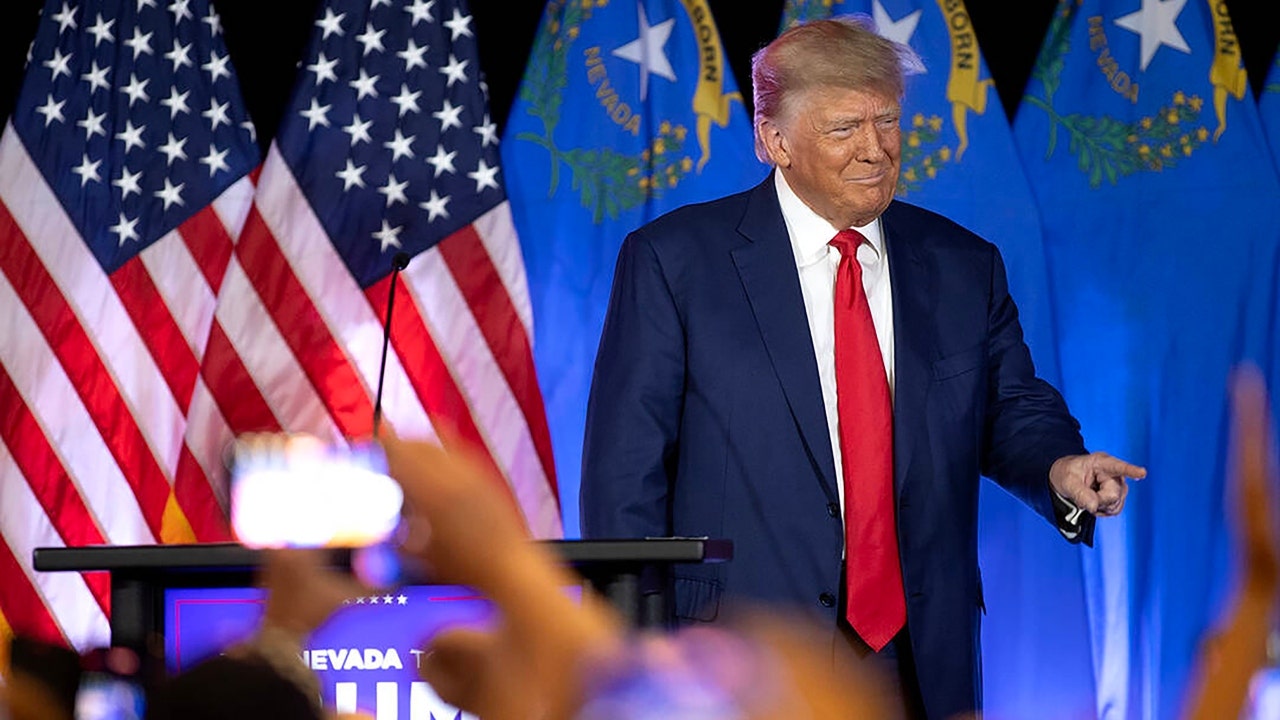
The Oregon Supreme Court will not hear the case challenging former President Donald Trump’s eligibility to appear on the state’s ballot in this year’s presidential election.
The court turned down the opportunity to hear the case, citing a lack of authority to handle the issue in the primary stage.
“Today, the Oregon Supreme Court declined to hear, for now, a challenge by five Oregon voters (relators) seeking to preclude Donald J. Trump from appearing on the Oregon 2024 Republican primary and general election ballots,” a media release from the court announced Friday.
TRUMP BACKED BY 27 STATES IN SUPREME COURT FIGHT, WHO WARN OF 2024 ‘CHAOS’ IF HE’S REMOVED FROM BALLOT
Former President Donald Trump takes the stage during an organizing event at Fervent Calvary Chapel in Las Vegas. (Ellen Schmidt/Las Vegas Review-Journal/Tribune News Service via Getty Images)
Democrats in a handful of states across the U.S. are in the midst of legal battles to remove Trump’s name from state ballots, saying Trump’s actions on January 6, 2021, violated a clause in the 14th Amendment that prevents anyone who “engaged in insurrection or rebellion” against the Constitution from holding political office.
DEMS’ PLAN TO STRIP TRUMP FROM NY BALLOT HAS NUMBER OF FLAWS UNDER STATE LAW: ELECTION EXPERT
The Supreme Court is set to hear arguments on whether former President Trump will be on the Colorado Republican presidential primary ballot.
The justices said they will hear the case on an expedited basis, with arguments on February 8.
The Oregon Supreme Court will not hear the case challenging former President Donald Trump’s eligibility to appear on the state’s ballot in this year’s presidential election. (ROBYN BECK/AFP via Getty Images)
“The petition for a writ of certiorari is granted. The case is set for oral argument on Thursday, February 8, 2024,” the SCOTUS decision said. “Petitioner’s brief on the merits, and any amicus curiae briefs in support or in support of neither party, are to be filed on or before Thursday, January 18, 2024.”
The SCOTUS justices issued an administrative stay that ordered the Colorado Secretary of State to put the former president’s name on the GOP primary ballot, at least until the case is decided.
The state supreme court left the door open to future petitions following an expected decision from the U.S. Supreme Court regarding the removal of candidates from the ballot under the 14th Amendment clause.
The Oregon court’s media release said: “Because a decision by the United States Supreme Court regarding the Fourteenth Amendment issue may resolve one or more contentions that relators make in the Oregon proceeding, the Oregon Supreme Court denied their petition for mandamus, by order, but without prejudice to their ability to file a new petition seeking resolution of any issue that may remain following a decision by the United States Supreme Court.”
Fox News Digital’s Emma Colton contributed to this report.
Read the full article from Here


WASHINGTON — Montana voters will select nominees in Tuesday’s state primary to replace departing Republican incumbents in the U.S. Senate and House, but one major contender won’t be on the ballot. Meanwhile, several state legislative primaries will highlight divisions within Montana’s dominant Republican Party.
Republicans hold slim majorities in both chambers of Congress. Montana has not been at the top of the list of seats Democrats hope to flip to regain control of either body, but the retirements do creak open the door for a candidate to possibly take advantage of the state’s independent streak.
Republican U.S. Sen. Steve Daines is not seeking a third term. He has endorsed former U.S. Attorney Kurt Alme to replace him. Daines’ late withdrawal from the race in March and the launch of Alme’s candidacy, both timed to occur just before the filing deadline, appeared to be carefully choreographed. President Donald Trump seemed to confirm as much in his endorsement of Alme.
“In fact, if Kurt didn’t have the highest level of aptitude and talent, Steve would have remained exactly where he is….” Trump said in a social media post.
Alme also has endorsements from the state’s other top Republicans, U.S. Sen. Tim Sheehy and Gov. Greg Gianforte. He faces Republicans Lee Calhoun and Charles Walking Child for the nomination.
The Democratic field includes former state Rep. Reilly Neill, whose fundraising is five times the combined haul of her four primary rivals.
The winners of both primaries will face former University of Montana president Seth Bodnar, who is running as an independent. As of mid-May, Bodnar had outraised the entire field of candidates, regardless of party. Bodnar is one of a handful of independent candidates who have opted to bypass the party primary process and could complicate the general election for some Republican incumbents.
In the 1st Congressional District, Republican U.S. Rep. Ryan Zinke is not seeking a fourth full term, citing health concerns. He, Trump, Sheehy and Gianforte have endorsed talk radio host and former Zinke congressional staffer Aaron Flint over Montana Secretary of State Christi Jacobsen, former state Sen. Al Olszewski and former high school government teacher Ray Curtis. The Democratic field includes former gubernatorial candidate Ryan Busse and union organizer Sam Forstag.
In the state Legislature, several primaries expose an ongoing rift within the ranks of Montana Republicans.
At the start of the 2025 legislative session, nine Republican state senators bucked the party on a variety of key floor measures, essentially handing control of the chamber to Democrats.
State Sen. Shelley Vance of District 34 is the only one of the maverick lawmakers, dubbed the “Nasty Nine” by the Montana GOP, up for reelection in 2026. Two others, state Sens. Jason Ellsworth and Bruce Gillespie, opted instead to run for the state House in Districts 34 and 18, respectively. The other six are either term-limited, retiring or not up this cycle.
In response to the revolt within the Republican caucus, the Montana Republican Party released a list of state legislative candidates it supports, including some who are challenging Republican incumbents in the state House. But some of the state party’s picks put the committee at odds with Gianforte, who has released a series of social media videos appearing with four state House incumbents targeted by the party.
The governor offered words of support for state House Speaker Brandon Ler and state Reps. Valerie Moore and Ken Walsh, who are all running for reelection, and for state Rep. Eric Albus, who is running in state Senate District 14. Gianforte does not explicitly endorse the lawmakers in the videos, but he called one a “great partner” and said he was “proud of the work” he’d done with another.
Half of the state’s 50 state Senate seats and all 100 state House seats are up for election in 2026.
Here are some of the key facts about the election and data points the AP Decision Team will monitor as the votes are tallied:
When do polls close?
Polls close at 8 p.m. MT, which is 10 p.m. ET.
What’s on the ballot?
The AP will provide vote results and declare winners in contested primaries for U.S. Senate, U.S. House, Public Service Commission, state Senate and state House.
Who gets to vote?
Any eligible voter may participate in any party’s primary.
How many voters are there?
As of May 25, there were about 791,000 registered voters in Montana. Voters do not register by party.
How many people actually vote?
About 190,000 Republican primary votes and about 108,000 Democratic primary votes were cast in the 2024 U.S. Senate primaries.
How much of the vote is cast early or by absentee ballot?
About 68% of the 2024 primary vote was cast before primary day.
As of Friday, about 166,000 ballots had already been cast in Tuesday’s election.
When are early and absentee votes released?
Counties vary in how they release votes. In previous elections, results from absentee voting mostly were released along with in-person Election Day voting throughout the night. About two-thirds of Montana’s 56 counties tend to release all or almost all of their mail and in-person early voting results in the first vote update of the night, often along with results from in-person Election Day voting. About half the counties tend to release all or almost all their in-person Election Day results in the first vote report.
How long does vote-counting usually take?
In the 2024 U.S. Senate primary, the AP first reported results at 10:26 p.m. ET, or 26 minutes after polls closed. The last vote update of the night was at 4:06 a.m. ET with about 84% of total votes counted.
When will the AP declare a winner?
The Associated Press does not make projections and will declare a winner only when it’s determined there is no scenario that would allow a trailing candidate to close the gap. If a race has not been called, the AP will continue to cover any newsworthy developments, such as candidate concessions or declarations of victory. In doing so, the AP will make clear that it has not yet declared a winner and explain why.
How do recounts work?
Montana requires an automatic recount only in the event of a tie vote. A candidate may request a recount if the margin is less than 0.5% of the total vote, but the state will only pay for it if the margin is 0.25% or less. The AP may declare a winner in a race that is subject to a recount if it can determine the lead is too large for a recount or legal challenge to change the outcome.
Are we there yet?
As of Tuesday, there will be 154 days until the 2026 midterm elections.

Ties to a Nevada lithium mine are causing investors in one of the nation’s top auto manufacturers to push for shareholder action on what they see as violations of Native American rights.
That includes Sister Susan Francois, a Catholic nun and assistant congregation leader at the Sisters of St. Joseph of Peace in New Jersey, who is calling for General Motors to issue a report on its operational conflicts with Indigenous sovereignty.
“It’s injury upon injury,” Francois said in a Thursday interview about the Thacker Pass mine near the Nevada-Oregon border. “It limits their ability to collect their traditional medicine, to have access to the hunting grounds, to have ceremonies. That is just something that breaks my heart.”
Detroit-based General Motors, which is behind brands such as Chevrolet, Buick and GMC, is the joint partner of Lithium Americas, the Canadian company building the mine.
In 2024, it committed $625 million to obtain a 38 percent stake in the mine. For the first 20 years of the mine’s life, the automaker will obtain 100 percent of the lithium produced in the first phase to manufacture electric vehicle batteries.
Requesting an analysis
Francois’ church, with at least $25,000 invested in General Motors shares, proposed the shareholders adopt a resolution that the company will discuss at a Tuesday meeting.
In it, they ask the company to publish a report evaluating the effectiveness of its policies in recognizing the U.N.’s Declaration on the Rights of Indigenous Peoples, which contends Native Americans should be given the opportunity to provide or revoke consent for extractive projects that impact their homelands.
The declaration is not binding in the United States, though President Barack Obama signed on in 2010 and federal agencies contend its often limited outreach is sufficient according to the country’s interpretation.
The resolution cites separate Amnesty International and Human Rights Watch reports that reached similar conclusions that Native Americans were not properly consulted before the Bureau of Land Management issued federal permits allowing construction of Thacker Pass to begin.
In response, the company’s board recommended the resolution’s denial, affirming that international human rights standards for Native American consent are already incorporated into its human rights framework. A company spokesman referred the Las Vegas Review-Journal back to that reply when asked for comment.
Francois pointed to a previous effort to compel Citibank to issue a similar report. While successful, Francois said she was disappointed that they did not consult Native Americans sufficiently in the creation of it.
“They have statements that they respect Indigenous peoples’ rights through their supply chains, but this Thacker Pass scenario shows that, obviously, it’s broken,” Francois said.
‘Simply being a voice’
Building a lithium mine in the so-called McDermitt Caldera region has stirred controversy among Northern Paiute and Western Shoshone tribal members, who remain divided on what is worth sacrificing to bring economic development.
Several tribes unsuccessfully sued the Bureau of Land Management over its approval of the mine, contending that the mine would be built on the site of a 19th century U.S. Cavalry massacre. A federal judge did not side with the tribes, but did acknowledge their “broader equitable and historical arguments.”
Lithium Americas spokesman Tim Crowley said evidence shows the massacre occurred miles away from the project site, and that the court found the company complied with all consultation standards set by law.
Chanda Callao, who co-founded the People of Red Mountain group that still protests the mine’s construction, said in a brief interview that her organization isn’t expressing its support for the resolution yet. Rather, Callao and other tribal members are taking the opportunity to, again, spotlight what they feel is injustice.
Reports from human rights organizations have been validating to the group’s mission, she said.
“We are just simply being a voice in telling GM that they’re violating human rights,” Callao said.
Francois said at the very least, she is proud that the church is prompting conversations. She said Catholics have a moral obligation to advocate against the harms of yesterday, particularly following Pope Francis’ public statements that American colonialism perpetuated grave sins against Native people.
Going forward, it is also about protecting investments, which could be jeopardized by permitting delays should General Motors not straighten out its policies, Francois said.
“I’m a woman of faith, so I pray that hearts are moved and that we realize that not only is this the moral thing to do, it’s also good business,” Francois said.
Contact Alan Halaly at ahalaly@reviewjournal.com. Follow @AlanHalaly on X.

ALBUQUERQUE, N.M. (KRQE) – The Rail Yards Market celebrated the state’s rich indigenous culture and history over the weekend through artistry, food, and craftsmanship. Some of the many attractions included a variety of southwestern jewelry pieces, handmade leather goods, as well as contemporary beadwork and artwork showcasing centuries-old traditions.
The Ry-Dale Largo Dance Group also performed traditional Navajo dancing styles. “I think it’s really important for everybody to get out and mingle and sit next to each other and create art. It really forms a sense of community, and it’s nice to just sit and create with people next to you that just really enjoy doing art,” said Lisa Richards, beading instructor.
Organizers say the Rail Yards Market sits on Tiwa land, emphasizing their pride in uplifting indigenous voices through their vendors and partners.
-

 Kentucky4 minutes ago
Happy Pride Month! See how Kentucky ranks for LGBTQ+ safety, inclusion
-

 Louisiana11 minutes ago
Louisiana is the eighth most affordable state to retire, study says
-

 Maine14 minutes ago
This Maine lawmaker is trying to ban Flock license plate readers
-

 Maryland19 minutes ago
GOP Panel Picks Replacement For Vacant 3rd District Seat
-

 Michigan26 minutes ago
Gasoline prices drop nationwide, but relief may be temporary
-

 Massachusetts29 minutes ago
Meteor Lands In Cape Cod + Bus Crash Kills 5 From MA + Wind Storm Knocks Out Power To Thousands: MA Weekend
-

 Minnesota34 minutes ago
Driver hits 2 cows in central Minnesota, suffers serious injuries
-

 Mississippi41 minutes ago
Mississippi ruling clears path for private AI power. Prado moves forward

