Entertainment
Happier than ever, Gary Oldman isn’t ready to quit ‘Slow Horses’ anytime soon


Two years ago, Gary Oldman found himself in Yorkshire for the wedding of his oldest son, Alfie. As Oldman’s other sons, Gulliver and Charlie, were there too, along with his wife, Gisele Schmidt, and his stepson, William, Oldman thought it’d be a lark to make the hourlong drive through the countryside to the York Theatre Royal, where he began his acting career in 1979.
The boys were intrigued, as they had heard stories over the years. Before Oldman burst on the film scene in the 1980s playing punk rocker Sid Vicious in “Sid & Nancy” and British playwright Joe Orton in Stephen Frears’ “Prick Up Your Ears,” he had turned heads in a run of plays throughout England. Then he was, as he puts it, “kidnapped by cinema.” Wanting to see their father’s career origin story, the family piled into a couple of cars and headed out.
“It was a lovely kind of homecoming, a debt paid, really,” Oldman tells me in a Zoom conversation from London. We’ve talked a great many times over the years, and while I wouldn’t call him nostalgic, Oldman most definitely is a sentimental man, especially when it comes to family.
That day, walking around the York Theatre Royal, thinking he needed to pinch himself because, really, how could it be 45 years since he first took that stage (“It all feels last week,” he thought), Oldman met Paul Crewes, the theater’s chief executive. “Do you think you might want to ever return to the stage,” Crewes asked Oldman, “and if so, where might that be?” Oldman thought for a moment and replied: “I think I’m standing on it.”
Sure enough, last year, in between filming seasons of his acclaimed Apple TV spy series “Slow Horses,” Oldman starred in Samuel Beckett’s “Krapp’s Last Tape,” playing a 69-year-old man who sits alone and listens to the recorded memories of his younger self. Everyone was so happy with it that Oldman was asked to reprise the role at London’s Royal Court Theatre this May, which is why he stayed in England after wrapping the seventh season of “Slow Horses.”
Gary Oldman as Jackson Lamb in “Slow Horses.”
(Jack English / Apple TV)
“It all fell into place,” Oldman says of his return to the theater, “and once we started, I was really champing at the bit to have the first preview. I was that wound-up. And it was a very nice thing for the family to come and see their papa up there onstage. It all feels quite harmonic.”
Having just celebrated his 68th birthday, Oldman is only a year removed from Krapp, though unlike Beckett’s character he isn’t disillusioned or lonely.
“I don’t know if I’ve worked out who I am, but I feel a little easier in my skin and happier than I’ve ever been,” he says. He attributes much of that bliss to his marriage to Schmidt, an art curator, writer and photographer whom he wed in 2017. “At this point in my life, I’m with someone who gets me and understands what I do. You have to incubate, and Gisele doesn’t take it personally. It’s a big part of who I am, the quiet and isolation needed to work on a character. I’m very lucky to have found someone.”
Musing about couples who have been together for decades, Oldman brings up Kevin Bacon and his long marriage to Kyra Sedgwick. “That’s a fantastic love story,” he marvels.
Everyone’s journey is different, I offer. For Oldman, sober since 1997 and married five times (“Maybe I’m a romantic or an optimist or just ‘never say never,’” he once told me), he found his own love story. And the feeling appears mutual.
“I might be the fifth one, but I am the one,” Schmidt says playfully off-camera. Oldman smiles and repeats it in case I didn’t hear her. “It’s a lovely thing,” he adds.
Oldman feels the same way about “Slow Horses,” which has broken through at the Emmys the last two years, winning awards for writing and directing. Its fifth season aired in the fall. Two more seasons are in the can. And as author Mick Herron continues to write new books in the Slough House series, there’s no immediate end in sight.
“I mean, if I go to Book 10, 11 or 12, I’ll have to be in a walker,” Oldman jokes. “They’ll have to get a stair lift.”
He’s still sporting the facial scruff we associate with “Slow Horses’” unkempt master spy, Jackson Lamb, and as he noted last year at a SAG-AFTRA Foundation event I moderated, he still carries a few extra pounds around the midsection, the consequence of having to portray Lamb’s greasy, takeaway-container diet onscreen.
“I hadn’t seen Gary — I’d seen him on the telly — and it happened that we were filming around the same time, and I went into the makeup trailer and I [said], ‘Bloody hell!’” jokes Oldman’s “Slow Horses” co-star, Jonathan Pryce. “I thought he had a fat suit on. I didn’t realize his dedication to his craft.”
“You have to realize it’s five seasons, and it’s murderous,” Oldman answers. “It’s French fries and hot dogs and hamburgers and ice cream. It’s disgusting, isn’t it?”
The menu hasn’t changed, and neither has Lamb, still cynical and lazy, but also brilliant when he puts his mind to it, abrasive and cruel to his team, but also loyal and protective of the “losers” in his charge. Yes, outwardly, Lamb is, as Herron writes, a “sentient grease stain,” but Oldman believes he possesses a “strong moral and ethical compass.”
Over the years, Oldman has compiled what he calls a “small bible,” a journal of things that he believes may have happened to Lamb that aren’t found in Herron’s books. In fact, the most memorable scene in Season 5, where Lamb recalls a harrowing story of one of his “joes” being tortured by the East German secret police, alongside a pregnant woman, wasn’t in the book. Lamb later insists he made the whole thing up, though we learn at least some of what he said was true in the season finale.
“When you do something like that, I have to decide whether it’s true or false and then just play the scene with enough sincerity,” Oldman says. “Remember, Lamb’s a spy and a very good liar. The thing that struck me about it came at the very end. He says, ‘Well, they never got any information out of him. They wanted a name. But he never knew the f— name.’ That always struck me as an honest declamation.”

Gary Oldman.
(Jennifer McCord / For The Times)
Oldman loves returning to “Slow Horses” every year and says that as long as Apple is willing to “keep writing those checks, I’m not ready to hang up my dirty raincoat just yet.”
“Most people I meet, including one of the royals, ask me, ‘Are you going to be doing more?’” he says. “They can’t get enough of it.”
One of the royals?
Oldman pauses. “Her majesty Queen Camilla is a keen viewer.”
How do you know this?
Another pause. “She … told me,” Oldman offers. “Long story for another time, perhaps.” Schmidt then fills in the blanks. They met the queen two years ago when Oldman performed at a Shakespeare celebration for the Queen’s Reading Room charity.
So perhaps there will be a Season 8, though with two unaired seasons still to come later this year and next, asking for more feels greedy. In the meantime, there are grandchildren to dote on. Last week, Oldman and Schmidt spent the day with their 18-month-old granddaughter, Ottilie.
“I do miss the baby stage, their character developing,” Oldman says. “Ottilie is already such a character. We just had a day of laughing with this innocent little soul.”
“But it’s that old story,” Oldman adds, smiling. “As a grandparent, you know you can love them and spoil them and then give them back.” He laughs. “It’s a good gig.”

(Jennifer McCord / For The Times)

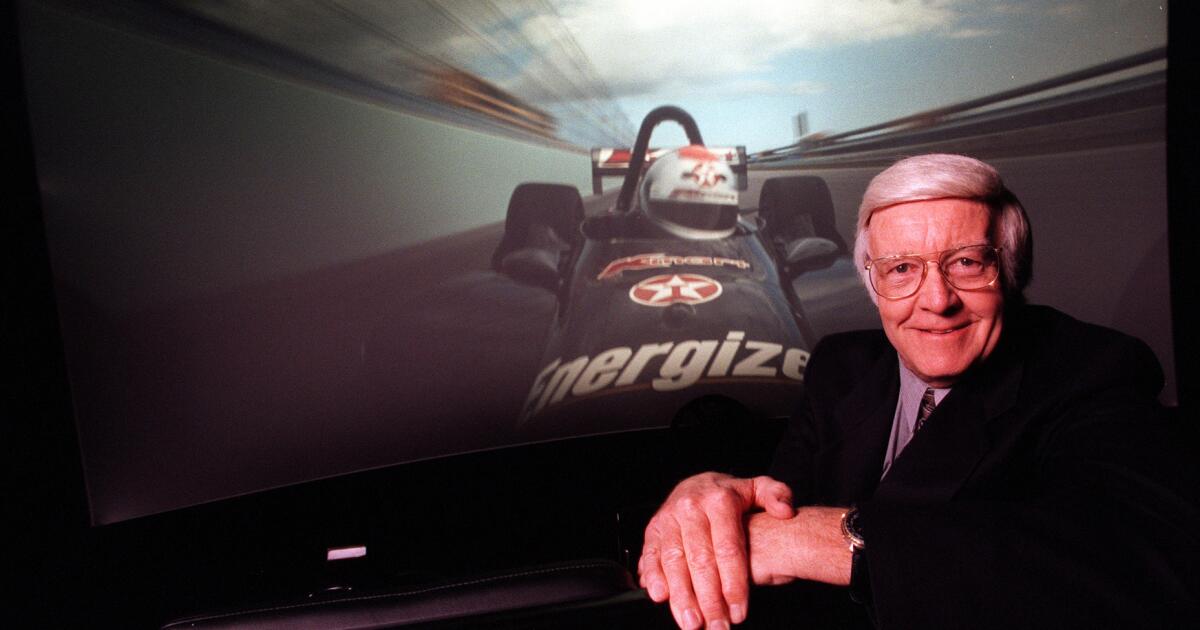
Don Iwerks, an Academy Award-winning special effects pioneer whose innovations transformed film and Disney theme parks, died peacefully Thursday at the age of 96, the Walt Disney Co. announced.
For Disney and his own studio, Iwerks Entertainment, Iwerks helped develop technologies and techniques like Circle-Vision, the 360-degree camera behind “America the Beautiful” and other early Disney attractions, and the 3-D effects used in attractions like Captain EO and the Star Tours ride.
“There was a ‘can-do’ attitude I learned from Walt and my father,” Iwerks said, according to a statement shared by the Disney Co. “Walt gave everyone a feeling that they were creating things that others had never thought of before, of being a part of history.”
Born July 24, 1929, Iwerks received his first camera at age 14 as a gift from his father, animator Ub Iwerks.
The elder Iwerks met fellow artist Walt Disney when both men were teenagers working at a Kansas City, Mo., art studio. They would go on to work together at the Disney Brothers Cartoon Studio, where Iwerks designed and animated “Plane Crazy,” the first Mickey Mouse cartoon.
After a stint at his own animation studio, Ub returned to Disney as a special effects engineer, pioneering techniques like the 360-degree motion-picture camera.
“He was absolutely my inspiration because he was technically minded. He made my childhood and formative years one of the greatest times of my life,” Don Iwerks told The Times in 1998.
The Iwerks family moved to the San Fernando Valley in 1936, where Don graduated from Van Nuys High School in 1947.
He served as a photographer in Germany during the Korean War and joined his father at Disney following his 1952 discharge from the U.S. Army. An allergic reaction to chemicals used to develop film led to his transfer to the company’s Studio Machine Shop, where he spent the next 34 years.
Don spent three months in the Bahamas manning underwater cameras for the 1954 Disney film “20,000 Leagues Under the Sea.” He then worked as the camera technician on “A Tour of the West,” an original Tomorrowland attraction at the soon-to-be opened Disneyland. The immersive 360-degree film was shot on the Circarama camera system his father invented.
Together, Don and Ub developed technologies like the “endless loop” system that enabled a single film print to run for up to 10,000 performances with minimal intervention and refinements to the photography processes used in “Mary Poppins” (his favorite of the Disney films) and other movies.
His own hands were used as the model for those of the Abraham Lincoln Audio-Animatronics figure in “Great Moments with Mr. Lincoln,” which opened at Disneyland in 1965. The “Iwerks Hands” now appear on similar figures at Disney parks around the world, according to his family.
In 1998, Don Iwerks received the Academy of Motion Pictures’ Gordon E. Sawyer Award for “technical contributions” that “brought credit to the industry.” In 1999, he received an Oscar for Scientific and Technical Achievement.
(Iwerks Family)
In 1986, he co-founded Iwerks Entertainment, which soon became a major player in the film and theme park industries. The company specialized in large-format films and created the 3-D projection system used in the Terminator rides at Universal Studios parks in Hollywood and Florida.
His innovations were honored with the Academy of Motion Picture Arts and Sciences’ honorary Gordon E. Sawyer Award and an Academy Scientific and Technical Award, among other prizes.
“It’s very obvious that computers are playing a big role in motion pictures today. The digital technology in film is able to put elements of scenes together on a film and have them look lifelike. It’s hard to know where that will go,” Iwerks said in a 1998 interview.
“My view is that technology should support a good story and add to it. Technology for technology’s sake?” he said with a shrug. “You still need good films.”
Iwerks is survived by his wife of 54 years, Betty; his sons, Larry and John; John’s wife, Chris; his daughter Leslie, and great-nephew,Mike, both of whom have also worked for Disney, according to an obituary shared by his family. His daughter Tamara preceded him in death.
“Like his father, he was a humble genius, a consummate problem solver, and delighted in sharing knowledge, encouraging others, and approaching every challenge with confidence and grace,” his family said in the statement from Conejo Mountain Funeral Home in Ventura.
Both Don and Ub Iwerks are commemorated in a storefront window on Main Street U.S.A. in Disney World’s Magic Kingdom. Located above the Main Street Bakery, the window is a lasting tribute to a family who made some of the park’s magic possible.
“Iwerks-Iwerks Stereoscopic Cameras,” the lettering reads. “No Two Exactly Alike.”

Earnest, preachy and melodramatic to a fault, “Mississippi Scholar” is exactly the sort of movie that the independent cinema was born to create.
Director and co-writer Marcus Bleecker’s film may traffic in tropes and cliches. But it has a vivid sense of place and a clear notion of the message it wants to send, and that message’s relevence.
Set in an unnamed small Mississippi city — it was filmed in Baldwyn, Saltillo and Fulton — the film is “a mind is a terrible thing to waste” in cinematic form. Our “Scholar” was born into a world of substance abuse, the racist legal traps of the country’s remaining marijuana laws and has a baby-mama-in-waiting and a drunken parent whom our teen hero is responsible for as his burdens.
But he has a world of promise that one dedicated teacher, his dead father (whom he still converses with) and even he himself can see if he can just “stay focused” and keep his eyes on this very personal prize — college and a better life beyond Ole Miss.
Shannon Brown is James, a kid with great grades and an ill-tempered mother (Gisla Stringer) who crawled into the bottle a long time ago and has no interest in crawling out.
But he’s got an ad hoc support system helping him through his senior year. His aunt (GiGi Marie Gaines) feeds him and keeps him advised of his mother’s latest tumbles. His dead dad (co-writer Obba Babatundé) passes on wisdom about his mother in fortune cookie-sized bites when father and son chat — at the cemetary or elsewhere.
“Hurt people hurt people.”
His English teacher, Mr. Keating (Sonny Marinelli) has high hopes for him, hopes he’s willing to nag the kid to achieve — “It takes only five seconds to get in trouble, and 25 years to get out of it!”
His school principal (Lance E. Nichols) expects greatness, but has learned to never get his hopes up over any Black boy at his integrated high school.
Even Ray-Ray (Jeremy Isaiah Earl), the ex-con drug dealer, takes a brotherly interest in the kid who is his “best distributor.” That money is what keeps a roof over James’ and his mother’s heads, and pays for his Jordans.
His white boy bestie (Dominic Arvielo) may act “Black,” but will he have James’ back when things get real?
And girlfriend Tammy (Aysa Branch) may be far and away the prettiest girl in school. But she’s taking the easy route, relying on her looks to achieve the limited goals the script sketches out for her.
“We’re gonna have ourselves a baby as soon as we graduate!”
Bleecker’s film covers all of the bases, all of the tropes and most of the cliches as James faces Big Choices with perils to his plan at every turn. Maybe taking him to visit the football-mad University of Mississippi isn’t the deal-maker his teacher hopes it is, as James doesn’t “see anybody who looks like me.”
Only a real civil rights hero (Dr. Donald Cole) can set him straight, relating the story of what James Meredith and generations before him did to give James this chance. Or can he?
“Mississippi Scholar” is well-crafted and an easy film to like, with relatable if “stock” characters and decent performances from all but the most amateurish (James’ classmates) cast members. But it’s entirely too predictable to surprise and too pre-digested to have an edge.
Worthy subject and novel setting aside, we’ve seen this story on the big screen and the small one too many times to count, seen this kid’s hand played out in every variation the cards have to offer.
But it makes a fine calling card for its cinematographer turned director, and let’s hope we see Bleecker’s name and hear his voice in another Deep South indie film, and soon.

Rating: TV-14, violence, profanity
Cast: Shannon Brown, Gisla Stringer, Sonny Marinelli, Jeremy Isiaah Earl, Aysa Branch and
Obba Babatundé
Credits: Directed by Marcus Bleecker, scripted by
Obba Babatundé, Marcus Bleecker and P.J. Leonard. A Narrative Distribution release on Amazon Prime.
Running time: 1:24

Entertainment
Dan Finnerty profaned Bonnie Tyler’s hit in ‘Old School.’ He regrets the f-bombs at her shows

For a certain swath of millennials, Dan Finnerty’s rendition of Bonnie Tyler’s “Total Eclipse of The Heart” in the frat comedy “Old School” is its definitive performance.
In the 2003 film, the Dan Band’s sweaty, inappropriately exuberant version of the ’80s power ballad upstages Will Ferrell’s wedding. The scene forever changed the lyrics of Tyler’s hit to something much more profane, but no less yearning.
After Tyler’s death at 75, Finnerty (who played a similar role in “The Hangover,” among many other comedies) reflected on his sideways journey into Tyler’s career, and how one quick scene on a two-decade-old comedy still endures.
You’ve had a pretty unique relationship to Bonnie Tyler’s music, how are you feeling after she passed?
It’s definitely sad. Everybody is texting me. I never met her, but what an impact she had on me. I grew up right when “Total Eclipse” came out in the ’80s, and it was such a huge song at the time. It had never left my head. I was always just belting that song out because it’s so epic, from Jim Steinman’s writing to Bonnie’s performance.
Why does that moment from “Old School” still endure? It arrived at the last cusp of the DVD era before culture transitioned into the internet and streaming video.
Without YouTube and the internet, you really had to grab pop culture moments from your memory. That’s definitely one of the reasons why pulling it out seemed obscure when we did “Old School.” People were like, “Oh my God, yes, I love this f— song.” Which is so different now because everything’s at your fingertips, so you can’t really rely on like pulling back some nostalgia moment because it’s always around anyway now with the internet. But people were reacting as much to me dropping the f-bombs as the nostalgia of the song, and rediscovering it and realizing that the song kicks ass and never stops kicking it.
Was the song already in your repertoire when you filmed “Old School?”
I was doing my show with the Dan Band in Los Angeles, and [director] Todd Phillips ended up coming to one of the performances. I met him afterwards, and he was like, “There’s actually a wedding scene in this movie. What song would you sing at a wedding?” I had just started working on a medley of “Total Eclipse,” and I think at the time I was going to do “Holding Out for a Hero,” but then I just merged it with “Private Dancer,” and he was like, “Oh my God, I love it.” The following Monday, he called and he’s like, “Can you put that together?”
The bit works because you totally commit to the song’s hugeness, and the profanity slips by like it’s spontaneous. You can tell you love the song on the merits.
I had never done it before. But Todd had seen my show, and when we went to do the first take, I didn’t think I was allowed to swear. But I obviously was swearing during my live show in all my little medleys. He came running up and he’s like, “Are you gonna swear like you do in the show?” I’m like, “Am I allowed to?” And he’s like, “Yeah.” So I’m like, “Buckle the f— up.”
But basically, what I was doing was honestly trying to match Bonnie’s commitment at the level she did with her voice, which is what I loved about all of her performances and Jim Steinman’s music. It’s just over-the-top commitment and drama. The swearing was just me being like, “How can I bump this up one notch when they’ve already just nailed it?”
Did you ever hear from either of them about what they thought about the film?
I’d tried to get Bonnie to do a duet of “Total Eclipse,” and I reached her management. He was like, “Well, Bonnie’s willing to do the song as long as there’s no profanity because she’s not a profane person.” I was like, “Well, neither the f— am I. I was an altar boy.” It didn’t end up working out, because I knew if I did the song without the swearing, people would be like, “What the f—?” But later, met Jim Steinman. I mentioned it to Steinman, and he was like, “Oh, I wish they called me because I can make Bonnie do anything, she’d love the swearing,” which killed me.
You did kind of alter her song forever for a certain generation.
I was just picturing them both hating how I bastardized their song. So when I finally met Steinman, he was like, “No, no, no! I f—ing loved it. In fact, I’ve always thought of all those epic booms, the Kurzweil, all the big hits in ‘Total Eclipse,’ those were musical f—s.”
Mostly I wanted to just find Bonnie and apologize to her for all the drunk guys I have pictured over the years at her concert screaming “F—” ever since that movie.
That song became your biggest hit as a comedian. How’d it change your life?
It got funnier the older we got. When I would do “Total Eclipse” right after “Old School” came out, it would get the biggest reaction. There was one set early on at the Playboy Mansion, we were hired to play some party there. There were just a bunch of drunk guys at the mansion and a couple Playboy bunnies that were contractually hired to walk around and wave. They’re like, “Play ‘Total Eclipse,’” and so I did. Then they’re like, “Play it again.” I’m like, “OK.” Then “Play it again.” I was like, “Here we go, give them what they want.” It was the least amount of work I had to do for a song that was pre-loved from a moment in a movie.
God, I hope she knew how much I loved her and apologize for all the drunk guys that had probably f-bombed the hell out of her concerts.
Before that song, people were like, “Do you have a flier for your next show?” I’m like, “For what?” But once “Old School” happened, suddenly a record label was like, “We want to do a live album.” I’m like, “Who’s gonna buy it?” But my manager is like, “Don’t say s— like that. There’s a record label that wants to make an album with you, dumbass.”
The whole thing has just been a surprise, but it’s been a good one. We’re playing this festival in Canada next weekend, and God, that song’s going to be such a big moment.
-

 Technology11 minutes ago
Lorde says Ray-Ban Meta AI glasses are ‘not sexy’
-

 World17 minutes ago
Four Americans caught in horrific Mexico highway pileup that killed at least 10
-

 Politics23 minutes ago
Medical examiner releases preliminary findings in Lindsey Graham’s death as death certificate remains pending
-

 Health29 minutes ago
Terminally ill man marries longtime love in hospital as final wish comes true
-

 Sports35 minutes ago
Stefon Diggs, still seeking new NFL home, insists no team has a better No 2 receiver ‘than me’
-

 Technology41 minutes ago
Google may use your photos and voice to train AI
-
 Business47 minutes ago
‘Moana’ loses its way at the box office with a $43-million domestic opening
-
Entertainment53 minutes ago
Academy Award-winning special effects pioneer Don Iwerks dies at 96

