California
Shooting attempt on 'Khalistan' activist raises fears among Northern California Sikhs

Until recently, Satinder Pal Singh Raju was a mostly unknown figure in Northern California’s large and sprawling Sikh community.
From his home in the small city of Woodland, he worked as a trucker — a popular job for Sikhs — took care of his wife and kids and was a regular at Gurdwara Sahib West Sacramento, the temple where he’s prayed since emigrating from India nearly 19 years ago.
In his free time, he volunteered to travel Northern California and Canada to organize educational events and symbolic voting drives to establish a long-desired independent nation, Khalistan, that Sikh activists want to carve out of India’s Punjab region. India considers the decades-old global separatist movement to be a terrorist operation because of its territorial ambitions and violence committed by some of its offshoots.
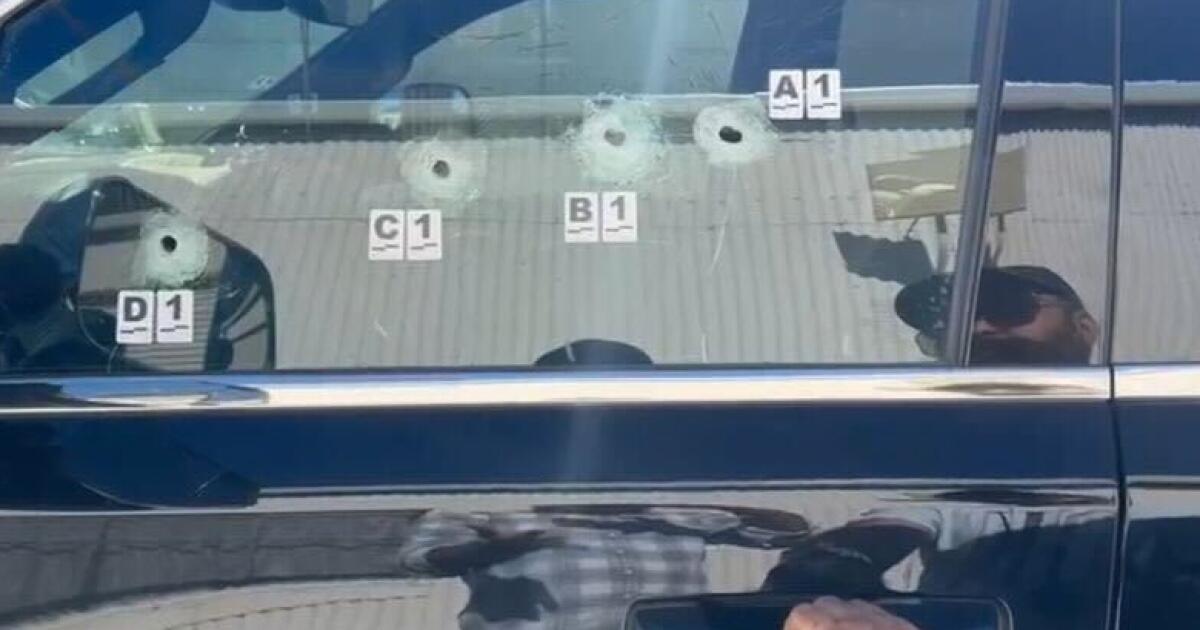
On Aug. 11, when Raju was making a late-night food run with two friends, someone fired at his pickup truck as it traveled down Interstate 505 in rural Yolo County. At least four bullets struck his vehicle, police said. Raju and his friends — who are also Sikh activists involved in the separatist movement — were not injured, although their car veered off the road, coming to rest near a drainage ditch and a two-story stack of hay.
“They tried to kill me,” said Raju, 44.
In the last two weeks, news of the shooting has reverberated across Indian media and Punjabi-language radio shows in North America as fears grow among California Sikhs about recent threats against them because of their political activity in opposition to the right-wing, nationalist Indian government. In recent months, Sikh leaders at several temples across Northern California have reported anonymous calls and text messages that threaten them in Hindi for pro-Khalistan activities.
There has been debate in the Sikh community about whether the attack on Raju and his passengers could be linked to broader transnational incidents in Canada and the U.S. in which authorities have accused the Indian government of having links to the fatal shooting of a Sikh activist in British Columbia and a plot to kill another in New York.
India has denied all allegations.
Local law enforcement in Woodland and the California Highway Patrol, which responded to the 911 call, have not commented on the motivation for the shooting and publicly released information about it on Aug. 22, 10 days after the incident. In a statement, the FBI said it “continues to collaborate” with the CHP on an investigation and “takes all acts of violence seriously.” The Indian Embassy in Washington, D.C., did not reply to questions from The Times.
Activists targeted
The Sikh Coalition, a U.S.-based civil rights group, said in a statement that the Yolo County incident, while under investigation, “underscores the continued threat of Indian transnational repression.”
The activists targeted in the Canada and New York cases were involved in a group called Sikhs for Justice. The organization promotes nonbinding referendum votes across the globe for the Sikh diaspora to express support for Khalistan, which means “land of the pure” in Punjabi. Voting events this year in Sacramento and San Francisco attracted tens of thousands of Sikhs.
In May, Canadian police arrested three Indian nationals residing in Alberta in connection with a June, 18, 2023, shooting that killed Sikh leader Hardeep Singh Nijjar — a close friend of Raju’s — as he stood outside his temple.
The three suspects — as well as a fourth alleged associate who was previously arrested — appeared in court this month on charges of first-degree murder and conspiracy to commit murder. The trial was delayed until October. The Royal Canadian Mounted Police — Canada’s national police force — did not disclose how it found the men. Prime Minister Justin Trudeau has said Canadian intelligence agencies were looking into “credible allegations” of possible Indian government involvement.
India has said that Canada has shared no evidence to back its allegations of government involvement. It instead accused Canada of giving “shelter” to extremists.
In November, the U.S. government alleged in a federal indictment that India paid a hit man — an undercover agent connected to the Drug Enforcement Agency, it turned out — to kill a Sikh activist in New York who is a lawyer and spokesman for Sikhs for Justice. In the indictment, the U.S. accused an unnamed Indian official of working with a known international narcotics trafficker to hire the fake hit man for $100,000. The trafficker was arrested in the Czech Republic and extradited in June to New York. He has pleaded not guilty in federal court ahead of a September trial.
India has said its investigation into U. S. charges found that “rogue” agents of the Research and Analysis Wing, India’s spy agency, were operating without government approval.
Sikhs vow to continue
Activists brush off the denials and said they remain unflinching in their commitment.
“They lie,” said Gurpatwant Singh Pannun, a lawyer and spokesman for Sikhs For Justice who has been promoting Raju’s case. Pannun is the New York resident that the U.S. government said India tried to kill.
“If a bullet and death is the price to pay for Khalistan, that is what we will face as Sikhs,” said Pannun, who produces YouTube shows from his Astoria, Queens, office where he rails against Indian Prime Minister Narendra Modi.
He’s now turned his attention toward Raju, who has become somewhat of a hero in the tight-knit community of Sikhs who organize for Khalistan.
For Raju, the shooting has emboldened his activism.
“What more is there to but keep on going?” he said. “We can’t stop now. We can’t be scared.”
Not all of of his co-activists agree with Raju’s allegations of a possible Indian plot against him.
“We don’t really know what happened. It could be something else,” said Bobby Singh, a 24-year-old Khalistan organizer in Sacramento who said he knows Raju from local pro-Khalistan rallies. “Still, we demand a full investigation.”
Decades-long strife
Sikhs number about 500,000 in the U.S., the third-largest population outside of India after the United Kingdom and Canada. About half of U.S. Sikhs live in California, where their presence in the Bay Area, Stockton and Sacramento goes back to the late 19th and early 20th centuries.
While the most ardent activists for Khalistan, such as Raju, make up a small group, support for the movement is widespread among Sikhs in the United States. Posters and prayers at temples regularly cite the envisioned Sikh nation.
Many, like Raju, point to modern Indian history as the reason why.
Now 44, he was a young boy growing up in the Punjabi city of Jalandhar during a peak of strife between Sikhs and the Indian government.
In 1984, Indian Prime Minister Indira Gandhi ordered a siege on separatists occupying the Golden Temple in Amritsar, the holiest site in Sikhism. In response, her two Sikh guards assassinated her. Mobs went rampage around Delhi, killing Sikhs, often with government approval. Some estimates put the deaths in the tens of thousands. In another incident a year later that was tied to the violence, militants blew up an Air India flight over the Atlantic, killing 329 people.
Raju has friends and family back home who saw the violence of that era, he said, and knows people in India who faced lingering discrimination against Sikhs over the decades.
That — and the opportunity to work and live in America — brought him California when he was 25. Raju moved in with family in Woodland and got a job in trucking. He briefly quit to run a Punjabi grocery store before returning to trucks a decade ago. For much of his working life, Raju has been on Interstate 5, hauling dry goods from California to Oregon and Washington state.
Growing activism
“I was not very political,” he said. That was until 2016, when friends from the West Sacramento temple recruited him to volunteer for Sikhs for Justice. The growing group had ambitions to launch voting drives for Khalistan across Sikh population centers from London to Australia.
Raju would be in charge of educating Sikhs about the process — a way to show global Sikh support for the nation they seek to establish — and helping with voting centers in California and Canada. In WhatsApp groups and in-person gatherings, he got to meet Sikh activists who crisscrossed the globe in support of the cause.
It was a part-time hobby until last year. That’s when his friend, Nijjar, was shot dead ahead of that region’s vote.
“I was mourning,” Raju said. He took time away from trucking to spend three months in Surrey, Canada, a suburb of Vancouver, to organize the voting referendum. When Sikhs came together in San Francisco in January for a Khalistan vote, Raju was there. He joined in Sacramento, too, when a vote took place in April. Raju was in Calgary, Canada, until voting there concluded last month.
Unlike some higher-profile activists, Raju never received threats. But he suspects that his increasing visibility through his travels, including photos where he posed with Nijjar, put him on the radar of those opposed to his work.
The night of the shooting
During the day on Aug. 11, he said, he was at home in Woodland with two friends from the Khalistan movement who are less involved than him and asked not to be identified out of fear for their safety. Raju had spent the day playing with his young children before talking late into the night with his associates.
Hungry, they got on the road to drive south on I-505 for Vacaville, where BJ’s Restaurant & Brewhouse was open until midnight, Raju said.
His friend was driving Raju’s Dodge Ram 1500. Raju was in the passenger seat and the other friend was in the back. About 11:30 p.m. they noticed a car, possibly a white Honda Civic, following them closely, Raju said.
The Honda pulled to the passenger side of the truck, Raju said, and someone — he didn’t see who it was — began shooting. The three friends ducked and the car rolled into a ditch. Raju said they got out and briefly hid behind bales of hay, still visible Thursday afternoon.
“I’m thankful I survived,” said Raju. “Our religion is one of peace. But we also have to fight for our rights. So we will keep on going.”
Kaleem reported from Los Angeles and Garrison from Woodland. Staff writer Richard Winton contributed reporting.


WASHINGTON (TNND) — Residents in a neighborhood in Southern California said that their homeowners association has threatened to fine them if they don’t take down the American flags displayed outside their homes.
Amy and Chris Cooke and their neighbor Terri Collins live in San Marcos, which is located in San Diego County.
They said that they could potentially face a $100 fine if they keep the flags displayed outside their homes, according to the Daily Wire.
“I’m not taking my flag down,” Collins said. “They can fine me, $100, $200, $1,000, I’m not paying it.”
Collins said that the neighborhood is very patriotic because it is located close to the former Miramar Navy Air Station.
She said that “all the Top Gun pilots lived here.”
The neighbors said that ever since President Donald Trump won the 2024 election, the HOA has enforced the rule about flags.
“Once the members allow use of a common property by an owner to express what is essentially a political or affiliative view in a flag, other owners will want to do the same and the common area will degrade,” a letter from the HOA reads.
Homeowners were told that flags displayed in “exclusive use” areas like backyards.
An HOA attorney told the Daily Wire HOAs “count on the fact that homeowners don’t know better and might be scared.”
BE THE FIRST TO COMMENT
“I would tell these people to stand firm and under no circumstances should they remove that flag,” he told the outlet.

SACRAMENTO — Gov. Gavin Newsom on Monday signed his final state budget as governor, a $351.7-billion spending plan that seeks to uplift the poorest Californians through a tax system reliant on the stock market gains of the wealthy.
In a video message, Newsom extolled free school meals, universal transitional kindergarten, 130,000 subsidized childcare slots and other accomplishments in his tenure at the state Capitol, a period in state history marked by a dramatic expansion of state government and over $100 billion in increased spending.
“Over the past eight years, we built great things for the people of California — some of the boldest actions any government in this country has taken in a generation,” Newsom said. “And we did this without breaking the bank. We did this by design.”
The agreement ends weeks of lobbying by outside interests and negotiations among lawmakers and the governor at the state Capitol about how to handle a surge of income tax collected on stock market gains related to artificial intelligence.
Economists have warned that the revenue bump is potentially temporary and analysts say the growth in state spending could leave California in a challenging position if the economy declines.
Assemblymember David Tangipa (R-Fresno) agreed with Democrats that the budget is “compassionate.”
“My fear is that it’s not too much of a competent budget, and the budget continues a pattern that Californians know all too well: Spend now, justify it later, and hope somebody else pays the bill,” he said during a floor debate Monday.
Here’s what you need to know about the spending plan, which takes effect July 1.
Who decides the state budget?
The simplest answer is: Democrats. California voters have elected Democrats to represent 30 of the 40 seats in the Senate and 60 seats of the 80 seats in the Assembly. The budget was passed through a majority vote in each house of the Legislature and signed by Gov. Gavin Newsom, also a Democrat.
A more complex answer is that the budget is a product of dozens of legislative hearings, millions of dollars spent on lobbying by outside interests, talks among lawmakers and the governor and ultimately subject to the same political dynamics that rule the Democratic party.
Senate President Pro Tem Monique Limón (D-Goleta) and Assembly Speaker Robert Rivas (D-Hollister), in consultation with the chairs of the budget committees, represent their Democratic caucuses and reach a final agreement on the details of the spending plan with Newsom. In reality, staff members for the three parties handle most, if not all, of the back of forth negotiations to get there.
Union leaders seeking better pay, working conditions, benefits for workers and opportunities to expand their ranks are often brought in to consult or hammer out thorny deals as business groups try to fight off more regulations, taxes and costs, and support policies that increase their financial performance.
Democrats are spending more than ever before. How is that possible?
The Legislative Analyst’s Office, the nonpartisan fiscal advisor for lawmakers, recently examined the increase in state spending since 2019-20, Newsom’s first full year in office.
Between the budget approved that year and the spending proposal Newsom unveiled in January, spending from the state’s main operating fund had grown by over $100 billion, or 70%. That was largely by a 60% increase in revenue during that time. California typically operates with a spending deficit because Democrats spend more money than the state brings in.
The LAO found that the increase in spending stemmed from the growing cost of sustaining programs and services that were already in place when Newsom took office. About 30% of the remaining spending growth was categorized as new, either by newly created programs or the expansion of existing services.
Among the report’s conclusions: California could not afford the programs that predated Newsom and the ones he and the Legislature adopted.
To balance the budget over the last few years, Newsom and lawmakers have dipped into the state’s reserves at a time when California is experiencing strong revenue growth, which the LAO has cautioned against. Democrats have also increased taxes on businesses, paid for programs out of other funds and suspended reserve deposits among other solutions.
This year, the state budget places $6.4 billion in higher than expected revenue into a temporary holding account to knock down a deficit and balance the budget through 2027-28.
Democrats are pursuing a change to the state constitution on the November ballot that would allow them to set aside more money in years of good revenue growth to prevent cuts in future downturns.
Where is the money going?
Education and Medi-Cal are the two largest costs for the state.
Medi-Cal is the state’s version of subsidized health insurance for low-income Californians and provides medical, dental and vision care for an estimated 14.5 million people, or about one-third of the state population.
The federal government pays for more than half of the cost of the program. California is expected to spend about $50 billion from the general fund next year out of a total estimated at more than $220 billion in costs shared between the state and federal government, according to the LAO. State taxes and fees on providers also help fund Medi-Cal.
Overall, Medi-Cal costs more than any other state program and takes up about 40% of total spending, including federal funds the state receives, according to the LAO.
Spending on Medi-Cal has more than doubled over the last 10 years, which the LAO attributes to an increase in costs per enrollee, more enrollees and a greater share of seniors seeking care, among other factors.
Under Newsom, California has expanded Medi-Cal, including offering coverage to include all immigrants regardless of their immigration status, which the governor said has dropped the state’s uninsured rate down to 5.9%
The cost of Medi-Cal has grown beyond what Democrats expected and resulted in Newsom suggesting spending cuts.
The final budget agreement rejects a call by Newsom to lower the asset limit to $2,000 now and instead lowers it to $21,000 in 2027-28 to be eligible for Medi-Cal. The Legislature also delayed the governor’s proposal to reduce dental coverage and shift asylum seekers and other immigrants to restricted scope Medi-Cal, according to Jason Sisney, the lead budget advisor for the Assembly who posts about the budget on Substack.
The budget includes Newsom’s proposal to shift enrollees with unsatisfactory immigration status, a term that includes undocumented immigrants and others, from managed care to fee-for-service to save costs.
Under Proposition 98, approved by voters in 1988, California has a minimum funding guarantee for schools and community colleges and dedicates roughly 40% of general fund revenue to education.
Sisney said the budget increases the Local Control Funding Formula by $2.2 billion and provides historic general fund per pupil spending of $21,148. Support for special education also grew by $1.8 billion.
The California Community Schools Partnership Program received a $1-billion boost and Democrats directed $2.8 million in additional funding to the program that provides free meals for school children.
The budget also establishes 22,770 new slots for free or reduced childcare, which Newsom had proposed decreasing.

OROVILLE — Bradley Scott Sayer was charged with two counts of first-degree murder and discharge of firearm with injury during his arraignment Thursday at the Butte County Superior Court.
Sayer, 18, is the suspect in the Chico library shooting on Monday in which two men were killed, and he could face life in prison. If convicted, Sayer is facing the highest penalty for capital murder with special circumstances, which would be life in prison without the possibility of parole. Butte County District Attorney Mike Ramsey, who is the prosecutor of the case, said the court is not seeking the death penalty.
Sayer was not given bail, as Ramsey said the court felt Sayer was “too dangerous.” Ramsey also said Sayer is on suicide watch in at the Butte County Jail.
“We felt that it would be too dangerous to let him go at this juncture,” Ramsey said. “He planned a mass shooting, and there’s no reason to believe that if he was let go, that he wouldn’t continue to do that.”
Sayer was staying at his father’s house, who was out of town, the day of the shooting, according to Ramsey. He then went to the closet in his father’s room and took two .22 caliber rifles and a 20-gauge shotgun, as well as several boxes of “No. 3 birdshot shells” before leaving for the library.
Sayer will appear in court next at 8:30 a.m. July 16 at the Butte County Superior Court, where he is expected to enter a plea. He is being represented by Roberto Marquez as retained counsel.
Autopsies
The Chico Police Department released a final update regarding the shooting case. The Butte County Sheriff’s Office completed the autopsies of both Jacob Cody Hull and Robert Johnson.
“The autopsies were completed; results indicate that both victims died as result of gunshot wounds. The wounds are consistent with a shotgun being used. The decedents will be turned over to their families who will be making funeral arrangements. The suspect remains in custody at the Butte County Jail being held in isolation,” Butte County Sheriff Kory Honea said.
-

 California1 minute ago
Southern California residents say HOA made them take down American flags
-

 Colorado8 minutes ago
Colorado’s Most Beautiful State Parks, Ranked By A Colorado Local
-

 Connecticut11 minutes ago
CT poised to invest again in childcare, pay down pension debt
-

 Delaware16 minutes ago
Delaware on Main Street Program Grows as 17 Communities Earn National Designations – State of Delaware News
-

 Florida23 minutes ago
Fast-growing South Florida wildfire consumes over 4,000 acres
-

 Georgia26 minutes ago
Aleks Arwood named runner-up at Miss Georgia – Thomasville Times-Enterprise
-

 Hawaii26 minutes ago
Maunakea Access Road proposals include toll booth, cultural center | Honolulu Star-Advertiser
-

 Illinois36 minutes ago
Serial Springfield Township sex offender faces public indecency charge

