West
Bryson DeChambeau using Saudi-funded $125M LIV Golf salary to expand size of town by 200 acres

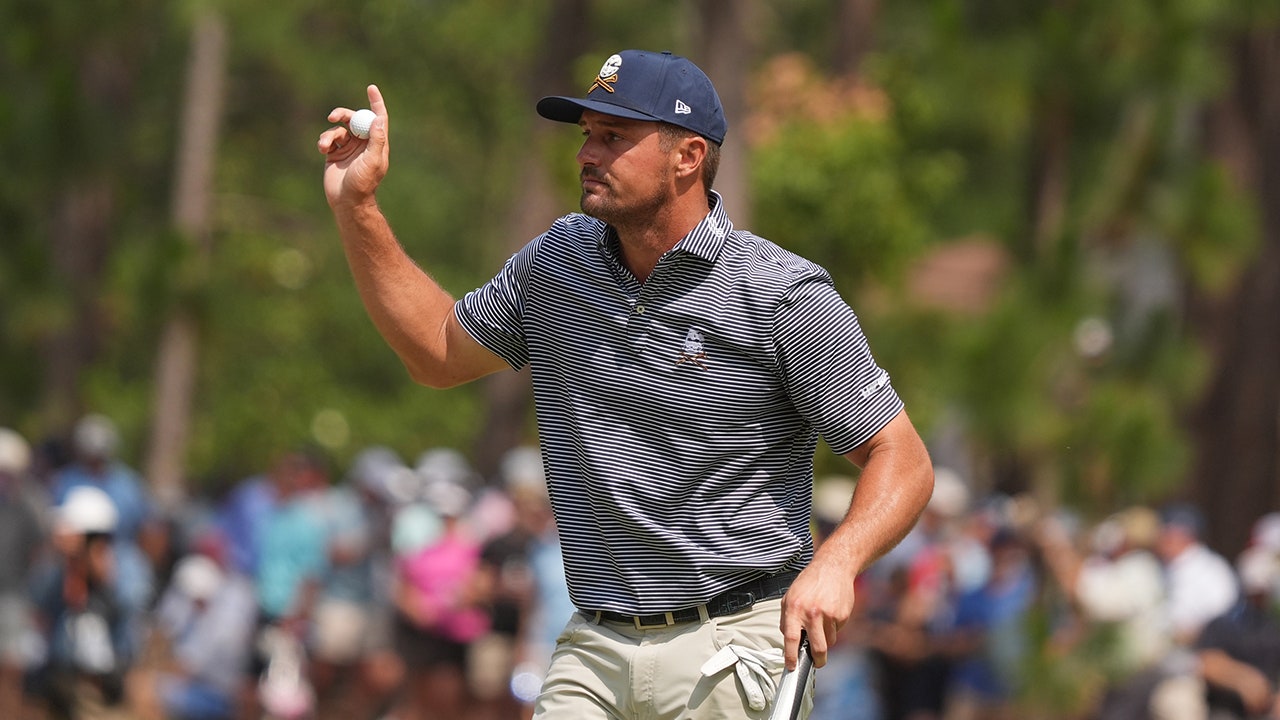
LIV Golfer Bryson DeChambeau has a grand plan for the $125 million he’s receiving from his Saudi Arabian bosses.
The controversial 31-year-old golf star said during an interview on “The Joe Pomp Show” he bought 200 acres of land in his hometown of Modesto, California, and plans to expand the town by 30%.
“We are doing a mega project,” DeChambeau said. “It’s been in the works for a couple of years now, and we’re at the place where we are getting permits to build. People know about it now.
“We have acquired massive amounts of land in my hometown, and it’s a three-phase process to build a whole community and increase the size of where I grew up by 30%”
Bryson DeChambeau of LIV Golf before The Showdown: McIlroy and Scheffler v. DeChambeau and Koepka at Shadow Creek Golf Course Dec. 16, 2024, in Las Vegas. (Kevin C. Cox/Getty Images for The Showdown)
DeChambeau says his intention is to create a prominent golf presence in the community, adding the timeline for completing this project is just over a year.
“It’s a full-scale plan, fully thought out. It’s not only to bring golfers to the game but also to bring people to the central valley. You build a community around a multisport complex center,” he said.
“It’s going to take 12-15 months to get the permits approved for the full scope. It’s over 200 acres of land what we have right now. It’s going to be a multisports complex center — driving range, golf course, residential community center, the whole thing.”
DeChambeau was paid a reported $125 million to join LIV Golf in June 2022. He says his latest project is only possible because of the massive salary from the Saudi-funded organization.
WOMEN’S GOLF STAR CHARLEY HULL FAWNS OVER ‘BRILLIANT, LEGEND’ TRUMP AFTER DOING HIS DANCE AT TOURNAMENT
Bryson DeChambeau reacts after putting on the fifth hole during the third round of the U.S. Open. (Jim Dedmon/USA Today Sports)
“A lot of the reason why I have been able to do this is because of LIV. They gave me the economic viability to do these things and the platform to be able to do it, growing on YouTube,” he said.
DeChambeau was one of many American golfers to compete in the Saudi-backed league when it launched.
Brooks Koepka, Phil Mickelson, Dustin Johnson, Patrick Reed and Jon Rahm were other prominent PGA stars who chose to accept the massive LIV paychecks during the league’s aggressive pursuit of the sport’s biggest names.
DeChambeau is also a close friend of President Donald Trump’s and invited Trump to play with him in a video on his YouTube channel.
Bryson DeChambeau cradles the U.S. Open trophy after his win in the final round of the 2024 U.S. Open Championship on the No. 2 Course at The Pinehurst Resort June 16, 2024, in Pinehurst, N.C. (David Cannon/Getty Images)
DeChambeau told Fox News Digital at the time he had no regrets about it.
“There’s always risk associated to that. But, from my perspective, it was focused on entertainment,” DeChambeau told Fox News Digital in August at Maridoe Golf Club, site of the LIV Golf Team Championship.
“We can talk about politics. That’s a whole different conversation, something that I was not trying to do on my YouTube channel. It was solely on providing great entertainment.”
DeChambeau joined Trump, Elon Musk and Sen. Ted Cruz, R-Texas, to watch the SpaceX rocket launch in November.
Follow Fox News Digital’s sports coverage on X, and subscribe to the Fox News Sports Huddle newsletter.
Read the full article from Here


WASHINGTON ― Montana Republican Senate nominee Kurt Alme, who previously served as his state’s U.S. attorney, cut a plea deal in 2020 that allowed a tribal police officer who sexually abused a 6-year-old girl to serve less than a year in prison and avoid being registered as a sex offender.
Alme, who has President Donald Trump’s backing in his bid for Senate, served as Montana’s U.S. attorney in two stints. Trump appointed him both times; Alme served in the role from September 2017 through December 2020, and then again from March 2025 through March 2026.
Alme oversaw the case of Mychal Thomas Damon, who was indicted in June 2019 by a grand jury on one count of abusive sexual contact with an individual under 12, which carries a maximum punishment of a lifetime in prison, a $250,000 fine and no less than five years to a lifetime of supervised release. The average sentence for this crime is less severe, but still significant: 62 months in prison, no fine and 143 months of supervised release, based on an analysis of 2025 data provided by the U.S. Sentencing Commission.
Damon, 28, had admitted he touched the 6-year-old’s genitals. But in February 2020, Alme’s office filed a plea deal in his case that reduced his charge to felony child abuse.
The changes in the plea deal raised the alleged age of the victim from below 12 to below 14, stripped out the language of sexual intent and moved the offense out of the federal sex crime framework, meaning Damon would no longer be required to register as a sex offender. It jointly recommended Damon be sentenced to the time he’d already served of 324 days, and required only a sex offender evaluation. Alme’s name appears on the bottom of the document, along with a signature by his assistant U.S. attorney, Cassady Adams.
In June, Alme filed a sentencing memorandum that described Damon’s conduct, which included details of him touching the child’s vagina with skin-to-skin contact, and the adverse effect it had on her mental health. Local reporting at the time said the victim had told a therapist “Mychal touched me” and hurt her by putting his fingers in her “hoo hoo.”
Ten days later, Alme announced Damon was being sentenced to time served of 324 days and two years of supervised release. As of June 2026, Damon is not listed in the national sex offender registry or in Montana’s Sexual or Violent Offender Registry.
It’s not clear why Alme reduced the charges against Damon as significantly as he did. During part of his tenure as U.S. attorney, his office declined 64% of sexual assault cases. He conceded in a 2019 interview that this “is something that has to be worked on,” and noted that a lot of these cases are declined due to “weak or insufficient evidence.”
Asked what happened in Damon’s case, an Alme campaign spokesman on Thursday lashed out at unnamed Democrats for trying to make him look bad.
“Kurt’s liberal opponents are twisting the facts to manufacture a fake narrative that exploits crimes against women and children,” said Alme’s spokesperson. “Department of Justice policy required defendants to plead to the most serious charge readily provable from the evidence. Kurt strongly supported the Multi-Disciplinary Teams on our Native American reservations, led by his office, to support investigations of crimes against children and to support victims.”
His spokesperson also pushed back on the idea that Alme unreasonably declined a large number of sexual assault cases during his tenure as U.S. attorney.
“Kurt’s office prosecuted every viable sexual abuse felony referred to it and pursued the most serious charge readily provable from the evidence,” the spokesperson said. “Many ‘declined’ cases were to allow more appropriate tribal prosecutions ― they were not dropped. Kurt will bring his years of experience prosecuting criminals and working with the Sexual Assault Response Teams on our Native American reservations to the U.S. Senate to strengthen investigations, support victims, and better protect women and children.”
The campaign pointed HuffPost to a 2010 report by the Government Accountability Office that found the most common reason for U.S. attorney’s offices to decline sexual abuse cases referred in from Indian country was “weak or insufficient admissible evidence.” It also highlighted statements of support for Alme in an October 2025 press release by Sen. Steve Daines (R-Mont.), when he celebrated Alme being confirmed as U.S. attorney.
Alme is currently running for Daines’ Senate seat, and Daines went out of his way to clear the path for him. In a stunning and orchestrated maneuver, the two-term senator in March abruptly withdrew from reelection as Alme filed to run for his seat, minutes before the state’s filing period closed. Daines’ last-minute change-up was an effort to block potential Democrats or any major Republican challenger from jumping into an open Senate race.
Alme is taking on Democrat Alani Bankhead and independent candidate Seth Bodnar in the November election. Bankhead and Bodner have been duking it out for weeks, with each appealing to different factions of the Democratic party and calling on the other to drop out.
Bankhead, a retired Air Force officer, unexpectedly won the Democratic primary earlier this month, boosted by grassroots supporters and more than $2.5 million in outside money from a progressive veterans’ PAC. But Bodnar, a former University of Montana president who did not appear on the primary ballot, has bipartisan endorsements from prominent establishment figures, including former Democratic Sen. Jon Tester and former Republican Gov. Marc Racicot. He’s also significantly outraised Bankhead and Alme.
This Senate seat is rated “solid Republican” by the nonpartisan Cook’s Political Report, meaning Alme is well-positioned to win the general election. But this race would be more competitive if Bodner and Alme were going head to head, without Bankhead in the running.
Nevada
Voting rights advocates score three legal victories but remain on alert against election threats


Did the Drug Enforcement Agency break the law and gamble with public safety when it permitted large quantities of fentanyl pills to be trafficked in New Mexico in the hopes of getting a larger drug-trafficking bust?
That is the question at the heart of an explosive story published in the Associated Press, based on information provided by a former DEA agent turned whistleblower; the whistleblower filed a complaint in 2023 that claimed agents had allowed hundreds of thousands of fentanyl pills into Albuquerque – a city still reeling from the opioid crisis while many others across the country are seeing overdose rates decline.
“We poisoned our community to make cases,” DEA special agent David Howell told the outlet. “Through our own willful blindness, we get to say, ‘We don’t really know what happened to the drugs.’ But we 100% got people killed.”
Howell told the AP that, in some cases, the DEA had detailed intelligence about drug deliveries, including precise pill counts in shipments to Albuquerque.
DEA agents deciphered coded chatter over cellphones and closely surveilled a transaction of 74,000 fentanyl pills at a mobile home park in Albuquerque in June 2023, according to documents reviewed by AP. Days earlier, another shipment had also gone without seizure.
“We did nothing but sit back and watch,” Howell said.
One kilogram of fentanyl, which equates to thousands of pills, has the potential to kill 500,000 people, per the DEA’s own reporting.
The DEA has since challenged the AP’s reporting, saying in a statement to the Guardian that “public descriptions suggesting that DEA knowingly permitted fentanyl to reach communities are false and fundamentally mischaracterize the facts”.
“The cases in question involved complex, court-authorized Title III investigations in which agents and prosecutors conducted real-time surveillance, intelligence gathering, and operational analysis targeting larger drug trafficking organizations,” it added.
The agency further said that in “operational decisions in investigations like this, DEA is mandated to coordinate investigative decisions with USAO (offices of US attorneys) leadership to ensure investigative steps are carefully coordinated to prevent harm to the public” and the decisions it had made “were lawful, reasonable under the circumstances, and consistent with department guidance”.
Nonetheless, in a subsequent statement, the DEA asked the US justice department’s internal watchdog – the office of inspector general – to investigate Howell’s complaint.
Meanwhile, New Mexico attorney general Raúl Torrez announced Friday the opening of a formal investigation into allegations.
“If those allegations are accurate, the consequences for New Mexicans were not abstract. They were fatal,” Torrez wrote in his letter to governor Michelle Lujan Grisham. “New Mexico already ranks among the states hardest hit by fentanyl overdose deaths, and the families who have lost children, siblings, and parents to this crisis deserve a full accounting of what the federal government knew, what it did, and what it failed to do.”
Torrez said he was “committed to pursuing every appropriate legal avenue to hold the responsible parties accountable” but warned while federal agents “are not above the law, the supremacy clause of the United States constitution provides substantial protections for federal employees acting within the scope of their authority”.
But the report has raised question about whether the US’s premiere drug enforcement agency underplayed the threat of fentanyl.
Additionally, there are questions about whether they have focused too much on largely Mexican criminal groups behind the trade instead of local or retail distribution and the tens of thousands of overdose deaths attributed to it.
While drug fatalities have fallen by 24% from roughly 105,000 in 2023 to 79,384 in 2024, the downward trend has not been seen in all regions – including in New Mexico, particularly along the Rio Grande valley, with its long history as a trans-shipment route for Mexican black tar and brown heroin. For decades, the Los Alamos dormitory town of Española, 80 miles north of Albuquerque, was known as the heroin-addiction capital of America.
But the issue was largely localized. Addiction soared in the area with the relaxation of the opiate prescription practices in the late 1990s. When those gates were closed 15 years later, Mexican cartels switched from costly heroin production to the cheap, synthetic and more unpredictable fentanyl.
Overdose deaths in New Mexico increased 23% over the past year, marking the second consecutive year the state led the nation in overdose mortality. During the first half of 2025, three north-east counties, Rio Arriba, Santa Fe, and Taos, saw drug-related emergency room visits increase by as much as 204%, according to the New Mexico department of health.
Howell was uncovered as the author of the complaint to the justice department’s office of professional responsibility after reporters noticed the redactions had missed the last letter of his name; they contacted DEA agents who had worked in Albuquerque on LinkedIn. He reportedly paid a price for making the complaint – getting relegated to desk duty and getting docked in his performance evaluations.
Internal records also show prosecutors barred him from testifying in federal court, citing his “pattern of refusing to heed” admonitions to allow drugs to go without seizure during long-term investigations.
Alex Uballez, who served as US attorney in New Mexico from 2022 through 2025, told the AP that drug shipments had been allowed to go through without seizure as part of a broader effort to gather intelligence and build cases against major drug traffickers.
“The bigger fish are worth catching,” he said, “And that will save more lives.”
The finding that federal agents allowed hundred of thousands of pills to be distributed in Albuquerque has sent political shockwaves through the state.
Governor Lujan Grisham called the DEA’s actions “reckless and dangerous” and urged the New Mexico attorney general’s office to prosecute anyone responsible, “regardless of whether they are a federal agent or not.” Grisham also told the Albuquerque Journal that the result of this influx of pills was “hundreds of New Mexican parents burying their kids. Hundreds of New Mexican kids growing up without stable parents. All while the federal government stood by.”
A Democrat who is facing a re-election contest with former interior secretary Deb Haaland, Grisham said she repeatedly petitioned Joe Biden’s administration and federal officials for help with the fentanyl crisis.
“While my administration was doing everything we could to stem the tide of fentanyl coming into our state, the federal government deliberately allowed it to flood in,” she said. “I plan to hold the federal government accountable for this disaster and will explore every possible avenue of action to right these wrongs.”
Albuquerque Mayor Tim Keller said on X that the fentanyl epidemic has “torn through our streets” and “it is disgusting to think that federal authorities may have allowed hundreds of thousands of these deadly pills to move into our community and possibly killed people through their actions.”
Keller said at a news conference on Thursday that DEA had made an “immoral decision” and called it “a huge slap in the face to all of us as New Mexicans”.
Bernalillo county sheriff John Allen, which incorporates Albuquerque, told the Albuquerque Journal that the DEA had been allowed “to feed poison to our community for a bigger case”.
“I agree with getting the big fish and everything, but not when people are dying while we’re doing these investigations,” he added.
In 2017, the Department of Justice issued an internal “fentanyl protocols” guidance that directed federal agents to “seize or otherwise prevent the distribution” of fentanyl “as soon as practicable” and said that “protecting public safety is paramount” irrespective of larger investigations.
But two years ago, the DoJ revised that guidance to give agents more discretion, saying investigators “may exercise discretion in determining whether to take action to prevent the trafficking of fentanyl”, balancing public safety risks against “the benefits to be achieved through preserving the investigation.”
In December last year, Donald Trump issued an executive order designating fentanyl a “weapon of mass destruction” and gave defense secretary Pete Hegseth and then attorney general Pam Bondi broad latitude to use the resources of both departments to combat the scourge.
Empower Oversight, whistleblower organization that now represents Howell, says DEA routinely “walked” fentanyl shipments from at least 2023 to March 2025. As the DEA did, it called on the justice department’s office of inspector general and congressional oversight committees to investigate.
“The same agency that warns the public, ‘one pill can kill’, should not intentionally allow hundreds of thousands of fentanyl pills to hit the streets,” the organization said. “It’s outrageous to put that many lives at risk in hopes of making a big case.”
-

 Louisiana3 minutes ago
Louisiana is epicenter for red snapper fishing in Gulf of America
-

 Maine6 minutes ago
Maine could face $50M in penalties from federal food assistance policy changes
-

 Maryland11 minutes ago
Hutzell: The best, worst and just plain weird of Maryland’s weak primary
-

 Michigan18 minutes ago
Michigan firefighter among 3 killed in Colorado. What we know
-

 Massachusetts21 minutes ago
Who will take care of our older and disabled people? – The Boston Globe
-

 Minnesota26 minutes ago
Allie Lauer Of St. Cloud Tech Claims Clay Shooting Championship With A Score Of 99
-

 Mississippi33 minutes ago
Bobby Harrison: Mississippi Democrats hope they are not saying ‘if’ again after midterm elections
-

 Missouri36 minutes ago
Nick Bolton earns induction into the Missouri Athletic Hall of Fame

