West
Best friends break world record by 9 days after successfully rowing across the Pacific Ocean

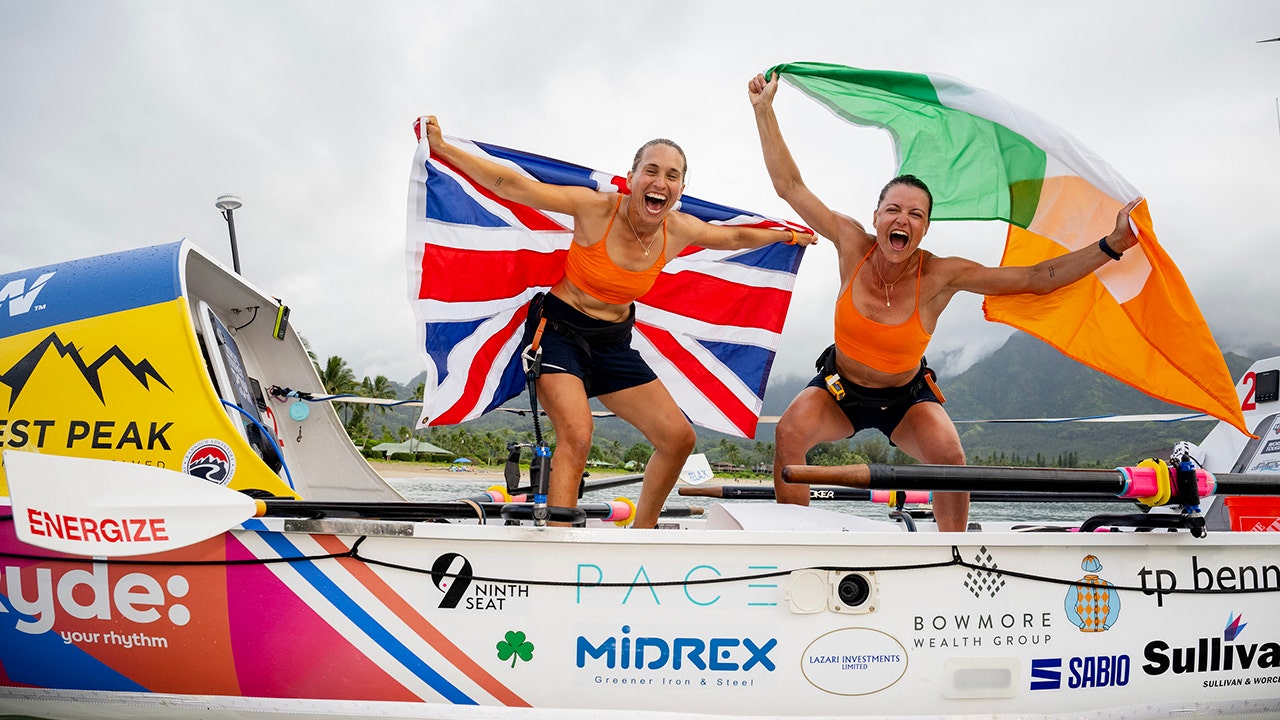
A pair of women broke the world record for the fastest row across the Pacific Ocean — by nine days.
Jessica Oliver, 32, and Charlotte Harris, 33, set out to compete in the World’s Toughest Row Pacific Challenge on June 8, 2024, from Monterey, California, with the goal of rowing 2,800 miles to Kauai, Hawaii.
Thirty-seven days, 11 hours and 43 minutes later, Oliver and Harris arrived in Hawaii having broken the world record for fastest row by female pairs, the fastest row by overall pairs. They were the first team in the competition to row both the Atlantic and Pacific Oceans successfully.
ALL-WOMEN ROWING TEAM BREAKS WORLD RECORD IN RACE ACROSS PACIFIC OCEAN: ‘BEST DECISION EVER’
Oliver, from Gloucestershire, England, spoke with Fox News Digital from Hawaii, just days after crossing the aquatic finish line, to discuss what led to the major milestone moment.
“We knew nothing about rowing. We knew nothing about the ocean,” she said about the pair’s experience prior to rowing the Atlantic Ocean a few years back. (See the video at the top of this article.)
Charlotte Harris and Jessica Oliver, pictured above, rowed from California to Hawaii in 37 days. (World’s Toughest Row)
Oliver met Harris, who’s from Hampshire, England, while in school at Cardiff University in Wales.
The two were in the hockey club, and Oliver said they became best friends almost instantly.
“Do you know when you meet someone [and] you’re like, ‘We are kindred spirits?’”
Today, almost 15 years later, the Salesforce consultant by day said she and Harris are nearly tied at the hip and love to compete – just like the old days.
VETERANS HIKE 100 MILES FROM MAINE TO MASSACHUSETTS TO RAISE PTSD AWARENESS: ‘CHANGED MY LIFE’
“In 2020, we signed up for something called the Talisker Whiskey Atlantic Challenge, having never rowed before,” she said, adding, “Charlotte [Harris] worked for a company who sponsored it… and she said to me, ‘Do you want to do this challenge?’”
Oliver said the pair had just completed a boxing challenge together and were looking for another challenge to join in an effort to raise money for Shelter & Women’s Aid — a national campaign for homeless people.
The pair competed in the Atlantic Ocean rowing competition two years ago. (World’s Toughest Row)
For two years after, the pair campaigned and prepared for the challenge — rowing 3,000 miles across the Atlantic Ocean from the Canary Islands to Antigua.
When the pair arrived 45 days later, they had beaten the world record for the fastest female row of the Atlantic.
Oliver said she and Harris were thrilled with their success and felt like they had checked the “adventure” box.
MOON LANDING 55 YEARS AGO TOPS LIST OF 7 POWERFUL EXAMPLES OF AMERICAN EXCEPTIONALISM
She recalled, “Six months later, the race organizers opened up the Pacific Challenge, and we sat at our desks going, ‘It wasn’t that bad, was it? The Atlantic? We could do it again?’”
Oliver and Harris ultimately signed up to row the World’s Toughest Row Pacific Ocean Challenge and trained five to six days a week for two years leading up to the race.
Oliver said the pair went through a few different challenges they weren’t expecting along the way. (World’s Toughest Row)
Oliver said, however, that nothing could have prepared them for the experience they had rowing the Pacific Ocean.
“The first 500 miles off America is extremely challenging from a weather perspective,” she said, adding that the pair’s nearly 23-foot-long boat lost its automatic steering within the first week.
Due to strong winds from Canada and roughly 13-feet-tall waves, Oliver said the training the pair had planned went out the window for the first period of time.
10 LOCATIONS AROUND THE WORLD THAT OFFER BREATHTAKING SUNSETS
Typically, she said, one person would row for two hours and then take a break and either sleep or eat inside one of the two cabins onboard for two hours — then repeat.
Oliver said she and Harris have been friends for 15 years — and they know each other to their core. (World’s Toughest Row)
She said this plan was ineffective for the majority of the row due to the uncertainty of the ocean and the race they were in with another team.
“By the end of it, when we were really neck and neck with the other female paddlers. We were rowing between 16 and 20 hours a day. It was just a case of going down and sleeping whenever you could,” she recalled.
For more Lifestyle articles, visit www.foxnews/lifestyle
One of the scariest encounters, Oliver recalled, was when the pair nearly collided with what appeared to be an oil tanker.
While the rowers were attempting to fix their automatic steering, Oliver said their systems didn’t alert them about a large boat nearby — and they were shocked to look up and see the boat coming directly toward them.
“This boat is massive, we are tiny, and we don’t have any steering,” she recalled thinking while panicking in the moment.
The pair beat the previous female pair’s world record by nine days. (World’s Toughest Row)
Oliver said the oil tanker came within 30 feet of their rowboat — saying it was “so close to just completely obliterating us.”
After the grueling 37 days of fighting to make it to the finish line, Oliver said crossing it was an “unbelievable” feeling.
She said, “We crossed the finish line, and it had been so stressful and had been quite traumatic, that we were like, “OK, we’ve done what we wanted.’”
Oliver said maybe they will try something a bit calmer for their next challenge.
“The real thing for us that was the cherry on top was actually winning the female class,” she explained, adding, “We beat all the teams of threes and fours, and we came second in the whole race only 24 hours behind a team of four military men.”
As for what’s next for the pair, Oliver said maybe they will try something a bit calmer for their next challenge.
The average crossing time for all crew sizes across the Pacific Ocean is 62 days, according to World’s Toughest Row.
Read the full article from Here


In 2025, professor Bruce Houghton retired from the University of Hawaii at Manoa after 25 years as the Gordon A. Macdonald chair of volcanology. He was only the second person to hold the position in the past half century. With his retirement, let’s reflect on a career that helped shape how scientists understand explosive eruptions, volcanic hazards, and how communities live with active volcanoes.
Born and educated in New Zealand, Houghton established himself as a leading volcanologist at the Institute of Geological and Nuclear Sciences New Zealand before joining the University of Hawaii in 2000. In Hawaii, he became not only a researcher and professor, but also the state volcanologist.
Much of Houghton’s scientific work focused on a deceptively simple question: what can volcanic deposits tell us about the processes that created them? His answer is that the details matter. The textures and densities of erupted volcanic particles, their organization in volcanic deposits, and how they travel in the atmosphere are not just measurements. They are clues to how magma rises, releases gas, interacts with the vent environment, and ultimately erupts.
Houghton also pioneered the application of high-speed, high-resolution imaging of active volcanoes to quantify eruption processes with unprecedented spatial and temporal resolution. The impact of this work is reflected in a research record that includes more than $8 million in research funding since 2000, 291 journal publications, and nearly 20,000 references to his work.
His research challenged the common perception that basaltic volcanoes such as Kilauea and Mauna Loa are relatively simple compared with explosive volcanoes elsewhere in the world. Houghton showed that basaltic eruptions can display a remarkable range of explosive behavior, from exceptionally weak bubble bursts to powerful explosive activity. Basaltic eruptions can shift rapidly and reversibly through a spectrum of styles in a single event, from pulsating gas emission and episodic bursts to Hawaiian fountaining and more explosive eruptions. His work demonstrated that these changes often depend on shallow conduit processes and the vent environment, not just magma composition.
Houghton remained deeply connected to Hawaii’s volcanoes and communities. He worked closely with scientists at the U.S. Geological Survey Hawaiian Volcano Observatory and participated in the scientific response to both the 2008-2018 summit lava lake eruption and the 2018 lower East Rift Zone eruption of Kilauea.
His influence extended far beyond his own research through the generations of students he mentored — 17 doctoral students at the University of Hawaii, four in New Zealand, and two in Iceland — many of whom now work in universities, geological surveys, volcano observatories, and emergency management organizations around the world. During the 2018 eruption, many former and current University of Hawaii students who trained under Houghton played important roles in the response, demonstrating the lasting impact of his commitment to education, mentorship, and public service.
Houghton also refused to separate volcano science from the human world around it. He championed the idea that volcanic crises are not purely scientific events; decisions by residents, emergency managers, planners, and elected officials can strongly influence how communities experience volcanic hazards.
Throughout his career, he advocated for closer collaboration between volcanologists, social scientists, emergency managers, and educators. As science director of the National Disaster Preparedness Training Center at the University of Hawaii, he helped develop training programs connecting volcanic science with emergency preparedness and public safety.
The scientific community recognized Houghton’s contributions through numerous honors. In 2017, he received the Thorarinsson Medal, the highest award in international volcanology. He was also elected a fellow of the American Geophysical Union, the Geological Society of America, and the Royal Society of New Zealand.
In 2025, he was named the world’s second-highest-ranked physical volcanologist based on publications, citations, awards, and impact. He was president of the Geological Society of New Zealand (at age 28!) and deputy secretary-general of the International Association of Volcanology.
Although Houghton has retired from his roles in Hawaii and returned to New Zealand, his connections to volcanology here remain strong. His continuing collaborations, including studies of Kilauea’s ongoing episodic lava-fountaining eruption, ensure that his influence extends well beyond his years at the University of Hawaii. As volcanic activity continues in Hawaii, many of the scientists, ideas, and approaches that guide our understanding of eruptions will continue to reflect the lasting influence of Bruce Houghton.
Volcano Activity Updates
Kilauea has been erupting episodically within the summit caldera since Dec. 23, 2024. Its USGS Volcano Alert level is ADVISORY.
Episode 49 of summit lava fountaining happened for 7.5 hours on June 14. Summit region inflation since the end of episode 49 indicates that another fountaining episode is possible. Models currently indicate that episode 50 is most likely to occur between June 25-27. No unusual activity has been noted along Kilauea’s East Rift Zone or Southwest Rift Zone.
Mauna Loa is not erupting. Its USGS Volcano Alert Level is at NORMAL.
Eight earthquakes were reported felt in the Hawaiian Islands during the past week. Those above magnitude-3 are: a M3.6 earthquake 14 km (8 mi) S of Volcano at 7 km (4 mi) depth on June 24 at 8:29 a.m., a M3.2 earthquake 13 km (8 mi) SSE of Fern Forest at 6 km (3 mi) depth on June 23 at 9 a.m. HST, a M3.8 earthquake 21 km (13 mi) S of Honaunau-Napoopoo at 5 km (3 mi) depth on June 22 at 6:20 a.m., and a M3.1 earthquake 12 km (7 mi) SSE of Volcano at 6 km (3 mi) depth on June 20 at 7:55 p.m.
Please visit HVO’s website for past Volcano Watch articles, Kilauea and Mauna Loa updates, volcano photos, maps, recent earthquake information, and more. Email questions to askHVO@usgs.gov.

SALMON — State officials are celebrating the grand opening of Idaho’s newest state park.
Twin Peaks Ranch State Park at 199 Twin Peaks Ranch Road between Challis and Salmon, opened in May. The Idaho Department of Parks and Recreation recently acquired the 670-acre site from a private landowner and hosted a ribbon-cutting and open house on Saturday.
The park offers a variety of amenities, including 25 full-service cabins, a lodge and a restaurant. It also has a disc golf course, a rodeo arena and an equestrian center.
“We’ll be able to stage horseback tours out of that area,” Ryan Buffington, the department’s East Region manager who serves as the park’s spokesman,” told EastIdahoNews.com in May. “We’re working with the U.S. Forest Service and the U.S. Bureau of Land Management to designate an off-highway vehicle trailhead as well.”
RELATED | Small mining community near Challis rose and fell in 30 years, and now it’s one of Idaho’s ghost towns
Two campgrounds are in development on the property for future use — one accommodating off-highway vehicles and the other catering to people on horseback.
Community members, local leaders and visitors across the state attended Saturday’s open house. Muzzie Braun from Challis-based band Braun Brothers Reunion was there, as was Salmon Back Country Horsemen Association. Multiple food vendors were there as well, including Water’s Edge Food Truck, and Taco Wagon Food Truck.
In a June 18 news release, Idaho Parks and Recreation Director Susan Buxton said she’s excited to celebrate the opening of Idaho’s 30th state park, and the 28th one under the department’s management.
“Opening Twin Peaks Ranch State Park marks a historic milestone for Idaho Parks and Recreation,” Buxton said. “This park serves as a gateway to endless outdoor recreation opportunities while creating a premier destination for visitors seeking adventure, relaxation and unforgettable experiences.”
Twin Peaks Ranch is the first newly acquired standalone state park in nearly 30 years. Thousand Springs in Gooding County, which is a natural discharge point for the Eastern Snake Plain Aquifer, wasn’t recognized as an official state park until 2005. The designation merged four natural landmarks — Malad Gorge, Niagara Springs, Billingsley Creek and Ritter Island — into one unified site.
RELATED | Curtailment order targets 924 groundwater rights across eastern Idaho
Heyburn State Park, created in 1908, is Idaho’s oldest state park, according to the University of Idaho. The donation of the Harriman family’s 11,000-acre ranch to the State of Idaho in 1963 — what is now Harriman State Park — led to the creation of the Idaho Department of Parks and Recreation.
RELATED | Disputed Idaho bill signed into law despite strong opposition in eastern Idaho
Buffington says the Moore family sold the Twin Peaks Ranch property to the State of Idaho in October. They bought it in 2018. It began operating as a guest ranch in the 1990s, but had been a dude ranch for 40 years before that.
While there is evidence of early settlements on the property in the 1890s, Buffington says its definitive history begins in the 1950s. E. DuPont bought it, built five cabins and ran it as a dude ranch. It was sold to another private holding in the 1970s, and more amenities were added.
Buffington says multiple Moore family members were involved in the ranch when they bought it eight years ago. Many of them backed out over time, and managing it became “too challenging.” That’s what led the family to list it for sale.
The State of Idaho saw the listing and bought it from them. Buffington says they were thrilled with the idea of it becoming public property that everyone could enjoy.
“Twin Peaks Ranch State Park represents a significant investment in Idaho’s public lands and local communities. The project reflects IDPR’s mission to improve quality of life through outdoor recreation and resource stewardship while expanding public access to some of Idaho’s most scenic and unspoiled landscapes,” the news release says. “The park is expected to deliver lasting benefits to recreation, conservation, tourism, and community well-being for generations to come.”
Department officials say Twin Peaks Ranch State Park is ideal for corporate retreats, weddings, family reunions and other events. To make a reservation or learn more, call 208-894-2290 or visit the website.
=htmlentities(get_the_title())?>%0D%0A%0D%0A=get_permalink()?>%0D%0A%0D%0A=htmlentities(‘For more stories like this one, be sure to visit https://www.eastidahonews.com/ for all of the latest news, community events and more.’)?>&subject=Check%20out%20this%20story%20from%20EastIdahoNews” class=”fa-stack jDialog”>
The Montana Lottery offers multiple draw games for those aiming to win big.
Here’s a look at June 27, 2026, results for each game:
Winning Powerball numbers from June 27 drawing
03-16-28-30-59, Powerball: 11, Power Play: 2
Check Powerball payouts and previous drawings here.
Winning Lotto America numbers from June 27 drawing
03-08-18-22-39, Star Ball: 06, ASB: 02
Check Lotto America payouts and previous drawings here.
Winning Big Sky Bonus numbers from June 27 drawing
05-16-19-27, Bonus: 08
Check Big Sky Bonus payouts and previous drawings here.
Winning Powerball Double Play numbers from June 27 drawing
02-26-34-43-45, Powerball: 15
Check Powerball Double Play payouts and previous drawings here.
Winning Montana Cash numbers from June 27 drawing
05-09-10-15-35
Check Montana Cash payouts and previous drawings here.
Winning Millionaire for Life numbers from June 27 drawing
26-32-38-51-52, Bonus: 05
Check Millionaire for Life payouts and previous drawings here.
Feeling lucky? Explore the latest lottery news & results
When are the Montana Lottery drawings held?
- Powerball: 8:59 p.m. MT on Monday, Wednesday, and Saturday.
- Mega Millions: 9 p.m. MT on Tuesday and Friday.
- Lucky For Life: 8:38 p.m. MT daily.
- Lotto America: 9 p.m. MT on Monday, Wednesday and Saturday.
- Big Sky Bonus: 7:30 p.m. MT daily.
- Powerball Double Play: 8:59 p.m. MT on Monday, Wednesday, and Saturday.
- Montana Cash: 8 p.m. MT on Wednesday and Saturday.
- Millionaire for Life: 9:15 p.m. MT daily.
Missed a draw? Peek at the past week’s winning numbers.
This results page was generated automatically using information from TinBu and a template written and reviewed by a Great Falls Tribune editor. You can send feedback using this form.
-

 Connecticut3 minutes ago
CT Lottery Powerball, Cash 5 winning numbers for June 27, 2026
-

 Delaware10 minutes ago
LGBTQ+ advocates look to open Wilmington visitor center, museum
-

 Florida13 minutes ago
Winner and Loser of the Week in Florida politics — Week of 6.21.26
-

 Georgia18 minutes ago
First Alert Forecast: Heat advisory issued for parts of east Georgia amidst building heat wave
-

 Hawaii25 minutes ago
Volcano Watch: A hui hou to a giant of volcanology – West Hawaii Today
-

 Idaho28 minutes ago
Idaho celebrates grand opening of first new state park in over 2 decades – East Idaho News
-

 Illinois33 minutes ago
Southern Illinois Airport Authority celebrates 76 years with ‘Big Bang Birthday Bash’
-
 Indiana40 minutes ago
Sparks make dubious WNBA history in defensive collapse against Indiana

