West
As many cities sour on hosting the Olympics, Salt Lake City's enthusiasm endures

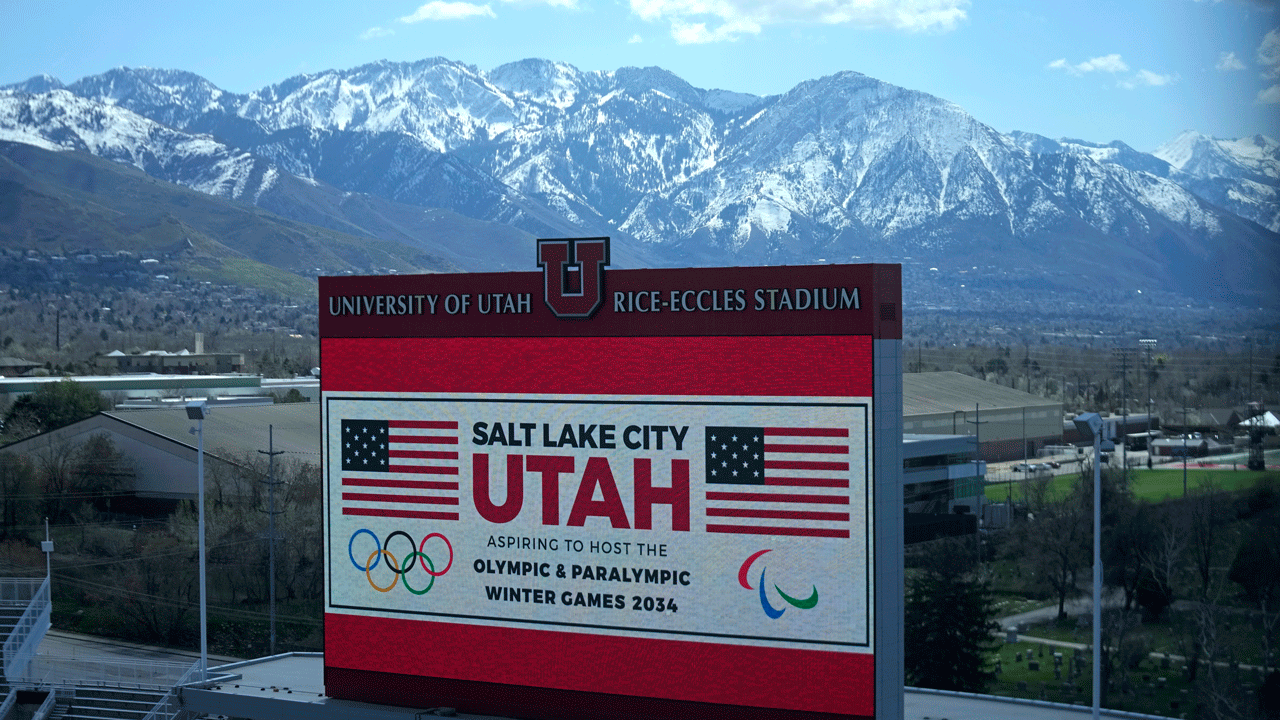
SALT LAKE CITY (AP) — The International Olympic Committee was effusive in its support Wednesday for a decades-long effort to bring back the Winter Games to Utah’s capital city in 2034.
Unlike so many other past hosts that have decided bringing back the Games isn’t worth the time, money or hassle, Salt Lake City remains one of the few places where Olympic fever still burns strong. Olympic officials praised the city for preserving facilities and public enthusiasm as they kicked off their final visit ahead of a formal announcement expected this July.
IN AN OLYMPICS FIRST, TRACK AND FIELD GOLD MEDALISTS TO BE AWARDED PRIZE MONEY
Reminders of the 2002 Winter Games are nestled throughout the city, from a towering cauldron overlooking the valley to an Olympic emblem stamped on manhole covers downtown. Leaving the airport, a can’t-miss arch amid snow-capped mountains shows visitors they’re entering an Olympic city.
The scoreboard at the University of Utahs Rice-Eccles Stadium promotes Salt Lake City’s bid to host another Winter Olympics in 2034 as International Olympic Committee members prepare to tour the stadium and other venues on Wednesday, April 10, 2024, in Salt Lake City. (AP Photo/Rick Bowmer)
Those remnants are part of a long-term strategy Utah leaders launched on the heels of their first Olympics to remind residents that the Games are part of the fabric of their city, and that being a host city is a point of pride.
Olympic officials said they were greeted with such excitement Wednesday that it felt like the 2002 Winter Games never ended.
In the decades since Salt Lake City first opened its nearby slopes to the world’s top winter athletes, the pool of potential hosts has shrunk dramatically. The sporting spectacular is a notorious money pit, and climate change has curtailed the number of sites capable of hosting.
Even though Salt Lake City got caught in a bribery scandal that nearly derailed the 2002 Winter Olympics, it has worked its way back into the good graces of an Olympic committee increasingly reliant on passionate communities as its options dwindle. The city is now a prime candidate if officials eventually form a permanent rotation of host cities, Olympic Games Executive Director Christophe Dubi told reporters.
“We are in an environment here where we look for opportunities more than concerns,” Dubi said. “For the next 10 years, we’re not so much looking at what is challenging, but what are the opportunities to work together.”
The committee was left with only two bid cities for 2022 — Beijing, China, and Almaty, Kazakhstan — after financial, political and public concerns led several European contenders to drop out.
“The International Olympic Committee needs Salt Lake City a lot more than Salt Lake City needs the International Olympic Committee, or the Olympics,” said Jules Boykoff, a sports and politics professor at Pacific University.
For Utah Gov. Spencer Cox, securing the bid is central to his goal of cementing the state as North America’s winter sports capital.
Cox has continued a long-running push by state leaders to beckon professional sports leagues and welcome international events like last year’s NBA All-Star Game that could help burnish its image as a sports and tourism mecca, while chipping away at a lingering stigma that Utah is a bizarre, hyper-religious place.
About half of the state’s 3.4 million residents and the majority of state leaders belong to The Church of Jesus Christ of Latter-day Saints, widely known as the Mormon church.
Dave Lunt, a historian at Southern Utah University who teaches about the Olympics, said the Games give members of that faith, and other residents, a chance to clear up misconceptions and share their values with the world.
“Latter-day Saints really just want to be liked. No disrespect or anything, that’s my community, but there’s this history of, we want to show that we fit in, we’re good Americans,” he said. “We’re happy to host the party at our house.”
The 2002 Games, widely regarded as one of the most successful Olympics, brought government funding for a light-rail system and world-class athletic facilities. The city grew rapidly in its wake.
Utah bid leaders declined to release a budget estimate, saying they should be able to provide one next month. But they assured the committee that they could keep costs down by using most of the same venues they’ve spent millions to maintain since 2002. They also touted bipartisan support for hosting in the Democratic capital city of a predominantly Republican state.
With few options remaining for the Olympic committee, Salt Lake City has leverage to dictate terms, Boykoff said. Those can include funds, deadlines and even which sports are included.
And with NBC’s multibillion-dollar broadcasting contract with the Olympic committee set to expire in 2032 — two years before Utah would host — the committee has a vested interest in selecting a U.S. city in a better time zone for live broadcasts to entice U.S.-based broadcasting giants.
Unlike many cities, Salt Lake City residents did not get to vote on whether they wanted another Games, even as leaders say their polling shows more than 80% approval statewide.
Olympic historians say the hype can distract residents from downsides for other hosts, such as gentrification, corruption, rising taxes or empty promises of environmental improvements.
So far, no opposition has formed in Utah.
“If we consider the Olympics a cultural institution,” Lunt said, “maybe it’s worth paying some money if the people of Utah decide that’s important to us, collectively.”
Read the full article from Here


PORTLAND, Ore. (KATU) — President Donald Trump campaigned on carrying out what he called the largest deportation operation in American history.
After taking office, his administration quickly ramped up immigration enforcement. Border czar Tom Homan also pledged to focus on so-called sanctuary cities, including Portland. According to the U.S. Department of Homeland Security, more than 675,000 people were deported in 2025, while the agency says more than 2 million people “self-deported.”
READ ALSO | Supreme Court hands Trump immigration wins, but birthright citizenship might be different
In Oregon, state data shows state and local agencies experienced a 265% increase in immigration-related requests from federal authorities last year.
So what does that mean for Oregon’s economy?
The state’s chief economist says the effects are beginning to emerge.
Carl Riccadonna, Oregon’s state economist, said immigration enforcement actions are influencing consumer spending and activity across several key industries, though the state cannot yet quantify the overall impact.
“What we’re seeing in terms of immigration action is playing out in either consumption patterns, which we’ve seen in some communities, or in industrial or sectoral activity,” Riccadonna said. “This does then have implications for how we are reading the overall macroeconomy and putting together that revenue forecast.”
Portland police officers walk outside the U.S. Immigration and Customs Enforcement facility on Thursday, Jan. 8, 2026, in Portland, Ore. (AP Photo/Jenny Kane)
Riccadonna said the effects extend beyond agriculture, an industry that has historically relied on immigrant labor.
“We have certainly, in sector-by-sector analysis, we’re hearing evidence of impacts from immigration in consumption numbers, so retail, groceries, those sorts of things,” Riccadonna said. “There are also significant impacts in the retail sector and leisure and hospitality, restaurants and construction, important legacy industries of Oregon like timber, forestry … and manufacturing has a very large footprint as well.”
While the state is seeing those trends, Riccadonna said economists cannot yet calculate exactly how much immigration enforcement has affected Oregon’s economy.
“We haven’t done an exercise to say, well, this is what the forecast would have been otherwise. We don’t produce counterfactuals … but there’s plenty of anecdotal evidence from the cherry harvest this past summer and stresses elsewhere throughout those specific sectors,” he said.
National data offers additional context.
According to the nonpartisan Congressional Budget Office, the recent immigration surge — which the report says mostly comprises immigrants who were not lawful permanent residents, were not eligible to apply for lawful permanent residency based on their current status, and were not admitted on a temporary basis under the Immigration and Nationality Act — generated approximately $10 billion in state and local tax revenue in 2023. During that same period, governments spent nearly $19 billion on services such as schools, shelters and border security.

A damaged car is seen as law enforcement officials work the scene following reports that federal immigration officers shot and wounded people in Portland, Ore., Thursday, Jan. 8, 2026. (AP Photo/Jenny Kane)
The Congressional Budget Office also projects the immigration surge that began in 2023 will increase the U.S. labor force by approximately 5.8 million people by 2034 and boost the nation’s economic output by nearly $9 trillion over the next decade.
Riccadonna said Oregon expects to gain a clearer picture of the economic effects as more tax and revenue data becomes available.
This story is part of KATU’s “The Cost of the Crackdown” special, which examines how increased immigration enforcement is affecting Oregon, from businesses and workers to the state’s broader economy.

SALT LAKE CITY — The Environmental Protection Agency awarded Utah and Salt Lake County a total of $3.5 million in grants to assess potentially polluted properties for eventual cleanup and redevelopment.
The agency announced a $2 million grant to Utah’s Department of Environmental Quality and $1.5 million to Salt Lake County to conduct environmental assessments and inventory brownfield sites for cleanup. Brownfields are sites that may be difficult to redevelop or expand because of “the presence or potential presence of a hazardous substance, pollutant or contaminant,” according to the agency.
“These brownfields grants will help Utah communities clean up contaminated sites and unlock opportunities for redevelopment and investment,” EPA Regional Administrator Cyrus Western said in a news release announcing the grants earlier this week. “By transforming underused properties into community assets, EPA is helping create healthier neighborhoods and stronger local economies.”
The two grants awarded to Utah and Salt Lake County are among more than $248 million awarded to nearly 200 communities nationwide for brownfield assessment and cleanup. Utah’s Department of Environmental Quality plans to focus the resources on several areas in Ogden, Heber City and Fillmore, among others, according to Bill Rees, who leads Utah’s brownfield cleanup program.
“What we do is work to secure the funding and then begin to reach out to our communities across the state, say, ‘Listen, there’s opportunity to do some assessment work in your community if you’re interested,’ and then work with our rural partners, work with our urban partners to see if there are sites that will fit that bill,” he told KSL.
The state has received similar grants in the past, and Rees said the money can help local governments determine what to do with ailing properties such as old schools, hospitals or private property that have gone to waste.
“Is there asbestos in it, or is there hazardous material in it? Or could there be something that’s impacting the soil or the groundwater, and a policymaker needs to make a decision?” asked Rees. “Knowledge allows you to make good decisions.”
The $1.5 million awarded to Salt Lake County is the largest brownfields assessment grant the county has ever received, according to a county press release.
“This grant is a real win for our communities,” said Mayor Jenny Wilson. “This funding will let us do vital environmental work on a larger scale and in more neighborhoods. It reflects exactly the kind of partnership between local and federal government that gets results for residents.”
The county grant funds will be used to help create cleanup plans in three areas, including a vehicle storage yard in Salt Lake City’s Ballpark Neighborhood, a 4.26-acre vacant lot in Millcreek and a small commercial building in Magna that was damaged during an earthquake in March 2020, according to the EPA.
Contributing: Don Brinkherhoff
The Key Takeaways for this article were generated with the assistance of large language models and reviewed by our editorial team. The article, itself, is solely human-written.

WashingtonCaps.com is the official Web site of the Washington Capitals. Washington Capitals and WashingtonCaps.com, WashingtonCapitals.com are trademarks of Lincoln Hockey. NHL, the NHL Shield, the word mark and image of the Stanley Cup and NHL Conference logos are registered trademarks of the National Hockey League. All NHL logos and marks and NHL team logos and marks as well as all other proprietary materials depicted herein are the property of the NHL and the respective NHL teams and may not be reproduced without the prior written consent of NHL Enterprises, L.P. Copyright © 1999-2020 Lincoln Hockey and the National Hockey League. All Rights Reserved. NHL, the NHL Shield and the word mark NHL Winter Classic are registered trademarks and the NHL Winter Classic logo is a trademark of the National Hockey League. NHL and NHL team marks are the property of the NHL and its teams. © NHL 2026. All Rights Reserved.
-

 Oregon24 seconds ago
The Cost of the Crackdown: How Trump’s immigration enforcement affects Oregon
-

 Pennsylvania8 minutes ago
Federal government sues Pennsylvania, others over SNAP data
-

 Rhode Island10 minutes ago
Target 12: State of RI’s fire hoses
-

 South-Carolina16 minutes ago
Mississippi State baseball lands Will Craddock, South Carolina transfer infielder
-

 South Dakota23 minutes ago
South Dakota Republicans reject censuring John Thune over stalled SAVE America Act
-

 Tennessee25 minutes ago
Flood watch in effect for Middle Tennessee: 2-3″ of rain expected Saturday
-

 Texas30 minutes ago
Texas state school board approves mandated reading list including Bible passages
-

 Utah38 minutes ago
Utah, Salt Lake County awarded grants for community cleanup

