As grim as the political scene is in Israel today – with Prime Minister Benjamin Netanyahu’s coalition bulldozing through contentious and damaging legislation on the final days of the Knesset before the October election – the view on the other side of the world in Washington regarding Israel is just as worrisome.
West
As many cities sour on hosting the Olympics, Salt Lake City's enthusiasm endures

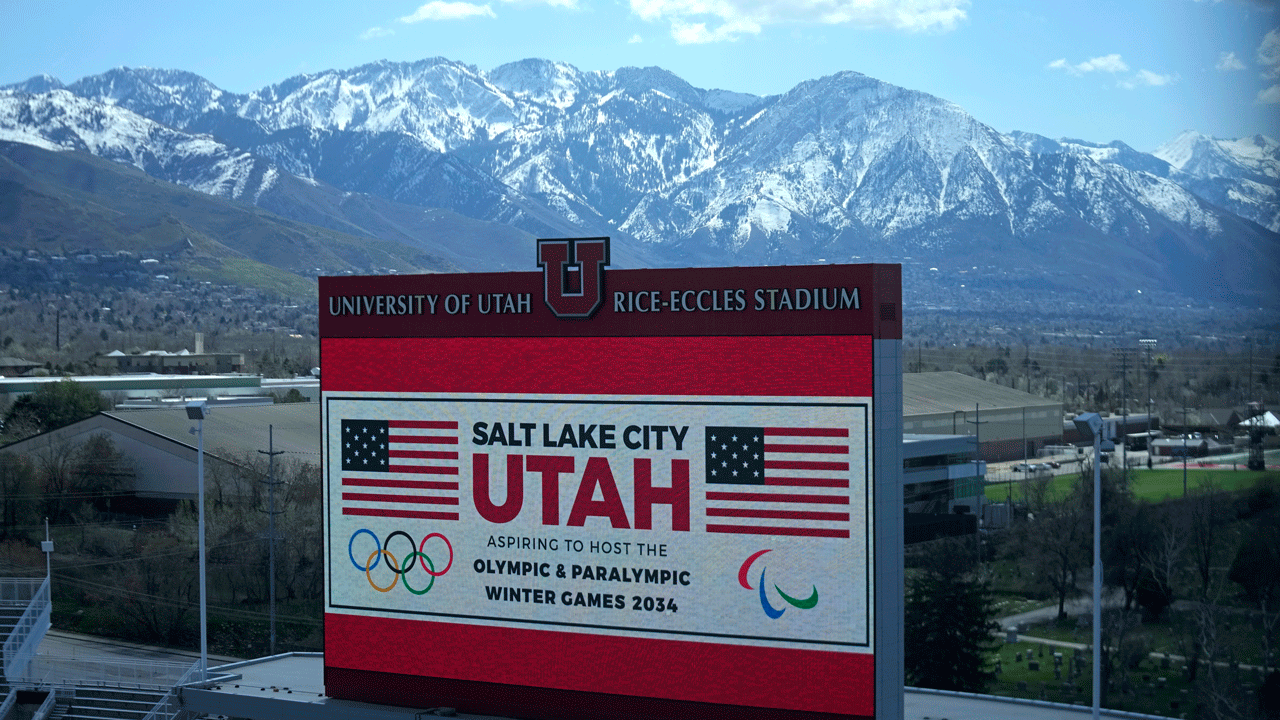
SALT LAKE CITY (AP) — The International Olympic Committee was effusive in its support Wednesday for a decades-long effort to bring back the Winter Games to Utah’s capital city in 2034.
Unlike so many other past hosts that have decided bringing back the Games isn’t worth the time, money or hassle, Salt Lake City remains one of the few places where Olympic fever still burns strong. Olympic officials praised the city for preserving facilities and public enthusiasm as they kicked off their final visit ahead of a formal announcement expected this July.
IN AN OLYMPICS FIRST, TRACK AND FIELD GOLD MEDALISTS TO BE AWARDED PRIZE MONEY
Reminders of the 2002 Winter Games are nestled throughout the city, from a towering cauldron overlooking the valley to an Olympic emblem stamped on manhole covers downtown. Leaving the airport, a can’t-miss arch amid snow-capped mountains shows visitors they’re entering an Olympic city.
The scoreboard at the University of Utahs Rice-Eccles Stadium promotes Salt Lake City’s bid to host another Winter Olympics in 2034 as International Olympic Committee members prepare to tour the stadium and other venues on Wednesday, April 10, 2024, in Salt Lake City. (AP Photo/Rick Bowmer)
Those remnants are part of a long-term strategy Utah leaders launched on the heels of their first Olympics to remind residents that the Games are part of the fabric of their city, and that being a host city is a point of pride.
Olympic officials said they were greeted with such excitement Wednesday that it felt like the 2002 Winter Games never ended.
In the decades since Salt Lake City first opened its nearby slopes to the world’s top winter athletes, the pool of potential hosts has shrunk dramatically. The sporting spectacular is a notorious money pit, and climate change has curtailed the number of sites capable of hosting.
Even though Salt Lake City got caught in a bribery scandal that nearly derailed the 2002 Winter Olympics, it has worked its way back into the good graces of an Olympic committee increasingly reliant on passionate communities as its options dwindle. The city is now a prime candidate if officials eventually form a permanent rotation of host cities, Olympic Games Executive Director Christophe Dubi told reporters.
“We are in an environment here where we look for opportunities more than concerns,” Dubi said. “For the next 10 years, we’re not so much looking at what is challenging, but what are the opportunities to work together.”
The committee was left with only two bid cities for 2022 — Beijing, China, and Almaty, Kazakhstan — after financial, political and public concerns led several European contenders to drop out.
“The International Olympic Committee needs Salt Lake City a lot more than Salt Lake City needs the International Olympic Committee, or the Olympics,” said Jules Boykoff, a sports and politics professor at Pacific University.
For Utah Gov. Spencer Cox, securing the bid is central to his goal of cementing the state as North America’s winter sports capital.
Cox has continued a long-running push by state leaders to beckon professional sports leagues and welcome international events like last year’s NBA All-Star Game that could help burnish its image as a sports and tourism mecca, while chipping away at a lingering stigma that Utah is a bizarre, hyper-religious place.
About half of the state’s 3.4 million residents and the majority of state leaders belong to The Church of Jesus Christ of Latter-day Saints, widely known as the Mormon church.
Dave Lunt, a historian at Southern Utah University who teaches about the Olympics, said the Games give members of that faith, and other residents, a chance to clear up misconceptions and share their values with the world.
“Latter-day Saints really just want to be liked. No disrespect or anything, that’s my community, but there’s this history of, we want to show that we fit in, we’re good Americans,” he said. “We’re happy to host the party at our house.”
The 2002 Games, widely regarded as one of the most successful Olympics, brought government funding for a light-rail system and world-class athletic facilities. The city grew rapidly in its wake.
Utah bid leaders declined to release a budget estimate, saying they should be able to provide one next month. But they assured the committee that they could keep costs down by using most of the same venues they’ve spent millions to maintain since 2002. They also touted bipartisan support for hosting in the Democratic capital city of a predominantly Republican state.
With few options remaining for the Olympic committee, Salt Lake City has leverage to dictate terms, Boykoff said. Those can include funds, deadlines and even which sports are included.
And with NBC’s multibillion-dollar broadcasting contract with the Olympic committee set to expire in 2032 — two years before Utah would host — the committee has a vested interest in selecting a U.S. city in a better time zone for live broadcasts to entice U.S.-based broadcasting giants.
Unlike many cities, Salt Lake City residents did not get to vote on whether they wanted another Games, even as leaders say their polling shows more than 80% approval statewide.
Olympic historians say the hype can distract residents from downsides for other hosts, such as gentrification, corruption, rising taxes or empty promises of environmental improvements.
So far, no opposition has formed in Utah.
“If we consider the Olympics a cultural institution,” Lunt said, “maybe it’s worth paying some money if the people of Utah decide that’s important to us, collectively.”
Read the full article from Here

Continue Reading

Two events overnight Wednesday emerging from the US Capitol, one a vote and the other an interview, exemplified the rockslide – turning into an avalanche – of anti-Israel sentiment that has taken hold in the hallowed halls of decision-makers.
The degree to which both the Republican and Democratic parties are sharpening their claws against Israel and hyper-focusing on it to the exclusion of critical issues indicates that the long-standing US-Israel bond is in a real crisis.
Nearly half of the Democrats in the House of Representatives, 103, voted for an amendment to cut off aid to Israel. The amendment was defeated 314-104. It was sponsored by Rep. Thomas Massie (R-Kentucky), whose disagreement with his party on Israel is his signature issue. He recently lost the GOP primary to run for reelection in the November midterms.
Lest we breathe a sigh of relief that Republicans en masse voted against the amendment, US Vice President JD Vance demonstrated that Israel has just as much to worry about from the Right in the US.
Vance claims Israeli ‘influence campaigns’ affect US political decisions
In an interview with highly popular America First podcaster Joe Rogan, who has labeled Israel’s war efforts in Gaza as “genocide,” Vance suggested that shadowy Israeli “influence campaigns” exist in the US.
“I definitely think you have seen this very discreet, extremely well-funded campaign to try to derail the negotiation and try to derail the deal,” he told Rogan.
An article in Time magazine on Tuesday was “worth reading because it lists a bunch of people who have quite literally been paid by a former Trump campaign person, who was himself paid by certain elements within the Israeli government,” Vance said. “And those people are attacking me viciously for quite literally trying to accomplish the negotiation objective that the president set for the country.”
“Many of the people who were receiving that money were actually attacking me in completely dishonest ways,” he said. “You know, my response to that is: ‘Go to hell.’ I’m going to do what I have to do for the American people. I represent Americans first.”
Vance shares claim spread by far Right influencers linking Jeffrey Epstein to Israeli intelligence
Vance, who is seen as a prime contender to be the Republican nominee for president in 2028, also waded into the conspiracy surrounding Jeffrey Epstein, the late convicted sex offender. Epstein “clearly had connections to the highest levels of Israeli intelligence,” he said, reiterating a claim that has been refuted and discredited.
The embrace by such a senior Trump administration official of conspiracy theories about Epstein’s ties to Israeli intelligence, which have proliferated in the years since his death and often have veered into antisemitism, is part and parcel with Vance’s increasing alignment with the far Right base populated by the likes of Tucker Carlson, Nick Fuentes, and Candace Owens.
Taken separately, the vote in the House of Representatives and the Vance interview are worrisome signs that the “special” relationship between Israel and the US is on life support at best. Taken together, they should be an alarming wake-up call that the days of the “kishkes” identification test with Israel – as exemplified diversely by the late Lindsey Graham and former president Joe Biden – are long gone.
Although it’s easy to place the blame elsewhere – and there are a plethora of strong arguments to be made in retort to both Democratic and Republican detractors of Israel – we must also look inward and see what can be done to reverse the tide of sentiment against us.
We can surely criticize the headline-provoking gambit by US Rep. Ro Khanna (D-California) last week, who chose to only hear and see the Palestinian side of life in the West Bank. But we can also acknowledge that vigilante Jewish groups are patrolling the area in a heavy-handed and lawless fashion that creates potentially lethal friction points and does irreparable damage to Israel’s image.
We can criticize Rahm Emmanuel for haughtily coming to Israel and warning us about what needs to be done to repair the US-Israel relationship, while acknowledging that some of his points were spot-on and unfolding before our very eyes in the House vote and Vance interview.
Jerusalem can no longer ignore or downplay the growing trends in the US of having to endorse the “Israel is genocide” trope to become a candidate, or of blaming Israel for getting the US entangled in Iran. The unsettling news this week demonstrates that with stark clarity.

The National Weather Service in Riverton has issued a Flood Watch advisory for portions of central and northwest Wyoming, including Owl Creek, the Bridger Mountains, the Southwest Bighorn Basin, the Absaroka Mountains, and the Cody Foothills. This includes the cities of Cody, Thermopolis, Meeteetse, and Clark, and many areas near or partially in Fremont County. […]

The owner and operator of the boat that capsized earlier this week near Alcatraz Island said Thursday that his brother was killed and his sister, sister-in-law and a family friend remained missing after what began as a family trip to spread a relative’s ashes.
“It’s been horrible,” John Boisa said in a brief interview.
His comments came as San Francisco police used sonar to search for the 49-foot Volare and recovered a body floating west of Treasure Island. Authorities had not identified the person as of early Thursday evening.
Police were alerted to the body shortly after 1 p.m. by a passing vessel. The agency said it was using “multiple boat-mounted sonar platforms” to search for the Volare, which sank in water roughly 130 feet deep between Alcatraz Island and San Francisco.
The search has been complicated by “strong tidal currents along with wind and weather challenges,” police said in a statement.
Twenty people were aboard the boat when a wave struck it shortly after 3:30 p.m. Tuesday, causing the vessel to list before rolling over and sending everyone into the water.
Clifford Boisa, the operator’s brother, was pulled from the water and later declared dead despite receiving CPR. Sixteen others were rescued by a flotilla of first responders and nearby boaters.
Still missing Thursday were Clifford Boisa’s wife, Jackie Boisa; John Boisa’s sister, Carol Boisa; and a family friend whom he identified only as “Tonda.”
In a text message to this news organization, John Boisa recalled Jackie Boisa as possessing “a rare combination of easy acceptance of others with a kind of elegant sophistication.”
“She was simply a Lady and conducted herself in accordance with the highest meaning of that term,” he wrote.
He remembered his sister as bringing “her own special flavor to family gatherings and the earthy, natural joy she brought was ineffable.”
“I was especially pleased to see her enjoy our boating in recent years, and her smiles in photographs were genuine and without affectation,” he added. “I wanted for her and her children happiness and ease, and now, peace.”
Boisa, a Stockton-based consultant, said he had known Tonda only a short time but recalled her as “a generous, welcoming and gracious person.”
“I wish I knew her better, and I pray for peace and healing for her family,” he wrote.
Boisa described himself as the “vessel operator” and said Tuesday’s outing was “a family gathering” that included spreading the ashes of a relative who had died “a long time ago.”
Two days after the disaster, more details emerged about the boat, its weeklong stay in San Francisco and its final hours on the water.
The Volare, a 1981 Marine Trader Pilot built in Taiwan with a fiberglass hull, was based at Village West Marina & Resort, according to Tamara Barak Aparton of the San Francisco Recreation and Parks Department.
John Boisa received a guest permit to berth the boat at the city’s Marina Yacht Harbor from July 11 through Thursday, Aparton said. He had previously stayed at the harbor, though details about those visits were not available Thursday.
The vessel left the harbor around 10:15 a.m. Tuesday and traveled beneath the Golden Gate Bridge into the Pacific Ocean, according to the tracking website VesselFinder. It turned around about an hour later off Lands End and the Sutro Baths before returning to the bay at a slower speed.
The boat appeared to stop at Ayala Cove on the northwest side of Angel Island, leaving shortly after 3 p.m. and heading back toward the harbor, tracking data showed.
The Coast Guard’s search for survivors covered 950 square nautical miles before ending Wednesday evening. As police continued the recovery effort Thursday, maritime experts said they expected a lengthy investigation into how a vessel such as the Volare could capsize.

The Volare — a monohull recreation craft complete with two walled-off cabin levels and a deck top — was intended to handle waters such as San Francisco Bay, said Eric C. Jones, a retired Coast Guard rear admiral and superintendent of the Cal Poly Maritime Academy in Vallejo. Still, he said it was “unusual” for such a vessel to flip over in the bay.
Investigators are likely to examine whether the boat was properly maintained and operating correctly, and whether it could safely carry 20 people, Jones said. They also are expected to scrutinize the weather and water conditions that day and how the boat was operated in that environment.
The area where the Volare sank can be among the most challenging to navigate in the bay because of its distinctive winds and currents, said John Arndt, who has sailed the bay for more than 40 years and spent the past decade as publisher of the Northern California sailing magazine Latitude 38.
Arndt called the area “the playground of sailing” and compared portions of the bay to a ski hill, with some areas better suited to beginner and intermediate boaters. The area where the Volare sank could be compared to a black diamond ski run, he said: a more “challenging” section but one that is navigable for people experienced with those waters and conditions.
July and August are generally the windiest months on the bay, a result of hot air rising over the Central Valley and pulling cooler air from the Pacific Ocean through the bay’s narrow entrance. While winds can remain manageable in some areas, the central channel between Angel Island and San Francisco can experience strong sustained winds and gusts.
The water can become particularly choppy when westerly winds collide with an outgoing tide. Water flowing from the Sacramento and San Joaquin river valleys toward the Pacific further complicates the currents in that area.
Arndt called a disaster of this magnitude involving this type of boat “exceptionally rare.” He said Tuesday’s conditions were not outside the normal range for summer boating on the bay.
“When people analyze accidents and disasters, it’s not one thing — it’s sort of these things that tend to be a spiral of events,” Arndt said.

Jakob Rodgers is a senior breaking news reporter. Call, text or send him an encrypted message via Signal at 510-390-2351, or email him at jrodgers@bayareanewsgroup.com.
-

 Virginia16 seconds ago
Did you know West Virginia has an official state gun?
-
Washington6 minutes ago
Israel must confront the collapse of its support in Washington | The Jerusalem Post
-

 Wisconsin12 minutes ago
Wisconsin Lottery Pick 3, Pick 4 results for July 16, 2026
-

 West Virginia18 minutes ago
West Virginia to conduct comprehensive review of all bridges as state targets repairs
-

 Wyoming24 minutes ago
NWSR issues Flood Watch advisory for portions of Central, Northwest Wyoming
-

 Crypto30 minutes ago
DeFi’s Newest Threat: How Malicious Liquidity Pools Are Trick-Quoting Ethereum and Polygon Users
-

 Finance36 minutes ago
Gold Purchases Accelerate as Dollar Confidence Wanes
-

 Fitness42 minutes ago
Strength training over decades linked to longer life – Harvard Health


