West
Appeals court appears skeptical of Newsom's claim that Trump illegally deployed National Guard
NEWYou can now listen to Fox News articles!
A three-judge panel appeared skeptical on Tuesday during a hearing of California Gov. Gavin Newsom’s argument that President Donald Trump violated the law when he deployed thousands of National Guard members to respond to protests and riots in Los Angeles County.
All three judges on the panel for the U.S. Court of Appeals for the Ninth Circuit grilled a state attorney over Newsom’s request for the court to restrict Trump’s use of the National Guard.
The judges conveyed uncertainty about whether the court even had the ability to review Newsom’s claims, citing a case from 1827 that found presidents have exclusive authority over the militia.
“Even if we were to agree with you that there is some limited role of judicial review, how can, with the facts here and the language in Martin v. Mott, how can that test be met here by the state to justify an injunction against the president’s actions?” Judge Mark Bennett, a Trump appointee, asked.
Judge Jennifer Sung, a Biden appointee, said the “problem” she saw with California attorney Samuel Harbourt’s arguments was that the 1827 decision “seemed to broadly hold that … Congress was essentially giving the president the authority, the exclusive authority, to determine whether the [need for military presence] existed.”
JUDGE MULLS TRUMP’S AUTHORITY OVER NATIONAL GUARD, WARNS US IS NOT ‘KING GEORGE’ MONARCHY
Protesters began gathering on the steps of Los Angeles City Hall early Tuesday afternoon after three days of anti-ICE riots in the city. (Peter D’Abrosca for Fox News Digital)
The panel is weighing whether to extend its temporary hold on a lower court order, issued by Clinton-appointed Judge Charles Breyer last week, that temporarily blocked Trump from using National Guard soldiers in parts of Los Angeles.
Trump and Secretary of Defense Pete Hegseth invoked a provision of Title 10 to deploy military forces in the county following spurts of riotous behavior and heavy protesting in response to immigration raids during the past ten days.
In court papers, Department of Justice attorneys said Trump and Hegseth were using the military strictly to protect Immigration and Customs Enforcement (ICE) personnel and federal buildings.
The law they invoked includes the condition that there be a rebellion or invasion or that federal authorities, in this case ICE officials, are unable to carry out their jobs. The law also includes the condition that the president go “through” a governor to federalize the National Guard.
DOJ attorneys said that language did not require Trump to obtain Newsom’s permission to deploy the National Guard, despite presidents typically only doing so with a governor’s consent. Instead, the law simply required that Trump notify Newsom, the attorneys said.
Newsom fiercely opposed Trump federalizing guard members, and attorneys for California argued in court filings that the decision exacerbated the unrest and led to exponentially more rioting incidents. They said that regardless of the severity of the rioting, it did not “remotely” meet the criteria required under the Title 10 provision.
TRUMP TELLS JUDGE HE DOES NOT NEED NEWSOM’S PERMISSION TO CRACK DOWN ON RIOTERS, DEPLOY NATIONAL GUARD
Anti-ICE rioters and police face-off in Los Angeles on Saturday, June 14, 2025. Demonstraions across the country are being teld today under that banner of No Kings. (Jamie Vera/Fox News)
“As the district court found based on the record evidence, the circumstances here do not remotely amount to a ‘rebellion or danger of a rebellion’ or a situation that renders the President ‘unable with the regular forces to execute the laws of the United States,’” the state attorneys wrote.
Harbourt said during Tuesday’s hearing that local and state law enforcement had made around 1,000 arrests related to protest activity.
Since June 7, Trump has federalized 4,000 National Guard members and enlisted 700 Marines to offer support in California as ICE officials carry out raids and arrest allegedly illegal immigrants, including dozens with criminal records.
GAVIN NEWSOM LAUNCHES SUBSTACK TO FIGHT ‘DISINFORMATION’
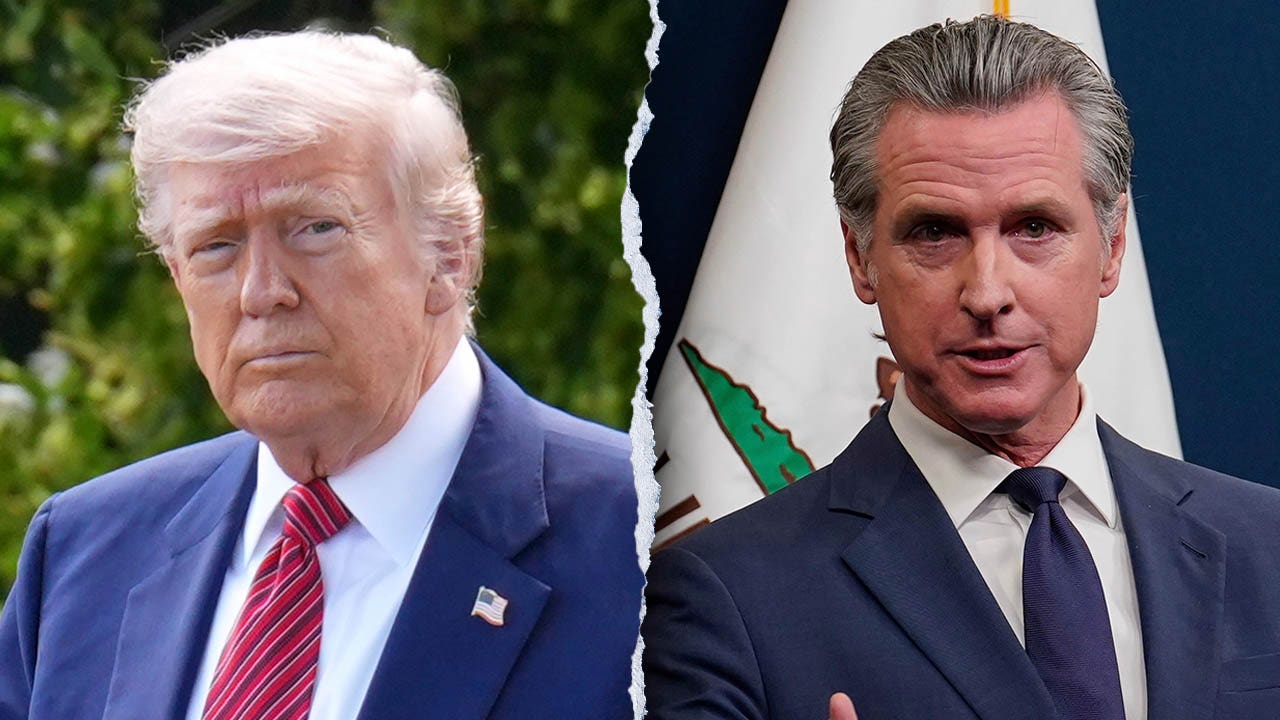
Left: California Gov. Gavin Newsom; Right: President Donald Trump (Getty Images)
An ICE official said in an affidavit that National Guard members have been “essential” to providing extra support around the 300 N. Los Angeles Federal Building, which has been the site of frequent protests and unrest since the immigration raids began.
“Prior to the National Guard’s deployment, rioters and protestors assaulted federal, state, and local law enforcement officers with rocks, fireworks, and other objects. They also damaged federal property by spray painting death threats to federal law enforcement officers,” the ICE official wrote.
Read the full article from Here

New Mexico
Meta threatens to pull Facebook and Instagram from New Mexico over child safety trial requirements
The Lanier Law Firm lead attorney Mark Lanier joins Varney & Co. to discuss the social media addiction trial verdict against Meta and Google, comparing it to tobacco litigation.
Tech giant Meta is threatening to cut off access to its social media platforms in New Mexico as a response to the state’s legal effort to compel changes to child safety protocols on the platform.
Meta and the state of New Mexico are expected to proceed to the second stage of their trial next week after a jury recently issued a $375 million award to the state after finding that the company misled consumers about the safety of its platforms and protections for children against sexual predators.
The next phase of the trial will concern what actions the parent company of Facebook, Instagram and WhatsApp must take to address those issues.
Among the remedies New Mexico is seeking is to impose a requirement that Meta meet a 99% accuracy threshold in verifying that children on its platform are at least 13 years old. Meta has pushed back on that requirement, arguing in a court filing that it’s unfeasible and would require it to “comply with impossible obligations.”
META VOWS APPEAL OF ‘LANDMARK’ SOCIAL MEDIA VERDICTS, WARNS OF FREE SPEECH EROSION
Meta is warning that it may be forced to pull its apps from New Mexico if the state prevails in requiring the social media giant to implement certain safeguards. (Arda Kucukkaya/Anadolu via Getty Images)
Meta’s legal team said in a filing that New Mexico’s “requests for relief are so broad and so burdensome, that if implemented it might force Meta to withdraw its apps entirely from the State of New Mexico as an alternative way of complying with the injunction.”
“It does not make economic or engineering sense for Meta to build separate apps just for New Mexico residents,” Meta’s lawyers added. “Nor could Meta guarantee the perfection the State demands, making it impractical for Meta to operate in New Mexico.”
EXPERT WARNS OF MASSIVE RECKONING FOR SOCIAL MEDIA COMPANIES: ‘GIANT CASE OF KARMA’
| Ticker | Security | Last | Change | Change % |
|---|---|---|---|---|
| META | META PLATFORMS INC. | 611.91 | -57.21 | -8.55% |
The company has argued that it’s being unfairly singled out in comparison to other social media platforms that are popular with young people. It also previously signaled it will appeal the $375 million civil judgment against it.
New Mexico pushed back on Meta’s assertion that it would be impractical to comply with the safeguards it’s seeking for social media apps.
META ORDERED TO PAY $375M AFTER JURY FINDS PLATFORM ENABLED CHILD PREDATORS IN LANDMARK NEW MEXICO CASE
Meta is the parent company of apps including Facebook, Instagram and WhatsApp. (Reuters/Dado Ruvic/Illustration)
“Meta is showing the world how little it cares about child safety,” said New Mexico Attorney General Raúl Torrez. “Meta’s refusal to follow the laws that protect our kids tells you everything you need to know about this company and the character of its leaders.”
“We know Meta has the ability to make these changes. For years the company has rewritten its own rules, redesigned its products, and even bent to the demands of dictators to preserve market access. This is not about technological capability. Meta simply refuses to place the safety of children ahead of engagement, advertising revenue, and profit,” Torrez added.
GET FOX BUSINESS ON THE GO BY CLICKING HERE
New Mexico is also seeking that Meta implement safer recommendation algorithms that don’t prioritize engagement over child well-being, restrictions on end-to-end encryption for minors, prominent warning labels about the platform’s risks, permanent bans for adults engaging in or facilitating the exploitation of children, and an independent oversight regime through a court-appointed child safety monitor.
Oregon
Pain at the pump: Gas prices jump nearly 20 cents in Oregon & Washington since last week
PORTLAND, Ore. (KATU) — Average gas prices have gone up nearly 20 cents a gallon in Oregon and Washington in the past week as tensions in the Middle East continue.
Washington state has the third most expensive gas in the country at an average of $5.57 a gallon for regular, followed by Oregon at fourth in the U.S. with roughly $5.15 per gallon for regular.
The average price for regular in the U.S. is $4.30 a gallon. AAA says the price of oil has surged to more than $100 a barrel, with no indication of when the Strait of Hormuz will be back open.
National Gas Price Comparison for 2023-26 as of April 30, 2026 – Graphic courtesy AAA
A poll found that half of all Americans expect gas prices to rise even higher in the next year.
That same poll from ABC and Ipsos said some Americans are changing their behaviors because of the higher gas prices.
About 4 in 10 people are driving less (44%) or have cut back on other household expenses (42%) to compensate.
More than a third have changed their travel or vacation plans, the poll said, and about 15% of people said they’ve considered buying an electric vehicle.
Pump prices are now the highest they’ve been during this time of year since 2022, when Russia’s invasion of Ukraine pushed crude oil prices above $100 per barrel.
The poll found that about a quarter (23%) of all Americans are falling behind financially, which is up from 17%in February, before gas prices started to spike.
JOIN THE CONVERSATION (1)
About half of those who took the poll said they have just enough to maintain their standard of living, while 24% said they are getting ahead – down from 28% in February.
Utah
‘It’s past the eleventh hour’: Utah and other Colorado River states call for mediation as current plans near expiration
ST. GEORGE — As negotiations over the Colorado River remain at a standstill, Utah and other states in the Upper Basin are asking for outside help.
Negotiators from Utah, Colorado, New Mexico and Wyoming called for “immediate mediation” among the seven states that share the Colorado River and the federal government, according to a statement from the Upper Colorado River Commission last week.
“It’s past the eleventh hour. It’s 11:59,” Estevan López, New Mexico’s negotiator, said during a commission meeting on April 21 while discussing the looming deadline for new operating plans for the river that provides water to roughly 40 million people.
Current guidelines for managing the river system and its reservoirs during dry times expire this year. The Bureau of Reclamation is currently going through an environmental review process and has said it must have a new plan in place by Oct. 1. If the states reach consensus, the bureau has said they will choose that as its preferred path forward.
The states have failed to agree, though, missing two federal deadlines over the past six months.
“I think it would be worth all of us stepping back from this and seeking to get a mediated solution to solve this really difficult problem,” López said.
So far, the bureau has facilitated negotiations among the states. López acknowledged the agency’s “good” attempts but also said that the bureau is “not an independent entity in this discussion.”
“Reclamation has a really important interest in the outcome,” he said. “They obviously operate the reservoirs. Reclamation and the Secretary of Interior are the river master in the Lower Basin. Interior serves in a trust responsibility for the tribes throughout the basin.”

Utah’s negotiator, Gene Shawcroft, said that he agreed with López and that “it’s extremely disappointing” that the states haven’t reached a resolution yet.
“It’s critical for us to continue to work together,” he added. “A seven-state solution will still be much better than any other alternative.”
The Upper Basin states are in discussions with the bureau and the Lower Basin states — Arizona, California and Nevada — about developing a mediation process currently, the commission said in an email to The Tribune on Wednesday.
John Entsminger, Nevada’s negotiator, said he’s “open to bringing on an independent mediator” but that he’s also disappointed that the states’ seven representatives “can’t come up with a common-sense solution.”
“But mediation beats litigation,” he added. “So if there’s a chance this helps break the logjam, then tell me when and where to be.”
The idea of a mediator has surfaced in river negotiations “a handful of times” over the past two decades, Entsminger said. But in the past the negotiators were able to come to “a mutually agreeable solution where everybody gives a little,” he added.
That hasn’t happened this time around. “I think it’s become more difficult for the states to agree, because the magnitude of the problem has increased,” he said.

Much of the Colorado River Basin experienced its worst snowpack and hottest winter on record. The bureau and Upper Basin states reached an agreement to release up to 1 million acre-feet of water from Flaming Gorge this year to prevent Lake Powell from reaching minimum power pool — the level at which the dam can no longer generate hydropower or sustainably send water downstream.
California proposed a mediator last year, JB Hamby, California’s negotiator, told The Tribune in an email.
“However, effective mediation requires common ground, and the system cannot wait,” he added. “Current conditions require immediate, measurable water reductions from every state.”
The Arizona Department of Water Resources said it had no comment at this time.
How a third party could help
Bringing in a mediator “makes total sense” to help states get past politics and personalities and reach a solution, said John Berggren, a regional policy manager on Colorado River issues for Western Resource Advocates.
“I kind of wish it would have happened two-plus years ago,” he added, “but some of the fundamental challenges that they’re facing come down to trust and communication … and not taking each other’s proposals seriously.”
The drawn out negotiations have put states in an unpredictable situation that makes finding a solution more difficult, said Danya Rumore, director of the Environmental Dispute Resolution Program at the University of Utah.

“Our options get more limited,” she said. “People are more likely to be entrenched. We get more fear in the conversation, and that makes it harder to actually productively deal with it. It doesn’t make it impossible, it just gives you one more thing you have to contend with.”
A trained third-party facilitator — or team of facilitators — would ideally create a process that helps people learn how to productively work through conflict while also integrating the complex science, legal frameworks and uncertainties involved in this issue, Rumore said.
“If somebody can’t understand the legal elements of what’s going on there, they don’t understand the scientific elements enough to be able to facilitate those conversations, that can create huge challenges,” she added.
Rumore and her co-workers jokingly call themselves “the group mom.” That means both getting things done and seeing what’s emotionally happening in the room.
“We have to stay regulated,” she said. “We have to stay present. We have to not go into this crisis thinking mode. And that’s going to help us get a good outcome.”
If the states do bring in a third party, Entsminger said he hopes it’s “somebody that could inject some objectiveness into the entire process because we’ve got some entrenched people. There’s no doubt about that.”
He said he thinks the states will come up with a short-term, two- or three-year operating plan this year while they continue hashing out a long-term plan.
This article is published through the Colorado River Collaborative, a solutions journalism initiative supported by the Janet Quinney Lawson Institute for Land, Water, and Air at Utah State University. See all of our stories about how Utahns are impacted by the Colorado River at greatsaltlakenews.org/coloradoriver.
-
New Hampshire6 minutes agoTheatre Productions | End Of Life Options | Storytimes | Open Studio: The Londonderry NH Patch Weekender
-
New Jersey12 minutes agoMay Day protests in Newark, Jersey City bring out support for causes
-
New Mexico18 minutes agoMeta threatens to pull Facebook and Instagram from New Mexico over child safety trial requirements
-
North Carolina24 minutes agoGroundhog tests positive for rabies in Rutherford County
-
North Dakota30 minutes agoCelebration of life held for North Dakota lawmaker killed in Brooklyn Park plane crash
-
Ohio36 minutes agoA talk with incoming Ohio FFA State Officer Sydney Beiting – Ohio Ag Net | Ohio’s Country Journal
-
Oklahoma42 minutes agoOklahoma EMT killed in Goodwill house fire
-
Oregon48 minutes agoPain at the pump: Gas prices jump nearly 20 cents in Oregon & Washington since last week