From our collaborating partner “Living on Earth,” public radio’s environmental news magazine, aninterview by managing producer Jenni Doering with Jon O’Donnell, ecologist for the Arctic Inventory and Monitoring Network at the National Park Service.
The rapid climate change happening to our planet is often invisible.
Think of rising carbon dioxide levels in the atmosphere, or heat waves across the globe.
But in the far north of Alaska some changes are impossible not to see.
Advertisement
That’s because dozens of crystal-clear streams in the Brooks Range are turning a cloudy orange.
We’re hiring!
Please take a look at the new openings in our newsroom.
See jobs
A 2024 paper published in the Nature journal Communications: Earth and Environment connects the change to rapidly thawing permafrost that appears to be releasing metals like iron into these streams.
Advertisement
Lead author Jon O’Donnell is an ecologist for the Arctic Inventory and Monitoring Network at the National Park Service. This interview has been edited for length and clarity.
JENNIDOERING:So when did you first notice that the streams in Alaska’s Brooks Range looked rusty? And what was your reaction?
Dr. Jon O’Donnell is an ecologist for the NPS’ Arctic Inventory and Monitoring Network and the lead author of the paper. Credit: Mike Records/USGS
JONO’DONNELL:So we were monitoring a site in Kobach Valley National Park, on the Akillik River. And we had been collecting samples there, water samples and biological samples, like fish and bugs. That was in 2017. And when we went back in August of 2018, for a site visit, we noticed that the stream had turned orange. And this was surprising to us. And so you know, we were accessing this site in a small helicopter. And you know, my initial thoughts were, this is kind of an important thing to document. But I kind of thought it was maybe just anomalous, or a case study, where you know, this might just be a one-off thing, but it’d be a good story. So we should do a good job, collect all the samples that we need to collect. So we grabbed water samples, and we collected fish and bugs. And then, when we went back out in 2019, we were flying around the region, and we noticed that there were more streams than we had previously noticed, had turned orange. And that was kind of when I started to think that this might be a bigger issue than this anomalous one stream in Kobach valley, that it may be a bigger issue. And at that point, we started trying to compile observations from across the Brooks Range.
DOERING:So you mentioned that you did some water sampling. And you were finding these minerals in the water samples. What kinds of minerals have you been collecting?
O’DONNELL:Yeah, so we collect water samples from these orange streams, and then nearby clear water streams. And we measure the same suite of chemicals on all of them. So the orange in the stream, that is a reflection of iron. And so those are iron particulates, it makes the stream very turbid or filled with particles. And then those particles often get deposited on the stream bed, and so they blanket the rocks and the sediments in the bottom of the stream. But in addition to the iron, we see that these orange streams are more acidic, so they have a lower pH than, than clear water streams. And there’s a whole range of trace metals that are potentially toxic, both in terms of drinking water and for life that are living in these streams. And so examples of those trace metals that we’ve seen are like zinc and copper and arsenic and cadmium and a range of others that are elevated in concentration in the orange streams.
DOERING: So what do you think is going on here? What do we know about what might be causing this change in the streams and rivers?
Advertisement
O’DONNELL:All of our observations point towards climate and permafrost thaw as a driver of this change. The reasons for that are one, the timing. So we’ve documented over 70 streams and rivers that have changed in the very recent past here, so in the last 10, 10- 5 years. And this is a period of time where the climate has warmed dramatically in the Arctic. There’s also evidence that in these specific watersheds, the climate has warmed past the point where permafrost can stay cold and stay frozen. And so we know that permafrost is thawing in this region. And when permafrost thaws, that changes the hydrology of these watersheds. So you can imagine these mineral deposits being contained in what is essentially a freezer. And as the permafrost thaws, that’s kind of like shifting them to a refrigerator. And so now things can melt, ice can melt, water can flow. And so what we’re seeing is that we think groundwater is flowing through these soils and mineral deposits, where permafrost has thawed. And that is creating this chemical reaction that’s releasing all these metals and acid into the streams.
The researchers hypothesize that melting permafrost allows groundwater to flow through mineral deposits, causing chemical weathering. Credit: Josh Koch/USGS
DOERING:Why are these metals and chemicals concerning? What effects could they have on wildlife and people in the area?
O’DONNELL:Right now we’re working to try to determine if these concentrations of metals have exceeded EPA, Environmental Protection Agency, thresholds for both aquatic life and for drinking water. And so we don’t have a definitive answer on that yet. At the concentrations, we know that this would affect taste of drinking water, so it might be more metallic. But one of our concerns is that these metals will be accumulated from the base of the foodweb through like algae and macroinvertebrates or bugs that live in the bed of the stream, up into fish, you know, similar to what people have shown with like mercury that can bio accumulate and magnify within a food web, and then it gets into fish and then into people if they eat the fish. So we’re concerned because these metals can be toxic both to the aquatic life, but into the people that might rely on the fish as part of their diet. And the stream where we were monitoring, and it changed from clear water to orange, when we first went there, and when it was a clear water stream, it had a really healthy fish population. So lots of small Dolly Varden. And these little resident fish, called slimy sculpin, there was just a lot of them. When we went back after the stream changed color, and it had turned orange, there were no fish. All the fish were gone. We did the exact same protocol for sampling, and the fish had disappeared. And the macroinvertebrate insects, the bugs that reside in the bed of the stream, their numbers declined dramatically with this change. So our thought probably is that the fish migrated out of this river to a better habitat. But there’s also a chance that they were impacted by this bio accumulation of metals up through the food web. And so this was just one instance, where we’ve measured this, we’re continuing our work now to try to figure out really, how are these fish being affected, but our initial thought is that the fish just left, the stream turned orange, and it was not a good habitat for them anymore.
DOERING:It’s amazing how rapidly these changes seem to have happened. I mean, it’s, you know, one year to the next, you notice these really rapid, significant changes, which is rare often when we’re studying what’s happening with climate change. How extensive is this issue in Alaska and beyond?
O’DONNELL:These observations that we have sort of span from the lower Noatak River Basin, in the West, all the way to the Arctic National Wildlife Refuge in the east. So it’s a you know, over 1000 kilometers. We’ve also been getting reports of observations from other areas in Alaska. So the North Slope, north of the Brooks Range, the Yukon River Basin to the south. So these are all watersheds and regions that are in permafrost zones. And so it’s possible that permafrost thaw is driving these observations elsewhere. There is some evidence in the literature for this kind of thing to be happening in non-permafrost regions, such as in the Alps, and in the Andes, in South America, where you have mountain glaciers, and when these glaciers melt, you expose minerals and rocks. And so similar process, except in these other regions, we’re talking about glaciers melting, as opposed to permafrost thawing.
DOERING:You know, this era that we’re living in is often called the Anthropocene, the age that’s shaped by humans. And it sounds like in this case, we’re changing geological processes. I mean, climate change is changing so many different geological processes, but it’s even changing the way that minerals are coming out of the soil.
Advertisement
O’DONNELL:Yeah, and I would say that the Arctic, because it’s so remote, and because of some of the unique features of the Arctic, it’s changing at a faster pace than other regions, like temperate and tropical regions and the globe as a whole. You know, I think the latest evidence shows that the Arctic is warming about four times faster than the Earth as a whole. And because of that, and because of the permafrost, and because of how much carbon and other things are stored in the soils up here, there’s potential for really rapid change, and really dramatic alteration of ecosystems up here that you don’t necessarily see in other parts of the planet. And so yes, the fact that there are these anthropogenic warming effects that are driving climate change in the Arctic and permafrost thaw, and ultimately, this release of mineral compounds, trace metals into streams, that’s a really unique set of factors that we wouldn’t necessarily have foreseen when thinking about climate change in the Arctic.
This story is funded by readers like you.
Our nonprofit newsroom provides award-winning climate coverage free of charge and advertising. We rely on donations from readers like you to keep going. Please donate now to support our work.
Donate Now
DOERING:Jon, what is it like to be studying this and seeing these changes as a scientist?
Advertisement
O’DONNELL:Yeah, so I’ve been working in Alaska now for over 20 years. And I view my job as an ecologist, is basically to document the changes that are occurring. And I’ve worked on a number of different types of studies related to wildfire, permafrost thaw and carbon cycling, things like that in the Arctic. This is by far the most surprising set of observations that I’ve been a part of in my time up here. And I think that it is shocking in terms of how fast it’s happening and the spatial scale at which it’s happening. As somebody who has documented these changes for over 20 years, I’ve become somewhat used to or maybe desensitized from some of the more dramatic things going on. When I sent this paper to my parents who live on the east coast in Philadelphia, they responded by saying that they were depressed and saddened by what they were seeing. And because I’m so used to just functioning as a scientist, I maybe separate my emotional responses from some of these dramatic things that are happening up here. But talking to the public and talking to my family and friends, I’ve kind of been forced to realize that there’s this emotional response that people have to wilderness and to nature, and to places like national parks that people love to go and visit, and when they see them undergoing this sort of change, it’s upsetting.
The first Jesuit missionaries in Alaska sailed up the Yukon River in 1887. By the turn of the 20th century, the religious order of the Catholic Church had as many as 50 Jesuits in the state.
Now, only two remain. And by the end of June, there will be none.
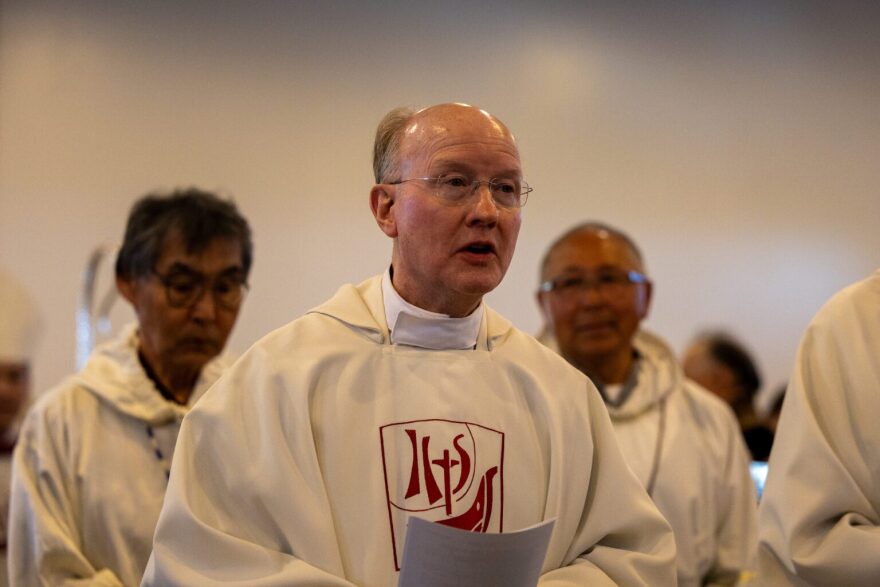
The Jesuits’ nearly 140 years in the state was honored at an event at Bethel’s Immaculate Conception Church on June 16. A procession of priests wearing long white gowns with red hems walked down the aisle to open the event. The Bishop of the Diocese of Fairbanks, Stephen Maekawa, thumped the ground with a shimmering silver staff known as a clozier as he approached the altar.
Bishop of the Diocese of Fairbanks, Steven Maekawa, walks toward the altar at the Immaculate Conception Church in Bethel.
“My brothers and sisters, we gather together to celebrate this wonderful and blessed occasion to acknowledge the love of God and the work of God through the 139 year mission of the Society of Jesus of the Jesuit fathers,” Maekawa said to open the event.
Advertisement
A traditional Catholic mass followed, with readings in both English and Yup’ik. During the sermon, Maekawa acknowledged the vastness of the Fairbanks diocese, and the tremendous amount of work done by the Jesuits to establish it.
“All of the 46 churches of the Diocese of Fairbanks that we currently have were established by either the Jesuit fathers or by direction of a Jesuit bishop,” Maekawa said. “We have a long history of the Society of Jesus’ presence and ministry here in all of Alaska.”
The Jesuits are an order within the Catholic Church, akin to the Dominicans or Franciscans. They have a reputation for taking on some of the Catholic Church’s most remote assignments.
That missionary spirit brought the Jesuits to the Yukon River in 1887, where they built churches, schools, and ministries. Without their work, Catholicism may not have taken root in huge swaths of Alaska, particularly among Alaska Native communities.
The Immaculate Conception Church in Bethel.
But the Jesuits leave a complicated legacy. Their methods of converting Native people to the religion, particularly in the first half of the 20th century, created generational traumas still felt to this day.
Advertisement
Fr. Sean Carroll is the provincial of the Jesuits West Province, which oversees Alaska and nine other states.
Fr. Sean Carroll, provincial of the Jesuits West Province, speaks at an event recognizing nearly 140 years of Jesuit service in Alaska.
“Thank you for all that you have taught us about who Jesus is and how to love and serve Him wholeheartedly,” Carroll said. “I also thank you for your patience with us. For there have been times when we have sinned and when we have hurt you.”
Missionaries, including the Jesuits, forcefully converted and assimilated Alaska Native people into Western culture and religion. Students at Jesuit-run boarding schools were forced to abandon their Native languages and physically punished when caught speaking languages other than English. Native dancing and drumming were also banned.
The Jesuits West Province maintains a list of 150 Jesuits with credible claims of sexual abuse against minors or vulnerable adults. A quarter of the accused Jesuits served in Alaska at some point in time.
“I ask for your forgiveness for all that we have done that was not rooted in Christ and love for Him, and for when we did not value your culture nor recognize the presence of God in you,” Carroll said.
Advertisement
Carroll gave the order to withdraw from the state last spring. A big issue was the recruitment of Jesuits willing to travel and serve in remote villages. He told the congregation that the Jesuits’ work would continue, just without a permanent presence.
Fr. Rich Magner, one of the two remaining Jesuit priests in Alaska, attends a ceremony in Bethel.
Fr. Rich Magner is one of the two remaining Jesuit priests in Alaska. His last day serving Chevak, Hooper Bay, and Scammon Bay is June 30.
“We all always knew coming in, or should have known, that we’re not going to be here forever. It’s going to be mission accomplished at some point,” Magner said. “And then we hand it off to the diocese that we’ve helped create, and so that’s a good feeling.”
Magner’s next stop is a Clinical Pastoral Education residency in Tacoma, Washington.
The other remaining priest, Fr. Tom Provinsal, first came to Alaska in 1968 to teach. A fond memory, he said, was meeting Elders that practiced traditional subsistence lifestyles.
Advertisement
“Some of the grandmothers, their fingers were just all bent with arthritis and stuff like that, you know, their whole lives they’ve been working out in the cold and the wet, doing food, sewing, all that kind of stuff,” Provinsal said. “I’d say I just feel very privileged to have come when I did come and to see that.”
Provinsal returned in 1975 as a priest and has served in the region ever since. After moving away, he plans to take a five month sabbatical. What happens next, he said, is in God’s hands.
Two lines formed in the aisle for communion at the end of the mass. After taking communion, Bethel’s Parish Administrator Susan Murphy gave a final thank you.
“It’s difficult to say goodbye to people who have been a part of our lives for so long,” Murphy said. “We know that you have done what was yours to do, and have taught us to do what is ours to do. We are grateful.”
Jesuit priests form a row along the altar of Bethel’s Immaculate Conception Church as members of the congregation lift their arms and pray.
Dominic Hunt, a Yup’ik deacon that flew in from Emmonak for the event, led the congregation through a final prayer.
Advertisement
“Bless them with your wisdom, that they may be a word of hope, a world in need. We ask this through Christ, our Lord. Amen,” Hunt said.
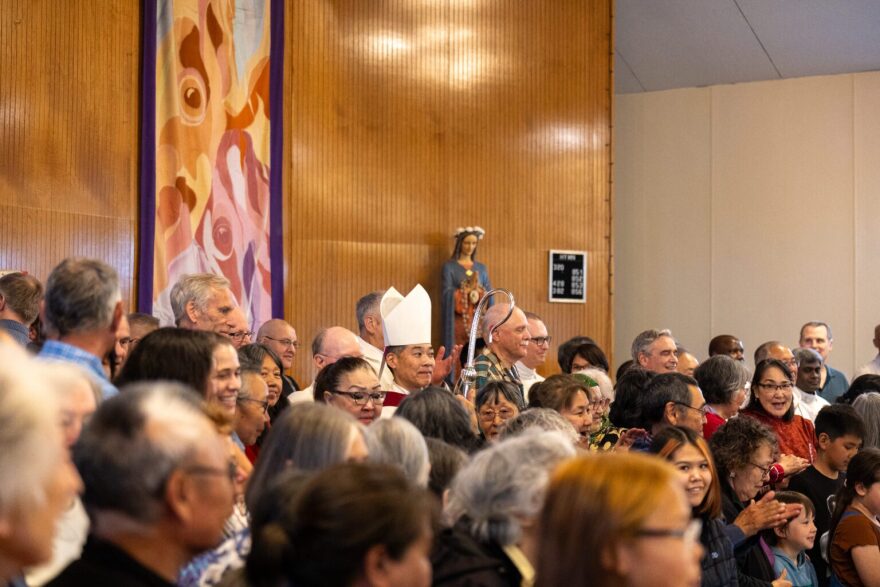
About 70 people posed for a photo on the altar – priests, deacons, parishioners, Elders and children — many of them smiling, some standing quietly.
The photo doesn’t tell the whole story. But it’s a moment when gratitude, grief, and memory all shared the same room.
Bishop of the Diocese of Fairbanks, Steven Maekawa, stands in the middle of a crowd waiting to take a photo at Bethel’s Immaculate Conception Church.
JUNEAU, Alaska (KTUU) – The Supreme Court of Alaska will be taking up the case of the State of Alaska, Division of Elections v. Daniel J. Sullivan, Jr.
The oral arguments will be held Monday at 10 a.m. via Zoom, according to an order and opening notice.
The document also specifies that a decision is expected to be made before noon on Tuesday.
According to documents from the Division of Elections, the state must start printing ballots at noon on the same day.
Advertisement
This comes after an Anchorage Superior Court Judge ordered Dan J. Sullivan on to the ballot Friday.
See a spelling or grammar error? Report it to web@ktuu.com