Alaska
Editorial: Decision time in Juneau: Discipline or make it rain?


Alaska has seen this movie before: oil prices spike, politicians celebrate and Juneau starts figuring out how fast it can spend the money.
The U.S. attack on Iran has pushed global oil prices higher, rattling energy markets and sending crude prices upward as supply fears ripple through the global economy. Energy markets surged as tanker disruptions and facility shutdowns across the Middle East threatened supply — a reminder that geopolitical shocks can move oil prices overnight.
For Alaska, that means something very specific: more money. But before Gov. Dunleavy and the Alaska Legislature start eyeing a fresh pile of cash like kids staring at a cookie jar, let’s get something straight. This is not prosperity. This is a temporary windfall driven by war.
And if the past is any guide, Juneau has a good chance to screw it up.
[Related news coverage: Spike in oil prices will boost Alaska revenue, but not enough to cover projected deficit]
Oil prices jumped sharply after the U.S. and Israel attacked Iran on Feb. 28, and analysts say prices could climb even higher if the conflict drags on. Some forecasts suggest oil could exceed $100 per barrel, which could mean roughly $1.5 billion more in revenue for Alaska in the coming year, according to reporting by the Juneau Empire.
That kind of money would erase much of the state’s budget deficit and could even fund a dividend north of $3,000.
Cue the political stampede.
In an election year especially, there will be lawmakers eager to promise giant Permanent Fund dividends fueled by this sudden surge in oil revenue. Expect campaign ads. Expect grandstanding. Expect speeches about “returning the wealth to the people.” And even before the attack on Iran, Gov. Dunleavy was already pushing an unsustainable full dividend for each Alaskan.
It’s a stupid idea — not because Alaskans don’t deserve dividends but because temporary revenue should never be used to make permanent promises. War-driven oil money is the worst possible revenue on which to build promises.
Alaska should know better by now
Alaska’s finances remain wildly exposed to oil price swings. A single dollar change in oil prices can move the state budget by roughly $25 million to $35 million, according to Alaska Public Media.
That volatility is exactly why treating a war-driven price spike as stable revenue is fiscal stupidity.
Even lawmakers watching the markets closely say the state should not assume the spike will last. As legislative leaders told Alaska Public Media, Alaska cannot build its spending plans around overly optimistic oil prices. Yet history tells us that when oil money shows up unexpectedly, discipline in Juneau disappears faster than reindeer sausage at the Tanana Valley State Fair.
The last time a global conflict sent prices soaring was after Russia invaded Ukraine in 2022. Oil shot above $100 a barrel for months. What did Alaska do? The Legislature and governor approved a massive dividend and energy payments totaling more than $2 billion. The state spent the money almost as fast as it arrived — don’t we wish we had those billions today?
Like any temporary high, it felt good at the time, and politically, it was wildly popular. It also did absolutely nothing to solve Alaska’s long-term fiscal problems.
The temptation is coming
The state’s spring revenue forecast arrives in about two weeks. If oil prices remain elevated, the numbers will suddenly look far healthier than they did a month ago.
That’s when it gets tempting. Lawmakers will start talking about “surplus revenue.” Candidates for public office will promise bigger dividends. The governor’s allies will argue the state can suddenly afford everything. Don’t fall for it.
As longtime Alaska fiscal analyst Larry Persily recently wrote in the Alaska Beacon, rising oil prices quickly create a long list of spending ideas in Juneau. But the real question isn’t how much money might arrive — it’s how long it will last. And nobody knows the answer to that. War-driven oil spikes can disappear just as quickly as they arrive.
If Alaska receives a revenue windfall from this conflict, the state should treat it for what it is: a one-time shot in the arm.
That means save it, invest it and strengthen the state’s fiscal stability.
Deposits into reserves like the Constitutional Budget Reserve — or even better, the Permanent Fund — would help rebuild the savings Alaska burned through during the last decade of deficits. Strategic investments in infrastructure, education and economic development would strengthen the state long after oil prices fall again.
What Alaska should not do is hand the entire windfall to voters as a massive dividend. That’s not fiscal policy. That’s a sugar rush.
A simple message for Juneau
There is nothing wrong with Alaskans benefiting when oil prices rise. Oil built this state, and its revenues still help pay for essential services. But relying on war-driven price spikes to fund giant dividends is reckless.
This moment will test the discipline of Alaska’s leaders. The attack on Iran may deliver Alaska a sudden burst of revenue. But the state’s long-term problems — structural deficits, unstable revenue and growing needs — will still be there long after oil prices settle down.
So here’s the message the governor and the Legislature need to hear: If this windfall arrives, don’t blow it the way you did last time.
Save it. Invest it. And for once, resist the urge to torch the cash in the middle of an election year.



I know I’m not the only Alaskan who is sick and tired of snow. We’ve had a long and unusually cold winter, and I want my lawn back. Probably, you do too, even if you don’t want to admit it. After nine months, it is not that hard to see the snow finally melt away.
As always, I can’t help but marvel how we lose most of our memories of last year’s arduous lawn chores, maybe the only good outcome of a long winter. Otherwise we might not have lawns at all.
Anyway, right now we are in the first part of the Alaska growing season. The seed racks are out and calling. No, they are screaming to us: Buy seeds! Be careful. It is easy to get carried away.
The fact of the matter is that many of us have already started seeds and many more will certainly be doing so this month. (You know the rule: You are not a real gardener unless you start at least one thing from seed by yourself.)
As I write this, I know the geese will be back late this week. It’s just like the swallows returning to Capistrano, and we all should be waiting and celebrating as a community. The first advance teams always arrive, snow or no, the first week of April. By mid-month, there are thousands of them, noisily and eagerly searching for food to sustain themselves.
Some stop here, but many continue migrating even farther north. And they are joined by trumpeter swans, snow geese and so many more birds. What a migratory sensation! Someone told me there are over 60,000 birds flying through Anchorage. Living on the bluff, I can believe it.
Anyhow, we threw down lots of wildflower seeds last fall, and I am hoping that they will germinate in a few weeks when this darn snow cover finally melts off.
The lawn beautification process that is characteristic of a northern population starved for flowers by a too-long winter will get underway. Ugh, and to continue to confront the dandelion war we have lost and no longer should fight. They are here and not going away. (What we should be doing is trying to develop different-colored ones.)
It is after April 1, a magical time for Alaska’s gardeners. It means there is sufficient natural light now, so you don’t have to have a set of grow lights under which to germinate your seeds (but you should — last nag of the season on this one). You can even grow tomatoes from seeds by the windowsill using natural light.
Remember, compost is the rule here, and if not available then organic potting soil should be used. Anything your plant might need is in organic soil or compost with the exception of mycorrhizal fungi and you can add that.
Remember, we are aiming to completely eliminate plastic materials from gardening. No more plastic pots! You could buy one of those gadgets to make paper ones, assuming you can find a source of newspaper with which to do so. I suppose you could substitute cardboard or paper bags if you can’t.
So, it’s been a long, long winter and one that was as cold as a bucket of penguin poop, as the saying goes. Who isn’t thrilled by the extended daylight? Even the most diehard skier can look forward to the end of the snow season. (The beginning of the garden season may just be why.)
All I can say is yippee! Melt, darn snow! Melt. It is gardening season now. We should all be happy campers.
Jeff’s Alaska Garden Calendar:
Alaska Pioneer Fruit Growers Association: Annual fruit tree grafting workshop at Begich Middle School, Sunday, April 19, 2-4 p.m. Rootstock for sale, free scion wood and instruction available. This is a great event and could be the start of a great hobby
Lilies: If you have been growing yours indoors, take them outdoors and keep there there until planted. Use a nice, wind-protected area in the shade.
Flowers to start from seed: Brachycomes, dianthus, stock, lockspar, asters, nicotiana, cleome, iceplant, zinnia and salpiglossis, schizanthus, nigella, phlox, portulaca, nemesia, marigold and nasturtiums.
Vegetables: Broccoli, kale, cabbage and cauliflower.
Gladioli: What are you waiting for?
Nurseries: Don’t wait. You should be buying plants and supplies. They can be hardened off when the birch tree leaves are the size of a squirrel’s ear.
Have an announcement? Send me announcements at least two weeks in advance of the event.
Alaska
‘He’s truly a legend in Alaska and beyond’: Loved ones remember Dick Griffith ahead of AK Sports Hall of Fame induction

ANCHORAGE, Alaska (KTUU) – In June, his life of adventure and innovation will be immortalized in the Alaska Sports Hall of Fame. But on Tuesday, it’s the memories he formed with countless others that earned its moment in the spotlight.
Dick Griffith, a man known for his epic nature exhibitions and an early user of the packraft, was honored at the Anchorage Museum earlier this week. It was a time for friends and family to reminisce about the near-century long outdoorsman.
“It was really moving for me,” former Alaska Mountain and Wilderness Classic runner and longtime friend of Griffith, Roman Dial, said. “I tried just to give a straight description of his life, like a bare bones, and it was hard not to weep a little bit because he meant a lot to me.”
Dial met Griffith in 1982, just before the first ever running of the classic. That interaction led to many lessons.
“I met him when I was at an influential age and he kind of changed my whole perspective about how to travel through the wilderness,” Dial said.
Dial was one of many Griffith appeared to impact in his 98 years on planet Earth. During the two-hour ceremony, which Dial led in organizing, several different individuals took the time to speak about him. Those stories ranged from surviving multiple bear encounters in the Alaska bush to simple meetups at the Eagle River Nature Center, of which Griffith was a big supporter.
Years later, those same people will soon see Griffith’s legacy remembered forever. Speaking with AK Sports HOF Executive Director Harlow Robinson in December, he said the legacy Griffith leaves behind was immense.
‘He’s truly a legend in Alaska and beyond both for his arctic exploration and being the first person to trek the arctic coast of North America and he’s got an amazing history pre-Alaska of white water rafter and river exploration,“ he said. ”He lived to be 98 years old and never slowed down until the end of his life.”
His accomplishments include traversing over 10,000 miles by foot and raft throughout his life. His longest trek, a 4,000-mile journey from Unalakleet to Hudson Bay in Canada, took nearly 12 years and almost a dozen annual trips.
“He imagined things that he would do and then he went and did them,” Dial said. “He didn’t look to see what other people did.”
Now just months out from that and many accomplishments being put in the public eye, Dial said the takeaways from Griffith’s experiences are universal.
“I hope that they take away not just the keep moving idea, but like to build a community and stay in touch with your community and to include people in what you do. But on the other hand, feed your own soul in whatever way it takes. I think he was really good at that,” Dial said.
He was a man remembered for time on the trail and his compassion to those he kept dear.
“He was affectionate, like in his own way. he cared about you,” Dial said. ”I’m not a big believer in the afterlife, but if there is one, you know, he’s up there with a big grin on his face, loving every minute of it.”
See a spelling or grammar error? Report it to web@ktuu.com
Copyright 2026 KTUU. All rights reserved.

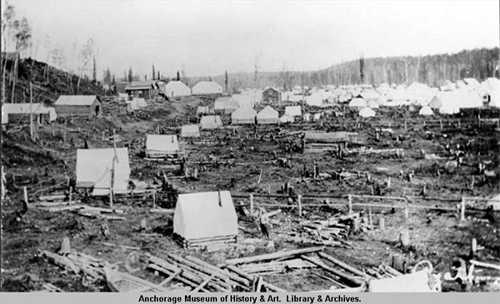
It was 111 years ago today that Anchorage began as the largest Alaskan city it is at present.
It was April 9th, 1915 that President Woodrow Wilson made his final decision as to the route of the Alaska Railroad from Seward to Fairbanks. The route led to the move of the headquarters from Seward to the tent city at Ship Creek in Anchorage, causing a boom in the area’s population.
2,ooo individuals from the Knik area scrambled to the Ship Creek area at first word of the railroad construction and this lawless, muddy area quickly became the foundation of the city of Anchorage.
The tent city would dissolve a mere three months later when 600 fixed lots were auctioned off on the bluffs above the creek and the townsite of Anchorage was formed.

Video: Mayor Mamdani Answers Questions From New Yorkers

How to buy Detroit Pistons 2026 NBA playoff tickets

Home of Sam Altman, CEO of OpenAI, hit with Molotov cocktail

Review: Sicily Comes to Dallas at Caffe Lucca, With Some Kinks to Work Out

A long line awaited the opening of Uniqlo in Downtown Crossing. Take a look inside. – The Boston Globe

Florida High School Football Rankings: Top 25 teams – Oct. 21

How old is Bo Nix? What to know about Oregon quarterback ahead of 2024 NFL Draft

Cleary's 21 help Le Moyne down Central Connecticut State 69-64 in OT

99th annual Pony Swim held in Virginia

Indiana Members Credit Union announced as new anchor tenant at Bottleworks District

Rep Randy Fine joins House Freedom Caucus: ‘Strongest group of conservative patriots in Congress’

Trump issues NATO ultimatum to reopen Strait of Hormuz ‘within days’

Women are getting most of the new jobs. What’s going on with men?

Video: How Trump’s Advisers Felt About Going to War With Iran

Unearthed clip exposes shocking claim by Newsom’s wife about inmates at violent California prison
-

 Atlanta, GA6 days ago
1 teenage girl killed, another injured in shooting at Piedmont Park, police say
-

 Education1 week ago
Video: We Put Dyson’s $600 Vacuum to the Test
-

 Movie Reviews1 week ago
Vaazha 2 first half review: Hashir anchors a lively, chaos-filled teen tale
-

 Education1 week ago
Video: YouTube’s C.E.O. on the Rise of Video and the Decline of Reading
-

 Georgia3 days ago
Georgia House Special Runoff Election 2026 Live Results
-

 Pennsylvania4 days ago
Parents charged after toddler injured by wolf at Pennsylvania zoo
-

 Education1 week ago
Video: Toy Testing with a Discerning Bodega Cat
-
 Milwaukee, WI4 days ago
Potawatomi Casino Hotel evacuated after fire breaks out in rooftop HVAC system