Connect with us

West

2 Kennedy children endorse opponent of progressive Los Angeles DA, cite parole hearing for RFK's killer

Published

on

2 Kennedy children endorse opponent of progressive Los Angeles DA, cite parole hearing for RFK's killer

Two of Robert F. Kennedy’s adult children threw their support behind a former federal prosecutor running against current Los Angeles County District Attorney George Gascón, citing his progressive policies, noting that it was the first time they had supported a candidate against a Democrat. 

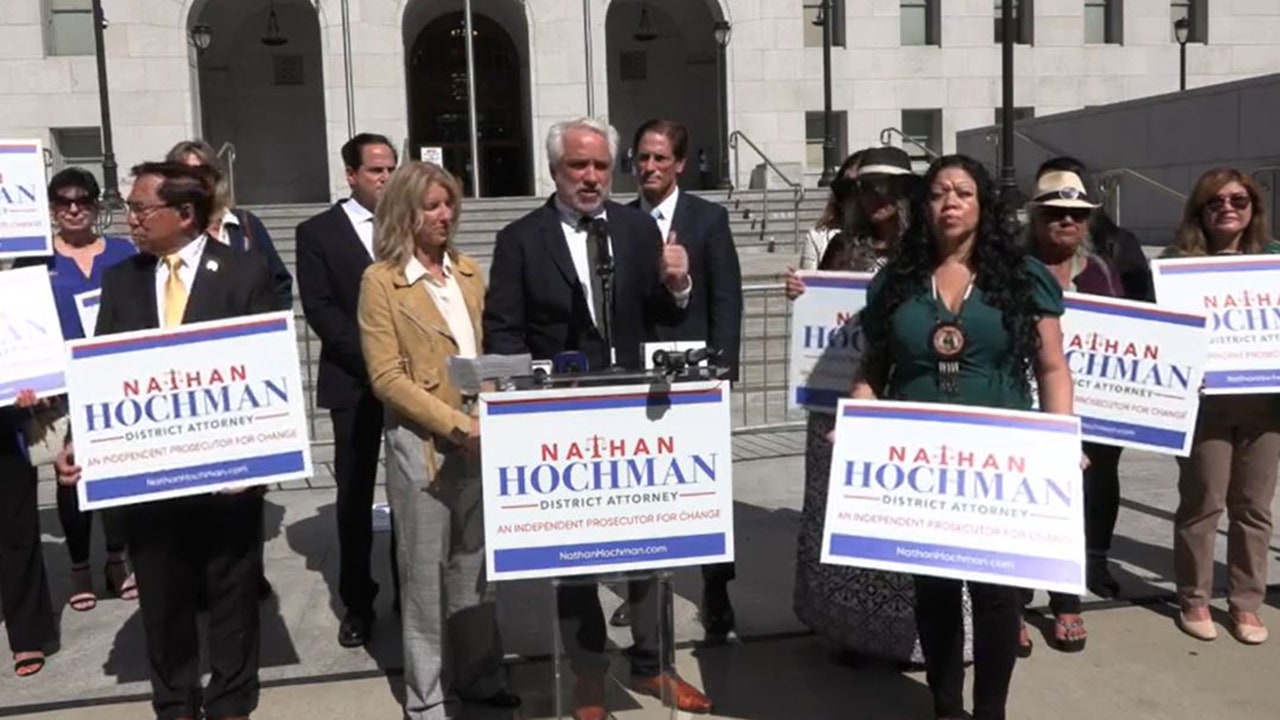
Max and Rory Kennedy announced their support of Independent Nathan Hochman in downtown Los Angeles in front of the Hall of Justice, where they accused Gascón, who is up for re-election, of failing to support victims of crime and their families.

“A lot has been written about Gascón and his questionable policies, Rory Kennedy said. “My family and I have lived through them.”

DAUGHTER OF ARMY VETERAN KILLED IN FRONT YARD CALLS FOR JUSTICE, CHANGE TO POLICIES: ;THIS IS A VICIOUS CYCLE’

Max and Rory Kennedy in Los Angeles on Tuesday to announce their support for Independent Nathan Hochman for Los Angeles County District Attorney.  (Front Page Index)

Advertisement

The Kennedys and Hochman specifically cited a DA office policy of barring prosecutors from attending parole hearings to argue against the early release of criminals, including Sirhan Sirhan, 79, who assassinated Sen. Robert F. Kennedy in 1968, at the former Ambassador Hotel moments after he delivered a victory speech in the pivotal California primary. 

Sirhan was convicted of first-degree murder for the slaying. 

“The reason we’re here is because Gascón’s policies are failing Los Angeles,” Max Kennedy said alongside mothers who have lost children to crime. 

Gascón has been heavily criticized after riding a 2020 progressive wave of promises to reform the way Los Angeles County prosecutes criminal suspects. Upon taking office, he issued a number of directives, including the prohibition of charging juveniles as adults, even for violent crimes, supporting zero cash bail and other progressive measures. 

CALIFORNIA DEPUTIES SHOT, KILLED TEEN KIDNAPPING VICTIM AS SHE WAS SEEN SURRENDERING: VIDEO

Advertisement

Los Angeles County District Attorney George Gascón is up for re-election. (Brian van der Brug / Los Angeles Times via Getty Images)

Max Kennedy said loved ones of victims of crimes have been deserted by the DA’s office and left to face the court system alone because of such policies, prompting him and his sister to throw their support toward Hochman. 

“This is the first that we’ve ever supported a candidate against a Democrat,” he said. 

Sirhan was found eligible for parole in 2022, but California Gov. Gavin Newsom reversed the decision. He was denied parole again in 2023. The Los Angeles County District Attorney’s Office didn’t send a prosecutor to the parole hearings in 2022 and 2023, as part of a new policy instituted by Gascón. 

Sen. Robert F. Kennedy speaks to the delegates of the United Auto Workers at a convention hall in Atlantic City, N.J., May 9, 1968. (AP Photo, File)

Advertisement

Hochman noted that the district attorney is involved in most aspects of criminal investigations and the prosecution of suspects. 

“Yet somehow, someway, DA Gascón views his responsibility as ending when that murderer seeks to get out of prison early,” he said. 

Sirhan Sirhan, left, was recommended for parole by a California board in 2022 for the 1968 assassination of Sen. Robert F. Kennedy.  (California Department of Corrections and Rehabilitation via AP; Photo by KEYSTONE-FRANCE/Gamma-Rapho via Getty Images)

Fox News Digital has reached out to Gascón’s campaign. In 2021, his office told Fox that prosecutors weren’t sent to Sirhan’s parole hearing as part of a promise to refrain from influencing the proceedings. 

Advertisement

“The role of a prosecutor and their access to information ends at sentencing,” Gascón’s office said at the time. “The parole board, however, has all the pertinent facts and evaluations at their disposal, including how someone has conducted themselves over the last few decades in prison. The parole board’s sole purpose is to objectively determine whether someone is suitable for release.”

Read the full article from Here

Continue Reading
Click to comment

Leave a Reply

Your email address will not be published. Required fields are marked *

This site uses Akismet to reduce spam. Learn how your comment data is processed.

Utah

Why America’s biggest companies gave up the fight against Utah’s app store law protecting kids

Published

on

Why America’s biggest companies gave up the fight against Utah’s app store law protecting kids


  • An industry group representing Apple and Google withdrew its complaint against Utah’s App Store Accountability Act. 
  • Lawmakers changed the law during the 2026 session to make it only enforceable through private lawsuits.
  • Several states are following Utah’s lead as courts decide whether age verification laws violate speech rights.

One of the largest technology groups in the country backed off from challenging Utah’s age verification requirement for app stores last week.

The Computer & Communication Industry Association withdrew its complaint after confirming the law could not be enforced by government prosecution.

But that was never the main intent of Utah’s first-in-the-nation policy.

The groundbreaking law, which was passed in 2025 and updated in 2026, relies on the threat of private lawsuits to shift corporate behaviors regarding children.

“They’re terrified of the private right of action,” bill sponsor Sen. Todd Weiler, R-Woods Cross, told the Deseret News. “Good fences make good neighbors. I think good potential for liability makes good corporate neighbors.”

Advertisement

Utah’s law orders app stores to verify users’ ages and to request a parent’s consent before a minor can download an app, agree to terms of service or make an in-app purchase.

Parents must be informed of whether the app has an age rating and how it will use their child’s information. Parents of harmed minors may sue app stores for violations.

The principle that minors are unable enter into contracts is respected in most commercial settings, according to Weiler. Starting May 6, 2027, that will also apply to app stores.

Why did Big Tech drop their lawsuit?

Despite CCIA’s lawsuit filed in February, the Utah Legislature didn’t narrow or reverse the law during the 2026 legislative session — they strengthened it.

Lawmakers expanded the App Store Accountability Act to cover pre-installed apps, apps that change to include ads and accounts created before the law goes into effect.

Advertisement

In reaction to CCIA’s lawsuit, they did remove a provision that allowed state agencies to enforce parts of the law under Utah’s deceptive trade practices statute.

The CCIA recognized this change when the updated bill became law in March, but continued to allege constitutional First Amendment violations for another month.

On April 21, the Utah Attorney General’s Office reaffirmed the law does not authorize enforcement by a government entity; it only creates a private right of action.

After suing the state, allegedly over free speech concerns, the industry group, representing Amazon, Apple, Google and Meta, withdrew its complaint the same day.

“With the state’s confirmation that it will not and cannot enforce this statute, the Association’s complaint has achieved its objective,” CCIA President & CEO Matt Schruers told the Deseret News in a statement.

Advertisement

Leading the nation in child protection

Utah’s law, empowering parents to sue Big Tech giants who fail to get parental consent for app downloads, emerged almost entirely intact from the legal battle.

CCIA’s decision to drop its lawsuit before a judge ruled on the law cements Utah’s status as a leader on child-protection policies and signals a national shift, Weiler said.

“It was a victory for the law,” Weiler said. “ I think that the day of reckoning, it’s not coming, it’s already here. And I think that we need to see a lot of reform. We’ve got to do a better job of protecting our kids.”

In 2023, Utah passed landmark legislation forcing social media to verify users’ ages, to give maximum privacy to minors and to remove addictive engagement features.

The law quickly invited litigation from NetChoice, representing Google, Meta and Snapchat, and was enjoined in 2024 while its constitutionality is litigated.

Advertisement

During the legislative session, lawmakers postponed implementation of the App Store Accountability Act from May 2026 to 2027 to see how tech companies respond.

Weiler expects Utah to become the first state with app store age verifications next year after the U.S. Supreme Court upheld similar requirements for porn websites in June.

What’s next for Utah’s law?

But the national legal environment is still far from settled on the question of age verification measure.

In December, CCIA successfully pushed for an injunction on a similar law in Texas as part of a national push to discourage states from pursuing age verification proposals.

Texas has appealed the ruling. It is expected to end up before the United States Supreme Court, which has signaled a desire to balance free speech with child protection.

Advertisement

The Digital Childhood Institute, the Utah-based group behind the App Store Accountability Act, filed an amicus brief in support of the Texas law, which it also helped to craft.

The Texas law, passed a few months after Utah’s, has stricter requirements around age ratings, and tasks the attorney general, instead of private citizens, with holding companies liable.

But, according to the amicus brief, which was filed with the Utah conservative think tank Sutherland Institute, lawsuits against app store age restrictions dodge the main question:

Should apps make contracts with minors without a parent being informed about what their child is agreeing to?

Corinne Johnson, executive director of Utah’s Child First Policy Center, said the fact that more than a dozen other states are following Utah’s lead suggests that the answer is clear.

Advertisement

“Big Tech spent enormous resources trying to kill a law that simply asks them to be accountable to Utah families,” Johnson said in a statement. “They failed. The App Store Accountability Act stands.”


Source link

Continue Reading

Washington

GDC: 12 inmates charged in ‘gang-affiliated disturbance’ at Washington State Prison

Published

on

GDC: 12 inmates charged in ‘gang-affiliated disturbance’ at Washington State Prison


12 inmates are facing additional felony charges in January’s “gang-affiliated disturbance” at Washington State Prison that left four inmates dead and over a dozen injured.

The Georgia Department of Corrections (GDC) confirmed that the 12 male offenders have been charged with Felony murder, aggravated assualt, gang participation and unlawful acts of violence in a penal institution in connection to the investigation of the deadly incident at Davisboro prison.

Jimmy Trammell, Ahmod Hatcher and Teddy Jackson (Courtesy: Washington County Sheriff’s Office).{ }

42-year-old Jimmy Trammell, 23-year-old Ahmod Hatcher and 27-year-old Teddy Jackson died in the altercation, while Silas Westbrook, who was injured in the fight, later died following a “medical emergency” while being transferred from of Washington State Prison, the GDC says.

READ MORE | Search for 2 of 13 suspects underway in Macon-Bibb County RICO investigation, BSO says

Advertisement

The following inmates have been charged in the case and the sentences they are currently serving, per the GDC:

  • Bryce Sims – Serving 35 years for Voluntary Manslaughter out of Fulton County.
  • Versache Evans – Serving 20 years for aggravated assault out of Spalding County.
  • Willie Beckham III – Serving 15 years for involuntary manslaughter out of Spalding County.
  • Kadeem Blenman – Serving life in prison for armed robbery out of Richmond County.
  • Aquinas Bush– Serving 10 years for obstruction of law enforcement officers out of Richmond County.
  • Christopher Bonner – Serving 20 plus years for armed robbery out of Rockdale County.
  • Jacorey Streeter – Serving 10 years for theft by taking out of Irwin County.
  • Paul White – Serving 40 years for robbery by force in Tift County.
  • Eric Howard – Serving nine years for trafficking narcotics in Clayton County.
  • Brandon Drummond – Serving 25 years for aggravated assault out of Gwinnett County.
  • Christian Brown – Serving 30 years for aggravated assault out of Sumter County.
  • Javarius Spaulding – Serving 55 years for aggravated assault out of Bulloch County.

The GDC says the investigation remains active.

Stick with WGXA as we learn more and keep you ready for what’s next.


Source link

Continue Reading

Wyoming

In Gun-Friendly Wyoming, When Is It OK To Shoot Somebody?

Published

on

In Gun-Friendly Wyoming, When Is It OK To Shoot Somebody?


Wyomingites love their guns, and many have no qualms about keeping a firearm by their bedsides, in their vehicles and even on their persons, in case any hooligans want to try starting something.

However, experts warn that this isn’t the Wild West any longer. Even in the most justified cases of shooting in self-defense, the shooter will be investigated. And one wrong move or bad decision can land them in big legal trouble, or possibly prison.

And even if somebody who shot in self-defense is cleared of any criminal wrongdoing, they still might face civil actions that could ruin them financially.

In short, the decision to carry a firearm with the intent that you might someday have to use it to save your life or other innocent lives isn’t something to be taken lightly, Casper attorney Ryan Semerad told Cowboy State Daily.

Advertisement

“It’s going to cause an investigation, and the investigation needs to be completed because it’s a hugely consequential matter,” said Semerad, who has defended civilians and law enforcement officers in use of deadly-force cases. “You might have just killed or nearly killed somebody.”

There are also the psychological effects to consider, he added.

“Taking a life is huge. I’ve never met a person who has taken another person’s life who hasn’t been touched by that experience,” Semerad said.

“If you’re not ready for that, don’t put yourself in that situation,” he added.  

Wyoming law is about as friendly as it gets toward gun rights and self-defense, but even here, the rules for opening fire on somebody are complicated. The wrong decision can land a shooter in big legal trouble. (CSD File)

When To Open Fire

Statutes governing the use of lethal force can vary by state, but there are overarching criteria that apply across the country, said James Cullers of Casper, a certified trainer with the U.S. Concealed Carry Association (USCCA) and National Rifle Association (NRA).

Advertisement

“You can’t initiate the scenario, you can’t escalate that scenario,” he told Cowboy State Daily.

USCCA lays out four basic rules for legitimate self-defense in most states:

• A reasonable and immediate fear of death or serious bodily harm to yourself or another person.

• The shooter must be an innocent party.

• No lesser use of force is sufficient or available to stop the threat.

Advertisement

• There is no reasonable means of retreat or escape.

Inside people’s homes, Wyoming’s strong “castle doctrine” standard favors residents claiming self-defense, Semerad said.

Wyoming’s justified use of force statute errs on the side of residents assuming that somebody trying to cross their threshold without their blessing means harm.

“A person who unlawfully and by force enters or attempts to enter another’s home or habitation is presumed to be doing so with the intent to commit an unlawful act involving force or violence,” according to the statute.

Even so, blasting away at somebody who is trying to run out your door with your television set would likely not be regarded as justified, Semerad said.

Advertisement

“You’ve got to let them go,” he said.

Outside of the home, matters get more complicated.

Wyoming statute makes it clear that the person who draws and fires can’t have been the initial aggressor in the situation, was where they had a legal right to be, and wasn’t engaged in illegal activity.

Semerad cited a case of a “weed dealer” who had another person threaten to kill him and fired in what he thought was legitimate self-defense.

However, since the dealer was engaged in illegal activity at the time of the shooting, he ended up going to prison, Semerad said.

Advertisement

Likewise, somebody who was trespassing and got into a deadly confrontation wouldn’t be able to claim legitimate self-defense, because they didn’t have a legal right to be where they were when the confrontation occurred, he added.

Self-defense experts recommend people who carry firearms in Wyoming get training.
Self-defense experts recommend people who carry firearms in Wyoming get training. (Courtesy U.S. Concealed Carry Association)

Situations To Avoid

One rule of concealed carry is to do everything reasonably possible to avoid sketchy places or situations, Cullers said.

“Don’t go down that dark alley (even when armed). If it takes you a little bit longer to walk around the block to your car, then walk around the block and don’t go down the dark alley,” Cullers said.

People who choose to carry firearms should be alert, he added.

“Don’t be walking down the street with your head in your cellphone,” Cullers said

Semerad said people who have had “even one drink” shouldn’t carry their firearms, because that could lead to poor decisions.

Advertisement

Likewise, firearms shouldn’t be present in emotionally fraught situations, he said.

Most assaults and murders don’t result from random law-abiding citizens being attacked by violent strangers, Semerad said.

Rather, they take place between people who know each other well and get into situations where emotions spiraled out of control, such as quarrels over money or romantic jealousy, he said.

Bringing A Knife To A Gunfight

Another common misconception is that it’s not justified or fair to shoot somebody who has only a knife or a club, or perhaps isn’t even armed, Cullers said.

The legal justification for self-defense shootings often hinges upon a disparity of force, he said.

Advertisement

So, for instance, a petite woman might be justified in using a gun if she’s attacked by a huge, strong man, even if he’s unarmed, Cullers said.

And just because somebody has a knife doesn’t mean that they aren’t a deadly threat to somebody with a gun, he said.

Law enforcement data indicates that somebody 21 feet away, or perhaps even 30 feet away, with a knife can be swift and deadly, Cullers said.

It’s commonly known as the “Tueller Drill,” and is a law enforcement training tool, not a legal rule or absolute law. 

“Someone with a knife can cover 21 feet in a second and a half. Most people could not draw a weapon and fire to protect themselves in the time it takes the attacker to cover that 21 feet,” he said.

Advertisement
Wyoming law is about as friendly as it gets toward gun rights and self-defense, but even here, the rules for opening fire on somebody are complicated. The wrong decision can land a shooter in big legal trouble.
Wyoming law is about as friendly as it gets toward gun rights and self-defense, but even here, the rules for opening fire on somebody are complicated. The wrong decision can land a shooter in big legal trouble. (CSD File)

Get Training, Legal Protection

The Wyoming Legislature this year passed a law allowing 18-year-olds to apply for concealed carry permits.

Cullers said that while he’s glad to see more people getting that right, he also stressed the need for proper knowledge and training.

And that should be two-pronged, he said. First, having a clear knowledge of the legal parameters of the use of deadly force. Second, training how to properly carry, draw and accurately fire a sidearm.

Cullers and Semerad said that a firearm should be a tool of last resort. People who wish to defend themselves should consider “less-lethal” options to use first, such as pepper spray, tasers or guns that shoot pepper balls instead of bullets.

“If you can carry a firearm, you can carry pepper spray. And if pepper spray will do the trick, then carry pepper spray,” Semerad said.

Those who choose to carry a firearm for self-defense should be prepared to have a legal defense, if they ever have to use deadly force, Cullers and Semerad said.

Advertisement

Cullers said that USCCA and other organizations, as well as some private law firms, offer self-defense legal insurance for concealed carry permit holders.

That can be particularly handy for people who are cleared of any criminal law violations in a self-defense shooting, but then get slapped with a civil lawsuit, he said.  

Semerad said his clients, civilians and law enforcement officers alike, paid a traditional retainer fee.

“Personally, nobody has ever hired me through an insurance company, I don’t know if I would accept that arrangement,” he said.

Mark Heinz can be reached at mark@cowboystatedaily.com.

Advertisement


Source link

Continue Reading
Advertisement

Trending
