Sports
Plaschke: How one man lost Shohei Ohtani's 40-40 home run ball and found L.A. love in return

His life was changing. A winning lottery ticket was approaching. Tony Voda was ready.
He was going to be rich. He was going to be famous. Magic was happening, and as the baseball fell from the night sky, Tony Voda was ready to live a miracle.
Shohei Ohtani was in the process of entering baseball’s 40-40 club with a walk-off grand slam in the ninth inning last week at Chavez Ravine, one of the most dramatic blasts in the long history of Dodger Stadium, and this anonymous insurance analyst from Minneapolis was right in the middle of it.
“Right up until the last second against the beautiful black night sky, I can see the ball, it’s seared into my mind, this is happening, this is really happening,” Voda recalls. “The crowd is screaming but you’re not hearing it, your senses shut down, tunnel vision happens, and all you can think of is, don’t mess this up.”
Then the unthinkable occurred, an event that forever changed Tony Voda on his way to becoming a hero.
He messed it up.
Shohei Ohtani hits a walk-off grand slam for the Dodgers against the Rays to join the 40-40 club.
A gazillion video replays have chillingly shown it a gazillion times.
He messed it up.
“A life-changing event was in my hands,” he said, “and I literally dropped the ball.”
This, then, would seem to be not your usual home-run catching story of good luck and great fortune, but a tale of deep remorse and enduring regret.
Except for one twist as pronounced as Ohtani’s swing.
On a Friday night when Tony Voda figured he was cursed, he was actually blessed.
For the man who will forever be known for one of the biggest fan errors in Dodger Stadium history, it wasn’t about what he lost, it was about what he gained.
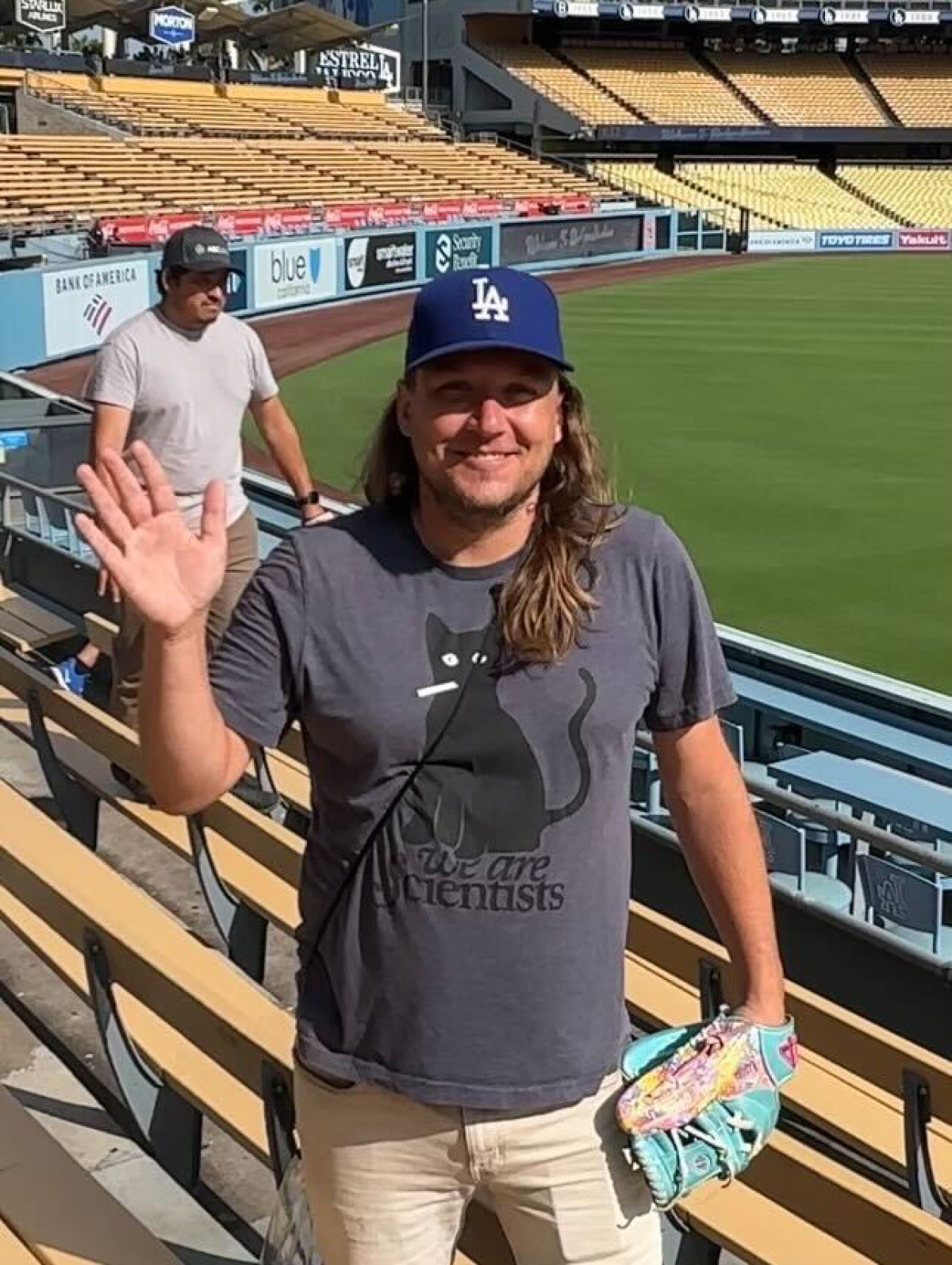
Tony Voda waves before a game between the Dodgers and Tampa Bay Rays at Dodger Stadium on Aug. 23.
(Courtesy of Tony Voda)
It looks so easy and natural on television. But in real life, catching a home-run ball is about as easy as catching a raindrop in a thunderstorm.
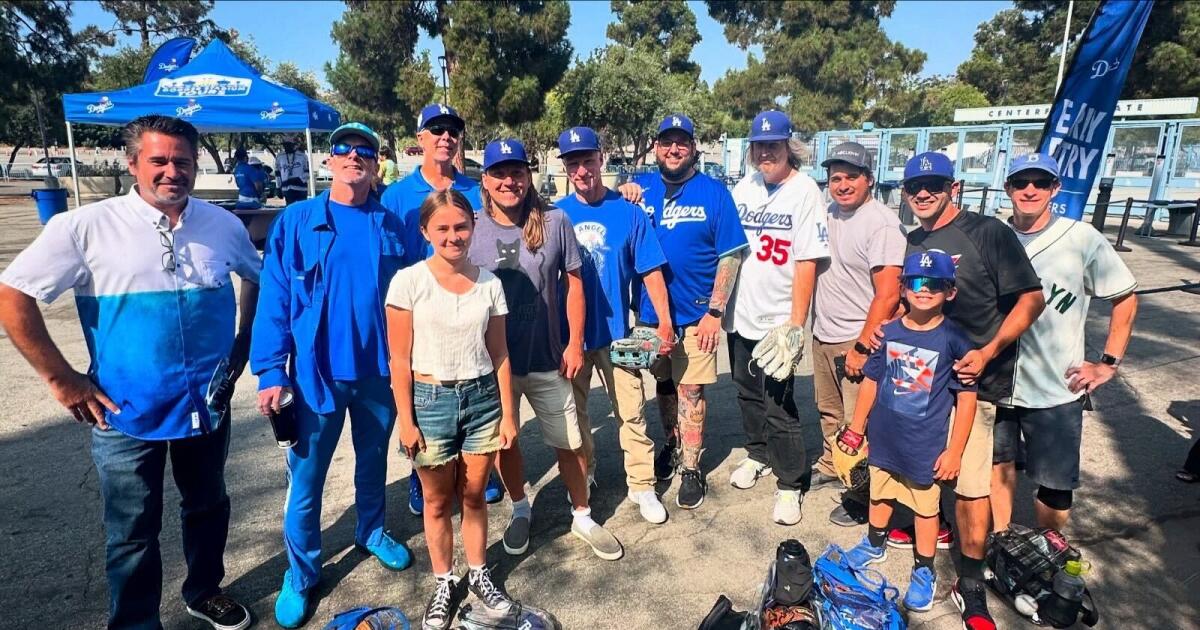
“The average fan has no idea,” says Matt Walker, one of a dozen members of “Dodgerhawks,” a group of season-ticket holders that gathers at Dodger Stadium in an attempt to catch homers.
It’s nearly impossible.
“Did you see it clearly off the bat because you’ve been following every pitch? Are you on your phone? Is it hooking? Drawing? Is the wind a factor?” Walker explained. “The crowd is elbow to elbow and you’re getting pushed and shoved usually. Is it going to clear the wall, are you at risk of interference, is the outfielder bearing down?”
Walker said the conditions for such a catch are frightful.
“Are you standing in spilled beer, water bottles, and loose peanut shells? Are the lights a factor? The sun?” he said. “Oh yeah, and it’s coming in at 100-plus miles-per-hour. And the whole thing takes maybe three seconds.”
Tony Voda, 40, knows these truths. He has been chasing home run balls in stadiums all over the country for 15 years and he’s caught exactly two.
“Home run balls are important to me because of that deep childhood tie to the game,” he said. “You see them going into the stands as a young kid and you not only want to be the guy who hit it, but the kid who has the souvenir.
“It’s one of the only pieces of sports that rarely makes it into the stands but is coveted by many because of how elusive it is.”
It’s so elusive, Voda paid several hundred dollars a couple of months ago for one of the Dodgers’ celebrated home-run seats lining the outfield walls. He picked a random game against the Tampa Rays as part of a longer baseball trip through California.
He had no idea Ohtani would be on the verge of becoming only the sixth player in baseball history to reach 40 home runs and 40 steals in a single season. He could never have dreamed that Ohtani would steal his 40th base in the fourth inning and then come to the plate with bases loaded into the ninth with a chance to make history.
“I would have been happy if any Dodger scrub hit it to me,” he said. “And then this happened.”
This, meaning Ohtani lofting a ball high toward the right-center field wall.
This, meaning that ball barely clearing the fence and falling directly toward Voda’s rainbow-colored glove.
This, meaning the ball bouncing off Voda’s glove and back to the field, where it is finally picked up by outfielder Jose Siri and thrown back into the stands far beyond Voda’s reach.
Grand slam. Grand boot.
“Every fan’s worst nightmare,” said Walker.
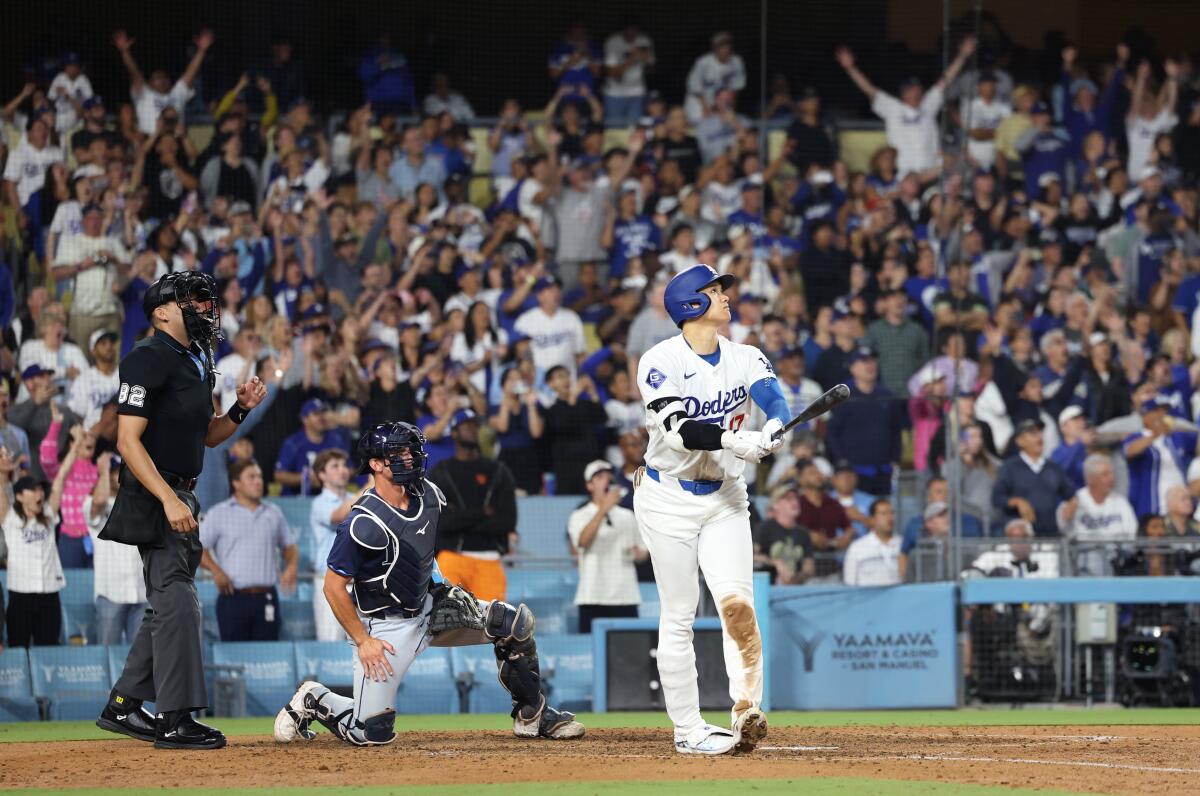
Dodgers star Shohei Ohtani hits a walk-off grand slam against the Tampa Bay Rays for his 40th home run of the season on Aug. 23.
(Wally Skalij / Los Angeles Times)
Gone was a chance to meet Ohtani and return the ball, which Voda said he would have done. Gone was a six-figure payday if Ohtani didn’t want to exchange anything for the ball. Gone was the greatest moment of Voda’s baseball life.
He knew all this, and he knew it immediately. Watch the replay and notice that the moment the ball bounces off Voda’s glove, he puts his hands on his head with an expression of deep pain.
“Pure shock, disbelief,” Voda said. “My heart sank.”
As he stood there stewing in his agony, fully expecting jeers and catcalls from the surrounding pavilion crowd, the strangest thing happened.
His phone buzzed. It was Walker, who had met Voda before the game with other Dodgerhawks. He had already watched the replay and wanted to console Voda immediately.
“What just happened? What did I do?” Voda moaned into the phone.
“You did your best,” Walker told him. “You did all you could.”
Sure enough, the replay shows a fan on Voda’s left bumping the pinky of his glove just a few inches before the ball landed, enough to prevent the ball from burrowing deep into the glove’s pocket.
“I guess it’s the ‘Minnesota Nice’ in me, I should have boxed the guy out, but I just didn’t want to interfere with another fan,” said Voda.
Also noticeable was Voda’s refusal to move to the edge of the fence, from where he might have had a cleaner shot at the ball.
“I didn’t want to get called for fan interference and see the home run taken away, are you kidding me?” said Voda. “I was being very careful.”
Too careful? Maybe. But maybe not.
The good sportsmanship with which Voda handled himself was noticed not only by Walker, but by several fans who surrounded Voda while he was accepting that initial phone call.
“You could hear people all around Tony while I was talking to him, and everybody was already consoling him,” said Walker. “It was as if, when he put his hands over his head, we all put our hands over our heads.”
The outpouring of support continued throughout the ensuing drone show, fans from all sections surrounding him and patting his back and sharing his regret, with one fan even accompanying Voda to his car afterward to commiserate on his bad luck. Then there were the words of encouragement from one stranger he’ll never forget.
“A guy came up to me and just said, ‘Next time, poppa,’” Voda recalled. “Like he was actually giving me a pep talk.”
Dodger Stadium can be a cantankerous place, particularly when a ball is hit into the stands. If a fan catches an opposing player’s home run, the verbal pressure to throw the ball back can be deafening.
But on this night, Dodger Stadium was a sympathetic, understanding place that filled Tony Voda with a warmth that no catch could match.
By the time he returned to his hotel he had received several dozen texts and many online words of support. There was no trolling. There were no insults. There was only a sense of kinship among Dodger fans who, it turns out, not only are historically forgiving of the players, but are also forgiving of each other.
“To catch the ball would have been potentially life-changing, but, so, too, were the lessons I took away from missing it,” said Voda. “I know it sounds cheesy and silly, but while I may have lost a ball, I gained more love from Dodger fans than I knew I had, more love than I thought I deserved.”
Voda is back in Minneapolis now, but he is hoping to return to Dodger Stadium again one day, hang out with the Dodgerhawks, buy another home run seat, stick out that rainbow glove on a long fly ball, pray again for a miracle while knowing full well that he has already lived one.
“I love L.A.,” he said.
Moments before Ohtani’s swing, a security guard standing next to Voda wondered out loud if this game was headed for a movie script ending.
In all ways, it was, as Ohtani wasn’t the only one who went deep.
So, too, did humanity.


NEWYou can now listen to Fox News articles!
In previous years, the Round of 16 was the first knockout stage match, but with an expanded field of 48 teams— it is now the second.
Let’s check out the odds at FanDuel Sportsbook as of July 2 for which countries are favored to make the Round of 16 and emerge from it.
This page may contain affiliate links to legal sports betting partners. If you sign up or place a wager, FOX Sports may be compensated. Read more about Sports Betting on FOX Sports.
To Reach Round of 16
Argentina: -2000 (bet $10 to win $10.50 total)
Colombia: -550 (bet $10 to win $11.82 total)
Portugal: -340 (bet $10 to win $12.94 total)
Switzerland: -235 (bet $10 to win $14.26 total)
Egypt: -148 (bet $10 to win $16.76 total)
Australia: +122 (bet $10 to win $22.20 total)
Algeria: +186 (bet $10 to win $28.60 total)
Croatia: +260 (bet $10 to win $36 total)
Ghana: +380 (bet $10 to win $48 total)
Cape Verde: +1160 (bet $10 to win $126 total)
Now let’s check out the odds at FanDuel Sportsbook as of July 2 for the matchups already in place.
SATURDAY, JULY 4
Canada vs. Morocco
To Advance: MAR -300, CAN +225
Moneyline: MAR -130, Draw +240, CAN +420
Paraguay vs. France
To Advance: FRA -1800, PRY +1140
Moneyline: FRA -600, Draw +600, PRY +1800
SUNDAY, JULY 5
Brazil vs. Norway
To Advance: BRA -245, NOR +196
Moneyline: BRA -120, Draw +260, NOR +340
Mexico vs. England
To Advance: ENG -134, MEX +110
Moneyline: ENG +145, Draw +210, MEX +200
MONDAY, JULY 6
USA vs. Belgium
To Advance: USA -110, BEL -110
Moneyline: USA +165, Draw +230, BEL +170
Sports
Thousand Oaks native Claire Liu finally reaches Wimbledon’s third round, will face Coco Gauff

LONDON — Claire Liu packed her bags and checked out of her London hotel room on Wednesday morning before heading to the All England Club.
It was more pragmatism than pessimism — a reality of a qualifier navigating her Wimbledon journey one day at a time.
But as her boyfriend reminded her while organizing her luggage: “Just because you’re packing doesn’t mean you’re leaving,” Liu recalled with a laugh.
He was right.
The Thousand Oaks native went on to win her second-round match against 51st-ranked Zeynep Sonmez of Turkey 7-5, 6-3, advancing to the third round of a Grand Slam for the first time in her professional career. She had tried 29 previous times at majors, including qualifying rounds, since 2015.
“I was just super relieved to get through that,” said Liu, noting she had blown a set and a break lead in the French Open’s second round last month.
For Liu, who turned 26 in May, returning to the manicured lawns of SW19 brings her tennis journey full circle. Nine years ago, she captured the 2017 Wimbledon girls’ singles title — the first American to do so since Chanda Rubin in 1992 — and was the No. 1 junior in the world. She still holds fond memories of that heady achievement, including chatting with her idol, Roger Federer, at the Wimbledon Champions Ball.
Yet, the transition from teenage phenom to professional mainstay has been anything but a linear ascent. When asked if she expected to be in the third round of a major this late in her career given her junior success, Liu was candid.
“Younger me would have believed it more than now,” she said.
That shift in perspective comes after weathering some brutal setbacks.
Liu climbed as high as No. 52 in early 2023 but then endured a wrist injury and took a months-long mental health hiatus in 2024 that eventually saw her ranking plummet outside the top 400 last year.
Currently sitting at No. 146, she’s been rebuilding her standing by playing a mix of WTA 125 events and ITF tournaments before returning to the main WTA Tour, with 2026 stops in far-flung places from Bahrain to Boca Raton and plenty of places in between.
“My goals haven’t changed, but I think the stress of how I got there really took a toll on me,” said Liu.
To navigate the darkness, Liu leaned heavily into both sports psychology and traditional therapy, including EMDR, a technique that helps people process traumatic experiences. She also started a Substack newsletter called “Finding Claire-ity,” where she openly chronicles her life and struggles on the tour.
The Southern California native, who has trained at the USTA facility in Carson since she was 9 years old and resides in Redondo Beach, also split with her longtime coach last season, a difficult decision, and hired Clemens Wagner.
The switch following the U.S. Open last year is clicking.
“I saw in her someone who fought a lot of battles inside herself,” says Austrian-born Wagner, who has a background in tennis analytics.
Together, they have focused on keeping an “aggressive undertone” on the grass, emphasizing coming to the net and squeezing the most out of her game.
Wagner notes that the 5-foot-7 player’s game isn’t the flashiest, but describes her as a “silent killer” who excels at “redirecting pace, standing close to the baseline, constantly putting pressure on her opponents.”
The reboot is starting to pay significant dividends.
Liu put together her best stretch in years this spring, winning a lower-tier title in Trnava, Slovakia, her first professional title since 2024, and then qualifying for the French Open.
Having again successfully navigated three rounds of qualifying to reach the main draw here, Liu has now won five consecutive matches at Wimbledon. Not surprisingly, she currently has no sponsors, just equipment support from Head Sport and Asics Corp., making her Wimbledon run particularly lucrative. By reaching the third round, Liu achieved her highest career payday: around $250,000. A victory Friday would boost that to nearly $400,000.
First, she faces her biggest test yet: a third-round contest against two-time major champion Coco Gauff on No. 1 Court, which perhaps fittingly is the same show court where Liu won the girls’ title almost a decade ago.
Gauff, 22, noted that she and Liu haven’t crossed paths much since Liu is older, but expects a serious battle. Gauff won both of their previous meetings on hard courts.
“I feel like anytime you’re playing a qualifier, it’s always tough because they have three matches already,” the seventh-seeded American said.
Liu, who didn’t even know she was playing Gauff until a reporter told her after her match, is purposefully keeping her focus narrow.
“I will just take today to be happy for winning, and then tomorrow I’ll think about it,” Liu said. “Obviously she’s one of the best players in the world right now, so that’ll be a good experience.”
Veteran Jessica Pegula, 32, the top-ranked American who also toiled away on the sport’s lower tier before becoming a top-10 mainstay, appreciates Liu’s resolve.
“It’s always nice to see girls that are figuring it out slowly but surely,” the No. 4 seed said. “I think I can relate to that.”
Liu’s accommodations? Fortunately, her mother was able to rebook the same hotel after the match, which eased some of the logistical issues for her unexpectedly extended stay in London.
“It definitely makes me stay in the moment, like, day by day,” Liu smiled of her lodging limbo.
On Wednesday morning, Liu packed her bags expecting she might leave Wimbledon. Instead, she emptied them one more time, with the biggest match of her career still waiting.

NEWYou can now listen to Fox News articles!
Folarin Balogun’s teammates came to his defense after the USA World Cup star was given a red card during the team’s 2-0 win over Bosnia and Herzegovina on Wednesday night.
Balogun received the red card after he stepped on defender Tarik Muharemovic’s right ankle. Brazilian referee Raphael Claus only gave Balogun the card after a VAR review. The red card meant Balogun will not be able to play in the team’s Round of 16 match against Belgium.
ZERO BS. JUST DAKICH. TAKE THE DON’T @ ME PODCAST ON THE ROAD. DOWNLOAD NOW!
United States’ Folarin Balogun, right, stands by after being issued a red card by Referee Raphael Claus, of Brazil, as United States’ Weston McKennie (8) looks on during the World Cup round of 32 soccer match between the United States and Bosnia in Santa Clara, Calif., near San Francisco, Wednesday, July 1, 2026. (AP Photo/Martin Meissner)
A FIFA official told The Athletic a team cannot appeal against the red card or the suspension. The official pointed the outlet to a portion of the organization’s rules and regulations, which states, “A sending-off automatically incurs suspension from the subsequent match. The FIFA judicial bodies may impose additional match suspensions and other disciplinary measures.”
Balogun’s teammate, Weston McKennie, called the lack of an appeal process “bogus” and disagreed with the referee’s decision to issue the red card.
Bosnia’s Sead Kolasinac (5) talks to United States’ Folarin Balogun after Balogun was sent off, as Christian Pulisic (10) watches during the World Cup round of 32 match between the United States and Bosnia in Santa Clara, Calif., Wednesday, July 1, 2026. (Julio Cortez / AP)
“Obviously the ref made a decision that he made, but I think it’s questionable,” McKennie said. “I think there’s been many other plays like that throughout the tournament on other players that a card wasn’t given at all. It’s disappointing.”
U.S. coach Mauricio Pochettino said Balogun’s act “was never intentional.”
“It’s never a red card. Never. … If the intention is to damage the opponent, OK, I understand. But that never was. It was a normal action in football that you are fighting for the ball and your feet land,” he said.
Balogun is the third player to score in a World Cup knockout match and be sent off. He follows Brazil’s Ronaldinho in 2002’s quarterfinal match against England and France’s Zinedine Zidane in the 2006 World Cup final against Italy.
Referee Raphael Claus of Brazil shows a red card to United States’ Folarin Balogun, right, during the World Cup round of 32 soccer match between the United States and Bosnia in Santa Clara, Calif., near San Francisco, Wednesday, July 1, 2026. (AP Photo/Julio Cortez)
It’s the fifth red card handed to an American in the squad’s World Cup history.
CLICK HERE TO DOWNLOAD THE FOX NEWS APP
Eric Wynalda received one against Czechoslovakia in 1990, Fernando Clavijo got one against Brazil in 1994 and Pablo Mastroeni and Eddie Pope each received one against Italy in 2006.
The Associated Press contributed to this report.
-

 Montana1 minute ago
Montana inspectors stop mussel-fouled Minnesota boat headed to Georgetown Lake
-

 Nebraska6 minutes ago
Former Nebraska wrestler AJ Ferrari wanted in Lincoln, accused of assaulting pregnant woman
-

 Nevada13 minutes ago
NDW invites all to learn more about bighorn
-

 New Hampshire16 minutes ago
Exeter Clinic In August Offers Free Sports Physical Day For High School Athletes
-

 North Carolina21 minutes ago
Wake County woman says housing authority failed to pay thousands in rent for over a year
-

 New Jersey21 minutes ago
Air conditioning fails at Delaney Hall as heat wave leaves detainees struggling to breathe • The Jersey Vindicator
-

 New Mexico28 minutes ago
7 Best New Mexico Towns For Retirees
-

 North Dakota36 minutes ago
L.L. Bean to Open Store in North Dakota

