Sports
Like it or not, the A’s have a new home, and it's a win for this scrappy city


WEST SACRAMENTO, Calif. — The arrival of a major league team to this decidedly minor league city last week was not, as they say in baseball, error free.
Players for the A’s, formerly of Oakland and eventually to be of Las Vegas, were unfamiliar with the layout of their temporary home, Sutter Health Park. There was “a lot of chaos,” manager Mark Kotsay told the Sacramento Bee, as the team tried to figure out how to navigate the much smaller footprint of a triple-A ballpark.
The Wi-Fi went down. The radio broadcast cut out numerous times. The beer line was epic. The game was paused after someone snuck a drone over the field in the seventh inning. Many die-hard Oakland fans in attendance were still roiled by a sense of betrayal at the manner in which the team departed Oakland. And then there was the score: The A’s lost to the Cubs, 18-3.
Summing it all up, the website SFist pulled no punches with its headline: “A’s first game in Sacramento was a complete debacle, and losing 18-3 was probably the least embarrassing part.”
But for boosters of the unsung city of West Sacramento — a scrappy town of 54,000 that many people, even in the wider region, don’t realize is a city — none of that mattered.
Excitement has been running high ever since team officials announced that the A’s would alight at the 14,000-seat stadium of the minor league River Cats — the triple-A affiliate of the San Francisco Giants — for three years while the A’s future home on the Las Vegas Strip is constructed.
This has been widely described in the national press as a move to the city of Sacramento, California’s capital, which is across the river from West Sacramento and in a different county. Most of the news organizations that crowded in to cover the season opener, and the players they quoted, didn’t seem to register the existence of West Sacramento.
A’s relief pitcher T.J. McFarland’s comments were typical. “It’s a nice city, the state capital,” he told the Sacramento Bee, standing in the heart of West Sacramento’s most treasured civic landmark.
West Sacramento took it all in stride. City officials are used to living in Sacramento’s shadow, and they are confident that bringing the A’s here — even if no one seems to know the team is here — will be a boon.
After all, it’s not the first time that the magic of baseball has lifted this town’s fortunes.
“I couldn’t be happier to share the limelight with our neighbors across the river,” said state Sen. Christopher Cabaldon (D-Yolo), who served two decades as West Sacramento’s mayor before being elected to the Senate last year.
Still, Martha Guerrero, the city’s mayor, made one thing clear: “We prefer West Sacramento. That is the official location.”
West Sacramento has long been the region’s scrawny stepchild of a municipality. The city of Sacramento, population 526,000, with its luminous Capitol dome, graceful tree canopy and Gold Rush-era prominence, was incorporated in 1850. Across the Sacramento River and the county line, the other major towns in Yolo County followed not too long after. Woodland dates to 1871. Winters was incorporated in 1898. And even relative newcomer Davis became an official city in 1917. Woodland was known for its stately Victorian homes; Winters for its picturesque downtown and miles of walnut orchards, velvet green against the purple Vaca Mountains; and Davis for its bustling University of California campus.
But for most of the 20th century, what is now called West Sacramento was a collection of small communities known, in many ways, as a dumping ground for people and pets the city of Sacramento didn’t want.
Back in the day, Sacramento authorities “escorted their criminals, morphine addicts and alcoholics” to the area, according to a historian quoted in the Sacramento Bee in 1984. During Prohibition, the area was known as “Sin City” because it did not embrace the era’s no-alcohol edict. During the Depression, one longtime resident told a local newspaper, it was common practice for Sacramentans to dump dogs and cats they could no longer afford to feed on the West Sacramento side of the river.
By the early 1980s, the area was known as a hub for drugs and prostitution, particularly along a strip of rundown motels that lined West Capital Avenue.
Still, local leaders always had big dreams. In the 1940s, Congress authorized construction of a deep water channel that connected the community with Suisun Bay. In the 1960s, the Port of West Sacramento (originally the Port of Sacramento) became operational, hosting big cargo ships and giving rise to a thriving industrial base.
In the 1980s, developers saw the area’s potential as an affordable bedroom community for legislative aides and other state employees working just a short drive or bike ride away in Sacramento’s downtown, on the other side of the landmark Tower Bridge. Single-family homes started going up on what had been vast acres of cropland sprouting corn, tomatoes, melons and rice.
And in 1987, voters in the area finally voted to incorporate.
The Tower Bridge spans the Sacramento River, connecting West Sacramento with the glittering downtown of its higher-profile neighbor, the city of Sacramento.
(Christina House / Los Angeles Times)
It was shortly after this that Cabaldon moved to town.
“I accidentally ended up in West Sacramento,” he said. The year was 1993, and he was starting work as a legislative staffer. A real estate agent took him to a “great neighborhood” that was “unusually affordable” and promised that exciting shops, restaurants, parks and other amenities were coming soon. Cabaldon was sold. “I didn’t realize it was the other side of the tracks, and no one wanted to go there at night,” he said.
Cabaldon grew to love his little city. He admired its gorgeous riverfront — mostly underused land, but so much potential. Still, he noticed that many of the amenities the real estate agent had promised were nowhere on the horizon. And he gathered, too, that the city had long felt like an underdog.
Instead of moving, he ran for City Council. He lost, but ran again and won in 1996. By 1998, he was mayor. Shortly thereafter, he recalled, he was approached by developers who wanted to build a minor league ballpark in the city.
“We kind of ran with it,” he said. “It really changed the notion that we were the armpit of the region.”
The park was built, and by 2001, the River Cats had moved in (originally as a farm team for the Oakland A’s before becoming the Giants’ triple-A affiliate in 2015). The ballpark, which is a stone’s throw from the Sacramento River and about a mile from the Capitol, quickly became a draw for people across the region.
Sure, the team took the name the Sacramento River Cats, but their presence in West Sacramento helped spur a whole new wave of development: affordable condos, apartments and townhomes geared toward young workers and, finally, the long-promised restaurants and big-box stores so that all these new residents had places to eat and shop without crossing the river. Parcel by parcel, the land along the city’s waterfront was transformed into entertainment venues, parks and trails.
“We’ve done so many ribbon cuttings,” said Guerrero, the mayor.
West Sacramento was on its way, even before the A’s very bad breakup with Oakland.
The Oakland Coliseum, the A’s longtime home, was widely considered one of the most run-down stadiums in the major leagues — baseball’s last dive bar, as the Guardian newspaper put it. There were, famously, feral cats roaming the complex. Dead mice where they didn’t belong. Sewage issues. Barbed wire. And so much concrete.
“It’s a giant concrete toilet bowl,” said baseball analyst Eric Byrnes, who played six seasons for the A’s. “But it’s their toilet bowl, and it’s a special toilet bowl.”
The A’s owner, John Fisher, made no secret of his desire to get out, and when he finally did, hatching a plan to move to a $1.5-billion stadium on the Las Vegas Strip, residents of Oakland — and a host of nostalgic sportswriters — erupted with fury and heartbreak.

In a 2023 photo, fans at Oakland Coliseum protest the A’s plans to relocate.
(Jed Jacobsohn / Associated Press)
“The argument could be made that the A’s departure from their run-down home for the riches of Las Vegas is a large part of what’s wrong with American professional sports today,” the New York Times said.
“The Oakland A’s were so much to so many of us, for so long, and now they are nothing at all,” wrote Ellen Cushing in the Atlantic.
At the last game in the Coliseum, desperate fans assailed the owner with loud chants of “Sell the Team.” Then they waited in line to collect dirt from the old diamond.
It is said there are two sides to every breakup. But in this divorce, it seemed almost everyone took the side of Oakland and its fans.

The A’s season opener in West Sacramento was marked by operational glitches as the team figured out how to navigate the much smaller footprint of a triple-A ballpark.
(Scott Marshall / Associated Press)
All these months later, West Sacramento officials emphasize they played no part in stealing the team from Oakland. But they also don’t hide their pride in being the A’s rebound city — even if it’s just for three years.
They spent the off-season making upgrades to the stadium, including a new clubhouse and expanded locker room facilities. They came up with a parking plan to accommodate what are expected to be bigger crowds. They added premium seating.
The dream, Guerrero said, is that the A’s short-term relationship with West Sacramento is such a success that Major League Baseball considers the region for an expansion team. And all the dreamier if they put that team in her town — and not that stepsister city across the river.
“West Sacramento has a strong fan base,” Guerrero said. “We’re a baseball city.”



NEWYou can now listen to Fox News articles!
All eyes were on Caitlin Clark on Wednesday night as she made her anticipated return from injury in a road matchup in Los Angeles.
But instead of a triumphant comeback, the Fever spent the entire night chasing the Sparks as Clark’s rough return fueled a 106-92 rout.
The superstar never found a groove, looking completely out of sync in her return from a back injury.
STEPHANIE WHITE GIVES CAITLIN CLARK STATUS UPDATE AHEAD OF FEVER-SPARKS, BUT HER NEXT MOVE RAISES QUESTIONS
Caitlin Clark huddles with teammates as the Indiana Fever battle the Sparks. (Photo by Katelyn Mulcahy/Getty Images) ((Photo by Katelyn Mulcahy/Getty Images))
Much of that disjointed performance falls squarely on head coach Stephanie White, who kept Clark on a ridiculously tight leash by limiting her to just 16 minutes. The stop-and-go approach could have sabotaged any chance for the phenom to establish a rhythm.
Clark finished with just 9 points, 4 rebounds and 3 assists. Her minus-16 plus-minus told the story.
The Los Angeles Sparks were severely shorthanded, taking the floor without stars Kelsey Plum and Cameron Brink.
MERCURY’S NOW-DELETED SOCIAL MEDIA POST MOCKING CAITLIN CLARK DRAWS SCRUTINY AFTER STAR’S INJURY
Yet while a depleted Sparks roster played to win, Indiana spent the night over-managing its biggest asset.
With Clark on a minutes restriction and Aliyah Boston out of the lineup, Kelsey Mitchell was forced to shoulder the entire offensive burden.
Mitchell did her part, pouring in 29 points while shooting 5-of-9 from beyond the arc.
Caitlin Clark orchestrates the Fever offense as Indiana battles the Los Angeles Sparks in primetime action. (Photo by Katelyn Mulcahy/Getty Images) ((Photo by Katelyn Mulcahy/Getty Images))
But one hot hand couldn’t stop an efficient LA squad.
The Sparks shot 45% from three-point range, going 9-of-20 from deep to cruise to the 106-92 victory.
White’s next move is to sit Clark against the Mercury on Thursday while Boston returns.
CLICK HERE TO DOWNLOAD THE FOX NEWS APP
After Wednesday’s loss to a shorthanded Sparks team, it’s fair to question whether Indiana’s cautious approach is working. The Fever dropped to 12-9.
Caitlin Clark and Dearica Hamby face off as Fever and Sparks battle at Crypto.com Arena in Los Angeles. (Photo by Tyler Ross/NBAE via Getty Images) ((Photo by Tyler Ross/NBAE via Getty Images))
Send us your thoughts: alejandro.avila@outkick.com / Follow along on X: @alejandroaveela
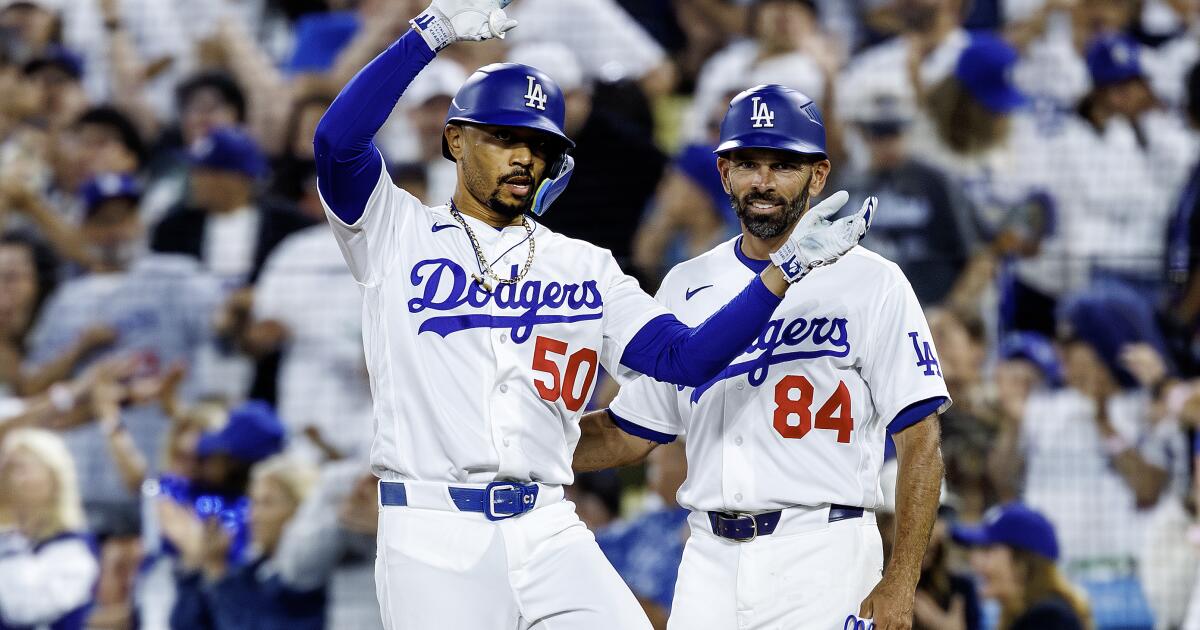
Mookie Betts’ first hit this series against the Rockies couldn’t have come at a more opportune time. With the crack of the ball against his bat, Tommy Edman scored from third, giving the Dodgers the lead.
And as Betts reached first, he pointed to Freddie Freeman, whose single put Edman in scoring position. It had taken a team effort to overcome another middling start from Roki Sasaki, and Betts, who had little to show before his game-winning hit, took the chance to highlight the joint contribution in the Dodgers’ 4-3 rubber-match win over Colorado (38-56).
“It feels great,” Betts said of his nine-pitch battle. “Helping the boys win, that’s really all it is. We play the game to win, and coming through in a big moment is kind of what, when you’re a kid, playing in the backyard, getting that hit is what you always strive to do, and fortunately, I was able to do it.”
Given a three-run lead in the first inning, brought to the Dodgers by a wild pitch and Kyle Tucker’s two-run, line-drive single to left field, Sasaki seemed set up for success.
Still, he gave away the lead as quickly as it came. In the second inning, he left a fastball too far over the plate, and third baseman Kyle Karros drove the ball over the left-center wall. The slider he dealt two batters later to second baseman Edouard Julien also crossed the zone too far over the plate, and Julien rounded the bases with another homer. In the third, a sacrifice fly by Mickey Moniak evened the scored, 3-3.
Sasaki’s troubles this season have been hard to pin down since his last win on May 23, as Sasaki tries to claw back the triple-digit velocity that’s escaped him as of late.
Against the Rockies, his fastball topped out at 99.1 miles per hour before steadily dropping to 98. He had managed five strikeouts in his six innings when manager Dave Roberts replaced him with Jack Dreyer, though the three earned runs couldn’t be ignored.
But Roberts also acknowledged the possibility that the pitcher had been tipping his pitches, possibly since he was playing in Japan, and Sasaki has tried to address it after a three-inning, six-run start last week. Even if he had fully self-corrected, his control issues remain. In the third inning, he walked the tying runner, Brett Sullivan.
“I’ve been working on a lot of things like the tipping stuff,” Sasaki said through interpreter Kensuke Okubo. “Also, I need to make quality pitches.”
Sasaki regained some of his confidence in the fourth when he worked out of a two-base jam with two strikeouts and a flyball to right, something that didn’t go unnoticed by Roberts.
“You can see the demeanor walking off the mound, the confidence,” Roberts said. “For me, it was more of let him end on a high note, feeling good about his outing, and then go from there.”
The Dodgers’ problems were compounded by Alex Call wasting the team’s two challenges in his at-bat in the first inning when the team had already taken the lead. And maybe it would’ve been excusable if Call had driven in the runners on first and second, but instead he ended the inning on a strikeout, stranding both. Roberts called the situation an “outlier” and didn’t feel as though he needed to have a conversation with Call regarding the situation.
After the three-run first, the Dodgers (61-33) remained hitless until Max Muncy laced a double down the right-field line in the sixth, though to little avail. As the innings ticked forward, Colorado’s chances seemed to increase. The Rockies hold the best league batting average (.297) in the eighth and ninth innings (the Dodgers are fourth with .268). And the Dodgers relievers, within the same constraints, have a 3.83 ERA — not bad, but not in the top 10 either.
Third baseman Max Muncy can’t get his glove on a line-drive double by Kyle Karros in the fourth inning.
(Gina Ferazzi/Los Angeles Times)
So when Alex Vesia struggled against the Rockies in the eighth inning and Muncy suffered a throwing error, Colorado seemed in position to score with the bases loaded and one out. Vesia struck out TJ Rumfield and Edgardo Henriquez (4-0), his replacement, retired Karros on a fly ball to right.
After Betts’ single allowed the Dodgers to take the lead, Tanner Scott (13) shut down the Rockies with back-to-back strikeouts, avoiding the team’s eighth series loss of the season.
“Didn’t feel great,” Roberts said. “Fortunately, we won a series, but that’s not the kind of way you want to do it.”
Sports
Justin Verlander announces he will retire after this season: ‘I’ve realized that time has come’

NEWYou can now listen to Fox News articles!
One of the greatest pitchers in the history of baseball will be hanging up his cleats after this season.
Three-time Cy Young Award winner Justin Verlander announced on Wednesday that the 2026 season will be his last.
Amid an injury-riddled season with the Detroit Tigers, Verlander decided it’s time to go.
Detroit Tigers pitcher Justin Verlander watches from the dugout during a game against the Chicago White Sox at Comerica Park in Detroit June 21, 2026. (David Rodriguez-Munoz/USA Today Network via Imagn Images)
“This season has challenged me in ways I haven’t experienced before, both physically and mentally. I’ve always believed that as long as I could compete at the level I expect of myself, I’d keep playing. I never wanted to retire because of a milestone, a number, or a date on the calendar. I wanted the game to tell me when it was time. Over the last several months, I’ve realized that time has come,” Verlander said in a social media post.
“While I’m fully committed to giving my team everything I have for the rest of this season, I’ve decided this will be my last. It’s fitting that I get to finish where it all started – with the Detroit Tigers, the organization that drafted me and gave me my first opportunity.”
Verlander inked a one-year deal with the Tigers, with whom he spent his first 12½ seasons before being traded to the Houston Astros, in the offseason. In Houston, he returned to dominance, winning both of his World Series titles and two of his Cy Young Awards.
“Baseball has given me more than I could have imagined. It taught me discipline, resilience, and the value of continuing to adapt and evolve. I’ve been fortunate to play with and against incredible players, for outstanding organizations, and compete in-front of fans who deeply appreciate the game,” Verlander added in his announcement.
Justin Verlander of the Houston Astros celebrates after the Astros defeated the Philadelphia Phillies in Game 6 of the 2022 World Series at Minute Maid Park Nov. 5, 2022, in Houston, Texas. (Mary DeCicco/MLB Photos via Getty Images)
PHILLIES STAR SAYS ‘BS RULE’ IS KEEPING HIM FROM BEING NAMED ALL-STAR IN FRONT OF HOME CROWD
“To every teammate, coach, player, clubhouse attendant, and fan who has been part of this journey – thank you. It’s been a privilege to share the field with you. To my family, especially my wife Kate, thank you for standing beside me through every season, every rehab, and every high and low. I couldn’t have done this without you. It’s time for the next chapter. But first, I’m excited to finish this season the only way I know how – with everything I’ve got.”
Verlander is the active leader with 3,554 strikeouts, which is good for eighth all-time. He needs 21 to surpass Don Sutton and 87 to pass Tom Seaver.
The 43-year-old made his MLB debut in 2005 and won the American League Rookie of the Year Award the following season in what was just a small glimpse of what was to come.
Verlander was a Cy Young Award finalist on four other occasions, consistently near the top of the leaderboard in just about every pitching stat. MLB Commissioner Rob Manfred gave Verlander a legend’s exemption to this year’s Midsummer Classic, making him a 10-time All-Star.
One could argue that Verlander should have at least one more Cy Young Award on his mantle, but he is on the fast track to Cooperstown and very much in the conversation to join Mariano Rivera as the only player unanimously elected to the Hall of Fame.
Verlander’s best season came in 2022, when he pitched to a career-best 1.75 ERA along with a 0.829 WHIP. However, that came after he missed the entire 2021 season due to Tommy John surgery for an injury he suffered after pitching just one inning in the abbreviated 2020 season.
Houston Astros starting pitcher Justin Verlander throws against the Boston Red Sox during the first inning Aug. 22, 2023, in Houston. (AP Photo/Michael Wyke)
CLICK HERE TO DOWNLOAD THE FOX NEWS APP
He won his first Cy Young Award in 2011, when he was also awarded the MVP Award, and his second in 2019. Verlander’s 11 seasons between his first and final Cy Young Awards are the second-most behind Roger Clemens, who had 18 seasons between his first and seventh.
Verlander led the majors in innings and WHIP four times while recording the most strikeouts in three seasons.
Follow Fox News Digital’s sports coverage on X, and subscribe to the Fox News Sports Huddle newsletter.
-

 Los Angeles, Ca3 minutes ago
Heat advisory, beach hazards in effect as Southern California sizzles
-

 Detroit, MI23 minutes ago
Teen on moped hit by car after cruising through stop sign in Detroit
-

 San Francisco, CA32 minutes ago
Flight of fancy: San Francisco moves to build private luxury airport terminal
-

 Dallas, TX38 minutes ago
Dallas’ digital creator economy is booming. Burnout is too.
-
Miami, FL45 minutes ago
I went to 2 famous Miami restaurants, a flashy steakhouse and a Cuban hot spot. Here’s how they compared.
-

 Boston, MA48 minutes ago
Pedestrian struck and killed in Roxbury – Boston News, Weather, Sports | WHDH 7News
-

 Denver, CO53 minutes ago
Santa Fe Drive in Denver closed this weekend for pedestrian bridge construction
-

 Seattle, WA1 hour ago
Police video shows West Seattle Bridge copper wire theft suspect’s arrest

