Texas
Texas Sued New Mexico Over Rio Grande Water. Now the States are Fighting the Federal Government – Inside Climate News


Reporting supported with a grant from The Water Desk at the University of Colorado Boulder.
DENVER—When Judge D. Brooks Smith traveled from Pennsylvania to Colorado, he passed over the 98th Meridian, the longitude line separating the water-rich East from the arid West.
The former chief judge of the U.S. Third Circuit Court of Appeals left a land of rushing rivers and ample rainfall in western Pennsylvania to gather facts in a case called Texas v. New Mexico Supreme Court over water rights from the Rio Grande.
Now a senior judge in the Third Circuit, Smith is serving as a special master to advise the U.S. Supreme Court on what is one of the longest-running disputes over dwindling water in the West, which also involves the federal government.

Explore the latest news about what’s at stake for the climate during this election season.
Smith traveled for a five-hour status conference last week at Denver’s federal courthouse involving attorneys representing the states, the federal government and several intervenors known as friends of the court.
At issue is the water Texas and New Mexico are entitled to under the Rio Grande Compact, signed in 1938 to allocate the waters of the Rio Grande between the states. Texas brought the current lawsuit against New Mexico in 2013, alleging that farmers pumping from groundwater wells in southern New Mexico were diverting water that the compact allocates to Texas.
The states reached a proposed settlement agreement in 2022 out of court. But the federal government opposed the deal. The Supreme Court then ruled in June that the case could not be settled without the federal government’s consent. Now the states and the federal government must resolve their disagreements to avoid going to trial in federal court, and Smith has ordered the parties to return to mediation no later than Dec. 16 in Washington, D.C.
The outcome of Texas v. New Mexico could fundamentally change how groundwater is managed in the Rio Grande basin in New Mexico and far west Texas, both for the agricultural industry and cities like Albuquerque and Las Cruce, in New Mexico, that pump water from aquifers. It will also be a bellwether for how deeply the federal government can intervene in inter-state water conflicts, which are likely to increase as drought and aridification grip the western United States.
“[The United States] is going to have to take some sort of action to get a handle on groundwater over-pumping,” said Burke Griggs, a professor of water law at Washburn University in Topeka, Kansas. “They really do want to keep the case alive.”
Groundwater Pumping Complicates Water Sharing Agreements
The Rio Grande forms in the San Juan Mountains of Colorado before flowing south through New Mexico to the Texas border. By the turn of the 20th century, disputes over Rio Grande water were brewing between farmers in southern New Mexico’s Mesilla Valley and those in El Paso, Texas, and neighboring Ciudad Juárez in Mexico.
To address these concerns, Congress extended the Reclamation Act of 1902 to the Rio Grande in 1905 through the Mesilla Valley and El Paso. This allowed the Bureau of Reclamation, the federal agency responsible for water management and dam building in 17 Western states, to undertake the Rio Grande Project, which included construction of the Elephant Butte Dam and irrigation infrastructure downstream.
Once completed, the Bureau of Reclamation began delivering water stored at Elephant Butte to two new irrigation districts: New Mexico’s Elephant Butte Irrigation District, and the El Paso County Water Improvement District No. 1 in Texas.
Further complicating matters, the U.S. and Mexico signed a treaty in 1906 committing the U.S. to providing 60,000 acre feet of Rio Grande water to Mexico at Ciudad Juárez annually.


Meanwhile, over the ensuing three decades, farmers in Colorado’s San Luis Valley and along the Rio Grande near Albuquerque were using more and more water for irrigation. Texas farmers worried this could jeopardize their irrigation water; an agreement was needed to ensure the water wouldn’t be all diverted upstream.
Thus, in 1938, Texas, New Mexico and Colorado signed the Rio Grande Compact, designating how much water Colorado must ensure would reach New Mexico, which in turn had to ensure a fair share of water would reach Texas.
A deep drought gripped the region in the 1950s. With less river water available for irrigation, farmers began to drill wells and pump groundwater.
Hydrologists now understand that wells drilled into the aquifer can reduce the flow of water into connected streams and rivers, and New Mexico state law evolved to manage groundwater and surface water together. The state was a pioneer in understanding this connection, according to Fred Phillips, emeritus professor of hydrology and environmental science at New Mexico Tech in Socorro, New Mexico.
“However, the Rio Grande Compact was put together long before that all happened,” he said in an interview. “It was entirely based on surface flow measurements, and nowhere in the compact is the effect of pumping even considered.”
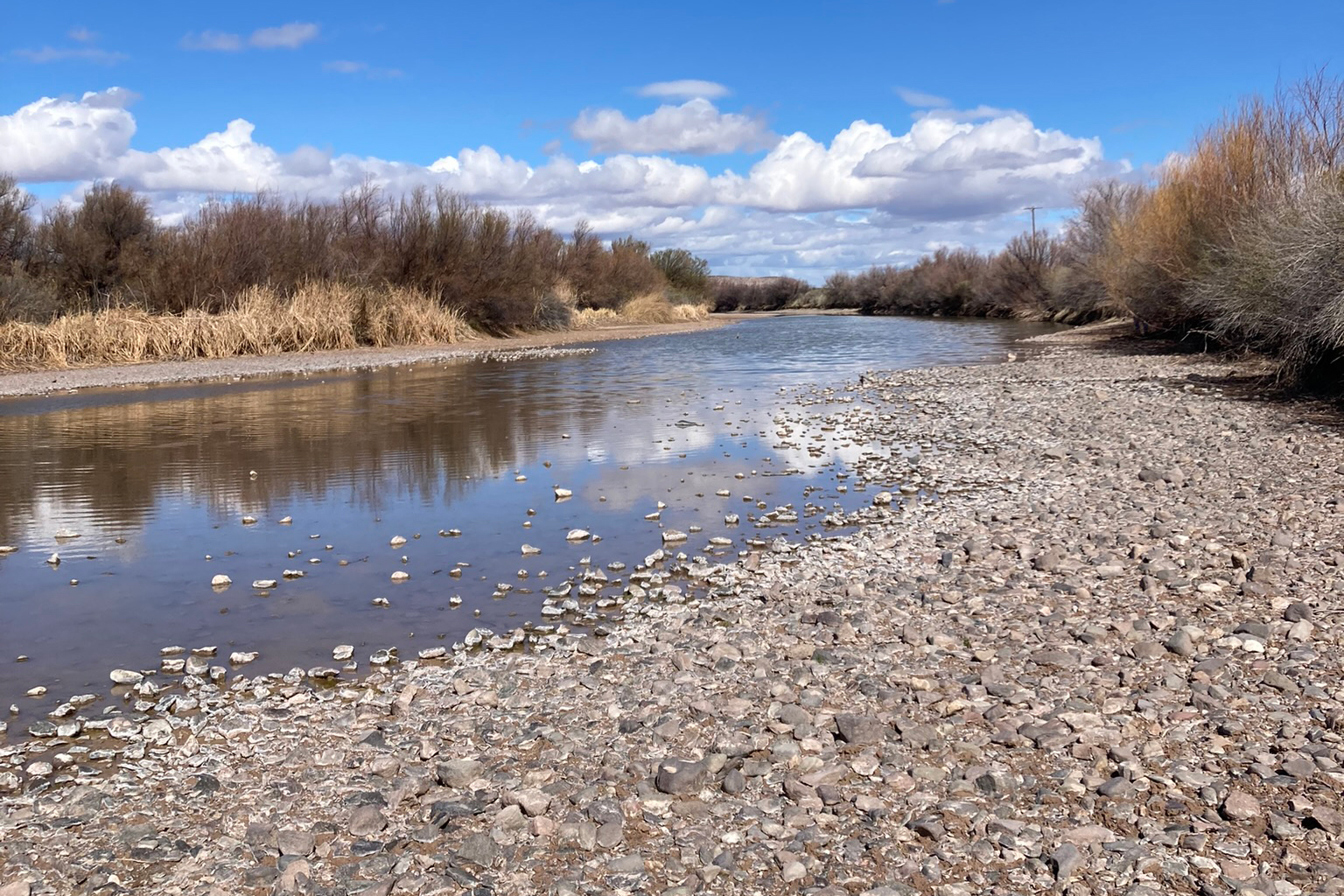
When the Bureau of Reclamation releases water from Elephant Butte and Caballo Lake in New Mexico, it must travel roughly 100 river miles to the Texas-New Mexico state line. Texas brought the suit in 2013, arguing that groundwater pumping in this stretch of New Mexico siphoned off water destined for Texas under the Rio Grande Compact. The United States and Colorado later both became parties to the lawsuit.
In 2022, Texas, New Mexico and Colorado proposed a consent decree to settle the case.
The states wanted to install a new water gage at the Texas-New Mexico border on the Rio Grande, which would measure Texas’ share of water.

Under the agreement, southern New Mexico would receive 57 percent of the water released from the upstream reservoirs and Texas 43 percent, accounting for drought and groundwater pumping. The states proposed calculating water deliveries based on what’s known as the “D2 period” between 1951 and 1978, when significant groundwater pumping had already begun.
But the federal government opposed the agreement. Its attorneys argued the deal did not reflect the United States’ treaty obligation to deliver water to Mexico, the Bureau of Reclamation’s role in water deliveries and its contracts with the irrigation districts. The federal government advocates for a return to a 1938 baseline for water deliveries, before the advent of widespread groundwater pumping.
This June, the Supreme Court ruled 5-4 to reject the consent decree, ruling that the states cannot reach a settlement without the federal government.
“That Texas’s litigation strategy has since changed, such that it is now willing to accept a greater degree of groundwater pumping, does not erase the United States’ independent stake in pursuing claims against New Mexico,” Justice Ketanji Jackson wrote for the majority.
“We cannot now allow Texas and New Mexico to leave the United States up the river without a paddle,” she wrote.
Justice Neil Gorsuch delivered the dissenting opinion.
“Where does that leave the States? After 10 years and tens of millions of dollars in lawyers’ fees, their agreement disappears with only the promise of more litigation to follow,” he wrote.
Gorsuch added that the decision could also hinder future cooperation between states and the federal government in water disputes.
“I fear the majority’s shortsighted decision will only make it harder to secure the kind of cooperation between federal and state authorities reclamation law envisions and many river systems require,” he wrote.
How to Manage a Declining River
Washburn University’s Griggs, the author of a forthcoming paper in the Idaho Law Review on the case, said many water law experts were surprised when the Supreme Court rejected the consent decree.
“States that settle water disputes are now going to think twice,” he said. “It’s a real wrinkle we haven’t seen before, where a non-party to a compact can intervene and then block a settlement.”
Griggs said that settlements are preferable in these inter-state water disputes because expert attorneys can craft the agreements.
“Do we want to leave the water future of millions of Westerns in the hands of nine Eastern justices?” he said. “You want negotiated settlements that are done by the level and talent of the lawyers involved in this case.”
But he acknowledged that the Supreme Court’s ruling is “legally understandable” because the Bureau of Reclamation has a clear role in executing the Rio Grande Compact.
Thomas Snodgrass, a Justice Department attorney representing the Bureau of Reclamation, articulated this role in his presentation to Judge Smith. He said that the bureau must release more water because of New Mexico’s failure to regulate groundwater pumping.
“Simply put, groundwater pumping is not sustainable,” Snodgrass said.
The New Mexico Pecan Growers, the City of Las Cruces and the Albuquerque Bernalillo County Water Utility Authority, among those filing amicus briefs, have sided with the states but technically are not parties to the case.
The Albuquerque water authority’s attorney warned against the “federalization of groundwater” and said the federal government’s position could be “disastrous” for existing groundwater permitting in New Mexico.
This story is funded by readers like you.
Our nonprofit newsroom provides award-winning climate coverage free of charge and advertising. We rely on donations from readers like you to keep going. Please donate now to support our work.
Donate Now
Griggs argues in his forthcoming paper that the United States does not trust New Mexico to protect the irrigation rights of the Elephant Butte District. If New Mexico has a shortfall of water to send to Texas, the state could cut back allocations to the Elephant Butte District.
The Elephant Butte and El Paso irrigation districts have filed amicus briefs that support the United States in the litigation.
“These surface irrigators see that their days are numbered—regardless whether they’re in Texas or New Mexico—if groundwater pumping continues,” Griggs said.
Meanwhile, farmers who rely predominantly on groundwater favor the states’ consent decree because it does more to protect existing groundwater pumping.
“The conflict between surface irrigators and groundwater irrigators is such an important theme to this case,” Griggs said.
Phillips, the hydrologist at New Mexico Tech, emphasized the contribution of climate change and drought to the water constraints on the Rio Grande. He pointed out that Elephant Butte Reservoir has been at low levels for years and is unlikely to refill as it once did. Climate change contributes to decreased snowmelt in the mountains of Colorado and increased evaporation at the reservoir.
“The system was sustainable under the climate conditions of the early 20th century,” he said. “But with the effect of global warming, the balance between consumption and replenishment has shifted.”


Scientists predict that within 50 years, New Mexico will have 25 percent less water available in rivers and aquifers. A 2022 paper modeled climate change scenarios for water availability at Elephant Butte. The authors projected that the volume of water released from the reservoir would be 10 percent lower between 2021 and 2070 compared to 1971 to 2020.
“Whatever agreement is arrived at needs to have provisions for how it’s going to be implemented in the case of a steadily declining water supply,” Phillips said of the ongoing case.
What Happens Next?
Oct. 23 was Smith’s first in-person hearing since the Supreme Court appointed him special master. His predecessor, Judge Michael Melloy, retired last year.
Attorney Stuart Somach, representing Texas, proposed the trial begin as early as April 2025. However, the lead attorney for the United States said that they would need more time to prepare.
The parties also discussed a site visit to the Rio Grande in 2025 so that Smith could see the river and irrigation infrastructure. The attorneys reminded the judge that water is not reliably flowing in the river below Elephant Butte until June.
In ordering the Washington mediation in December, Smith indicated that if the case goes to trial, he is inclined to hold it in Philadelphia or Pittsburgh.
Smith, who has a reduced caseload as a senior status judge, said he would continue his own education on the Rio Grande, first by reading Paul Horgan’s 900-page history of the river. He quipped that he hoped to live long enough to finish the book and to see the end of the case.
“I hope,” he said before adjourning court, “we can reach an end to this odyssey.”
About This Story
Perhaps you noticed: This story, like all the news we publish, is free to read. That’s because Inside Climate News is a 501c3 nonprofit organization. We do not charge a subscription fee, lock our news behind a paywall, or clutter our website with ads. We make our news on climate and the environment freely available to you and anyone who wants it.
That’s not all. We also share our news for free with scores of other media organizations around the country. Many of them can’t afford to do environmental journalism of their own. We’ve built bureaus from coast to coast to report local stories, collaborate with local newsrooms and co-publish articles so that this vital work is shared as widely as possible.
Two of us launched ICN in 2007. Six years later we earned a Pulitzer Prize for National Reporting, and now we run the oldest and largest dedicated climate newsroom in the nation. We tell the story in all its complexity. We hold polluters accountable. We expose environmental injustice. We debunk misinformation. We scrutinize solutions and inspire action.
Donations from readers like you fund every aspect of what we do. If you don’t already, will you support our ongoing work, our reporting on the biggest crisis facing our planet, and help us reach even more readers in more places?
Please take a moment to make a tax-deductible donation. Every one of them makes a difference.
Thank you,


Martha Pskowski
Reporter, El Paso, Texas
Martha Pskowski covers climate change and the environment in Texas from her base in El Paso. She was previously an environmental reporter at the El Paso Times. She began her career as a freelance journalist in Mexico, reporting for outlets including The Guardian and Yale E360. Martha has a B.A. in Environmental Studies from Hampshire College and a master’s degree in Journalism and Latin American Studies from New York University. She is a former Fulbright research fellow in Mexico.


hosting the Athletics in the club’s home opener on Thursday, April 1. The complete 2027 schedule was announced today
by Major League Baseball.
The Rangers’ season opener on March 25

In an incident that was horrific beyond words, late last month, a stunned family watched in horror as a car plowed into the Katy, Texas home of a 76-year-old mother and grandmother, killing her. The driver has been charged with manslaughter.
In the aftermath of the crash, it emerged that the car in question was a Tesla, and that the driver was making use of full self-driving mode (FSD) around the time the crash occurred. The victim’s family has named Tesla and the driver as defendants in a lawsuit. But per Electrek, Tesla was able to view crash data very quickly after the incident, and the head of AI at the company, Ashok Elluswamy, said the driver “manually overrode self-driving by pressing the accelerator all the way to 100% of the accel pedal in this residential area.”
In the days after the crash, Tesla fans took issue with coverage that characterized the car as in FSD when the crash occurred. CEO Elon Musk seemed to agree, replying to a post, “Yes, this makes no sense. FSD drives slowly through neighborhood streets and this was a high speed crash!”
But Musk seems to be assuming bad faith, as if coverage implied FSD had suddenly shifted into, perhaps, some kind of previously unannounced homicidal maniac mode and attacked a house. If anyone was saying this is what happened, they should apologize. It’s clearly not what happened.
And on Wednesday, the National Transportation Safety Board (NTSB) largely confirmed Tesla’s version of events. Their report reads, in part:
“Electronic data recovered from the vehicle indicated that before the crash, the driver manually overrode FSD (Supervised) by pressing the accelerator pedal to 100%, and the vehicle’s speed was greater than 70 mph when the crash occurred.”
But cooler heads had noted weeks earlier that, like with good old fashioned cruise control, accelerating doesn’t boot you from FSD. The car takes the input, and stays in FSD. The question isn’t one of mechanics and technology, but one of philosophy: if FSD is meant to be “driving” when someone jams on the accelerator in a residential area, FSD may not be the “driver” in one important sense, but the car was still in FSD mode.
Because as much as Tesla would probably like FSD to be a total non-factor in the incident, that may not be the case either.
ABC News noted that, according to court documents, the driver claimed he “passed out” with the car in FSD on the highway, and that’s the last thing he remembers before the crash. He says he wasn’t sick, and medical records show no seizures, cardiac episodes, drugs, or alcohol.
A local Fox affiliate says records show the car was making deliveries for DoorDash while in FSD in the “hours and minutes leading up to the crash.” While in a neighborhood, it apparently signaled it was going to turn left onto one street, but instead the pedal went to the metal. This took the Tesla onto the victim’s cul-de-sac instead, and put it on its fateful collision course with her house.
To make matters weirder, other court records now show, per Electrek, that the driver had Googled the terms, “Tesla fsd not aggressive enough 2026,” “FSD is not aggressive enough for city driving,” and “Tesla fsd too timid.” That’s the kind of thing you Google when you’re looking for a Reddit post from someone sharing your consumer gripe.
In any case, the odds aren’t good that the driver wanted this to happen, nor that Tesla programmed its cars with evil intent. But FSD was being used around the time of this unusual fatal incident, and the public deserves to know more. Fortunately, a lot more will come out as the lawsuit progresses.

AUSTIN – Texas Attorney General Ken Paxton said Wednesday he has secured a settlement of bankruptcy claims against genetic testing company 23andMe stemming from a 2023 data breach that exposed personal information, including some genetic ancestry data, of 6.9 million customers worldwide.
Paxton’s office said the settlement includes $150 million for a multistate coalition of 42 states. But because of limited funds in 23andMe’s bankruptcy estate and competing claims, the states’ recovery will be $18 million paid immediately, with Texas receiving $1,266,860.
23andMe disclosed in October 2023 that attackers had accessed accounts affecting 6.9 million consumers. Some of the information was later posted for sale on the dark web, according to Paxton’s office, which said the company learned of the breach months after the data became publicly available. The office said 23andMe initially denied a breach and later blamed consumers’ account settings and password practices.
Paxton joined a multistate investigation that concluded 23andMe used unreasonable security practices and failed to implement adequate safeguards against hacking, the office said.
23andMe filed for bankruptcy protection in March 2025. Paxton’s office said the settlement incorporates privacy and cybersecurity requirements, including enhanced security standards, comprehensive risk assessments and creation of an independent advisory board, along with enforcement of state privacy laws and continued consumer data deletion rights.
“Companies that collect and profit from Texans’ most personal information have a legal duty to protect it,” Paxton said in a statement.
The company also agreed to a $46.75 million class-action settlement in the bankruptcy case for affected U.S. consumers who submitted claims by Feb. 17, 2026, Paxton’s office said.
Copyright 2026 by KPRC Click2Houston – All rights reserved.
-
 News11 minutes ago
Flood sirens blare in South Central Texas as rivers reach perilous heights
-

 Los Angeles, Ca2 hours ago
Arrest made in deadly shooting at 4th of July gathering in Compton; search for 2nd suspect continues
-

 Detroit, MI2 hours ago
Detroit crime hits decades-low as Michigan governor candidates debate how to keep progress going
-

 San Francisco, CA2 hours ago
Operator of boat that capsized near Alcatraz mourns brother as search continues
-

 Dallas, TX2 hours ago
Mavericks vs Thunder Game Preview and Injury Update
-

 Miami, FL3 hours ago
Miami Dolphins Fans Vs. The Media
-

 Boston, MA3 hours ago
Man who allegedly shot at Boston Police officers arrested after foot chase in Dorchester
-

 Denver, CO3 hours ago
Swan, dragon and duck boats are back pedaling around City Park

