Texas
A New Study Confirms Texas Abortion Ban “Is Responsible” for Rise in Infant Deaths


Texas leaders promised the ban, enacted ten months before Roe was overturned, would “save” newborn lives.
A protester at Trafalgar Square following the abortion ban in Texas, on October 2, 2021, in London, United Kingdom.
(Photo by Hasan Esen / Anadolu Agency via Getty Images)
Before thousands of anti-abortion protesters at the Texas Capitol in 2023, Republican Gov. Greg Abbott brazenly touted his party’s passage of draconian abortion laws as “life-saving.” “We promised we would protect the life of every child with a heartbeat, and we did. I signed a law doing exactly that,” Abbott told the crowd at the annual Texas Rally For Life event. “All of you are life savers, and thousands of newborn babies are the result of your heroic efforts.”
Abbott’s words now ring particularly hollow in light of a new study in the Journal of the American Medical Association Pediatrics that reveals infant deaths in Texas starkly increased following SB 8, which barred care at the first sign of embryonic cardiac activity, typically around six weeks of pregnancy, and carried a private enforcement provision that deterred the vast majority of care in the state. The 2021 law stood as the most restrictive abortion ban at the time.
Researchers with Johns Hopkins Bloomberg School of Public Health found that infant deaths rose by nearly 13 percent in 2022. Comparatively, these deaths, defined in the study as occurring under 12 months old, increased less than 2 percent in the rest of the United States.
“We found that infant mortality increased pretty substantially in Texas but not in the rest of the country,” Alison Gemmill, assistant professor in the Bloomberg School’s Department of Population, Family and Reproductive Health and one of the study’s lead authors, tells The Nation. “It speaks to how these restrictive laws can have horrific and devastating effects on infant health, pregnant people, and on families overall—unintended or not.”
While many reproductive health studies (including ones that show a link among infant mortality and abortion bans) can only prove a correlation between factors, this one notably claims a direct causation, providing important evidence of the law’s dire impacts. “This study shows that the state policy is responsible for these deaths—there is a very, very strong causal link here,” says Gemmill.
The research is said to be one of the first large-scale studies to highlight the spillover effects of anti-abortion laws in the United States on maternal and infant health. By analyzing monthly death certificate data, researchers were able to isolate and examine outcomes of what would happen with and without the law.
Congenital anomalies—birth defects that can include fatal conditions of the heart, spine, and brain—lead the cause of death among infants, researchers found. These deaths spiked nearly 23 percent in Texas between 2021 and 2022, compared to a decrease of 3.1 percent in the rest of the U.S. during the same period. Glaringly, the Texas abortion law holds no exception for fatal fetal anomaly, which are typically diagnosed later than six weeks.
Those unable to access abortion care were forced to “experience the physical risks of continuing the pregnancy and the emotional and psychological hardships of losing a pregnancy in this way,” Dr. Gracia Sierra, a Texas-based data scientist who focuses on infant mortality and the impact of abortion bans at Resound Research for Reproductive Health (unaffiliated with the study) tells The Nation. “The process can be difficult and painful, and it ultimately takes away their freedom to make their own decisions about their reproductive life.”
In response to the study, Abbott’s office doubled down on its ostensible “pro-life” agenda, despite the findings. It applauded a study from the same Johns Hopkins researchers that found SB 8 may have resulted in nearly 10,000 additional births.“Texas is a pro-life state, and Governor Abbott will always fight for the most vulnerable among us,” Andrew Mahaleris, spokesperson for Abbott, told The Nation. “Texas passed a critical law to save the innocent unborn, and now thousands of children have been given a chance at life.”
While Abbott and anti-abortion advocates continue to laud the measure as life-saving, in reality this means perpetuating forced births—no matter the outcome of that birth.
“It’s never been clearer that the term ‘pro-life’ is a farce,” says Nicolas Kabat, staff attorney at the Center for Reproductive Rights. “Politicians are forcing women to carry doomed pregnancies and give birth to babies who will live only a few painful minutes or hours. This suffering is man-made – it’s being inflicted by Texas lawmakers.”
Women who recently fought the state of Texas in court after being denied abortion care despite severe pregnancy complications are all too familiar with the state’s forced birth policy. Zurawski v. Texas, a legal challenge filed by 22 women, sought to provide much needed clarity to the abortion laws’ vague medical exceptions.
Samantha Casiano, one of nearly a dozen women in the lawsuit who faced a non-viable pregnancy, was forced to watch her baby slowly die. Diagnosed with the lethal condition anencephaly, her child would be born without a skull. The mother of four lacked the resources to travel for abortion care, and had no choice but to carry her fatal pregnancy to term. In court, Casiano tearfully recounted how she watched her baby gasp for air for four hours before ultimately dying. “I told her, I am so sorry I couldn’t release you to heaven sooner. There was no mercy for her,” she said. The trauma will haunt her and her family forever, said Casiano.
Current Issue

Last month, the all-Republican Texas Supreme Court failed to provide clarity on the laws or grant any relief for those who might suffer the same fate as Casiano, issuing a ruling that confirmed pregnant people cannot have abortions for fetal diagnoses of any kind, even lethal ones. The Center for Reproductive Rights’ Kabat, who represented the plaintiffs in Zurawski, says the recent study is a stark reminder that the state is uninterested in taking responsibility for deaths like the one Casiano and others were forced to painfully endure.
Gemmill says this is the first of many studies to come. Researchers are now working to assess the impact of abortion restrictions on the live births of different races, ethnicities, and socio-economic backgrounds. They’re also examining infant mortality in Texas from 2022 forward and taking a look at those rates across the country.
They predict what they’ve found in Texas foreshadows what is happening in more than a dozen states that have also barred abortion care, since Texas enacted its law ten months before Roe was overturned. At least 13 states similarly carry no exception for fatal fetal anomalies, which impact roughly 120,000 pregnancies a year.
“This will likely be a harbinger of what’s to come for other banned states, since Texas is nearly a year ahead of everyone else,” says Gemmill.
“Unless we get a flood of resources for patients to seek care across state lines, I really don’t see this increase in infant deaths changing. I don’t have any reason to think this wouldn’t persist into the future.”
Thank you for reading The Nation
We hope you enjoyed the story you just read, just one of the many incisive, deeply-reported articles we publish daily. Now more than ever, we need fearless journalism that shifts the needle on important issues, uncovers malfeasance and corruption, and uplifts voices and perspectives that often go unheard in mainstream media.
Throughout this critical election year and a time of media austerity and renewed campus activism and rising labor organizing, independent journalism that gets to the heart of the matter is more critical than ever before. Donate right now and help us hold the powerful accountable, shine a light on issues that would otherwise be swept under the rug, and build a more just and equitable future.
For nearly 160 years, The Nation has stood for truth, justice, and moral clarity. As a reader-supported publication, we are not beholden to the whims of advertisers or a corporate owner. But it does take financial resources to report on stories that may take weeks or months to properly investigate, thoroughly edit and fact-check articles, and get our stories into the hands of readers.
Donate today and stand with us for a better future. Thank you for being a supporter of independent journalism.


Man, identified as Lorenzo Salgado Araujo, is latest to be killed by ICE officers since President Trump took power.
Published On 8 Jul 2026
A United States immigration agent fatally shot a man in Houston, Texas, while officers were attempting to stop his vehicle, US Immigration and Customs Enforcement (ICE) said.
The man killed on Tuesday was identified as Lorenzo Salgado Araujo, described by ICE as a Mexican national and “illegal alien” who attempted to evade arrest during a “targeted enforcement operation” by federal immigration officers.
Recommended Stories
list of 3 itemsend of list
Ronaldo Salgado, who identified himself as Salgado Araujo’s son, told the Spanish-language television station Telemundo Houston that his father was shot while he was looking for workers to hire in the area.
The Department of Homeland Security (DHS), which oversees ICE, said Salgado Araujo ignored commands to stop his vehicle, saying he “rammed an ICE law enforcement vehicle, refused to follow multiple verbal commands, and weaponized his vehicle in an attempt to run over an ICE law enforcement officer”.
In past shooting incidents, including the January killings of Renee Good and Alex Pretti, immigration officials had said that their officers were being attacked when the two were shot, claims vigorously disputed in both incidents.
Video footage captured on Tuesday by a surveillance camera from a nearby business and reviewed by the Reuters news agency showed a person lying on the ground beside a white van and surrounded by officers, in what appeared to be the aftermath of the shooting.
Salgado Araujo was targeted in an operation because he was living in the country without legal permission, according to DHS.
Democratic US Representative Sylvia Garcia called for an independent and thorough investigation of ICE’s claims about the fatal shooting.
“All available footage, communications, and other evidence should be preserved and reviewed as part of a full and impartial investigation,” Garcia posted on social media.
Juan Proano, CEO of the League of United Latin American Citizens, echoed Garcia’s calls for a transparent investigation into ICE’s actions.
“We don’t take DHS at their word at all,” Proano told The Associated Press news agency. “There should be an independent investigation, and they should release all the videos.”
There have been at least six fatal shootings by federal immigration officers since the start of President Donald Trump’s intensified immigration enforcement crackdown.
Good, a 37-year-old US citizen, was shot in the head by a federal immigration agent during a crackdown in Minneapolis. DHS also said Good was trying to hit the agent with her vehicle, which local officials and witnesses disputed, saying she was only trying to drive away.
The backlash from Good’s killing and other similar incidents led ICE to step back from some of its more controversial operations.
However, Tuesday’s deadly confrontation in Houston came amid a recent increase in the number of ICE arrests nationwide, with immigration officers picking up about 2,000 migrants a day last week, Reuters reported.
Texas
Trump takes credit for Toyota moving some truck production from Mexico to Texas: ‘That’s what tariffs do’
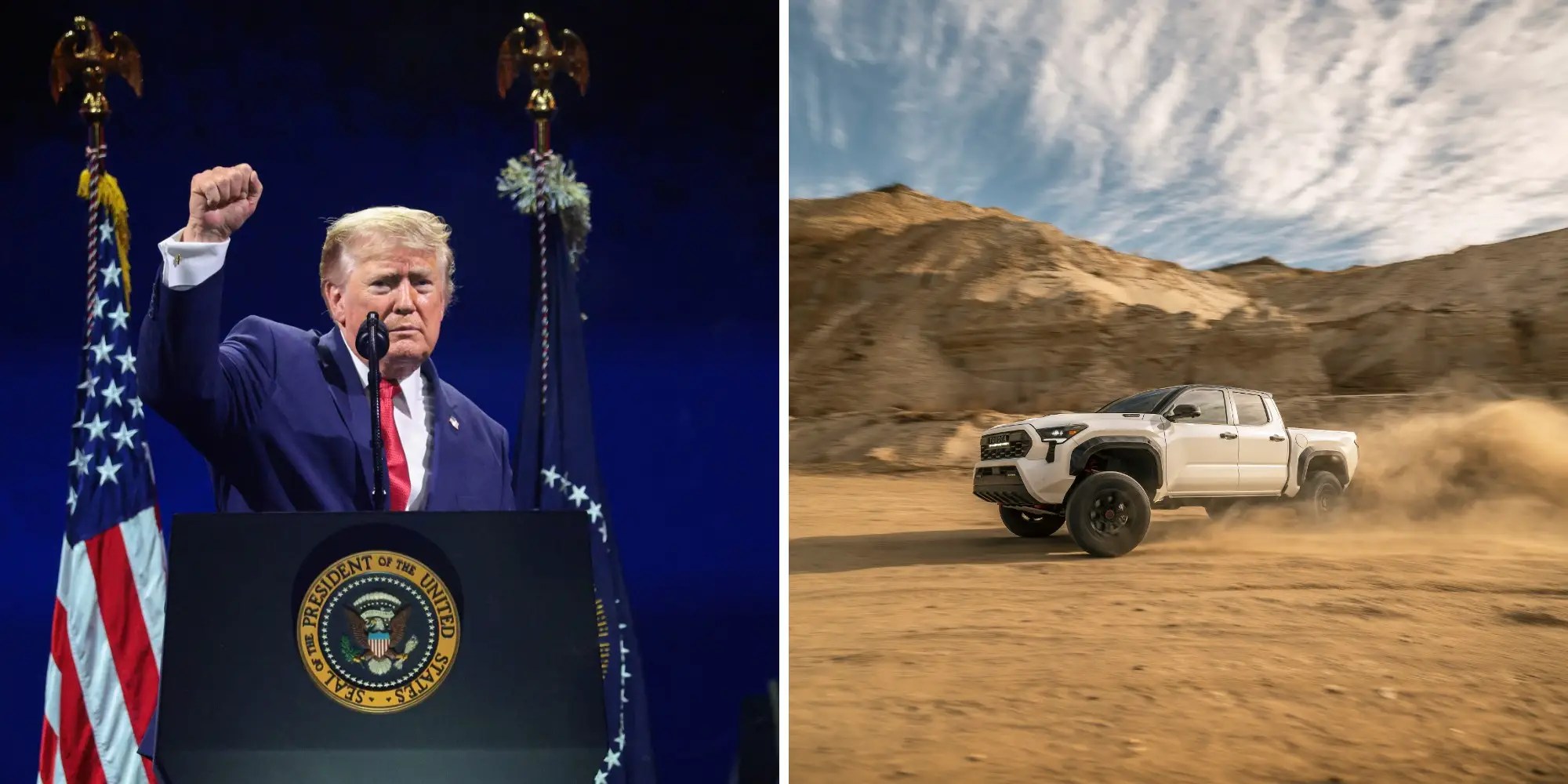
Toyota is planning a $3.6 billion expansion of its Texas truck assembly plant. President Donald Trump took credit for the investment.
On Monday, the automaker announced the multibillion-dollar investment to add a second vehicle assembly line at its San Antonio manufacturing campus to support production of the Tacoma pickup. Toyota said the expansion project would shift some of the midsize truck’s production from its Mexico plants to San Antonio over roughly 4 years. Toyota will still build some Tacoma models and the Corolla in Mexico.
While Toyota did not attribute the expansion to tariffs in its announcement and the company is not fully exiting production in Mexico, Trump said the fresh investment was a sign that his tariffs were working.
“It came over the wires that Toyota is moving out of Mexico into the United States, and building one of the biggest truck and car plants ever built,” Trump said on Tuesday during a visit to Ankara, Turkey. “It’s amazing. That’s what tariffs do, properly used.”
Toyota said the investment will create 2,000 jobs and add 2.5 million square feet to the site, doubling the company’s Texas footprint by 2030.
Toyota
On Monday, Ted Ogawa, president and CEO of Toyota Motor North America, said the investment reflected the company’s “confidence in the region’s workforce, innovation, and long-term growth potential.”
The move gives Trump a high-profile example of a well-recognized company creating manufacturing jobs. His administration has argued that tariffs incentivize companies — particularly automakers — to reshore manufacturing in America and reduce reliance on foreign production.
Toyota’s announcement also comes amid major uncertainty for automakers with plants in North America. The USMCA — the trilateral free trade pact between the US, Canada, and Mexico struck during Trump’s first term — is under review after the US declined to renew the treaty in its current form on July 1. The Trump administration is reportedly pushing to change the agreement so 50% of all automotive parts and manufacturing would happen in the US.
Toyota also nodded to that trade uncertainty in its release, saying it remained committed to operations in all three countries while encouraging “a quick resolution to USMCA” to keep North America globally competitive.
Texas
Supreme Court won’t block Texas from enforcing a law requiring age verification for app downloads

WASHINGTON – The U.S. Supreme Court on Monday declined to block Texas from enforcing a state law that requires apps stores to verify users’ ages and obtain parental consent for minors seeking to download apps or make in-app purchases on mobile phones.
Justice Samuel Alito, in a pair of one-sentence orders, denied petitions by plaintiffs who claim that the Texas App Store Accountability Act violates users’ constitutional rights to free speech.
Last month, a three-judge panel from the 5th U.S. Circuit Court of Appeals ruled that the law can take effect. The panel suspended a district court’s ruling last December that the law is unconstitutional.
The plaintiffs suing to block the law include the Computer & Communications Industry Association and Students Engaged in Advancing Texas. Texas Attorney General Ken Paxton is a defendant in both cases.
Plaintiffs’ lawyers argued that the law impermissibly seeks to limit access to content protected by the First Amendment, including news and educational material.
“Equity and the public interest support relief because protecting First Amendment rights — and parents’ rights to supervise their children as they see fit, not as the government tells them they should — is always in the public interest,” wrote attorneys for Students Engaged in Advancing Texas.
Attorneys from Paxton’s office argued that the law protects children from “dangerous modern products.”
“A child with access to an app store and a mobile device (such as a tablet or smartphone) can potentially download any number of software applications, potentially agreeing to invasions of the child’s privacy and sale of the child’s data and be exposed to any conceivable content without parental consent or even parental knowledge,” they wrote.
Copyright 2026 The Associated Press. All rights reserved. This material may not be published, broadcast, rewritten or redistributed without permission.
-

 Vermont7 minutes ago
Vermont offers money to replace diesel vehicles with electric
-

 Virginia9 minutes ago
Virginia reports 10 cases of cyclosporiasis
-

 Washington15 minutes ago
Washington law says to alert the public when doctors are accused of misconduct. It can take months
-

 Wisconsin22 minutes ago
Former Wisconsin judge to be sentenced after conviction in obstructing arrest of Mexican immigrant
-

 West Virginia24 minutes ago
West Virginia town’s entire police force fired after ex-sergeant claims evidence room was broken into
-

 Wyoming30 minutes ago
Wyoming coal company wins federal money to extract critical minerals from Powder River Basin – WyoFile
-

 Crypto37 minutes ago
Residents question proposed crypto mining center
-

 Finance39 minutes ago
How Natura &Co Is Transforming Finance with Generative AI on SAP S/4HANA

