Texas
Texas primary runoff: Key races on the May 26 ballot


SAN ANTONIO – Texas voters will settle unfinished business from the March Primary on May 26, when they decide either who will be on the ballot for the November general election or who will take office next year.
Those contests in which no candidate received 50% plus one of the vote will be on the Tuesday, May 26 runoff election ballot.
The marquee matchup on that ballot is the Republican nomination for U.S. Senate between incumbent John Cornyn and Texas Attorney General Ken Paxton. Cornyn received 42% of the vote to Paxton’s 41%. The two were the top vote-getters in a field of nine candidates seeking the seat on the November ballot.
Cornyn and Paxton were both hoping to get the endorsement of President Donald Trump, but that didn’t happen before the March vote and hasn’t happened since.
One day after the primary, the president said that he would endorse one of them but expected the other to drop out of the race. Neither candidate was inclined to do that. There still hasn’t been an endorsement.
Whoever wins will face Democratic nominee James Talarico, an Austin-area state representative and former San Antonio teacher who won his primary bid against U.S. Rep. Jasmine Crockett.
Another seat both parties have their eyes on in the newly-drawn Congressional District 35. Republicans and Democrats both want this seat formerly held by Greg Casar, who was drawn out of the district in last year’s redistricting. Casar will seek re-election in District 37.
Both the red and blue parties have runoff contests for voters to settle. On the Republican side, Carlos De La Cruz and John Lujan are the two candidates who came out with the most votes from a field of 11 candidates. Lujan, who had 33% of the vote, is giving up his seat in the Texas House to run for the job in Washington. De La Cruz, an Air Force Veteran and brother to U.S. Rep. Monica De La Cruz (District 15), received 27% of the vote. Trump endorsed De La Cruz early in the campaign.
On the Democratic side, the race was close between Maureen Galindo with 29% of the vote and Johnny Garcia (27%). The pair outlasted two other candidates to qualify for the runoff. Garcia is a now-former spokesperson with the Bexar County Sheriff’s Office. Galindo is a housing advocate who also works as a marriage and family therapist.
In Bexar County, the race for the Democratic spot on the ballot for District Attorney is down from eight to two: Luz Elena Chapa and Jane Davis. Chapa, a former appellate judge, received 27% of the vote. Davis, the chief of the juvenile section of the Bexar County DA’s Office, earned 18%.
The winner of this runoff will face Republican Ashley Foster in November, along with any independent candidate who makes it onto the ballot. The winner of that contest will take over from outgoing District Attorney Joe Gonzales, who is not seeking re-election after two tumultuous terms in office. Gonzales has endorsed Jane Davis as his successor.
Voters, depending on their party and address, will also be deciding the lieutenant governor, attorney general, state representative, state senator, county clerk and district clerk races.
The Bexar County Democratic sample ballot can be seen below:
The Bexar County Republican sample ballot can be seen below:
Early voting begins on Monday, May 18, and runs through Friday, May 22.
Election day is Tuesday, May 26.
Read also:
Copyright 2026 by KSAT – All rights reserved.



Texas
Texas man admits embezzling $3.2 million to pay student loans, fuel online gambling, prosecutors say

A Texas man who siphoned off millions from his employer to wipe out tens of thousands in student loan debt and bankroll extensive online gambling has pleaded guilty to federal embezzlement charges, prosecutors said.
Mitchell David Slentz, 34, of Kyle, pleaded guilty in federal court to embezzling more than $3.2 million from Austin Freight Systems, according to the U.S. Attorney’s Office for the Western District of Texas.
Financial oversight role detailed
Prosecutors said Slentz held broad responsibility for Austin Freight Systems’ finances, managing accounting operations, overseeing financial reports and internal controls, and handling vendor payment requests submitted to JPMorgan Chase.
Between October 2023 and March 2025, Slentz executed 147 fraudulent payments, diverting $3,277,937.35 into his personal accounts via interstate wire transfers. He used part of the stolen money to make two student loan payments — $25,000 and $33,887. He also gambled heavily on an online platform, depositing and winning more than $1 million, the U.S. Attorney’s Office said.
Charges and court proceedings
Slentz was charged on May 14, appeared on June 8, and pleaded guilty Monday to wire fraud and engaging in monetary transactions with criminally derived proceeds.
A federal judge will determine Slentz’s sentence based on U.S. Sentencing Guidelines and statutory factors.
Investigation led by the FBI task force
The FBI Austin White Collar Crime Task Force handled the investigation.
CBS News Texas will provide updates as more information becomes available.

Tuesday morning is off to another warm start, with temperatures in the 70s. Expect another day with breezy winds, hot temperatures and Saharan dust in the sky. Most of the dust will move out of North Texas by Wednesday.
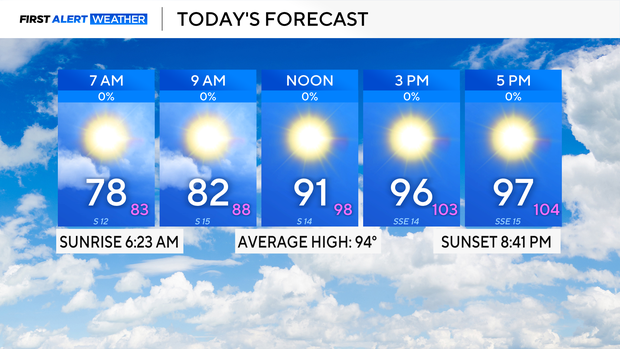
Temperatures on Tuesday afternoon will feel like triple digits, and this trend will continue into the Fourth of July weekend. Because dew points will drop slightly toward the end of the workweek, high temperatures should finally reach the 100° mark by Saturday.
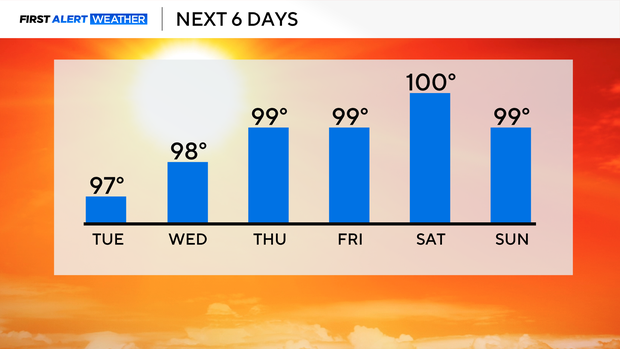
There’s just a slim 10% chance of showers in the forecast for Friday and Saturday, with slightly better rain chances on Sunday and Monday at 20%. Until then, temperatures will continue to heat up, and the feel-like temperatures will be at 100°+ each day. Stay cool.


The Texas Longhorns are in a lull before firing on all cylinders ahead of the 2026 season, looking to once again handle expectations that are larger than most programs experience, for the season year in a row.
Ahead of the season, though, head coach Steve Sarkisian is already gaining victories on the road before even kicking off. After a slow start on the recruiting trail, the Longhorns are in full swing, stacking elite pieces for the 2027 cycle.
Now it is no different, as the program has landed a commitment from Jason Johnson, one of the most sought-after defensive line prospects in the country, and a big piece of the Longhorns recruiting class for the cycle.
Who is Johnson?
Johnson is widely viewed as one of the most slept on prospects in the class. He is ranked as the No. 42 defensive line prospect in the class and is a top 60 prospect in the state of Texas. Despite his star rating, though, he is one of the most sought-after prospects in the class, including multiple offers from elite programs around the country.
Standing at 6-foot-3, 270 pounds, he has the size of an edge defender but the strength and bull-rush ability of an interior defender, combining an elite mix of speed and power that makes him difficult to handle in the interior.
Johnson has a lot of projectability in his frame, and has the strength already to go with it. As he continues developing at the next level, he has the chance to turn into a legitimate interior wrecker at the college level.
Where Johnson Will Impact the Longhorns Future
The Longhorns have been the beneficiaries of elite defensive linemen under the reign of Sarkisian, and that won’t change for the upcoming season or beyond. The program has shown a profound ability to develop talent across the front of the defense and will continue to do so.
For Johnson, the defensive front is manned by veterans across it, with talented underclassmen waiting in the wings for their turn on the field. It also doesn’t help that, so far, he is the lowest-rated defensive line commit of the class for the Longhorns.
Still, the coaching staff, including defensive coordinator Will Muschamp love what Johnson brings to the field, and that was one of the reasons that his class ranking didn’t bother them. He will get the time to develop in the program, and could turn into a vital piece of the future.
Sign up to our free newsletter and follow us on Facebook, X and Instagram for the latest news.
 Add us as a preferred source on Google
Follow
-

 Alaska1 minute ago
Alaska moves to award $350M contract to replace 62-year-old Tustumena ferry
-

 Arizona4 minutes ago
What areas are affected by the Pocket Fire near Oak Creek Canyon?
-

 Arkansas9 minutes ago
Northwest Arkansas-based Community Clinic aims to acquire multiple Baptist Health-Fort Smith clinics | River Valley Democrat-Gazette
-

 California16 minutes ago
Billionaire tax measure heads to California’s November ballot, with Kern County watching
-

 Colorado19 minutes ago
Smokey skies and critical fire danger conditions continue in southern Colorado
-

 Connecticut24 minutes ago
US Supreme Court to consider challenge to Connecticut assault weapons ban
-

 Delaware31 minutes ago
Delaware Fire Marshal Urges Fireworks Caution Ahead of July 4th – 47abc
-

 Florida34 minutes ago
New details in deadly Florida alligator attack

