Georgia
Georgia cracks down on pro-EU protests with crippling fines

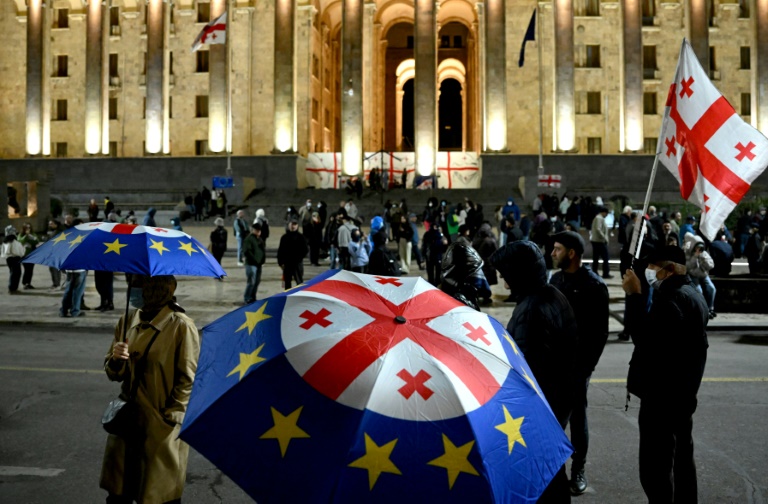
Nadim Khmaladze has been joining thousands of fellow Georgians on the streets every evening since November, when Tbilisi’s increasingly repressive government shelved EU membership talks.
The 60-year-old rights activist said he was “ready to face police violence” when he first joined the anti-government rallies in Tbilisi, but he never imagined that standing on the street for a few hours could cost him more than 22 months’ salary.
Three months into the protests, he received a summons: a total of 45,000 lari (around $16,000) in fines for briefly blocking traffic along Tbilisi’s central avenue.
“The government is using Russian-style methods to abolish freedom of assembly in Georgia,” he told AFP.
Khmaladze is one of thousands of Georgian protesters facing crippling fines for taking to the streets.
Prominent writer Mikheil Tsikhelashvili, who returned to Georgia last year from emigration in Portugal to fight against the ruling Georgian Dream party’s “pro-Russian policies,” has been attending protests daily.
He says he and his girlfriend were each fined the equivalent of $1,850, in what he called a “financial terror aimed at extinguishing popular anger.”
“I took the case to court,” he said, adding however that he had “little hope in Georgia’s justice system, which is fully controlled by the ruling party.”
– Unprecedented protests –
Braving bitter frost, protesters continue to rally daily in Tbilisi and cities across the Black Sea nation, in what has become an unprecedented protest movement against Georgian Dream’s perceived democratic backsliding and growing rapprochement with Moscow.
The mass protests first erupted following disputed parliamentary elections in October, which the opposition rejected as rigged in favour of Georgian Dream.
The movement intensified after Prime Minister Irakli Kobakhidze’s November 28 announcement that his cabinet would not seek to open EU membership talks with Brussels until 2028 — a move that shocked many.
Georgia is an official candidate for membership in the 27-nation bloc, a bid supported by more than 80 percent of the population, according to opinion polls, and enshrined in the country’s constitution.
During the protests’ initial phase, security forces used tear gas and water cannons to disperse demonstrators and made hundreds of arrests.
Georgia’s top human rights official, ombudsman Levan Ioseliani, and Amnesty International have accused police of “torturing” detainees — a charge the government denies.
Authorities have since resorted to harsh financial penalties and increased surveillance, deploying facial recognition technology to identify protesters and issue hefty fines.
– ‘Slowly strangling’ –
“After the bare violence proved ineffective, the government turned to intimidation — televised police raids on activists’ homes and anonymous threats over the phone,” Salome Khvadagiani, the director of Liberty Institute rights group, told AFP.
“When that too failed to suppress the protest, the government moved to slowly strangling them — financially,” she added.
In December, fines for blocking roads were increased tenfold, to 5,000 laris ($1,850), leaving thousands facing “absolutely disproportionate financial sanctions” or, alternatively, 15 days in prison.
In January alone, the total amount of fines surpassed $6.5 million in the country of four million people, where the average monthly salary is some $740, according to the For Georgia opposition party.
The interior ministry said it only issues fines “when the number of demonstrators doesn’t justify blocking the road” and a rally can be held without disrupting traffic.
To enforce these measures, authorities have expanded surveillance capabilities, including the deployment of facial recognition technology.
Rights groups said the government has drastically increased the number of high-resolution surveillance cameras in the streets of Tbilisi.
The widespread use of “facial recognition and remote biometric recognition technologies facilitates discriminatory targeted surveillance,” said GYLA rights watchdog. “These practices undermine fundamental rights.”
– ‘We will never back down’ –
In 2021, Amnesty International, along with several other international rights groups, called for “an outright ban on uses of facial recognition and remote biometric recognition technologies that enable mass surveillance and discriminatory targeted surveillance.”
Khvadagiani of the Liberty Institute said the “campaign of mass and disproportional financial sanction has caused protests turnout to dwindle significantly over the last month.”
But demonstrators are now “adapting to the situation” she said, filing court complaints that have overwhelmed the judicial system, “significantly delaying the enforcement of financial sanctions or even making them unenforceable.”
“The government can’t scare us,” said Khmaladze, who fought for nearly two years on Ukraine’s frontlines against invading Russian troops.
“We are taking to the streets for Georgia’s democracy and will never back down,” he said.
im/dt/gv/jfx



ATHENS, Ga — Behold, in all the usual glory, the Georgia football team: elite of the elite, two-time defending SEC champion, expected to contend for a national title. And behold the attention on this same team: not much, to the point of being overlooked, including by many of its fans.
Georgia held its spring game Saturday, and official attendance was 31,012, the lowest-attended spring game of Kirby Smart’s tenure, other than the pandemic-restricted game five years ago. The two upper sections of Sanford Stadium, full a decade ago for Smart’s first G-Day, were empty Saturday.
Part of it was outside factors: The hot weather. The devaluing of spring games throughout college football. Other things to do in Athens, including the annual Twilight bike race. Maybe the middle school Science Olympiad state competition on campus drew some away.
But part of it is the state of things for this Georgia team: No drama. No quarterback competition. No new coordinators. No worries about the program slipping. The drama, it’s assumed, won’t come until December and will revolve around whether this team can break a three-year drought of at least reaching the national semifinals.
But right now? Eh.
“I don’t like drama, so that’s a good thing,” quarterback Gunner Stockton said, smiling.
The best comparison for the current Georgia program might be from another sport but the same state: the Bobby Cox-era Atlanta Braves.
It was just a given that the Braves would be good, and they normally would be, with 11 straight division titles at one point. There would be offseasons when rivals would make more noise, and then spring training would roll around, and Cox would tell reporters (like me): “I like this team.” And sure enough, the Braves would go win the NL East by 10 games.
Then they’d flame out in the postseason, which, to be fair, was a crapshoot, as the expanded College Football Playoff is developing into, to Georgia’s chagrin. But no program has been to the CFP as many times (four) as Georgia in the past five years. And this year’s team is easily preseason top 10.
This can make for a boring spring. The most interesting thing to happen was probably Stockton’s passing being called “dog doo” by former NFL receiver Steve Smith, and Smart shooting back, “Do your homework.” Even that was mild enough that neither was asked about it Saturday, at least specific to Smith. The subject of Stockton airing it out hangs over this team. But it’s a relatively minor issue within a team that seems to have plenty else going for it.
Georgia’s defense, which has been hit or miss the past couple of years, should be back to being very good. There’s the usual array of talent but now also plenty of experience. It won’t be as great as the 2021 version — none will be in this era — but it can be dominant.
Georgia’s offense should at minimum be efficient: Stockton enters his second full season as the starter, has two game-changing tailbacks in Nate Frazier and Chauncey Bowens, an experienced offensive line and some good pieces at receiver and tight end.
The questions that would take this team from good to great …
Explosive passing
There are two issues here:
1. Georgia lost six of its top seven players in receiving yards and didn’t add a star transfer like it did last year with Zachariah Branch, who set the school record with 81 catches.
2. Stockton was inconsistent throwing downfield. He was fantastic at Tennessee and in the first Ole Miss game. He seemed afraid to air it out in other games, though, including the second Ole Miss game.
Returning starter Gunner Stockton said he’s working to improve his pocket presence and footwork. (Dale Zanine / Imagn Images)
On the receiver front, Georgia did add Isiah Canion from Georgia Tech to be an outside, possession-type receiver. Otherwise, Georgia spent its money retaining young receivers — sophomores Talyn Taylor, CJ Wiley, Sacovie White-Helton and Thomas Blackshear — and hoping they pop this year.
Between them, senior receiver London Humphreys and tight ends Lawson Luckie, Elyiss Williams and Jaden Reddell, there might not be a Branch or Brock Bowers, but there are plenty of options.
“They’ve got to grow up,” Smart said. “We’ve got guys that can make plays if given the opportunity. Gunner can get the ball to them.”
Stockton showed he could do that last year — but not every week. He needs to not be tentative or over-reliant on his scrambling ability. To that end, Stockton said he’s working on his pocket presence and footwork. But he also cautioned it’s not just about slinging it downfield all the time.
“Every explosive play isn’t a 50-yard bomb downfield; it’s just getting the ball to your playmakers,” he said. “And I think we’ve got the playmakers to do that.”
It is a deep group. But unless one emerges as a clear No. 1, the way Branch and Bowers were, it will be on Stockton to find the right ones on the right plays. That might make it hard to be explosive every week, even though Stockton said that’s the goal.
“It’s hard to do that,” he said. “But it’s what we’re here for.”
Pass rush
Does everyone remember Trinidad Chambliss scrambling free and hitting game-changing plays in the Sugar Bowl? That wasn’t a one-off. Georgia had the fewest sacks — 20 — in the SEC last year. Sacks might not be the best measure of a pass rush, but that number is still bad and reflected the defense’s weakness.
Will that turn around? One positive is that Gabe Harris Jr. is healthy; Harris was coming on last year as a factor before being hurt in December and could have helped keep Chambliss in check. But spring brought some bad news with an ACL injury to edge rusher Amaris Williams, an Auburn transfer who had a chance to get major snaps. Still, there are options, such as junior Que Johnson, and the secondary could be good enough to buy time for the pass rush.
Smart seems optimistic.
“Pass rush is something that’s done as a group, not just one person,” he said, mentioning linebacker Chris Cole stepping up and defensive linemen doing better at getting a push. “That’s something you always want to get better at, but I’m very pleased at where we are.”
Smart didn’t exactly invoke Cox’s “I like this team.” But he essentially said it. Normally fairly critical, he said there was only one practice this spring, out of 12, that he didn’t like. Otherwise, he loved the team’s approach.
“They enjoy it; they compete,” Smart said.
Left tackle Earnest Greene III is one of the few remaining pieces from the national championship teams. He was a true freshman in 2022. Though not exactly comparing it to that team, Greene sees something about this 2026 version.
“The competitive nature of this team seems a little bit different,” Greene said. “It goes back to the first (spring) scrimmage. Usually, the first scrimmage is more one-sided; the next time, the other side shows up. This year, both scrimmages have been going neck-and-neck at each other. So I can just tell from that we have a real competitive squad.”
So the vibe of this team, Greene was asked, is no drama, but in a good way?
“Yeah, definitely,” Greene said. “You try to have your team be like that every year.”
So far, this Georgia team is pulling it off. But there’s a long way until September.
And then December.

ATHENS — Georgia will hold its annual spring game on Saturday, April 18. Below you can find live updates, the score and rosters for the 2026 G-Day game.
Georgia will have the red team, featuring the first team offense and second team defense, taking on the black team, which will be the first team offense and second team defense.
Georgia football live updates, highlights, roster for 2026 G-Day game
Seventh Drive Black- Red 17, Black 7
Hezekiah Millender completes a short pass to Jeremy Bell for 2 yards. Millender goes back to Bell for a gain of 10 yards. Then, Jae Lamar rushes to the left for 4 yards. Millender is sacked by Khamari Brooks for a loss of 7 yards. On 3rd & 13, Millender passes to Brayden Fogle for 32 yards. Jae Lamar picks up 5 yards on the ground. Team Black picks up the first down on a 7 yard reception by Will Taylor. Then, Bo Walker carries for a 2 yard gain. On the 10 yard line, Jae Lamar picks up 9 yards to put his team on the 1 yard line. Millender keeps for a TD.
Third Quarter
Sixth Drive Black- Red 17, Black 0
Hezekiah Millender completes a short pass to Bo Walker for 4 yards. Then Millender completes another pass to Ethan Barbour for 20 yards. After back to back it to back incomplete passes, Harran Zuriekat in brought in to kick a 48 yard FG which he narrowly misses.
Sixth Drive Red- Red 17, Black 0
Gunner Stockton completes a short pass to Craig Dandridge complete for 8 yards. Stockton attempts to get it to Dandridge again but it is incomplete. Josh Horton receives an offsides penalty which gives team Red the first down. Back to back incomplete passes by Gunner Stockton ends the drive for the Red Team.
Fifth Drive Black- Red 17, Black O
Todd Robinson picks off Ryan Montgomery’s pass intended for Ethan Barbour
Fifth Drive Red- Red 17, Black O
10 Plays 65 Yards, 5:10
The drive begins with a Ryan Puglisi incomplete pass intended for Elyiss Williams and the next play sees another incomplete pass intended for CJ Wiley. Team red picks up the first down thanks to Puglisi’s 32 yards pass to Talyn Taylor. Dwight Phillips Jr see back to back carries for a totaly gain of 3 yards. On 3rd & 7, Chauncey Bowens rushes to the left for 10 yards. On the 20 yard line, Puglisi completes a short pass to Elyiss Williams for 2 yards. Then Ryan Pugli’s pass to Jaden Reddell is good for 16 yards and a first down to put Team Red at the 4. Dwight Phillips Jr rushes up the middle for 3 yards. On 2nd & 1, Dwight Phillips Jr finds the endzone.
Fourth Drive Black- Red 10, Black 0
Ryan Montgomery’s pass intended for Ethan Barbour is incomplete. Dante Dowdell rushes to the left for a gain of 27 yards. Montgomery’s pass to Jeremy Bell is complete for 4 yards. On 2nd & 6, Bo Walker carries up the middle for a gain of 4 yards followed by another Walker carry for no gain. The drive ends after an incomplete pass intended for Talyn Taylor.
Fourth Drive Red- Red 10, Black 0
Chauncey Bowens rushes up the middle for a gain of 4 yards. Ryan Puglisi scrambles to pick up 1 yard. On 3rd & 5, Puglisi’s passed is tipped by Justin Greene.
Third Drive Black- Red 10, Black 0
On the first play, Jeremy Bell rushes for 35 yards but Lincoln Keyes draws a holding penalty. Then, Bell rushes again but there is no gain. On 3rd down, Montgomery’s pass intended for Ethan Barbour is incomplete.
Third Drive Red- Red 10, Black 0
8 Plays, 67 Yards, 4:32
Gunner Stockton’s pas intended for Craig Dandridge is incomplete. Chauncey Bowens breaks loose for an 18 yard rush. After an imcomplete pass intended for Talyn Taylor, Stockton completes a pass to Dwight Phillips Jr for 19 yards. Bowens takes a tackle for loss that brings the Red team back to the 32. Jaden Reddell gets involved with a 23 yard carry. On 1st & 9, Chauncey Bowens rushes up the middle for a gain of 2 yards. The Red Team scores on a 7 yard reception by Jaden Reddell.
2nd Quarter
Second Drive Black- Red 3, Black 0
Ryan Montgomery completes a pass to Kaiden Prothro for 2 yards followed by another pass to Prothro for 7 yards. On 3rd & 1, Bo Walker fumbles.
Second Drive Red- Red 3, Black 0
8 Plays, 67 Yards, 4:40
Stockton completes a pass to Isiah Canion followed by Dwight Phillips Jr carries for a 2 yard gain. Dwight Phillips Jr breaks loose for an explosive run of 15 yards. Then, Stockton completes a pass to Craig Dandridge for 33 yards. On the 16 yard line, Chauncey Bowens picks up 4 yards. Bowens gets the ball on the next play but there is no gain. On 3rd down, Stockton keeps but is short of the 4th down so Peyton Woodring is brought in to kick a 26 yard field goal which he makes.
First Drive Black- Black 0, Red 0
The first play sees an incomplete pass by Ryan Puglisi, intended for Ethan Barbour. Then, Nnmadi Ogboko gets the sack against Puglisi for a loss of 4 yards. On 3rd down Puglisi completes a pass to Jeremy Bell but it is short of the first down.
First Drive Red- Red 0, Black 0
The first play for the red team sees Nate Frazier rush for 5 yards. Then, Gunner Stockton pass to Chauncey Bowens is complete for yards. After an incomplete pass intended for Isiah Canion, Dwight Phillips Jr rushes for 7 yards. On 3rd down, Gunner Stockton keeps but is short of the first down.
1st Quarter
12:45 p.m. ET update: Couple of Bulldogs look like they won’t play today. As Georgia compeltes pregame warmups, wide receiver Sacovie White-Helton, linebacker Raylen Wilson and cornerback Demello Jones were not seen going through warmups. Cornerback Gentry Williams is in a white non-contact jersey, as is linebacker Zayden Walker. Both were dealing with shoulder injuries coming into today.
On the offensive line, Zykie Helton was working as the first-string right guard, with Juan Gaston at right tackle. Jah Jackson is also expected to play with the first-team offensive tackle.
11:30 p.m. ET: Georgia has released the rosters for the 2026 G-Day game. You can see them below.
RED TEAM
0 — Sacovie White-Helton
1 — Talyn Taylor
3 — Nate Frazier
4 — CJ Wiley
5 — Chauncey Bowens
6 — Isiah Canion
7 — Lawson Luckie
8 — Landon Roldan
10 — Zayden Walker
10 — Elyiss Williams
11 — Darren Ikinnagbon
12 — Ja’Marley Riddle
12 — Ryan Puglisi
13 — AJ Kruah
13 — Tyler J. Williams
14 — Gunner Stockton
15 — Khamari Brooks
15 — Ryan Montgomery
16 — London Humphreys
18 — Caden Harris
20 — Dwight Phillips Jr.
22 — Todd Robinson
23 — Tyriq Green
23 — Jaden Reddell
27 — Balke Stewart
28 — Walter Blanchard
28 — Jordan Smith
29 — Isaiah Gibson
32 — Jaylan Morgan
33 — PJ Dean
35 — Elijah Littlejohn
36 — Daniel Okonkwo
38 — AJ Lonon
39 — Will Snellings
41 — Carter Luckie
42 — Nick Abrams II
45 — Terrence Penick
48 — Duncan Carpenter
50 — Cortez Smith
52 — Valdin Sone
55 — Zykie Helton
55 — London Seymour
63 — Dontrell Glover
64 — Jahzare Jackson
71 — Earnest Greene
73 — Juan Gaston
74 — Drew Bobo
82 — Craig Dandridge
82 — Colton Heinrich
91 — Peyton Woodring
92 — Preston Carey
94 — Henry Bates
95 — Nnamdi Ogboko
96 — JJ Hanne
97 — Wade Register
BLACK TEAM
0 — Gabe Harris
1 — Ellis Robinson IV
2 — Thomas Blackshear
2 — Zion Branch
3 — Quintavius Johnson
4 — KJ Bolden
5 — Raylen Wilson
7 — Khalil Barnes
8 — Demello Jones
9 — Ethan Barbour
9 — Chris Cole
11 — Jeremy Bell
16 — Maurice Hayes
17 — Golter Ginn
17 — Amaris Williams
18 — Bryson Beaver
19 — Hezekiah Millender
19 — Justin Williams
20 — Zech Fort
22 — Donte Dowdell
24 — Braylon Conley
24 — Bo Walker
25 — Jake Bobo
25 — Jontae Gilbert
26 — Micah Bell
26 — Gentry Williams
27 — Rasean Dinkins
27 — Jae Lamar
30 — Terrell Foster
31 — Kyron Jones
31 — Wade Penn
36 — Jackson St. Clair
37 — Ben McElreath
41 — David Lalaian
44 — Jordan Hall
45 — Eli Barrow
46 — Danny Curan
47 — Will Taylor
51 — Malachi Toliver
52 — Michael Uini
53 — Zach Lewis
54 — Waltclaire Flynn
60 — Henry Peagler
65 — Dennis Uzochukwu
66 — Tyreek Jemison
67 — Clinton Barlow
69 — Graham Houston
70 — Daniel Calhoun
72 — Ekene Ogboko
75 — Mason Short
76 — Marcus Harrison
78 — Tate Helms
79 — TyQuez Richardson
80 — Kaiden Prothro
81 — Josh Horton
83 — Brady Holbert
84 — Dallas Dickerson
85 — Chase Linton
85 — Ryan Mosley
87 — Lincoln Keyes
88 — Brayden Fogle
88 — Nasir Johnson
90 — Elijah Griffin
90 — Drew Miller
91 — Justin Greene
94 — Xzavier McLeod
98 — Connor Ferguson
99 — Joseph Jonah-Ajonye
99 — Harran Zuriekat
Georgia will be without a few key players on Saturday, as outside linebacker Amaris Williams and cornerback Ellis Robinson are not expected to play due to injury.
Georgia spring game: How to watch 2026 G-Day online
This game will not be streamed over traditional cable. You can still watch the game if you have a cable subscription to ESPN. Visit the WatchESPN tab on ESPN’s homepage and find the game on either ESPN+ or SECNetwork+. Click here to watch the game.
Below is a video walking through how to watch the game.
Georgia spring game game time for 2026 G-Day
The Georgia spring game starts at 1 p.m. ET.
Georgia spring game TV Network for 2026 G-Day
The Georgia spring game will be broadcast on SECNetwork+/ESPN+.
Georgia spring game radio options for 2026 G-Day
The G-Day scrimmage can be heard loclally on WNGC 106.1, 95.5 WSB and WXKT 103.7. G-Day will also be distributed to all network affiliates and the game will be available on the Georgia Bulldogs app.
Georgia spring game rosters for 2026 G-Day
*These have not been released by UGA yet. This section will be updated as soon as the rosters are available.

WR Ted Hurst
- Height: 6’4”
- Weight: 206 lbs
- Class: Senior
- School: Georgia State
- Hands: 9 ¾”
- Arm length: 32 ⅝”
- 40-yard dash: 4.42s
- 10-Yard Split: 1.55s
- Vertical Jump: 36 ½”
- Broad Jump: 11’3”
- STATS
An unranked recruit out of Johnson High School in Savannah, Georgia, where he enrolled at Valdosta State and played two years at the small school before transferring to Georgia State in 2024.
He was a three star recruit in the transfer portal; the 211th wide receiver, and the 1,624th player. Hurst was raised in a military family and his brother, Darrell Myers Jr. was a wide receiver for Valdosta State when they won the 2018 Division II National Championship.
Hurst dominated the smaller level of competition and caught 61.1% of his contested catches during his two years at Georgia State. He dropped 14 passes (drop rate of 9.7%) and his average yards per reception was 15.4-yards with an 14.8-yard aDot and a 2.18 yards per route run number.
Hurst had an excellent 2026 NFL Scouting Combine and has quietly been a “sleeper” during the draft process.
Strengths
- Elite size + fluidity combination
- Solid thickness + muscle definition + excellent AA
- Excellent size/speed/fluidity combination
- Long strider with IMPRESSIVE acceleration and stop/start
- Has an explosive second gear
- Above-average change of direction + excellent explosiveness on in-breaking routes
- Swift transitions on the vertical plane
- Quickly gets his numbers back to the QB on curls/comeback
- Excellent ability to gear down on the vertical plane
- Very good ball skills – tracks and secures deep balls well
- Concentration is great – can pluck away from his frame
- Has acrobatic catch ability
- Wide catch radius with above-average hands
- Solid YAC ability
Weaknesses
- Limited route tree
- Route nuance and pacing could improve
- Solid YAC ability, but won’t consistently make NFL defenders miss
- Not much special teams in his past
- Was not used much as a run blocker
Summary
Ted Hurst possesses a rare blend of size, speed, and fluidity. He has an elite ability to smoothly transition/break on routes within the vertical plane (comeback/curl); he has great hip bend and explodes out of his breaks with above-average suddenness.
Hurst has traits that any WR coach would love to develop + his ball-skills are great. He’s a developmental option with a high ceiling, but his route running, timing, and ability to consistently beat NFL athletes must be refined and/or proven. He’s a high upside traits pick that may find his way into Day 2.
GRADE: 6.22
Sign up for our free newsletter and follow us on Facebook and X for the latest news and send your mailbag questions to us.
 Add us as a preferred source on Google
Follow
-
 News15 minutes ago
Real estate investors are buying up long-term care facilities. Residents can suffer
-

 Detroit, MI2 hours ago
Former Piston shows Detroit what they’re missing as he dominates next to LeBron
-

 San Francisco, CA2 hours ago
Eastbound I-80 closure in San Francisco snarls traffic, slows business
-

 Videos2 hours ago
Can Keir Starmer survive the latest Mandelson revelations? | BBC News
-

 Dallas, TX3 hours ago
Petar Musa’s Brace Not Enough as FC Dallas Draws LA Galaxy 2-2
-

 Miami, FL3 hours ago
MLS: Messi double helps Inter Miami slay Rapids in front of huge crowd
-

 Boston, MA3 hours ago
From across Boston they flock to play for Latin Academy boys’ tennis, a co-op of 29 schools – The Boston Globe
-

 Denver, CO3 hours ago
Dale Kistler Obituary | The Denver Post