News
Washington Bends to RFK Jr.’s ‘MAHA’ Agenda on Measles, Baby Formula and French Fries


Babies are not ordinarily a fixture of closed-door White House meetings.
But when Robert F. Kennedy Jr., the health secretary, convened a group of women this month for a discussion on nutrition and other topics, a healthy-eating activist who calls herself “the Food Babe” was stunned to see President Trump’s press secretary with her eight-month-old on her lap.
While several female cabinet secretaries looked on, the press secretary, Karoline Leavitt, lamented that baby formula seems healthier in Europe than in the United States, where a recent study found that many varieties are laden with added sugars. Last week, Mr. Kennedy met with formula makers and announced a push to expand options for “safe, reliable and nutritious infant formula.”
The activist, Vani Hari, was thrilled. “It was such an amazing opportunity to see some solidification of the MAHA agenda across the different cabinets,” she said, using the initials for Mr. Kennedy’s “Make America Healthy Again” movement. She called the event “a dream come true.”
The gathering of “MAHA Moms,” as Mr. Kennedy calls the corps of influencers and activists who follow him, was one of a series of choreographed events held in recent weeks by Mr. Kennedy, who occupies a highly unusual place in Washington. The scion of a famous Democratic family, his embrace of Mr. Trump, his tendency to spin wild theories out of kernels of truth and his promotion of what critics say is quack medicine have made him one of the most polarizing figures in the cabinet, even as he has developed a loyal following of his own.
Yet even some critics of Mr. Kennedy applaud his focus on obesity and healthy eating. He makes powerful industries and civil servants uncomfortable, holding forth from his newly powerful perch as head of the Department of Health and Human Services on an eclectic menu of topics — offering up alternative remedy ideas one day while blasting industrial food companies the next.
Now companies and the government must contend with what might be called the Kennedy factor. So far, there has been little public pushback.
The Centers for Disease Control and Prevention posted information about vitamin A on its website after Mr. Kennedy promoted it as a measles treatment, to the consternation of public health officials who want him to advocate forcefully for vaccination.
A fast-food chain announced it had “RFK-d” its French fries by ditching seed oil for beef tallow, a type of rendered beef fat that is similar to lard, despite cardiologists who say it poses risks to the heart.
Infant formula makers, who came under scrutiny amid a shortage in 2022, said simply that they look forward to working with Mr. Kennedy. And after Mr. Kennedy instructed food executives to rid the food supply of artificial dyes, he followed up with a video message on social media: “They understand that they have a new sheriff in town.”
Mr. Kennedy declined an interview request.
It is far too soon to know whether Mr. Kennedy will make a real impact or whether these early steps are more posturing than substance. The Trump administration is taking actions that would seem to undermine his goals, such as disbanding an expert committee studying how to spare infants from a deadly bacteria that contributed to the decision in 2022 to temporarily shut down an Abbott Nutrition infant formula plant.
Mr. Kennedy could run into resistance from Congress. His disdain for the refined oils made from certain plants — seed oils like canola, soy and corn — and the ultra-processed foods that contain them has alarmed Republicans including Senator Charles E. Grassley of Iowa, whose farmer constituents receive subsidies from the government to grow the plants that produce the oils.
Mr. Kennedy opposes the subsidies. Mr. Grassley publicly instructed him to “leave agricultural practice regulations to the proper agencies,” including the Agriculture Department. Mr. Kennedy said he agreed.
“That’s talk; I want to see what the action is,” Marion Nestle, an emeritus professor of nutrition, food studies and public health at New York University, said of Mr. Kennedy’s ambitions to remake the food supply. “And if the only action is getting colors out of the food supply, that’s not enough.”
Public health experts still have serious concerns about Mr. Kennedy, whose skepticism of vaccines has colored his response to a Texas measles outbreak. Biomedical researchers say that if he really wanted to make America healthy, he would block Elon Musk’s Department of Governmental Efficiency from targeting the nation’s scientific enterprise by reducing jobs and cutting grants.
“I think he has to take the blame for it; he’s destroying science in America,” said Dr. Walter C. Willett, a pioneer in nutrition research at Harvard’s School of Public Health.
Yet so long as he is not talking about vaccines, Mr. Kennedy’s ideas are winning cautious support in some surprising places. Dr. Willett said he agrees with Mr. Kennedy that the National Institutes of Health should rebalance its research portfolio to spend more studying ways to prevent disease. Dr. Nestle praised him for taking on the food industry.
“When President Trump announced on Twitter that he was appointing R.F.K. Jr., he used the words industrial food complex,” she said. “I couldn’t believe that. It sounded just like me, and R.F.K. sounds just like me.”
At the height of the coronavirus pandemic, Mr. Kennedy was identified as one of the top spreaders of misinformation by the Center for Countering Digital Hate, which listed him as one of the “disinformation dozen.” His Instagram account was suspended in 2021, and reinstated in 2023 when he began his presidential bid.
Now, as the health department leader, Mr. Kennedy has a much bigger platform from which he can shape American attitudes and beliefs.
Some of his assertions, public health experts say, have been just plain wrong. Mr. Kennedy, for instance, told Sean Hannity of Fox News that immunity to the measles vaccine wanes over time and thus “older people are essentially unvaccinated.”
That contradicts the C.D.C. website, which says measles, mumps, rubella vaccines “usually protect people for life” against measles and rubella, but mumps immunity may decrease over time. Dr. William Schaffner, an infectious disease expert at Vanderbilt University, agreed, saying, “The data continue to support that measles vaccine protects the vast majority of people lifelong.”
Last week, Mr. Kennedy proposed banning cell phones in schools, an idea with bipartisan backing. But in addition to citing children’s mental health, he made another, unsubstantiated claim: that cell phones “produce electromagnetic radiation” that can cause cancer.
So far, Mr. Kennedy also appears to be largely ignoring government experts. He has not had any in-person or virtual briefings on measles from infectious disease experts at the C.D.C., according to two people familiar with the response to the Texas outbreak. Instead, he receives written reports from the agency.
An administration official said Mr. Kennedy meets daily with “career leadership” at H.H.S., the C.D.C.’s parent agency, to discuss matters including measles.
Health officials in Texas say Mr. Kennedy’s messages have been confusing. Dr. Katharine Wells, the director of public health in the city of Lubbock, said she is having trouble persuading parents to vaccinate their children because they think “vitamin A is protective, like the vaccine.”
But Kennedy allies were thrilled when the C.D.C. added a mention of vitamin A in its measles advisory on its website. Del Bigtree, Mr. Kennedy’s former communications director, lauded the move on a recent podcast. “My God,” he said, “do you see what a small step for mankind we just made?”
Mr. Kennedy is getting quiet advice from at least one person in the public health mainstream, Dr. Jeffrey D. Klausner, a professor at the University of Southern California who spent years with the C.D.C., including work on disease prevention in South Africa. Dr. Klausner, a neighbor of Mr. Kennedy’s in Los Angeles, said he is working to identify new members of the C.D.C.’s vaccine advisory committee, a panel Mr. Kennedy says is rife with conflicts of interest.
He said Mr. Kennedy has given him just one criteria: “He wants highly credentialed, unbiased people who can look at the science objectively.”
Despite his promise of “radical transparency,” Mr. Kennedy is offering Americans a highly curated version of himself. Like Mr. Trump, he speaks to the public largely through social media and Fox News.
In a sense, Mr. Kennedy is offering a new twist on Mr. Trump’s “Make America Great Again” slogan; he wants United States customers to be able to buy Froot Loops, the colored sugary cereal, with the same ingredients — dyes made from colored blueberries and carrots, instead of chemicals — used in Canada, and French fries to be cooked like they are in Europe.
Mr. Kennedy’s crusade against seed oils has caught the eye of executives at Steak ’n Shake, which says it will now cook its fries in Mr. Kennedy’s preferred frying agent, beef tallow — even though nutrition experts say there is no evidence that tallow, a saturated fat akin to butter, is healthier than seed oils.
“He says he’s following the science,” Dr. Willett said. “If you look at the scientific evidence, that doesn’t take you to the conclusion that beef tallow is better than seed oils.”
An Indianapolis-based restaurant chain, Steak ’n Shake announced the switch this month on social media with a picture of a ball cap in Mr. Trump’s signature MAGA red that declared, “Make Frying Oil Tallow Again.” Mr. Kennedy, who otherwise appears to be no fan of French fries, traveled to a Florida Steak ’n Shake with Mr. Hannity, of Fox, and picked away at a basket of them for the cameras.
“We’re very grateful to them for R.F.K.-ing their French fries,” he said.
Ms. Hari, the healthy-eating activist, called the Steak n’ Shake announcement “an interesting example of how we can make incremental changes to the food system to make it better than it was.” She said she intends to push Mr. Kennedy to make fast-food chains post all of their ingredients online.
Mr. Kennedy’s inner circle seems to be divided into two camps: those like Mr. Bigtree, who are drawn to him because of his stance on vaccination, and those like Ms. Hari and Calley Means, an author and health care entrepreneur, whose focus is nutrition and chronic disease. Mr. Means recently joined the White House as a special government employee to help carry out Mr. Kennedy’s agenda.
Mr. Kennedy has also inspired a MAHA movement in the states. On Monday, the governor of West Virginia signed legislation banning certain food dyes from school lunches.
Last week, Mr. Means was in Arizona, along with other Kennedy allies, to speak in favor of a “Make Arizona Healthy Again” bill that would ban certain chemicals from school lunch programs and prohibit candy, soda, chips and other junk foods from being purchased with the federal nutrition dollars formerly known as “food stamps.”
Helene Leeds, who with her daughter founded Step It Up, a weight loss program, also testified, and was identified as a “MAHA Mom” by the MAHA Alliance, a group that backs Mr. Kennedy’s agenda. The moniker gave her pause.
“It’s new for me to be called that,” she said. “I mean, absolutely, I stand for health in everything that I do.” She added: “I also look at myself as a MAHA leader.”
After the MAHA Moms meeting, the White House posted video of Mr. Kennedy and some of his guests on social media stumbling over how to pronounce food ingredients like riboflavin. Mr. Kennedy posted photos with a message to the women: “You got me where I am today, and I will not let you down.”



Argentina’s Lionel Messi celebrates the team’s second goal by Lautaro Martínez during their World Cup semifinal against England on Wednesday in Atlanta. Argentina defeated the English 2-1 to advance to Sunday’s final against Spain.
Shaun Botterill/Getty Images
hide caption
toggle caption
Shaun Botterill/Getty Images
ATLANTA — Argentina, the death-defying defending World Cup champion, will play for a second consecutive title after scoring two late goals to beat England in the semifinal, 2-1.

For a fourth straight knockout game, Argentina survived a heart-stoppingly close call. First was Cape Verde, the African island nation underdog, who took the champions to extra time. Then was the furious miracle comeback after Egypt took a 2-0 lead. Then, in the quarterfinal, a shorthanded Switzerland squad forced extra time despite a 72nd-minute red card.
This gutsy Argentina squad prevailed in all three games, and Wednesday, they pulled it off yet again. In the 55th minute, England took a 1-0 lead when forward Anthony Gordon tapped in a cross.
But, as the clock ticked up, Argentina turned up the intensity. A relentless onslaught yielded near miss after near miss before finally midfielder Enzo Fernández scored off a rocket from outside the penalty area to equalize the game at 1-1 in the 85th minute.
Then, in stoppage time, forward Lautaro Martínez sent the Argentina crowd into delirium with a header off a cross from 39-year-old superstar Lionel Messi, who assisted on both goals.
“I think that this team plays the best when we are facing a difficult situation, with adversity, ” said Argentina coach Lionel Scaloni afterward. “We had a challenging game, a challenging situation. There was blood in the water, and we went for it.”
In Sunday’s final they will face Spain, which defeated France on Tuesday 2-0 to contend for their second-ever title.

England’s Anthony Gordon celebrates scoring his team’s first goal during the World Cup semifinal against Argentina on Wednesday in Atlanta.
Justin Setterfield/Getty Images
hide caption
toggle caption
Justin Setterfield/Getty Images
Wednesday’s game, the sixth meeting between these two teams at the men’s World Cup, was the newest chapter in their storied rivalry. That history includes the infamous “Hand of God” goal scored by Diego Maradona in the 1986 World Cup, four years after a war between the two countries over the Falkland Islands. The British won the war, but the sovereignty of the territory is still under dispute.
(Asked Tuesday about the “Hand of God,” which was the first of two goals scored by Maradona, coach Scaloni slyly deflected. “I think all of the world remembers that game, remembers Diego’s performance, remembers above all the second goal,” he said.)
To hear England’s coach, none of that mattered on Wednesday. “We respect our opponent, but we don’t dip in historic events, and we don’t make it bigger than it is,” Thomas Tuchel told reporters the day before the match.
Yet from the opening kick, both teams eagerly played a physical game: Collisions, jersey tugs, tough tackles, bodies flying to the ground. Referee Ismail Elfath, the first American man to work a World Cup semifinal, awarded a yellow card to each team before halftime.

And after the game, as Argentina’s players celebrated on the field, midfielder Giovani Lo Celso, who did not play in the match, unfurled a white banner bearing the words “Las Malvinas son Argentinas,” or “the Malvinas are Argentine,” a reference to the Argentine name for the Falkland Islands. The banner appeared to have been first held by Argentina fans in the stands.
For England fans, the pain is a familiar one as they watched the team fall short in yet another major tournament knockout game. England lost in the Euros final in both 2024 and 2020, and the last time they reached the World Cup semifinal in 2018, they lost by the same score as Wednesday’s match, 2-1, despite scoring first.

England’s forward Harry Kane (#9) and teammates react after losing their World Cup semifinal match 2-1 against Argentina.
Odd Andersen/AFP via Getty Images
hide caption
toggle caption
Odd Andersen/AFP via Getty Images
“It’s a similar story to what’s happened in previous tournaments,” England Captain Harry Kane conceded afterward. “We’d done so well for that 60 minutes. We scored. We deserved to be ahead. And then, for one reason or another, we struggled to keep the ball. We struggled to put pressure on the ball and it just allowed them to create more momentum.”
The atmosphere inside Mercedes-Benz Stadium in Atlanta was raucous and ear-splitting. Argentine fans by the thousands wore the white and sky blue striped jerseys bearing the name of their star Messi. The English celebrated their team wearing all-white or all-red jerseys of their scoring sensations: Kane and Jude Bellingham.
But neither star could save England from another defeat, extending what has already been an agonizing 60-year wait to return to the final.
NPR’s Russell Lewis contributed reporting from Atlanta
News
ICE should do traffic stops despite recent shootings, Trump says, seeming to oppose new suspension

WASHINGTON (AP) — The Immigration and Customs Enforcement agency should continue vehicle stops after recent fatal shootings, President Donald Trump said on Wednesday, seeming to oppose a new suspension of the practice used as part of his immigration crackdown.
ICE is “doing a GREAT job, one that has to be done,” Trump wrote on his social media site.
The Republican president said that to remove criminals he claims were let into the country under the previous Democratic administration “we must be strong, tough, and smart, and we CANNOT give up one of ICE’s most important and effective Crime Fighting tools, THE TRAFFIC STOP!” Trump said, “Once we do, we are playing right into the criminal’s hands.”
Trump administration officials have told Immigration and Customs Enforcement officers to suspend most vehicle stops after two deadly shootings within a week, people familiar with the decision said Tuesday.
The suspension was ordered after an ICE officer shot and killed a Colombian driver Monday in Maine and a week after another officer shot and killed a motorist in Houston, renewing criticism of the agency’s enforcement tactics that were widely condemned last winter after the killings of Alex Pretti and Renee Good in Minnesota.
In Florida on Tuesday, a third man in roughly a week died during an encounter with immigration officers. This time, a 28-year-old man was killed after he was hit by a tractor trailer while running from immigration and other federal officers, authorities said.
It’s a narrative that has been repeated again and again since the Trump administration’s immigration crackdown began, with federal officers confronting drivers and then saying they opened fire when the drivers’ vehicles became a danger. That’s despite decades of warnings from policing experts that shooting into moving cars presents a danger of its own and should almost always be avoided.
There have been at least 10 deaths involving encounters with immigration agents since Trump launched his deportation campaign. At least four of those deaths involved people in vehicles, including the one last week in Houston, a trend so troubling that U.S. Sen. Susan Collins, R-Maine, said Tuesday that she had urged Department of Homeland Security Secretary Markwayne Mullin “to cease all non-urgent vehicle stops.”
John Sandweg, who was acting director at ICE, which is part of DHS, during President Barack Obama’s Democratic administration, estimated recently that there have been roughly 18 traffic stop shootings during the Trump immigration crackdown.
The office of Maine Sen. Angus King, an independent who caucuses with Democrats, was told by DHS that ICE was suspending traffic stops, office spokesperson Matthew Felling said.
ICE, which has been under pressure to beef up arrest and deportation numbers, often says people it’s trying to arrest are increasingly resistant to leaving their homes. ICE officers blame immigration advocates who advise immigrants to stay in their homes unless ICE produces a warrant signed by an independent judge instead of the administrative warrants the agency generally uses that are signed by another ICE officer. So, ICE officers say, they’re forced to find other areas in which to make arrests.
Shooting angers Maine
Hundreds of people in Maine protested Tuesday over the fatal shooting of Johan Sebastián Durán Guerrero, a 25-year-old Colombian national. Advocacy groups said Guerrero, who had a wife and a young daughter, was authorized to work in the United States.
DHS said Monday that an officer, “fearing for public safety,” shot and killed Durán Guerrero while officers were watching the home of someone they believed was in the U.S. illegally and facing a final order of removal from the country. It said in a post on X that when ICE tried to stop a car driven by someone who came from the home, the person attempted to flee in the vehicle and the officer fired.
That was a shift from how King earlier described the encounter, when he said Mullin told him the officer opened fire after the man tried to use his vehicle as a weapon. King said Mullin told him the officers were trying to serve an arrest warrant but not for the man who was shot.
In a scathing post on X, outgoing Colombian President Gustavo Petro called the shooting a targeted killing “at the hands of the U.S. government.”
Petro, who has openly quarreled with Trump, urged Trump to provide an explanation and accused ICE officers of treating Durán Guerrero as “an inferior being without rights.”
In Wednesday’s social media post, Trump told ICE to be “judicious, fair and smart, and go back and do your very important job.”
Maine’s congressional delegation on Tuesday demanded a “comprehensive, transparent, and expedited investigation.”
Questions surround the shooting
Photos showed bullet holes in Durán Guerrero’s car windshield, but the officers involved in the shooting didn’t have body cameras, leaving many questions. Among them are how close the officer was to the vehicle when shooting, whether officers told Durán Guerrero to stop and why ICE believes he had put the public in danger.
Border czar Tom Homan told reporters Tuesday that the investigation needs to play out and that officers will be held accountable if they are found to have acted inappropriately or illegally.
Maine’s attorney general’s office, which said it is working with federal agencies to investigate, said initial statements suggest the driver was trying to flee in the direction of the officer, whose name hasn’t been released and who was placed on leave.
Collins said Mullin told her the DHS inspector general is investigating in cooperation with the FBI.
Democrats seeking to unseat Collins in November have sought to connect her with ICE’s methods, which have drawn public scrutiny and derision. Collins later said in a statement that although ICE needs to improve, eliminating the agency would make the nation less safe.
Maine Secretary of State Shenna Bellows, a Democrat who is vying for Collins’ seat, called the ICE officers at the shooting “thugs” during a vigil Tuesday in Lewiston.
___
Whittle contributed from Biddeford, Maine; Brook from New Orleans; and Sisak from New York.
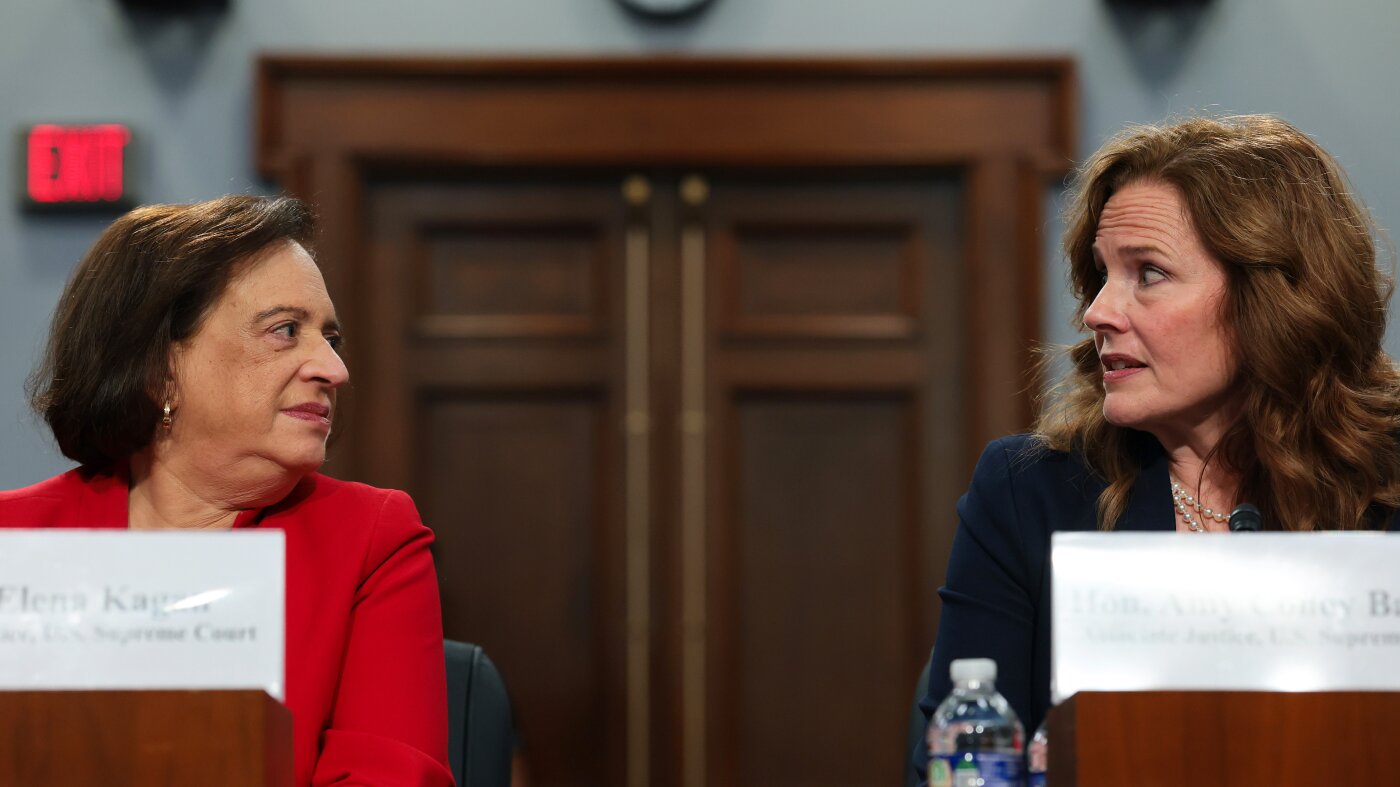
Supreme Court Justices Elena Kagan and Amy Coney Barrett testify before the House Appropriations Committee on Capitol Hill on July 14, 2026 in Washington, D.C.
Anna Moneymaker/Getty Images
hide caption
toggle caption
Anna Moneymaker/Getty Images
The Supreme Court did something Tuesday that it has not done in seven years. It sent two of the justices to Capitol Hill to testify about the court’s budget request for the coming year. The budget has grown dramatically in recent years because of the equally dramatic rise in the number and intensity of threats to the justices’ safety.
Designated as the court’s representatives were Justice Elena Kagan, appointed by President Obama, and Justice Amy Coney Barrett, appointed by President Trump.
As Kagan pointed out in her testimony, it was Republican Darrell Issa and Democrat Elijah Cummings who insisted that the court beef up its security ten years ago after Justice Antonin Scalia died in his sleep on a hunting trip, with no security anywhere nearby to respond quickly.

“They said, kind of like, we think you’re crazy, you know, that that you have less security than director of the Office of Personnel Management does,” she recounted the Congressmen as telling the Court, “and we think that you have to do better.”
Before that, the justices basically had little to no security. They drove their own cars to work; went to the movies and shopped at supermarkets unaccompanied, and did their private travel on their own. And frankly, they liked it that way, because having security is personally invasive.
In recent years, however, the court has undertaken major changes, including continually expanding the court police force to protect the justices and their homes at all times, and funding additional cybersecurity measures.
And yet, as Justice Kagan pointed out, the Court’s $207 million budget request is less than one tenth of one percent of the entire federal budget.
The justices spoke at length Tuesday about how rising threats impacted their lives. Justice Barrett came prepared with two harrowing stories. First was the day she brought home a bullet-proof vest.
“My 12-year-old son was standing in the doorway of my bedroom and he wanted to know what it was,” she testified, “and I didn’t know how to respond. I didn’t expect that performing this service was going to put me in the position of explaining to my children what a bulletproof vest was and why I had to wear one.”
She also described how just six weeks ago, her house was swatted, with local police responding to a fake emergency call. Local police could have stormed her home, but for the fact that her own security detail was there to prevent it.
Indeed, threats have deeply affected judges across America. After U.S. District Court Judge Esther Salas’s 20-year old son was murdered by a gunman seeking to kill her, many federal judges have reported receiving packages bearing the name of her slain son. Those threats, Justice Barrett testified, “are meant to intimidate and they’re meant to harass.”
Sen. Jack Reed (D-R.I.), asked questions about President Trump’s furious response to adverse rulings in the tariff and birthright citizenship cases, and whether Trump’s heaping insults on the court could play a role in jeopardizing the safety of some justices. Kagan had a two-part reply.
“Criticism is fair game. I mean, go for it. You know, life in the big city is that you’re subject to all kinds of criticism. But intimidation is a different thing entirely. And when political figures of any stripe are trying to intimidate judges,” she said, “that’s where we really have crossed the line.”
The hearings were not confined to issues of safety. Congresswoman Rosa De Lauro (D-Conn.) asked about the Supreme Court’s ethics requirements, noting that members of Congress and the executive branch are limited to gifts under $50, while the Supreme Court has no such limit.
She is supporting a bill that would impose upon the Supreme Court the same restrictions on receiving gifts that apply to Congress. And she called for an enforcement mechanism for the ethics rules adopted by the Supreme Court itself.
But Justice Kagan, who said she favors an enforcement mechanism, added that creating such a system is “hard.” After all, as she noted, “you wouldn’t want either the President or Congress” imposing a system on the court because that could well lead to compromising the independence of the judiciary.
One idea that Kagan seemed to like would be to create a panel of distinguished retired judges to enforce the court’s ethics code. But Justice Barrett seemed unpersuaded.
“Who selects the judges? How is the panel composed? There’s just a lot of complexity,” that hasn’t been worked out, she said. The disagreement between the two was, if anything, illustrative of just how hard it was to get the court to finally agree on even the relatively porous ethics code it voluntarily adopted in 2023.
The Justices were also questioned about the court’s emergency docket, dubbed by critics “the shadow docket.” These cases were extremely rare until the Trump administrations.
The critical difference between the emergency docket and the so-called merits docket is that emergency docket appeals often leapfrog over the lower courts, allowing the high court to decide cases without full briefing and argument, and inevitably without much, if any, explanation.
Critics, including Justice Kagan, have often criticized these unsigned and unexplained emergency docket orders for making it difficult for lower courts to know what the law is. Some have in fact accused the court of inviting the Trump administration to treat the docket like a fast-pass to getting policy rubber-stamped.
Questioned by Senator Chris Van Hollen (D-Md.), Kagan observed that part of the reason for the Court’s increasing use of the emergency docket comes from the fact that “we’ve granted a number of these…And when people know that relief is available, there are a lot of smart lawyers out there in the world who are going to say, ‘Why don’t we take our shot at that?’” In other words, the court’s own behavior may have invited the existing problem to metastasize.
-

 Detroit, MI23 minutes ago
Detroit’s air quality early Thursday ranked as hazardous, worst in the world
-

 San Francisco, CA35 minutes ago
‘It was a scene from the Titanic’: Fishermen recall rescuing passengers from sinking boat in SF Bay
-

 Dallas, TX41 minutes ago
Big picture takeaways from the Dallas Mavericks first week at Summer League
-

 Miami, FL47 minutes ago
“We’re going to be champions”. Argentina fans in Miami Beach celebrate team’s win against England
-

 Boston, MA53 minutes ago
4 Red Sox Trade Targets to Solidify Boston’s Push for a Playoff Spot
-

 Denver, CO59 minutes ago
RTD considers ending Denver’s 16th Street FreeRide shuttle due to budget issues
-

 Seattle, WA1 hour ago
Trump immediately fires the new court-appointed top prosecutor in Seattle | CNN Politics
-

 San Diego, CA1 hour ago
Karepango San Diego Comic-Con 2026 Debuts, Merchandise

