Richard Chamberlain, who soared to fame as the handsome young Dr. Kildare on television in the early 1960s and two decades later reignited his TV stardom as a seasoned leading man in the highly rated miniseries “Shogun” and “The Thorn Birds,” has died. He was 90.
A Los Angeles native, Chamberlain died Saturday night in Waimanalo, Hawaii, of complications from a stroke, according to his publicist, Harlan Boll.
“Our beloved Richard is with the angels now. He is free and soaring to those loved ones before us,” Martin Rabbett, his lifelong partner, said in a statement reported by Associated Press. “How blessed were we to have known such an amazing and loving soul. Love never dies. And our love is under his wings lifting him to his next great adventure.”
In a six-decade career that spanned television, movies and theater, Chamberlain played a wide variety of roles — including Hamlet and Professor Henry Higgins on stage and a swashbuckling French musketeer and a frontier America trapper on screen.
“I need to do theater. If I don’t, I feel something is missing,” Chamberlain told The Times in 1984. “But I love doing television and movies too. And I think I’ve shown that an actor can do all three.
Advertisement
“As I’ve said before, the fun in acting is playing different roles. If you’re just going to play one role all your life, you might as well be selling insurance.”
Chamberlain was a virtual unknown with a limited number of TV guest shots and a low-budget movie to his credit when he was cast by MGM as Dr. Kildare in the hour-long medical drama. As Dr. James Kildare, an idealistic young intern at Blair General Hospital, Chamberlain starred opposite Raymond Massey as his wise medical mentor, Dr. Leonard Gillespie.
“The series may be among the solid hits of the season,” predicted Cecil Smith, The Times’ late TV columnist, shortly after “Dr. Kildare” made its debut in 1961. “Chamberlain is an agreeable, attractive young actor with great warmth; he’s an ideal foil for the expert Massey, one of the finest actors of our time.”
Overnight, the tall, blond, blue-eyed, 27-year-old former college sprinter, who later admitted to being “as green as grass” as an actor, became a teen idol and a fan-magazine favorite who was soon generating up to 12,000 fan letters a week.
“Dr. Kildare,” which premiered on NBC the same season as another popular medical drama on ABC, “Ben Casey,” starring Vince Edwards, ran for five years.
Advertisement
Raymond Massey as Dr. Gillespie, left, and Richard Chamberlain as Dr. Kildare with a patient in the 1960s NBC series “Dr. Kildare.”
(NBC)
During his time off from the series, Chamberlain starred in two movies: as a trial lawyer in the 1963 courtroom drama “Twilight of Honor,” and opposite Yvette Mimieux in the 1965 dramatic love story “Joy in the Morning.”
But his role as the noble TV doctor remained his greatest claim to fame at the time, his popularity generating comic books, trading cards, a board game, a doll and other merchandise bearing his white-coated “Kildare” likeness.
Advertisement
Chamberlain’s weekly TV exposure also led to a brief side career as a recording artist, one that revealed a pleasing baritone on releases that included the album “Richard Chamberlain Sings.”
“Kildare had been an incredible break for me, and a grand, if grueling, rocket ride,” the actor recalled in his 2003 memoir, “Shattered Love.” “Though I was considered more a heartthrob than a serious actor, it had put me on the map.”
That point was driven home during a luncheon gathering at Massey’s home when veteran English actor Cedric Hardwicke told him, “You know, Richard, you’ve become a star before you’ve had a chance to learn to act.”
After his five-season run on “Dr. Kildare,” Chamberlain turned down a number of new TV-series offers, preferring instead to concentrate on theater and film.
His first attempt on Broadway — in a troubled 1966 production of a musical version of “Breakfast at Tiffany’s” with Mary Tyler Moore — ended when producer David Merrick pulled the plug on the much-anticipated musical’s opening after only four preview performances in New York.
Advertisement
Chamberlain went on to appear in what he called his first serious film, playing Julie Christie’s occasionally violent husband in “Petulia,” a 1968 drama directed by Richard Lester.
Determined to obtain “some solid acting training,” he moved to England, where he immediately was cast in a 1968 six-hour BBC production of Henry James’ novel “The Portrait of a Lady.” Instead of joining an acting academy in London, as he had planned, Chamberlain received what he referred to as on-the-job training during his more than four years living in England.
Indeed, “The Portrait of a Lady” led to a challenging, most unlikely role for TV’s Dr. Kildare: Hamlet.
His performance in the BBC production of the James novel had drawn the attention of the well-known Birmingham Repertory Company, which was looking for a known actor who could fill seats for its upcoming production of the Shakespeare tragedy.
Richard Chamberlain, left, as Edward VIII, acts with Faye Dunaway, as Wallis Simpson, on the ABC Television Network’s re-creation of their love story in “Portrait: The Woman I Love” in November 1972.
(ABC)
Advertisement
After undergoing long and intensive rehearsals, Chamberlain said he was amazed when most of the London critics gave him “quite good” reviews. He later went on to play Hamlet in a different production for Hallmark Television.
“Having graduated from pretty boy to actor, I was at last taken seriously, and it was an exhilarating experience,” he wrote.
Chamberlain appeared in director Bryan Forbes’ 1969 film “The “Madwoman of Chaillot,” starring Katharine Hepburn, and he starred as the Russian composer Tchaikovsky opposite Glenda Jackson in director Ken Russell’s 1970 film “The Music Lovers.”
Among his other film credits in the ‘70s were “The Three Musketeers” (1973), “The Towering Inferno” (1974) and “The Last Wave” (1977).
Advertisement
Chamberlain’s early work on the American stage included starring in the Seattle Repertory Theater’s 1971 production of Shakespeare’s “Richard II,” a performance deemed by Times theater critic Dan Sullivan as “an astonishingly accomplished one.” And his 1973 starring role in “Cyrano de Bergerac” at the Ahmanson Theatre in Los Angeles earned him a Los Angeles Drama Critics’ Circle Award.
Over the years, Chamberlain starred on Broadway four times, all in revivals: as the Rev. T. Lawrence Shannon in “The Night of the Iguana” (1976-77), as Charles in “Blithe Spirit” (1987), as Professor Henry Higgins in “My Fair Lady” (1993-94) and as Captain Georg von Trapp in “The Sound of Music” (1999).
On television, his leading role in the 1975 TV movie “The Count of Monte Cristo” earned him the first of his four Emmy nominations.
But it was a string of TV miniseries that would give him his biggest post-“Dr. Kildare” career highs, beginning with his role as Alexander McKeag, a bearded Scottish trapper, in “Centennial,” a star-studded 12-episode historical epic that aired on NBC in 1978-79.
Richard Chamberlain, right, portrays John Blackthorne next to Frankie Sakai as Lord Yabu in the TV miniseries “Shogun.”
(NBC )
Advertisement
Then, in 1980, came his starring role in “Shogun,” an NBC miniseries set in feudal Japan in the year 1600. As John Blackthorne, a shipwrecked English navigator who is taken prisoner, he becomes involved in a battle among warlords seeking to become Japan’s supreme military ruler and falls in love with his married interpreter.
Chamberlain was unprepared for the response to his role in the critically acclaimed, highly rated miniseries.
“I’d forgotten about being besieged in supermarkets,” he told The Times in 1981. “I used to get it during my ‘Dr. Kildare’ days, but then it stopped and I forgot about it. Now it’s started all over again.”
In the 1983 ABC miniseries “The Thorn Birds,” he played Father Ralph, an ambitious Catholic priest who struggles with his vows after falling in love with the beautiful young niece (played by Rachel Ward) of the wealthy matriarch of a sprawling Australian sheep ranch (Barbara Stanwyck).
Advertisement
Dubbed the “king of the miniseries,” Chamberlain won Golden Globes and received Emmy nominations for his performances in both “Shogun” and “The Thorn Birds.”
He went on to earn another Emmy nomination as the star of the two-part “Wallenberg: A Hero’s Story” on NBC in 1985, in which he played a Swedish diplomat in Budapest who saved thousands of Hungarian Jews during World War II.
Actor Richard Chamberlain poses during his time at the Pasadena Playhouse while staring in “The Heiress” in 2012.
(Robert Gauthier / Los Angeles Times)
Born George Richard Chamberlain in Los Angeles on March 31, 1934, Chamberlain was named after his grandfather but was always called Dick or Richard. He and his older brother Bill grew up in Beverly Hills, in a three-bedroom house in what Chamberlain called “the wrong side of Wilshire Boulevard.”
Advertisement
His mother was a housewife. His father, a salesman for a small company that manufactured grocery-store fixtures, was an alcoholic whose periodic drinking binges devastated the family. When Chamberlain was about 9, his father joined Alcoholics Anonymous.
After graduating from Beverly Hills High School, where he was a four-year letterman in track, Chamberlain majored in art at Pomona College in Claremont. Despite being shy and inhibited, he began “moonlighting” in the drama department, where, he later wrote, he found himself “fast losing my heart to drama.”
Drafted into the Army after graduation, Chamberlain spent 16 months as an infantry company clerk in South Korea.
Intent on becoming an actor after his two-year stint in the Army, he returned to Los Angeles, where he was accepted into an acting workshop taught by blacklisted actor Jeff Corey and landed an agent.
Chamberlain quickly began doing guest roles on TV series such as “Gunsmoke,” “Bourbon Street Beat” and “Alfred Hitchcock Presents.”
Advertisement
Throughout most of his long career, Chamberlain took great pains to keep a secret from the public: He was gay.
Although his friends and people in show business knew, Chamberlain said he avoided talking about his private life in interviews, fearful of what it would do to a career built on his being a romantic lead opposite a woman.
But that changed with the publication of his candid memoir in 2003, a time in his life when, as he told the New York Times, he no longer had “an image to defend.”
By then, he had been in a more than two-decade-long relationship with Rabbett, an actor, producer and director. The two lived together in Hawaii until Chamberlain returned to Los Angeles in 2010 to resume his acting career.
Chamberlain had always hated himself for being gay, he told the Los Angeles Times in 2003. “I was as homophobic as the next guy,” he said. “I grew up thinking there was nothing worse.
Advertisement
“Sixty-eight years it took me to realize that I’d been wrong about myself. I wasn’t horrible at all. And now, suddenly, I’m free. Out of the prison I built for myself. It’s intoxicating. I can talk about it positively because I’m not afraid anymore.”
Actor Richard Chamberlain in 2003 in Los Angeles.
(Gary Friedman / Los Angeles Times)
Despite his concern over how the public would react, he found acceptance and warmth instead.
“Everyone has been so supportive, so positive ,” he said. “In New York, people walked up to me in the street, and in theaters. Strangers gave me the thumbs up, wished me well, said, ‘Good for you.’ I’m just awestruck by the change in the way I feel about life now.”
A family and friends gather for a naming-day ceremony at a Danish seaside hotel, but an unexpected appearance by one uninvited attendee (Trine Dyrholm) ruptures the veil of bland, happy-clappy familial unity in director Mads Mengel’s gutsy, well-wrought debut feature, The Guest.
The most audacious move here may be Mengel and co-screenwriter Christian Bengtson’s choice to write something that will inevitably invite comparisons with Festen (The Celebration), arguably the most notorious Danish-language film of the last 30 years, which similarly revolved around a bougie gathering disrupted by angry revelations. But there’s a savvy 2026 vibe about the way the film refuses to create florid melodrama out of quotidian crisis, and instead observes with generosity as the characters grope awkwardly toward emotional détente and mutual forgiveness.
The Guest
The Bottom Line
When wetting the baby’s head goes too far.
Advertisement
Venue: Karlovy Vary Film Festival Cast: Simon Bennebjerg, Trine Dyrholm, Josephine Park, Peter Gantzler, Petrine Agger, Mette Klakstein Wiberg, Kristine Kujath Thorp, Buster Lund Luscher Director: Mads Mengel Screenwriter: Christian Bengtson, Mads Mengel
1 hour 40 minutes
Festen-alumnus Dyrholm, having a bit of a career moment with outstanding performances both here and in the recent The Girl With the Needle among others, leads a uniformly excellent cast in a work that deserves celebration on the festival circuit and beyond.
Dyrholm’s Vibeke is technically the first person we meet, although she’s seen only in shadow at first as she smokes and drives while her unattached seatbelt, caught outside by a closed door, clatters on the road. This is the kind of unsafe driving her son Karl (Simon Bennebjerg) so deplores, a point of contention later on in the story when he will steal her car keys in interest of her own safety and that of others.
Advertisement
But well before we get to that flashpoint, the film introduces Karl, effectively the film’s protagonist, as he arrives at the swanky resort with his wife Emilie (Mette Klakstein Wiberg) and their infant son Elliot (Buster Lund Luscher). The young family, who’ve chosen this new, secular tradition instead of a christening to welcome their child to the world, are there a day before the ceremony to meet up with core family members.
As this advance party settles down for dinner, a table that includes Karl’s sister Rikke (Josephine Park) and Emilie’s parents Frank (Peter Gantzler) and Kirsten (Petrine Agger), there’s a surprise: Vibeke is coming, courtesy of Rikke’s invitation. Karl is quietly furious and seems determined to turn her away, even when she shows up minutes later. Poor Frank and Kirsten look on confused, determinedly polite in their insistence that all family members should be welcome.
Bengtson and Mengel’s economical script carefully dripfeeds backstory as the film unfolds to explain that Karl hasn’t spoken to his mother in years, that Rikke has taken over all the daily mom management and that she’s very worn out by it. Even so, she insists Vibeke is regularly taking her medication and isn’t a problem these days, although to Karl every weird anecdote and moment of emotional intensity is an augur of impending chaos. Rikke counters that their mother is just “big, that’s her personality not her condition.”
Interestingly, that specific condition is never named throughout, although armchair diagnosticians might spot many of the signs of bipolar disorder. But the film’s emotional focus on the person and her actions rather than the label is also very contemporary, reflecting a more holistic, inclusive mindset and approach to dealing with mental health issues.
Which is all fine and dandy, until Vibeke duly does skip a dosage and starts getting manic. One of the first signs of chemical imbalance arrives during the ceremony on the beach, when Vibeke carries little Elliot much further away from the shore than anyone wants, creating a panic. From there it just gets worse as Vibeke picks up on the censorious feeling emerging from the other party guests, who had found her so charming the night before when she’d led everyone to the casino to play roulette and diverted a bunch of partying teenagers from the room next to Karl and Emilie so they could get some sleep. When the toasts at the formal dinner begin, Vibeke’s mood darkens much further, and if we’ve all learned one thing from Festen, it’s be very afraid when a Dane gets up to make a toast.
Advertisement
Cinematographer David Bauer’s nimble-footed lensing and use of natural light does indeed hark back considerably to the look of those Dogme 95 movies back in the day, as does the naturalistic editing style deployed by Louis Emil Ramm Seeberg. But there are plenty of sins against the rules of cinematic chastity that marked that movement, such as the ample space made for Lasse Aagaard’s affecting, low-key score that amps up the anxiety as Vibeke starts to spiral.
That said, Mengel keeps things simple in sonic terms when it really counts, letting the musicality of Dyrholm’s deep, sonorous voice ring out on its own in the big monologue scenes. She is, as ever, utterly mesmerizing but the performance is made even more powerful by the muted, expressive reactions of the rest of the cast as they look on, frozen like deer in the headlights of the car crash of pseudo-christening. Moments of levity puncture the gloom, but the final feeling is one of numbed sorrow and pity for all these kind, fallible people, just trying to do their best.
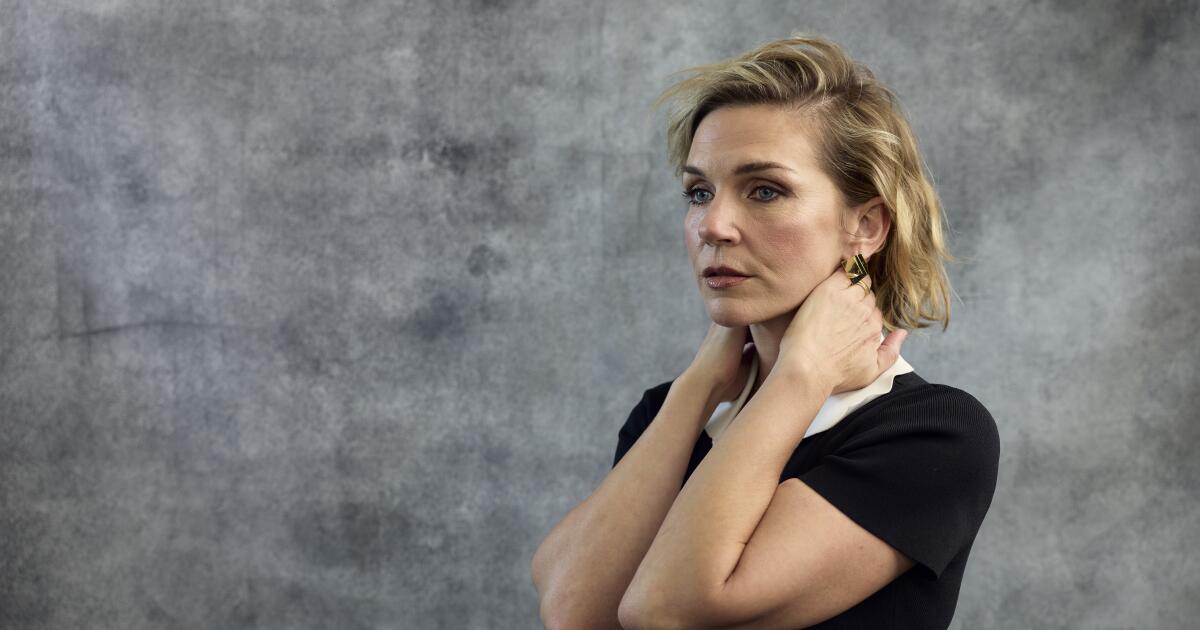
Rhea Seehorn was nervous about whether “Pluribus” would be recognized by Emmy voters Wednesday when nominations were announced. So she was jubilant when she and the surreal sci-series on Apple TV scored 18 nominations, the most for a first-year drama.
“I’m just so grateful,” the actor said in a phone interview. “People were like, ‘Why were you nervous?’ Honestly, you never actually know. I’m just so thrilled for the show, my co-stars, the production design, the editing, the writing, the music, the sound. I haven’t moved from my couch since they first announced everything because I’m still trying to call everybody on the show.”
Seehorn received a nomination for lead actress in a drama series for her portrayal of cynical Carol Sturka, a fantasy romance author who finds herself in a mystifying situation after a virus seems to have wiped out most of Earth’s population. The series was created by Vince Gilligan, who created the acclaimed series “Breaking Bad” and co-created its spinoff “Better Call Saul,” which also featured Seehorn.
The actor compared her experience of being nominated for “Pluribus” to “Better Call Saul,” which earned her two supporting actress nominations: “ ‘Better Call Saul’ was such a family that supported and cheered each other on, and I’m so grateful I have that environment again. People could not be happier for each other, and we get to celebrate the show together.”
She added, “The only part that feels different is that it’s my first nomination as a lead. It’s the process of Vince writing this for me and seeing the mountain which he wanted me to climb and going through that process. The whole thing has been its own journey, so ending up with awards and nominations, and being so well received by critics and fans is not lost on me.”
Advertisement
The series has been applauded for its mix of drama, comedy and strangeness in its portrait of a woman coming to terms to what seems like an impossible dilemma.
“I love the storytelling, how much Vince and I would drill down on making this as authentic as we could in terms of an everyman who has to deal with an insane situation,” Seehorn said. “Most of us are just not heroic or leaping off the couch to go save the world. And Carol is dealing with immense grief and confusion in an utter dystopian crisis. I love the humor and the drama that comes out of us being as realistic as we can with her amidst an unrealistic event.”
Fans of “Pluribus” have been relentlessly curious since the finale in December about when the second season will launch.
“I don’t know anything about that,” Seehorn said. “I don’t have to keep secrets because I’m not great at keeping them, and I know nothing. I don’t know what I’m doing with an atom bomb in the driveway. I can’t wait to find out. The writers want to have the same quality and reward the intelligence of the fans and never phone a single thing in. So their process is their process.”
In a roundabout way, the fact that I don’t have a strong attachment to The Wizard of Oz as a film (my late mother loved it, so that memory is deeply rooted in me, but the movie itself never did much for me) contributed directly to how amusing I found Gail Daughtry and the Celebrity Sex Pass to be. This comedy spoofs the plot of the classic fantasy movie, though the jokes are largely about Hollywood. The humor is big and broad, with some of the jokes really landing. Others? Not so much. Still, more than enough do to warrant a recommendation.
Gail Daughtry and the Celebrity Sex Pass gets a lot of mileage out of sending up show business, even if the observations, while funny, are not particularly new. Besides the deluge of jokes, there’s also a lot of likably broad characters to spend time with, especially our lead. They make the 90 minutes and change spent together with them go down very easy.
Sony Pictures Classics
For Gail Daughtry (Zoey Deutch), her life as a small town hairdresser is perfect. Engaged to her high school sweetheart Tom (Michael Cassidy), she’s the picture of happiness, at least until a trip to a celebrity book signing. There, Tom meets and ends up sleeping with his “celebrity pass,” a term Gail wasn’t even really previously aware of. Feeling betrayed, Gail impulsively joins her co-worker and friend Otto (Miles Gutierrez-Riley) on a trip to Los Angeles. There, a psychic convinces her that the can save her marriage by sleeping with her own celebrity pass: Jon Hamm (Jon Hamm).
Journeying through Tinseltown in a manner that recalls Dorothy’s adventure in Oz, Gail and Otto won’t have to find Hamm alone. Joining forces with talent agency assistant Caleb (Ben Wang), down on his luck paparazzo Vincent (Ken Marino), and actor John Slattery (John Slattery). As they search for Hamm, some for their own purposes, they meet other celebrities, while also being hunted by a group of Italian assassins after a case of mistaken identity. Eventually, they come across Hamm, and the moment of truth is at hand.
Sony Pictures Classics
Zoey Deutch dives headfirst into a broad comedy like this, absolutely relishing the opportunity to get silly again. She’s able to make Gail a babe in the woods but also someone you laugh with, not at. It’s a wildly enjoyable turn. Deutch started out in comedies and was always a talented comedic actress, so it’s a pleasure to watch her back at it. Miles Gutierrez-Riley and Ben Wang get some very funny moments, while Ken Marino is a reliable comic presence. Jon Hamm and John Slattery are delighted to be sending up themselves, with amusing results. Supporting players here, in addition to Michael Cassidy, also include Kerri Kenney, Richard Kind, Thomas Lennon, Joe Lo Truglio, Fred Melamed, and more, plus some cameos.
Advertisement
Filmmaker David Wain, again co-writing with Ken Marino, continues to make it look easy. Few can make a silly comedy like Marino and Wain, especially as they pack their flicks with extra bits that only subsequent viewings reveal. Is Gail Daughtry and the Celebrity Sex Pass on the same level as Wet Hot American Summer or They Came Together? No, not quite. At the same time, is this, scattershot approach and all, funnier than most other 2026 releases? You bet. Marino and Wain have a hit rate that allows some of the jokes to miss, as you only have seconds to wait before the next one, which probably will hit.
Gail Daughtry and the Celebrity Sex Pass is very amusing, and occasionally hilarious, even if not as many jokes land as you might expect. Zoey Deutch is great in the lead role, David Wain is in his comfort zone, and the laughs come hot and heavy. If you’re a Wain fan, this new movie should be a must see.




 Sony Pictures Classics
 Sony Pictures Classics


