Lifestyle
VIP Records helped launch Snoop Dogg’s career. Now the shop owner wants to build a museum


In the early 1990s, Kelvin Anderson Sr. built a makeshift recording studio in the back of his Long Beach record store, a vinyl-filled paradise called the World Famous VIP Records on the corner of Pacific Coast Highway and Martin Luther King Jr. Avenue. He wanted to give youth a creative outlet in the gang ridden neighborhood.
Word quickly spread around the city, and aspiring artists started sprinkling in. Folks like Snoop Dogg, Warren G and Nate Dogg — who were part of a trio dubbed 213, the Long Beach area code at the time — famously cut their first demo there.
The late Christopher George Latore Wallace, better known by his stage name The Notorious B.I.G., is pictured with fellow artist Craig Mack and VIP Records owner Kelvin Anderson in front of the store.
(Courtesy of VIP Records)
”Trust me, there were many kids in there,” says Anderson, who’s now 70 and known as “Pops” in the community. “Some were learning how to sing, dance, to be a producer and, in Ricky Harris’ case, how to be a comedian. There was a lot going on. Jamie Foxx used to hang out there. DJ Quik learned how to produce music there. It was a place to come and explore the possibility of being an entertainer.”
These are among the decades of stories that stem from the family-owned record store that has been a mecca for G-funk music and has helped boost the careers of some of rap’s biggest stars. Today, Anderson, who’s worked in the music industry for more than 50 years, is hoping to preserve the history of VIP Records by converting it into a museum and educational center.
“This brand is so loved and recognized around the world, so we need this museum,” Anderson said during a Tuesday unveiling event, co-hosted by the nonprofit Creative Class Collective. “The story needs to be told and the importance of Black music in general, and the role that it has played.”

Ashanti Dykes plays the guitar at VIP Records.
(William Liang / For The Times)
Anderson adds, “When it comes to rap and hip-hop, VIP Records was the first to sell rap music on the West Coast, period.”
Anderson’s older brother, Cletus, opened the first VIP Records in 1967, and his siblings helped open 13 more locations throughout L.A. County. Anderson, who is one of 10 children, followed his family’s tradition of moving from their Mississippi hometown to L.A. after he graduated high school, to help run the stores. In 1978, Cletus opened the World Famous VIP Records in Long Beach, and Anderson took it over a few months later. (Cletus died in 2024 at age 82.)
In 2017, the city of Long Beach made VIP Records’ iconic sign a historic landmark. Mayor Rex Richardson says that the city also put forth a “significant amount of money” to refurbish the sign and that he hopes to place it onto public property near the store so visitors can visit and experience it. He says he wants to turn it “into an actual monetary opportunity” to support Anderson’s vision for the museum. He and the Anderson family are in the process of working out an agreement.
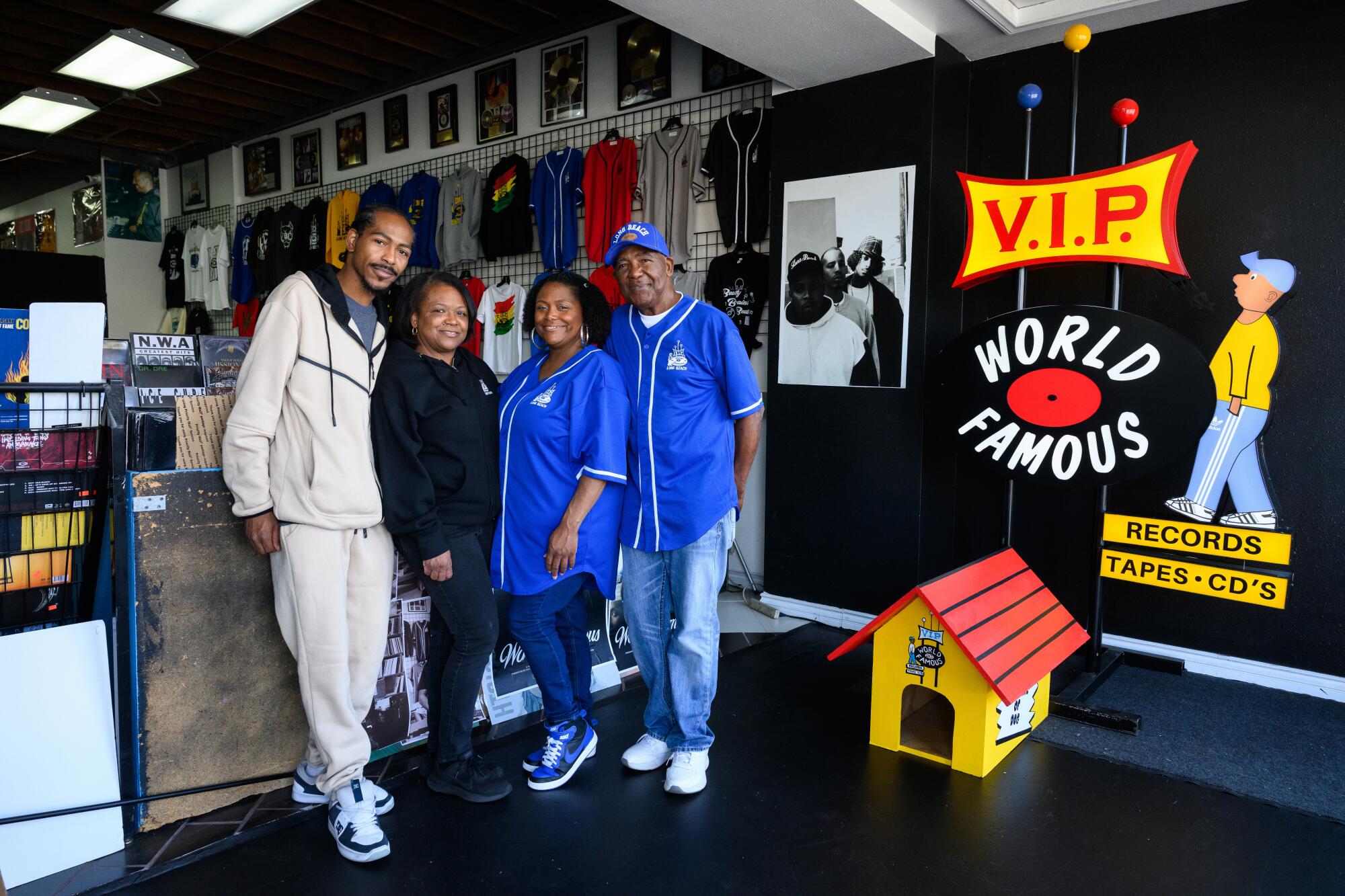
Members of the Anderson family. There were once 14 VIP Records locations throughout L.A. County but today, only the Long Beach store remains.
(William Liang / For The Times)
“A museum, in order to do it right, it will need some sustainable resources, so let’s take this rich cultural capital we have and begin to put it on display,” says Richardson, adding that the restoration project is part of a larger plan known as Elevate 28 to beautify and highlight historic landmarks in Long Beach in time for the 2028 Summer Olympics, which Los Angeles is hosting. He also wants to open a legends walk to showcase famous Long Beach natives.

-
Share via
Due to the ever-evolving music industry that has shifted to streaming, the Anderson family closed all but its Long Beach store, which is a few steps away from its original location. Historical artifacts fill the walls of the record store, including plaques and awards from various record labels and photos of artists like Rick James, the Jacksons and Donna Summer who visited the shop. Near the front of the store is a replica of the shop’s landmark sign that Snoop Dogg famously featured in his music video for “Who Am I (What’s My Name)?” from his 1993 debut album, “Doggystyle.” Next to a counter, there’s a framed image taken by longtime photographer, Duke Givens, of his childhood friend, Snoop Dogg, on display.
“The reason why [VIP Records] has staying power is because of love,” says Givens, a Long Beach native who grew up frequenting the store and described it as a third space for locals. “It’s an institution. It’s more than just a location. You know how we have church, we have school, we have sports … we have VIP.”

Photographer Duke Givens poses for a portrait with an image he took in 1994.
(William Liang / For The Times)
The idea to open a museum came to Anderson several years ago when a father walked into the store with his two sons. As they thumbed through the vinyl records, one of the preteens said, “Dad, what’s that?” Anderson recalls.
“There were a lot of people at the store that day, and everyone seemed to be tuned in,” Anderson says. “It was funny. I said, ‘Man, we need to tell the story. We need to tell the story of the record business.’”
During Tuesday’s event, Snoop Dogg called in and shared his support for the museum, marking a full-circle moment.
“I just want to thank you for giving us an opportunity to actually showcase our talent back when rap wasn’t so popular and it wasn’t so easy to do,” he said to Anderson. “All of y’all up there at the VIP gave us hope. Y’all gave us opportunity to actually make our dream come true and give us a platform to hear our voice for the first time on a cassette, to hear what we sounded like, to see what we meant to people.”
Travis A. Scott, a Long Beach native and rapper who goes by H.O.B.O (an acronym for Heart of a Brave One), went to VIP Records for the first time several years ago after hearing that Anderson was allowing artists to record music in the studio. He recorded his debut album, “City by tha Sea,” there and was signed under At Last VIP Entertainment, VIP Records’ label.
“VIP Records is a safe haven,” he says. “It protected me. It protected my mind from venturing fully into the gang violence and into the drug trade and all the other things that were negative in my community. This where I was able to come to be able to take my negative frustration out in a creative and productive way. That allowed me to free myself from the burdens of others calamities, to be able to be myself instead of what the community and the environment wanted me to be.”

The record store, which remains a place to find modern and classic albums, often hosts events for the community.
(William Liang / For The Times)
Anderson says he envisions great-grandparents bringing their great-grandkids to the space to learn about the evolution of the music industry and most importantly, VIP Records’ impact on it.
“We need that support,” says Anderson, adding that people can make donations via their foundation website. “We need everybody to get behind this movement. It would be something that people would enjoy throughout the rest of their life.”
As Tenisha Anderson, chief operating officer for VIP Records, flipped through photos of her father, Kelvin, in his early days at the store, she said that it’s a “no-brainer” for VIP Records to have a museum.
“There are so many things that are actually dying off, and I don’t want to be political, but they are even taking books away,” says Tenisha, who is also the founder of the VIP Family Foundation and runs several young adult programs including Beauty, Brains and Beats, a workshop that highlights the music industry from a female perspective. “The thing is, you can’t take the music away. The music is always going to tell the story. The music is always going to build you up emotionally. The music is always going to be empowering because it comes from the soul.”



For its upcoming Los Angeles venue, experiential art firm Meow Wolf will focus on the art of storytelling, with a specific eye toward skewering our city’s moviemaking magic. To help bring that vision to life, Meow Wolf has entered into a creative partnership with Titmouse, one of L.A.’s most renowned independent animation houses.
The Hollywood-based studio behind popular series such as “Big Mouth” and “Star Trek: Lower Decks” will create animation that will be shown throughout the West L.A. venue, which is on target for a late 2026 opening at the Howard Hughes entertainment complex.
It’s a move that represents a shift for Santa Fe, N.M.-based Meow Wolf. Over the last decade-plus, the art collective has grown beyond its anything-goes, punk-meets-psychedelic roots into an organization with full-scale, maximalist installations in its hometown, Denver, Las Vegas, Houston and the Dallas suburbs. In the past, Meow Wolf kept most of its media in-house.
As part of its larger-than-life participatory art installations, Meow Wolf L.A. will feature a mix of live action and animation, the former filmed by Meow Wolf in its Santa Fe studio. Meow Wolf’s James Stephenson, a senior VP with the company and its creative director of emerging media, said the degree to which the L.A. exhibition will lean into various animation styles necessitated an outside partner. Titmouse’s work, in development by a number of directors with contrasting tones, will be shown on a variety of formats, ranging from cinema screens to full-room projections.
“I really believe in animation as an art form, and I know the Titmouse folks do too,” Stephenson says. “Animation is made by artists. It’s made by artists with their own hands. It’s something that is still very rooted in craft.”
Meow Wolf’s L.A. space is set in a former cinema complex, and will champion its location, taking guests on a journey through a converted movie house and beyond, into a sci-fi-inspired fantasyland with sentient spaceships and a 30-foot-tall mushroom tower. Meow Wolf creatives have spoken of the fantastical movie theater as one that will feature animated, self-aware candy before attendees enter the main exhibition space, making Titmouse’s work some of the first art guests will encounter. Titmouse co-founder Chris Prynoski has said the studio has lined up at least six directors for the exhibit.
An in-progress art installation destined for Meow Wolf L.A. at the art collective’s Santa Fe, N.M., headquarters. The L.A. exhibition will feature animation from Titmouse.
(Gabriela Campos / For The Times)
Titmouse, says Stephenson, is the right partner because “they’re known less for a house style, and more for a house vibe.” Over the years, Titmouse has been behind such diverse shows as “Scavengers Reign,” owning a Jean Giraud influence rooted in French and Spanish surrealism, the lively “Jentry Chau vs. the Underworld,” with an unique color palette that took inspiration from anime and Chinese mythology, the exaggerated comic book feel of Adult Swim’s “Metalocalypse,” and the approachable yet expressive tone of “Star Trek: Lower Decks.”
“Meow Wolf’s vibe is similar to Titmouse’s vibe,” Stephenson says. “It’s artist-first, artist-driven, independent and kinda edgy. They are always trying to find the edge of what’s possible. They try to see how far they can go, and it’s done for fun and in the spirit of taking risks.”
Prynoski says working with Meow Wolf will give Titmouse a sense of artistic freedom it doesn’t always have when delivering content for more traditional Hollywood partners. He says the multi-director approach is a callback to the early days of Warner Bros. Animation, when individual creators put their own stamp on Looney Tunes material.
“I use Bugs Bunny as an example,” Prynoski says. “You’ve got a Friz Freleng Bugs Bunny short. You’ve got a Chuck Jones Bugs Bunny short. You’ve got a Tex Avery Bugs Bunny short. They’re all different versions of Bugs Bunny, and people who are really paying attention can tell which director directed each one. Even though to the layman, these are all Bugs Bunny, but if you lined them up, they are drawing in different styles, sensibilities and techniques.”
Prynoski says that was a centerpiece of his pitch to Meow Wolf, noting that characters will reappear in multiple installations, each handled by a different artist. Meow Wolf L.A., in fact, will be the firm’s most character-driven exhibition, as guests will follow the storylines of three main protagonists throughout the space.
In announcing the partnership, Meow Wolf and Titmouse released an image from an animated work directed by Luca Vitale. It features a key character having a moment with a hummingbird and it’s done in an elegant, slightly anime-influenced style. It’s an image full of movement, reflecting a character in transition with inviting pastels and bold dashes.
“I like that image because I think it captures some of the sense of wonder that we want people to feel,” Stephenson says. “The character is having an encounter with the elusive nature of creativity and reality in a way that makes them have a different perspective of what’s possible.”
Other contributing animation directors to Meow Wolf L.A. include Space Dawg, Felix Colgrave, Alexander Vanderplank and Phimémon Martin, and Jun Ioneda.
Titmouse’s partnership with Meow Wolf will extend beyond the L.A. exhibition. The two will be working on the development of Meow Wolf New York, which is slated to open some time after Los Angeles, and are collaborating on a planned animated series, which Prynoski is spearheading.
Meow Wolf exhibits are the result of sometimes hundreds of disparate artists coming together in a shared space. Distilling that into a signature, singular style for a series could be a challenge. Stephenson pinpoints some guiding principles.
“You really need to feel the hand of the artist,” he says. “You need to feel a DIY aesthetic. You need to feel the materiality. Those are very specific to what we are.”

The Kennedy Center on June 28, with its facade signage still covered by a tarp and scaffolding.
Alex Wroblewski/AFP via Getty Images
hide caption
toggle caption
Alex Wroblewski/AFP via Getty Images
On Wednesday, a federal appeals court denied President Trump’s request to stop the removal of his name from Washington, D.C.’s Kennedy Center. The signage on the building has been covered with tarp and scaffolding since June 13, but in a court filing last month, the center’s current executive director said that Trump’s name has been removed.
In their decision, three judges from the U.S. District Court of Appeals for the District of Columbia Circuit said that the president had failed to prove that the arts center would be “irreparably injured” without Trump’s name attached to it.

NPR requested comment from the Kennedy Center, but did not receive an immediate reply.
This latest round of court decisions is part of the ongoing litigation filed by Rep. Joyce Beatty, D-Ohio, against President Trump and the board of the Kennedy Center. In a statement emailed Wednesday to NPR, Beatty said: “Today’s ruling again affirms that this administration’s efforts to rename the Kennedy Center were unlawful. His name no longer desecrates this sacred memorial, which belongs to the American people. Now it is time for the Trump administration to accept this, comply with the law, and take the tarps down.”
In previous court filings, Trump’s legal team had asserted that removing the president’s name from the arts complex, both on the physical building and in its digital materials, would inflict irreparable harm in both time and money already spent. In the denial, the three judges — Patricia Millett, Robert Wilkins and Gregory Katsas — wrote that since Trump’s name has already been removed, “a stay would not avert those harms.”
Furthermore, Trump had claimed that without his name attached, future fundraising would be threatened “and [will] contribute to the financial decline of the Center.” In response, the appeals judges wrote: “Appellants, however, have failed to support this assertion with any specific facts or evidence. They offer only the conclusory assertions of the Kennedy Center’s Executive Director that were made in a factually unsupported declaration.” The center’s current executive director, Matt Floca, specializes in physical plant management.
The presiding judge in the case, Christopher R. Cooper, has ordered that the center provide him a status report on the center’s operation and programming before the end of this month. As of Wednesday, the center’s calendar lists a small roster of programs, including outdoor free movie screenings, workshops for children, and five free live performances in July on its Millennium Stage. In the past, the Kennedy Center presented over 2,000 arts and education events each year, including free daily Millennium Stage performances.

Lifestyle
A meal with an animated Mona Lisa? Immersive dining goes high tech — but will L.A. eat it up?
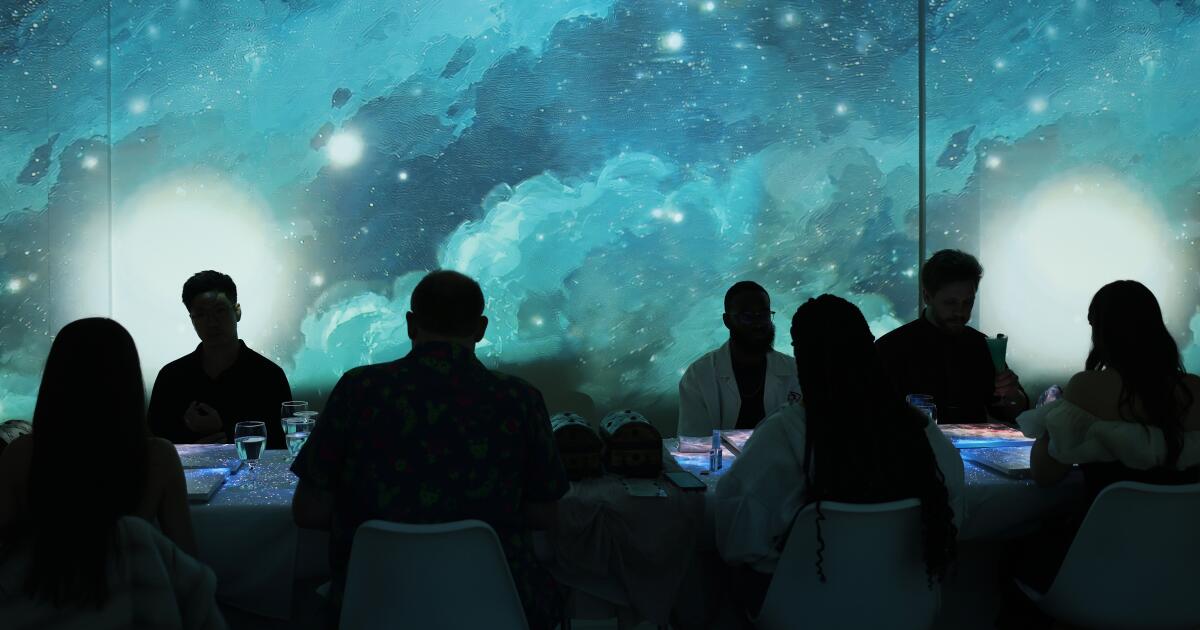
My dinner course is served. It is a Campbell’s-inspired soup can, lightly angled so strands of broccoli are peeking out. I lift the can to uncover a slow-braised short rib and mashed potatoes. An American dish to represent an American artist, here Andy Warhol.
The room is overtaken with projections, scenes of bustling New York traffic paired with bachelor-pad-like guitar riffs. Shown on a wall above a dinner table is a selection of Warhol silkscreens. It’s a Friday night in West Hollywood, and I’m surrounded by a mix of out-of-towners and those celebrating an anniversary. And while this is a special occasion, we’re urged to get a little messy with our food — to use our hands, to paint with a salad, to draw on a cookie.
The main course: A tomato soup can? “7 Paintings” is an immersive event that occasionally hides dishes in artist-inspired presentations.
(Christina House / Los Angeles Times)
Play is the primary side dish at “7 Paintings,” a tech-infused dinner theater that aims to be a crash course in fine art. That selection of veggies paired with multiple mini cups of colorful dressings? Guests are encouraged to mix and match the vinaigrettes into a mess of hues, a nod to abstractionist Jackson Pollock. And yellowfin tuna with dashes of avocado and taro chips? That’s an edible tribute to Banksy, of course. What does raw fish have to do with stenciled street art? It’s bold, heavily angled and has a short shelf life? Maybe? Perhaps don’t overthink it.

Even the paper is edible.
(Christina House / Los Angeles Times)
“Have you ever eaten a painting before?” says Nadine Beshir, the Dubai-based creator of “7 Paintings.” “We try to get people out of their comfort zones and eating paper. I want to bring out the child in them.”
“7 Paintings,” held at Sunset House L.A. through the end of August, is the latest example of immersive dining to arrive in this city. These experiences often involve guest participation and are accentuated with advanced multimedia technology and sometimes theatrical elements.
Worldwide, there have been standouts. For instance, Eatrenalin at Germany’s Europa-Park, a dining room-meets-ride where participants are whisked around the space on trackless “floating chairs,” has just received a coveted Michelin star. Ibiza’s Sublimotion has similar haute ambitions, pairing 12 diners together in a room that will come alive with otherworldly projections and performers. At times, diners will win don virtual reality headgear.
But tech-driven immersive dining experiences have never quite taken off in Los Angeles as a trend. Last year, the Gallery, where fantastical cityscapes and projections surrounded downtown L.A. diners, stood just a couple months before the concept was abandoned.

“7 Paintings” pairs food with art and music. It’s “fun dining, not fine dining,” says its founder.
(Christina House / Los Angeles Times)

Bartender Luca Famulari shakes a cocktail at the immersive dining event.
(Christina House / Los Angeles Times)
“The economics of a restaurant are not the same as the economics of theater and the challenge of combining the two lies in thinking outside the box with respect to pricing and cost structure, such that the customer perceives high value from both the food and the experience,” says the Gallery co-founder Daren Ulmer.
Entrepreneurs keep aiming for that careful balance. “Le Petit Chef and Friends” is currently running at Tangier at downtown’s Hotel Figueroa, an event in which a fully animated film is projected on our plates and tables. Long-running pop-up event Fork N’ Film leans more dinner and movie, pairing dishes directly inspired by what is happening on screen. Upcoming films include “Ratatouille” and “Lilo and Stitch.”
The field comes with challenges. “The costs are very high,” says Joanna Garner, an immersive designer and former creative director with experiential art firm Meow Wolf. Garner has been experimenting herself with communal, immersive dinner events, and her next, the flirtatious “Please Open Your Mouth,” is set for July 11. (No tech there, as Garner is after a more sensual, adult-focused gathering.) Tickets for her event are $150 and a spot in the “7 Paintings” dining room runs $175, priced on par with a number of city’s most acclaimed restaurants.
There is also the reality that all public dining is in some fashion immersive, usually requiring varying combinations of engagement, communication and presentation. And then, are all these added elements distracting?

An animated Mona Lisa sits on the wall as guests enjoy their meals. Throughout the dinner, the painting provides factoids on various artists.
(Christina House / Los Angeles Times)
Throughout “7 Paintings,” for instance, an animated Mona Lisa, situated on the wall next to the main dinner table, will provide brief biographical details of each artist represented.
“Being able to nail the food, and nail the story, those are two very difficult threads to weave,” Garner says. “I do think, ultimately, people come to a dinner table to talk to the people at the table and to have intimate experiences. To have an experience where you’re constantly being taken away from the food, I’m not so sure if that’s what people are looking for.”
Food is framed as a star of “7 Paintings” but tasting it is just one component. At one point, we must uncover a cheese course in a tiny treasure chest, the code for the lock hidden in the projections (don’t stress, it’s not a hard puzzle). Beshir highlights the Pollock-inspired salad course, which is accentuated with a jazz soundtrack, as the thesis of the evening.
1

2

1. A guest uses a silicon brush to apply sauces onto an entree, a nod to abstractionist Jackson Pollock. 2. Projections fill up the dining table during meals.
“This course is really about getting people to free their minds from preconceived ideas,” Beshir says. “Like, you have to eat with a fork and knife, or the salad comes and then the dressing. No, the dressing comes and then the salad, and it’s trying with big brushes to paint the way he did. A lot of people do not understand Abstract Expressionism, and they think it’s people just splashing colors around. But when you understand the link between the rhythm of the music and painting, you live it. We give you time to paint with your salad dressing.”
In L.A., Beshir has partnered with nightlife impresario Kim Kelly, who is plotting a “Sleep No More”-inspired walk-around theatrical show for the Sunset House venue later this year. “7 Paintings,” however, is fully seated, and purposefully a little silly. Beshir and Kelly have been evolving it during its L.A. run, recently adding a stronger painting component by giving guests their own canvas to work on throughout the evening. Each night crowns a winner.
“Everyone comes over to look at their art,” Kelly says. “It just kind of changed the whole thing, to be honest. People are now being creative throughout the entire evening. Instead of just watching and occasionally painting, you’re now painting the whole time.”
As for what, perhaps, soba noodles with edamame and mushrooms have to do with Pablo Picasso, or why Salvador Dali gets an unexpected dessert course of a white chocolate potato souffle, Beshir clarifies the goal of the evening. While the animated Mona Lisa will provide backstories on each painter, this isn’t an educational night. “It’s fun dining, not fine dining,” Beshir says.
And by the end of my night, strangers were socializing, showing off their painted cookie creations, sharing Banksy tidbits and asking for recommendations on various vinaigrette combinations. Ultimately, it’s an evening of discovery, packed with surprises like finding an entire course hidden under a canvas.

Darryl Mayes of Charlotte, N.C., left, and Taylor Smith of North Hollywood, right, uncover their course.
(Christina House / Los Angeles Times)
“We try not to have too much sophistication, like fried ants or something. I’m personally very adventurous in how I eat, but if I want to have this in 100 cities around the world, I cannot be too meticulous.”
And Beshir has big goals.
“I want this be your movie and dinner thing,” Beshir says. “I want people to be waiting for our next show, and to be able to afford to come every couple months.”
And to come home not with leftovers, but perhaps a painting of their own.
-
Lifestyle3 minutes ago
Meow Wolf taps famed L.A. animation house for its new Los Angeles venue
-
Politics10 minutes ago
Column: Trump decries ‘communism’ while his government takes ownership of companies
-
 Science13 minutes ago
‘I’d rather my house burn down than get cancer’: Herbicide use upends California’s fight to save forests
-
 Sports18 minutes ago
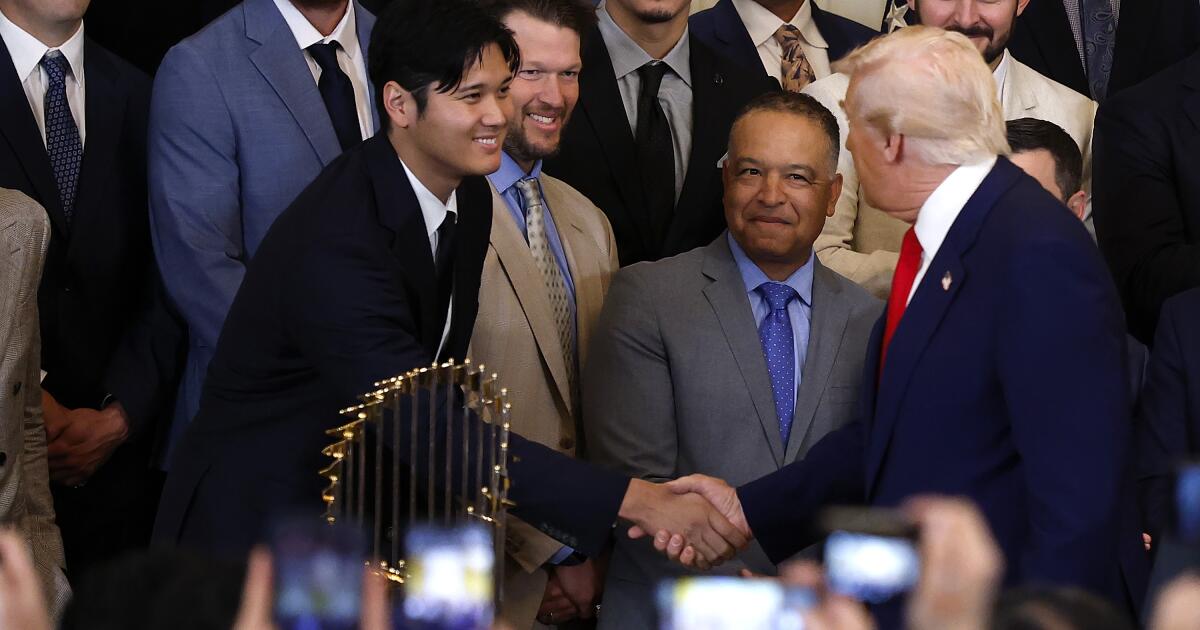
Dodgers scheduled to visit White House in late July to celebrate 2025 World Series win
-

 World28 minutes ago
Former US Olympian pleads not guilty in DC reflecting pool vandalism case
-
 News55 minutes ago
Former Olympian pleads not guilty in reflecting pool vandalism charges
-

 Los Angeles, Ca2 hours ago
Heat advisory, beach hazards in effect as Southern California sizzles
-

 Detroit, MI3 hours ago
Teen on moped hit by car after cruising through stop sign in Detroit

