Georgia
Georgia cracks down on pro-EU protests with crippling fines

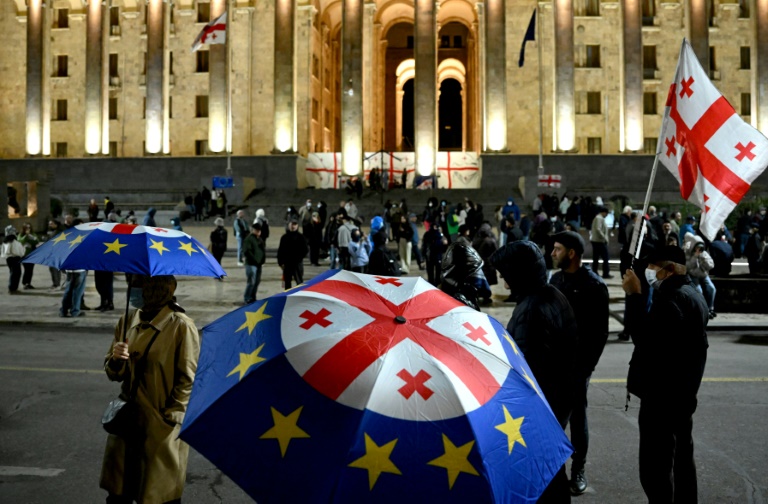
Nadim Khmaladze has been joining thousands of fellow Georgians on the streets every evening since November, when Tbilisi’s increasingly repressive government shelved EU membership talks.
The 60-year-old rights activist said he was “ready to face police violence” when he first joined the anti-government rallies in Tbilisi, but he never imagined that standing on the street for a few hours could cost him more than 22 months’ salary.
Three months into the protests, he received a summons: a total of 45,000 lari (around $16,000) in fines for briefly blocking traffic along Tbilisi’s central avenue.
“The government is using Russian-style methods to abolish freedom of assembly in Georgia,” he told AFP.
Khmaladze is one of thousands of Georgian protesters facing crippling fines for taking to the streets.
Prominent writer Mikheil Tsikhelashvili, who returned to Georgia last year from emigration in Portugal to fight against the ruling Georgian Dream party’s “pro-Russian policies,” has been attending protests daily.
He says he and his girlfriend were each fined the equivalent of $1,850, in what he called a “financial terror aimed at extinguishing popular anger.”
“I took the case to court,” he said, adding however that he had “little hope in Georgia’s justice system, which is fully controlled by the ruling party.”
– Unprecedented protests –
Braving bitter frost, protesters continue to rally daily in Tbilisi and cities across the Black Sea nation, in what has become an unprecedented protest movement against Georgian Dream’s perceived democratic backsliding and growing rapprochement with Moscow.
The mass protests first erupted following disputed parliamentary elections in October, which the opposition rejected as rigged in favour of Georgian Dream.
The movement intensified after Prime Minister Irakli Kobakhidze’s November 28 announcement that his cabinet would not seek to open EU membership talks with Brussels until 2028 — a move that shocked many.
Georgia is an official candidate for membership in the 27-nation bloc, a bid supported by more than 80 percent of the population, according to opinion polls, and enshrined in the country’s constitution.
During the protests’ initial phase, security forces used tear gas and water cannons to disperse demonstrators and made hundreds of arrests.
Georgia’s top human rights official, ombudsman Levan Ioseliani, and Amnesty International have accused police of “torturing” detainees — a charge the government denies.
Authorities have since resorted to harsh financial penalties and increased surveillance, deploying facial recognition technology to identify protesters and issue hefty fines.
– ‘Slowly strangling’ –
“After the bare violence proved ineffective, the government turned to intimidation — televised police raids on activists’ homes and anonymous threats over the phone,” Salome Khvadagiani, the director of Liberty Institute rights group, told AFP.
“When that too failed to suppress the protest, the government moved to slowly strangling them — financially,” she added.
In December, fines for blocking roads were increased tenfold, to 5,000 laris ($1,850), leaving thousands facing “absolutely disproportionate financial sanctions” or, alternatively, 15 days in prison.
In January alone, the total amount of fines surpassed $6.5 million in the country of four million people, where the average monthly salary is some $740, according to the For Georgia opposition party.
The interior ministry said it only issues fines “when the number of demonstrators doesn’t justify blocking the road” and a rally can be held without disrupting traffic.
To enforce these measures, authorities have expanded surveillance capabilities, including the deployment of facial recognition technology.
Rights groups said the government has drastically increased the number of high-resolution surveillance cameras in the streets of Tbilisi.
The widespread use of “facial recognition and remote biometric recognition technologies facilitates discriminatory targeted surveillance,” said GYLA rights watchdog. “These practices undermine fundamental rights.”
– ‘We will never back down’ –
In 2021, Amnesty International, along with several other international rights groups, called for “an outright ban on uses of facial recognition and remote biometric recognition technologies that enable mass surveillance and discriminatory targeted surveillance.”
Khvadagiani of the Liberty Institute said the “campaign of mass and disproportional financial sanction has caused protests turnout to dwindle significantly over the last month.”
But demonstrators are now “adapting to the situation” she said, filing court complaints that have overwhelmed the judicial system, “significantly delaying the enforcement of financial sanctions or even making them unenforceable.”
“The government can’t scare us,” said Khmaladze, who fought for nearly two years on Ukraine’s frontlines against invading Russian troops.
“We are taking to the streets for Georgia’s democracy and will never back down,” he said.
im/dt/gv/jfx



Athlon Sports projected the best SEC games for each week of the 2026 regular season.
The conference features some of the most compelling matchups in all of college football, from opening weekend through rivalry week. The selections emphasize games anticipated to have the biggest impact on the SEC championship race and College Football Playoff picture.
Florida’s annual clash with Georgia was tabbed as one of the SEC’s premier fixtures. The game has grown in national significance since it began in 1904, continuing as a battle of blue-blood programs that routinely produces iconic results. The game temporarily moves to Mercedes-Benz Stadium in Atlanta during the Jacksonville stadium renovations.
The Jon Sumrall era carries with it an increasing sense of belief — many experts see the Gators as a dark-horse CFB playoff contender. Regardless of its final win-loss record, UF will play a part in shaping the season’s narrative as they face several post-season favorites in Texas, Georgia and Oklahoma.
Noted in the article is the SEC’s depth and newly implemented nine-game conference schedule. Georgia, Texas, Alabama and LSU appear multiple times on this list, with Georgia facing Alabama in Week 6 and Ole Miss in Week 10 while LSU hosts Clemson in Week 1 and will see Texas in Week 11 take on Alabama.
Many contenders from the SEC face multiple nationally relevant foes over the course of the season.
Athlon Sports’ Best game for every week of the 2026 season
- Week 1: Clemson at LSU (Sept. 5)
- Week 2: Ohio State at Texas (Sept. 12)
- Week 3: LSU at Ole Miss (Sept. 19)
- Week 4: Oklahoma at Georgia (Sept. 26)
- Week 5: Auburn at Tennessee (Oct. 3)
- Week 6: Georgia at Alabama (Oct. 10)
- Week 7: Alabama at Tennessee (Oct. 17)
- Week 8: Ole Miss at Texas (Oct. 24)
- Week 9: Florida vs. Georgia (Atlanta) (Oct. 31)
- Week 10: Georgia at Ole Miss (Nov. 7)
- Week 11: Texas at LSU (Nov. 14)
- Week 12: Texas A&M at Oklahoma (Nov. 21)
- Week 13: Texas at Texas A&M (Friday) (Nov. 27)
Follow us @GatorsWire on X, formerly known as Twitter, as well as Bluesky, and like our page on Facebook to follow ongoing coverage of Florida Gators news, notes and opinions.

The Georgia Bulldogs are expected to have one of the country’s best defenses again in 2026. Georgia has a lot of continuity from the 2025 defense and should be able to dominate many of their opponents this fall.
The Bulldogs defense will be led by potential All-American defensive backs KJ Bolden and Ellis Robinson. Georgia appears to be set at inside linebacker with the likes of Raylen Wilson, Chris Cole, Justin Williams and Zayden Walker forming a formidable group.
Georgia’s defense is not without questions. The Bulldogs need defensive tackle Elijah Griffin to play like a star as a sophomore. Georgia has to get more pass rush production. UGA managed only 20 sacks a year ago and their top defensive transfer addition, Amaris Williams of Auburn, is expected to be out for the season. Georgia fans can all remember Ole Miss quarterback Trinidad Chambliss running circles around the Georgia defense in crucial moments of the Sugar Bowl.
Outside of the pass rush, Georgia’s depth at outside cornerback is probably the Bulldogs’ second-biggest weakness. If Ellis Robinson gets hurt, then Georgia could be in trouble. Despite these concerns, Georgia’s defense should overwhelm weaker SEC opponents this fall.
Nose tackle
- Jordan Hall
- Xzavier McLeod
- Nnamdi Ogboko
Georgia defensive tackle Jordan Hall is a former five-star recruit with a significant injury history. His snaps will probably be limited at times this fall. Xzavier McLeod has improved in each of his two seasons at Georgia and should be one of Georgia’s top depth options in the defensive line rotation. Nasir Johnson is another big body to know up front at nose tackle.
Defensive tackle
- Elijah Griffin
- Josh Horton
- Nasir Johnson/London Seymour/Valdin Sone
Five-star defensive lineman Elijah Griffin is entering his second season and is looking to have a big year after making an impact as a true freshman. Josh Horton has plenty of experience, but Bulldog fans would like to see a bit more production. Another defensive lineman to know is freshman Valdin Sone, who is a five-star recruit.
Defensive end
- Gabe Harris
- Joseph Jonah-Ajonye
- Justin Greene/JJ Hanne
Gabe Harris has the size to play both defensive end and outside linebacker. Georgia needs him as a pass rusher. He missed the Bulldogs’ Sugar Bowl loss and spring practice due to a turf toe injury. Joseph Jonah-Ajonye is a former elite recruit.
Outside linebacker
- Quintavius Johnson
- Chase Linton/Isaiah Gibson
- Darren Ikinnagbon/Khamari Brooks/PJ Dean
Quintavius Johnson is expected to start after a promising 2025 season. Gabe Harris and Chris Cole will also see action at outside linebacker. One of these second-year players needs to step up: Isaiah Gibson, Chase Linton and/or Darren Ikinnagbon. All have a lot of talent and are in for bigger roles after Auburn transfer Amaris Williams suffered an ACL injury in the spring. Freshmen Khamari Brooks and PJ Dean were both four-star signees.
Inside linebacker
- Raylen Wilson
- Chris Cole
- Justin Williams
- Zayden Walker
Once again, Georgia and coach Glenn Schumann have a stacked inside linebackers room. The Bulldogs will start two inside linebackers, but their backups will all play key roles. Chris Cole led UGA in sacks during the 2025 season. Cole and Zayden Walker are important pieces in Georgia’s pass rush. Raylen Wilson (knee) and Walker (shoulder) both missed the spring.
Georgia freshmen Nick Abrams has a lot of talent and veteran Terrell Foster is reliable, but they’re expected to be buried on Georgia’s depth chart along with redshirt freshman AJ Kruah.
Outside cornerback
- Ellis Robinson IV
- Demello Jones
- Braylon Conley/Gentry Williams
- Jontae Gilbert/Caden Harris/Justice Fitzpatrick
Georgia’s outside cornerback room is led by Ellis Robinson, who should be an All-SEC pick. The spot opposite Robinson should go to Demello Jones, but don’t rule out experience transfers Braylon Conley (USC) and Gentry Williams (Oklahoma). There is some concern about Georgia’s outside cornerback depth this season. Jontae Gilbert, Caden Harris and Justice Fitzpatrick all have talent, but Fitzpatrick did suffer a torn ACL in December.
Slot cornerback
- Khalil Barnes
- Rasean Dinkins
- Zech Fort
Rasean Dinkins did well in the SEC championship against Alabama, but not as strong in the Sugar Bowl. Clemson transfer Khalil Barnes is projected to start over him with Tyrique Green being another name to watch at star.
Free safety
- KJ Bolden
- Tyrique Green
- Jaylan Morgan/Jordan Smith
Georgia junior KJ Bolden should be an All-SEC pick. Four-star signee Tyrique Green is going to find a way on to the field this season.
Strong safety
- Rasean Dinkins
- Zion Branch/Ja’Marley Riddle/Kyron Jones
- Todd Robinson/Blake Stewart
Dinkins and Barnes will both likely start for UGA. Zion Branch, Ja’Marley Riddle and Kyron Jones should all see snaps with Jones’ health being a question.

-

 Virginia5 minutes ago
Dragas responds to accusations of having unfair advantage in quest to buy VB National
-

 Wisconsin17 minutes ago
Wisconsin Lottery Mega Millions, Pick 3 results for July 14, 2026
-

 West Virginia23 minutes ago
Belle residents learn about, discuss proposed Clean-Seas plastic repurposing plant – WV MetroNews
-

 Wyoming29 minutes ago
Six cases of measles confirmed by Wyoming Department of Health
-

 Crypto35 minutes ago
Proposed cryptocurrency mining facility under review in Starkville
-

 Finance41 minutes ago
The average cost of fertility treatments and how to plan for them
-
Fitness47 minutes ago
‘The pants don’t lie’: Lenny Kravitz’s bizarre workout trick
-

 Movie Reviews58 minutes ago
Saari Review: Memory, Betrayal and Identity Converge at River Valley Film Festival – Hollywood Times


