Florida
Florida Senate committee approves proposal to set term limits for county commissioners, school board members


TALLAHASSEE, Fla. – Rural officials are balking at legislation that would allow voters to decide whether county commissioners should be limited to eight years in office, arguing that the restriction would quash the voices of local residents.
Florida lawmakers propose constitutional amendment to set county commission term limits, cement school board limits
The Senate Ethics and Elections Committee on Monday voted 6-2 to approve a proposal (SJR 802) that would put in the Florida Constitution eight-year term limits for county commissioners and school board members. The Legislature in 2023 approved eight-year term limits for school board members, but those limits are not in the Constitution.
Sen. Blaise Ingoglia, a Spring Hill Republican who is sponsoring the proposed constitutional amendment, told the committee that voters overwhelmingly support term limits for elected officials.
“All we’re asking is, let’s put it on the ballot. This is overwhelmingly popular. This is what the voters want,” Ingoglia said.
But two Republicans on the committee, Sen. Erin Grall of Vero Beach and Jennifer Bradley of Fleming Island, voted against Ingoglia’s proposal.
Grall unsuccessfully attempted to increase the proposed term limits from eight to 12 years. Grall said that, while she supports term limits, eight years might not be long enough for elected officials to get the “institutional knowledge” they need to be effective.
“It takes time to come up to speed,” she said, arguing that it takes “at least two, if not four years” for state lawmakers “to understand the scope” of the legislative process. “I don’t think it’s in the best interest of our constituents to lose the institutional knowledge of the person who is willing to put their name on a ballot.”
Elected officials from rural areas also argued against the restriction.
Wakulla County Commissioner Ralph Thomas called the proposed term limits “an affront to the spirit of liberty.” Imposing eight-year limits “strips away the sacred right of local determination,” Thomas told the Senate committee.
“This proposal flies in the face of principles upon which our nation and our republic were founded. The citizens of each county who live with the consequences of their leaders’ decisions should be the ones to decide what limits, if any, are best suited for their unique needs,” Thomas argued.
Chris Doolin, a lobbyist who represents the Small County Coalition, said that voters in the group’s 29 rural counties make up just a fraction of more than 14.2 million voters statewide. Local commissions have experienced a high degree of “turnover” in recent elections, according to Doolin.
In the last two election cycles, between a third and half of local officials “were replaced,” Doolin said.
“The voters know what they want,” he argued.
A similar House measure (HJR 679) has not been heard by committees.
State lawmakers, the governor and state Cabinet members have eight-year term limits. The Legislature in 2022 approved imposing 12-year term limits on school board members and the following year lowered the cap to eight years.
The proposed term limits, if approved by the Legislature, would go on the 2026 ballot and would need 60 percent approval from voters to pass. The state Constitution addresses the structure of county commissions and four-year terms for commissioners but does not place limits on terms.
Counties with charters can adopt term limits for commissioners. Currently, 12 of the state’s 20 counties with charters have adopted such restrictions, Florida Association of Counties Deputy Director of Public Policy Jeffrey Scala told the Senate panel. Four of the counties have 12-year term limits and eight have eight-year limits, according to Scala, whose group opposes the proposal.
The measure “strips voters’ ability to self govern by forcing them to vote on term limits statewide and imposing their choices on other counties,” Scala said.
But Ingoglia suggested that small counties are opposed to term limits to protect incumbents. He pointed to Brooksville, a Hernando County city located within his Senate district.
“When you look at the city commissioners on there, including the mayor, they’re all rock stars. Everyone could probably run for state House, state Senate. Might even be able to run for Congress. They’re just that good. So the question that these smaller counties have to ask is, are they really looking or have they created the environment where you have the good-old-boy system not allowing other people to run, or discouraging other people to run?” Ingoglia told The News Service of Florida after Monday’s meeting.
The Ethics and Elections Committee also on Monday gave initial approval to a proposed constitutional amendment (SJR 536) that would limit state lawmakers to serving eight years in the Florida House and eight years in the Florida Senate, for a total 16-year cap.
The issue is salient this year, after Gov. Ron DeSantis’ administration tried to block state Rep. Debbie Mayfield, R-Melbourne, from running in a special election for a Senate seat. Mayfield was elected to the House in November after serving eight years in the Senate.
The Florida Supreme Court sided with Mayfield after the Division of Elections said she could not be qualified in a special election for Brevard County’s Senate District 19, which opened when Sen. Randy Fine submitted his resignation to seek a congressional seat.
The Supreme Court cleared the way for Mayfield to appear on the ballot, with a special primary election in the Senate district on April 1.
Bradley said she opposed the proposed “lifetime” cap on legislative service.
“I understand the intent is to kind of stop that ping-ponging” between the House and Senate, Bradley said. She suggested Ingoglia consider allowing legislators to return following a “required gap” in service.
“But if you serve and years later you want to come back and serve your community, I think that’s the most American thing you can do and for that reason I don’t support this lifetime ban,” she said before the committee approved the measure, which Bradley voted against.



Brevard County couple gets married in NICU after birth of premature twins
A Florida couple, told they may not be able to have children, welcomed premature twins and had an impromptu NICU wedding.
Provided by AdventHealth for Children
Ben and Danielle Cassidy were told they likely wouldn’t be able to have children.
But this year they will celebrate Mother’s Day just months after having an impromptu wedding in the AdventHealth for Children hospital’s neonatal intensive care unit shortly after Danielle gave birth to twins prematurely — a week before the Palm Bay couple was scheduled to get married.
Both babies, Joshua and Rhett, are doing well despite arriving nine weeks ahead of schedule on Jan. 19, 2026, just one day after their scheduled baby shower. With a proper wedding out of the question with two premature babies in the NICU, a nurse took action.
Issabel Kenkel, the nurse behind the ceremony, said she was already in wedding planning mode for her own upcoming nuptials when she found out the Cassidy family’s ceremony would be interrupted.
“I couldn’t just let them do something small. They needed decorations and something fun, so I spoke to the music therapist and the chaplain,” Kenkel said. In short order, a wedding was being planned for their hospital room and the couple was saying their vows in the company of their safely delivered newborns.
“When we found out we could request staff members to be on our team, that’s when we requested Issabel and having that kind of consistency from someone who has such a big heart and is so kind,” Danielle said.
The hospital ceremony was all the more special because of the Cassidy family’s own health struggles.
“I have five autoimmune diseases and didn’t really think I would have kids. It’s been a rough journey. When Ben and I met, we were floored at how much a miracle it was to have kids,” Danielle said.
Ben, who battled and beat cancer, said he was worried that his prior treatment would result in negative health outcomes for his future children. Having twins for him was an unexpected blessing.
“When we found out we were pregnant, we found it so shocking. We said, wouldn’t it be great if it was twins? It filled out our hopes and dreams list,” Ben said. “They’ve been miracles for sure.”
The Cassidy couple said there was so much fear and uncertainty when their twins were born nine weeks early. Being able to get married right away just made them feel all the better about the future.
“It was nice getting married because we didn’t have to wait any longer to make it official. It made it that much harder for her to get rid of me,” Ben said.
“The unknown made it scary,” Danielle added. “We had no idea how long we would be in the hospital. Our wedding was going to be at the beach with immediate family and parents. Having NICU babies, we realized we’d never be able to get to the beach. It was really special having the people who care for our babies be part of the ceremony.”
The couple hadn’t even planned to have a band at their wedding ceremony and now the hospital’s music therapist was performing live for them and the chaplain was conducting the ceremony, something nurse Kenkel said was just part of her job.
“The babies are going to have the best outcomes if the families are taken care of and going home happy,” she said. “Being in the NICU is already so stressful. This is just one more thing I could do to take care of my patients.”
Tyler Vazquez is the Growth and Development Reporter at FLORIDA TODAY. Contact Vazquez at 321-480-0854 or tvazquez@floridatoday.com. X: @tyler_vazquez.

The Vero Beach Police Department took a man into custody May 8 in connection with a threatening phone call directed toward a business.
The agency received information at 5:21 p.m. May 7 about a threatening call to Thrive IRC Inc. at 2300 5th Ave. in Vero Beach, according to a news release. The call included someone threatening to come to the business with an AK rifle and “light the building up.”
Detectives began investigating the threat and identified Michael Sean O’Brien, 27, of Vero Beach, as the person associated with the phone number used during the call.
O’Brien was taken into custody at about 3:30 p.m. May 8 without incident. He was charged with the false report concerning the use of firearms in a violent manner, which is a second degree felony, according to the news release.
O’Brien was booked in the Indian River County Jail at 6:13 p.m. May 8 but was released at 1:36 p.m. May 9 after posting the $5,000 bond, according to the jail website.
No additional information was available the afternoon of May 9.
Olivia Franklin is TCPalm’s trending reporter. You can contact her at olivia.franklin@tcpalm.com, 317-627-8048 or follow her on X @Livvvvv_5.

Charmaine Hickey, of Lang Realty in Port St. Lucie, was named in KNOW Women’s “100 Women to KNOW in America” list.
A Treasure Coast woman was named in a “100 Women to know in America” list for 2026.
KNOW Women is a global media company dedicated to giving women leaders connections and visibility. The company released a list of “100 Women to know in America” for 2026 to highlight the most influential women in business and leadership.
Charmaine Hickey, who works for Lang Realty in Port St. Lucie, was on the list.
“Charmaine’s recognition on a national stage like this comes as no surprise,” said Scott Agran, president of Lang Realty in a news release. “Her leadership, integrity, and commitment to both her profession and her community exemplify what this award stands for. She represents the very best of our industry.”
Hickey holds many industry designations and is known for her expertise in complex real estate transactions, as well as her client-first approach defined by honesty, patience and attention to detail, according to the news release.
Her community involvement includes serving on nonprofit boards, mentoring emerging leaders and supporting initiatives focused on education, women, families and youth.
“I am truly honored to be recognized among such an inspiring group of women,” said Hickey in the news release. “This award reflects not just individual achievement, but the power of community, mentorship, and lifting others as we grow. I’m grateful to be part of a network of women who are building meaningful impact every day.”
To see the full list go to theknowwomen.com.
Olivia Franklin is TCPalm’s trending reporter. You can contact her at olivia.franklin@tcpalm.com, 317-627-8048 or follow her on X @Livvvvv_5.
-
 Lifestyle2 minutes ago
What is an eye massage? We tried it at this under-the-radar L.A. spot
-
 Politics8 minutes ago
‘Extremely scary’: Specter of an all-GOP governor’s race spurs push to remake open primary
-
 Science14 minutes ago
Californian exposed to hantavirus aboard cruise ship resides in Bay Area, officials say
-
 Sports20 minutes ago
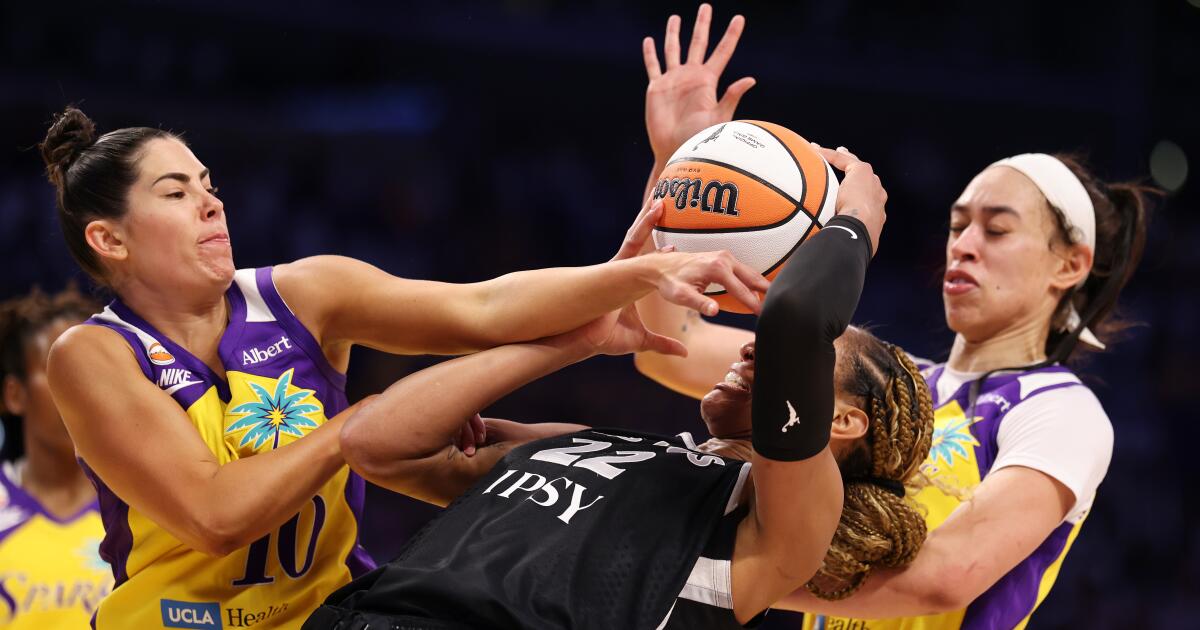
‘They punched us in the face.’ Sparks can’t keep pace with Aces in season-opening loss
-

 World32 minutes ago
Trump says Iran’s reply to US peace plan ‘totally unacceptable’
-
 News1 hour ago
U.S. cruise passengers head to Nebraska for hantavirus monitoring
-

 New York3 hours ago
Maya Lin Connects Nature to a New Manhattan Skyscraper and Beyond
-

 Detroit, MI3 hours ago
A chilly start to the week gives way to warmer weather in Metro Detroit