Austin, TX
Texas beef experts host Austin 'smoke lab' to teach barbecue greatness


There’s one piece of the Antlers Lodge at the Hyatt Regency Hill Country Resort and Spa that visitors will remember above all — bet you can’t guess what it is. But the restaurant space around the huge, three-tiered antler chandelier was in need of an update.
After significant renovations to the surrounding space, the dining room is looking less like a hotel event room and more like a chic, modern restaurant. Along with the visual changes, the restaurant on the western edge of San Antonio is also debuting a new chef and an updated menu.
Previously cloaked in brown and beige, the semi-rustic dining room looked a little more country before the renovation, but the hotel walls were unmistakable. Now with a cool gray carpet, gray and floral seating, and much darker walls, the space has a more wintery upscale look without fully leaving the woods behind. The mounted deer head pops much more on its white mantle.
The chandelier pops more against the darker tones.Photo courtesy of the Hyatt Regency Hill Country Resort and Spa
Most eye-catching are the patinated mirror tiles above the open kitchen, which continues to display its copper cookware and the hard work of the kitchen team.
The rustic look pays homage to the more than 100-year-old Rogers Wiseman cattle ranch that was previously located where the ranch stands today. Now the award-winning resort is keeping up with its luxurious
Native San Antonian Joseph Lambert is the new chef de cuisine in charge of making sure the food matches the chic new atmosphere. Having worked his way up the ranks from washing dishes, he’s been with the Hyatt Corporation for six years, according to a press release.
“I am excited to join the incredible team at Hyatt Regency Hill Country’s Antlers Lodge,” said Chef Lambert in the release. “My goal in my new role is to foster an environment of creativity and passion for the food our team prepares for our guests. I look forward to helping guests make lasting memories through delicious dining experiences.”
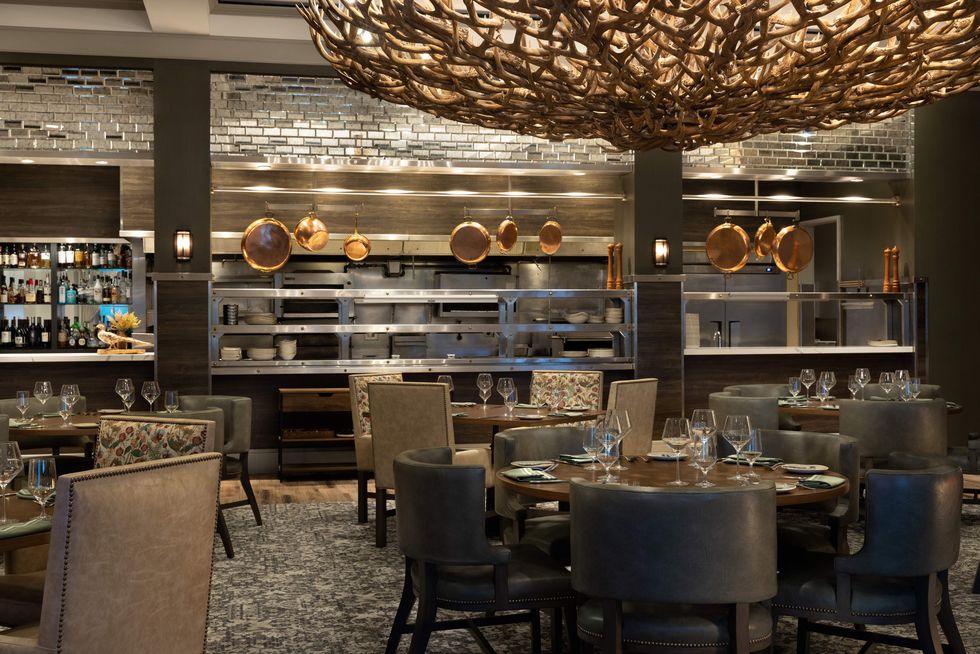 The open kitchen keeps the culinary excitement up.Photo courtesy of the Hyatt Regency Hill Country Resort and Spa
Some of the new menu is reserved for exactly what diners would expect in a restaurant so fully adorned with antlers: center cut filet mignon, Lone Star bone-in ribeye, and a variety of creatively prepared game like bison meatballs, chili-rubbed elk tenderloin, chili coffee-crusted elk carpaccio, and South Texas antelope.
But not all the dishes are from so far inland, and they don’t all center around meat. Lighter fare includes vegan garden ravioli, seared haibut, and elote shrimp from the Texas Gulf. Of course, any restaurant with such outdoorsy inspiration must include s’mores, which in this case sandwich the toasted marshmallows between brown butter graham crackers, chocolate ganache, and a whiskey chocolate sauce.
This renovation is part of a much broader, multi-phase project that’s transforming the resort as a whole. In 2023, it completed a $50 million phase that updated the rooms with hardwood, better tech, and walk-in showers. Austinites may recognize the resort for its lazy river, which bridges the gap between the outdoorsy Hill Country and the tourist-ready city with competing hotels.
More information about the Antlers Lodge (9800 Hyatt Resort Dr., San Antonio) and reservation links are available at antlerslodge.getbento.com.



Got story updates? Submit your updates here. ›
The 2026 Pro Swim Series, the first leg of the prestigious swimming competition, is set to begin tomorrow in Austin, Texas. This four-day event will showcase some of the fastest swimmers in the world as they compete in a variety of events, including new semifinal structures and updated prize money. Fans can look forward to comprehensive previews, live results, and multiple ways to watch the action unfold.
Why it matters
The Pro Swim Series is a critical stop on the road to the 2026 Olympics, with swimmers looking to qualify for national teams and secure valuable ranking points. The Austin event will also feature new event formats and prize money structures that could impact the competitive landscape and strategies of the top athletes.
The details
The 2026 Pro Swim Series in Austin will run from January 14-17, with preliminary sessions starting at 9:00 a.m. local time and finals kicking off at 6:00 p.m. local time. All sessions will be streamed live on the USA Swimming Network, and the finals on January 15 and 16 will also be aired on Peacock. The event schedule includes a variety of individual events, with the women’s and men’s 1500m freestyle, 800m freestyle, and 400m individual medley being the highlight distance races.
- The competition will begin on Wednesday, January 14 and run through Saturday, January 17.
- Preliminary sessions will start at 9:00 a.m. local time (CT) each day, with finals beginning at 6:00 p.m. local time.
The players
USA Swimming
The national governing body for the sport of swimming in the United States, responsible for organizing the Pro Swim Series.
Peacock
The streaming platform that will air the finals sessions on January 15 and 16.
SwimSwam
A leading swimming news and media outlet that has provided comprehensive previews and analysis of the 2026 Pro Swim Series event in Austin.
Got photos? Submit your photos here. ›
What’s next
Fans can look forward to additional previews and analysis from leading swimming media outlets in the days leading up to the event, as well as live results and coverage throughout the four-day competition.
The takeaway
The 2026 Pro Swim Series in Austin promises to be an exciting showcase of the sport’s top talent, with new event formats and prize money structures adding an extra layer of intrigue. Swimming fans won’t want to miss this must-watch competition as athletes vie for Olympic qualification and national team spots.

AUSTIN, Texas (KVIA) — A new partnership is helping provide revolutionary care for families as they wait in the hospital.
The Ronald McDonald House in Central Texas and Texas Children’s in Austin opened the first in-hospital Ronald McDonald House in the Central Texas region. The house includes nine family suites, a dining area, a lounge, complimentary laundry facilities, and a room for art and activities. Kitchen volunteers also provide meals.
The house provides a place for families to stay while their children receive care at Texas Children’s Hospital in Austin.
The first family to move into the house is from El Paso. Nathan and Yadira are currently waiting for the arrival of their daughter, Amelia. Yadira is currently nine months pregnant, and is set to give birth this week.
The family learned early in their pregnancy their daughter has omphalocele, a rare condition. It’s a birth defect of the abdominal wall, where intestines stick outside of the belly.
Her parents were referred to Texas Children’s Hospital because of the severity of Amelia’s case. After birth, Amelia will need close monitoring, specialized care, and eventually surgery.
The chief of surgery at Texas Children’s, Dr. Matias Burzoni, is in close contact with the family. He said both parents are still in good spirits.
“They have the best attitude I’ve seen in a long time. They’re extremely optimistic,” he told ABC-7 over a Zoom interview.
Following Amelia’s arrival, she will be receiving treatment at Texas Children’s, and her parents will be just steps away.
Dr. Bunzoni said this opportunity will be a game-changer for many families.
“We can chat with them any time during the day. They can come visit their baby any time during the day. And specifically when there are important decisions to be made, they are readily available,” he said.
He adds, the rooms are warm and welcoming. Meals and lodging are free to families.
“The fact that we have them just a few steps away from their kids makes a big difference. And that’s why I think the Ronald McDonald House is just so powerful because it really improves the outcomes of these babies,” he said.
Yadira and Nathan said they are grateful this place is available to them.
“It means a lot for us to be able to stay here because, you know, it takes away the final financial burden as well as the needs that our daughter will be needing,” Yadira said.

Texas is a land that revels in its idiosyncratic history and associated iconography. On bar signs, brand logos, T-shirts, and tattoo sleeves, the Western-outfitted cowboy and land-roping barbed wire feature heavily. These tangled symbols aren’t easily sorted politically, but when it comes to talking about the Texan past, more often than not, that past is associated with conservative, right-leaning political values.
The resilient trail of leftist ideologies that David Griscom traces through the state’s history in The Myth of Red Texas: Cowboys, Populism, and Class War in the Radical South aim to trouble that assumption. The author’s debut work doesn’t craft an idealized ancestral politic that left-leaning Texans can saunter on home to, but instead lassos the many worker-led movements that’ve impacted Texas history into a traceable path, complicating simple assumptions about the Lone Star State and its people and crafting a loosely tethered intergenerational community of Texas radicals.
In his pages, Griscom attempts to reassociate cowboy individualism with cowboy solidarity in the strikes of late 1800s, and the rural, tough-living pride of said barbed wire with property-hungry landowners that strangled the open range, despite resistance from fence-cutting cowpokes, farmers, and neighbors.
Following these fence-cutters through the populist movement, labor unions, and socialists, Griscom drops in on different casts of characters each cut in the rugged shape of Texas who face variations of the same struggle. Though they differ in ideology and approach, these charismatic speakers and movement leaders grapple with the same temptations of political power and infighting. Griscom does not shy away from interrogating the pitfalls of these movements – particularly the racism and misogyny that manage to transcend solidarity more often than not – and the backstabbing dance of courting imagined moderates in a plea for reelection. The Brotherhood of Timber Workers and some German socialists prove to be exceptions to these common drawbacks, Griscom reveals.
The author’s debut work doesn’t craft an idealized ancestral politic that left-leaning Texans can saunter on home to, but instead lassos the many worker-led movements that’ve impacted Texas history into a traceable path.
As staunchly as conservatives want to turn the wagon around, liberals can fix their eyes on the horizon too closely. In an introductory analysis of recent Democratic defeats in Texas, the writer argues that colloquial assumptions about history deeply impact contemporary campaigns and grassroots organizing. No modern movement is reinventing the wheel, and moving forward with a knowledge of the successes and missteps that came before could embolden today’s organizers. As Texas once led the country in socialist party sign-ups, the Houston chapter remains the organization’s largest branch and, as Griscom notes, the Texas AFL-CIO was the first statewide labor association to advocate for a ceasefire in Gaza. The legacy of collective movements and outspoken groups persists in Texas, even when the overarching narrative doesn’t celebrate them.
Unique though it may be, Texas is also something of a microcosm, a laboratory, and a weather beacon for the politics and culture that ripple throughout the United States – a fact that Griscom, a writer and podcaster for Jacobin and host of Left Reckoning, knows well. A return to the past has been the great call of the political right in America for the past decade, and its leaders have revised and reshaped that past to suit their current intentions. As Griscom writes, recalling Texas’ rich and undertaught liberalist history makes it “difficult for the GOP to remake the state in its own image completely.” As Texas leads the country in enacting conservative policies in education, reproductive rights, and voting legislation, it stands to reason that muddying its narrative can remind other states to look backward for ideas in imagining a radical future.
Griscom is clear-eyed in his introduction about this 177-page primer being a cursory introduction to the history of leftist movements in Texas, much less the history of Texas politics as a whole. But for those who have felt excluded by the mythologizing of Texas’ past, it serves as a galvanizing read for further education and collective action.
The Myth of Red Texas: Cowboys, Populism, and Class War in the Radical South
By David Griscom
OR Books
This article appears in April 10 • 2026.

Microsoft starts removing Copilot buttons from Windows 11 apps

Inside Tehran after strikes: Iranian woman describes fear, checkpoints and people used as ‘human shields’

Rep Randy Fine joins House Freedom Caucus: ‘Strongest group of conservative patriots in Congress’

Common vaccine slashes Alzheimer’s disease risk when dose is increased

Fever’s Lexie Hull speaks out against attacks on players as team’s popularity grows during Caitlin Clark era

Florida High School Football Rankings: Top 25 teams – Oct. 21

How old is Bo Nix? What to know about Oregon quarterback ahead of 2024 NFL Draft

Cleary's 21 help Le Moyne down Central Connecticut State 69-64 in OT

99th annual Pony Swim held in Virginia

Indiana Members Credit Union announced as new anchor tenant at Bottleworks District
Rep Randy Fine joins House Freedom Caucus: ‘Strongest group of conservative patriots in Congress’

Trump issues NATO ultimatum to reopen Strait of Hormuz ‘within days’

Women are getting most of the new jobs. What’s going on with men?

Video: How Trump’s Advisers Felt About Going to War With Iran

Unearthed clip exposes shocking claim by Newsom’s wife about inmates at violent California prison
-

 Atlanta, GA5 days ago
1 teenage girl killed, another injured in shooting at Piedmont Park, police say
-

 Education1 week ago
Video: We Put Dyson’s $600 Vacuum to the Test
-

 Movie Reviews1 week ago
Vaazha 2 first half review: Hashir anchors a lively, chaos-filled teen tale
-

 Georgia3 days ago
Georgia House Special Runoff Election 2026 Live Results
-

 Pennsylvania3 days ago
Parents charged after toddler injured by wolf at Pennsylvania zoo
-

 Education1 week ago
Video: YouTube’s C.E.O. on the Rise of Video and the Decline of Reading
-
 Milwaukee, WI4 days ago
Potawatomi Casino Hotel evacuated after fire breaks out in rooftop HVAC system
-

 Education1 week ago
Video: Toy Testing with a Discerning Bodega Cat