Arkansas
Arkansas was not always ‘the Natural State’, here were the state’s other nicknames


FAYETTEVILLE, Ark. (KNWA/KFTA) — Arkansas is known as “the Natural State” but that hasn’t always been the case.
In the state’s earlier days, Arkansas had unofficial nicknames but did not get an official one until the 20th century.
Here were some of the early unofficial nicknames:
- The “Bear State”: The Arkansas Game and Fish Commission said pre-settlement estimates showed there were more than 50,000 bears in the state. Most of the bears were Louisiana black bears, one of 16 species native to the United States. By the 1930s, the bears in the state were almost hunted out completely.
- The “Toothpick State”: Early Arkansans kept large sheath or belt knives on their person. Some were double-edged knives called “dirks”. The Encyclopedia of Arkansas said in 1837 one state representative dispatched of another with a knife “[cementing]the new state’s renown as a violent place.
- “Rackensack”: No one knows exactly where this nickname came from but CALS said by the end of the 1840s, it was used as an exaggerated definition for the rural and hilly western parts of Arkansas.
The “Wonder State”
In 1923, Arkansas officially got a nickname when the legislative assembly recognized the Arkansas Advancement Association’s activities. The AAA was a group of businessmen looking to attract economic investment to the state and improve its image.
Former governor Charles H. Brough was an advocate for AAA and traveled around the south earlier in the decade praising the natural resources the state had to offer.
A resolution from January 1923 said, “It is an admitted fact that the State of Arkansas excels all others in natural resources, its store of mineral wealth being practically inexhaustible, its vast forests supplying pine and hardwoods in quantities sufficient to place the state in the forefront, and its agricultural and horticultural prowess recognized not only in the United States; but in foreign countries.”
The resolution claimed the “Bear State” nickname was a misnomer and led to a false impression while the “Wonder State” is accurate and deserves special recognition.
“Though official, the nickname did little to change popular perceptions of Arkansas as an underdeveloped, even backward, state,” the Encyclopedia of Arkansas said.
“Land of Opportunity”
Since the nickname did little to improve the state’s image, a second group of businessmen called the “Committee of 100” looked to come up with a new nickname.
Looking to improve economic development in Arkansas, the group decided on the “Land of Opportunity”.
Although not official at the time, the nickname was added to license plates in the 1940s and was printed on various promotional materials, according to CALS.
In 1953, the Arkansas General Assembly passed a resolution by dropping the “Wonder State” and replacing it with the “Land of Opportunity.”
The “Natural State”
In the back half of the 20th century, tourism in the state started to grow. In the 1980s, the Arkansas parks system adopted the “Natural State” nickname to help highlight the state’s natural landscape, the Encyclopedia of Arkansas said.
State Representative Dennis Young introduced a legislation in 1995 wanting to change the nickname to the “Natural State” as it proved to be more popular than the previous one.
Young cited the “unsurpassed scenery, clear lakes, free-flowing streams, magnificent rivers, meandering bayous, delta bottomlands, forested mountains and abundant fish and wildlife” Arkansas has to offer.
His bill became Act 1352 later that year and the nickname has stuck ever since.



Arkansas
Arkansas Foodbank and Walmart partner to kick off annual hunger relief campaign | Texarkana Gazette

For the next month, Walmart and Sam’s Club shoppers in Arkansas and across the country will have the opportunity to support local hunger relief efforts at the register.
Through May 3, shoppers will be able to round up or donate while checking out as part of the 13th annual “Fight Hunger. Spark Change” campaign, a national partnership between Feeding America and Walmart that supports local Feeding America food banks around the country.
In Arkansas, donations will go to the Arkansas Foodbank, the local Feeding America food bank, which describes itself as the state’s largest hunger relief organization. The organization serves much of central, south and east Arkansas and distributes food from its warehouse to a network of local pantries, schools and shelters.
“We are so excited to partner with the Arkansas Foodbank,” Walmart Vision Center Development Coach Rhonda Johnson said Monday at a news conference at the Walmart on Bowman Road in west Little Rock.
“Every dollar matters,” Johnson said. “Make sure that you donate when you come into our Walmart and Sam’s Clubs.”
Arkansas Foodbank CEO Brian Burton said at the news conference that last year’s campaign yielded more than $188,000 for the food bank.
“The food bank doesn’t do this work alone,” Burton added. “Our 100,000-square-foot warehouse on 65th Street would quickly become a ‘food museum’ if it wasn’t for almost 400 pantry partners, scattered across these 33 counties, that actually move the food, that actually serve the people and carry them through life’s ups and downs.”
Shoppers can also contribute to “Fight Hunger. Spark Change” by donating online or purchasing food items made by companies that are participating in the fundraiser, including Dole, Frito-Lay, Hershey and Kellogg’s. Every participating item purchased at a Walmart or Sam’s Club translates into an additional donation for local hunger relief efforts.
“Funds raised through the campaign help Arkansas Foodbank prioritize nutritious food, including fresh produce, dairy and protein — foods families want and need,” according to a news release. “The support also strengthens local food pantries and meal programs, ensuring neighbors can access food in ways that are dignified and welcoming.”
Lascelles Lyn-Cook Jr., who heads community outreach at Hunter United Methodist Church in Little Rock, said at the news conference that his church’s food pantry has benefited greatly from its retail rescue partnership — through which Walmart diverts unsold food items — with the Bowman store.
“When I first took over with the food pantry, we were able to provide maybe 25 to 35 boxes of food, but now we go at least 160 because of the additional food that we get weekly from Walmart,” Lyn-Cook said.
The food pantry is monthly, Lyn-Cook said, and the 160 boxes feed roughly 500 to 600 people.
A federal report in January ranked Arkansas the hungriest state in the country for the third consecutive year.
The report, which relied on survey responses, estimated that 19.4% of households in Arkansas were food insecure, significantly higher than the 13.3% national average.
“We’ve been through some really hard few months here, with the government shutdown and a tumultuous economy and a lot of uncertainty,” Burton said. “But this is something we can control and we can shape and make better.”

LITTLE ROCK (KATV) — Arkansas’ labor force reached an all-time high in January, officials say.
The state’s unemployment rate climbed to 4.4 percent in January, up from 4.3 percent in December, the Arkansas Department of Commerce and Bureau of Labor Statistics announced today. The unemployment rate for December 2025 was originally estimated at 4.2% but was later revised up to 4.3%.
The U.S. jobless rate declined one-tenth of a percentage point, from 4.4% in December 2025 to 4.3% in January 2026.
Arkansas’ civilian labor force rose by 2,644 in January, reaching a record high level of 1,451,310.
Employment increased by 1,205, also setting a record high.
Arkansas’ labor force participation rate increased to 59.1%.
Compared to January 2025, employment has grown by 17,185 and there are 9,520 more unemployed Arkansans actively seeking work. The unemployment rate is up six-tenths of a percentage point.
Nonfarm payroll jobs in Arkansas decreased by 17,800 in January, typical for a seasonal decline.
Compared to January 2025, there are 9,200 additional nonfarm payroll jobs in the State.
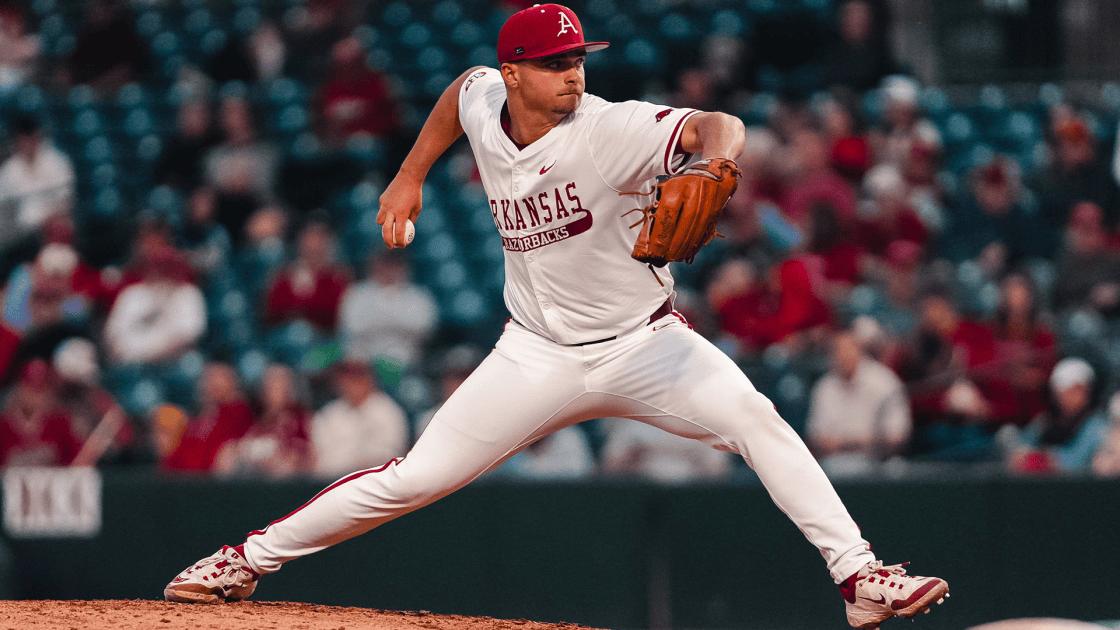
FAYETTEVILLE, Ark. – Six Razorback pitchers combined to shut out in-state opponent Little Rock (19-14) and lead No. 22 Arkansas (21-13) to a 7-0 win Tuesday night at Baum-Walker Stadium. With the triumph, the Hogs improved to 7-2 in midweek games this season and 31-7 overall against in-state foes, including an 8-2 mark against Little Rock, since 1947.
Making his first start of the season on the mound, Tate McGuire opened Tuesday night’s contest with three shutout frames for Arkansas. The right-hander struck out one while working around two hits and a walk before turning the game over to the bullpen, which combined for six scoreless innings with six strikeouts to secure the Razorbacks’ midweek win.
Parker Coil (1.0 IP, 2 SO), Steele Eaves (2.0 IP), Gabe Gaeckle (1.0 IP, 1 SO), Cooper Dossett (1.0 IP, 1 SO) and Ethan McElvain (1.0 IP, 2 SO) worked together in relief of McGuire to lock down Arkansas’ fourth shutout of the campaign.
The Trojans held the Razorback offense both scoreless and hitless until the bottom of the fifth. After TJ Pompey and Reese Robinett reached safely to lead off the inning and advanced on a double steal, Ryder Helfrick stepped up to the plate with one out and delivered the go-ahead sacrifice fly to left field, giving Arkansas its first run of the night.
A five-spot in the bottom half of the sixth inning broke the game open for the Hogs. Arkansas loaded the bases with no outs for Robinett, who ripped a bases-clearing double down the right field line to extend the advantage to 4-0.
Later in the inning, Helfrick collected his second RBI of the game with a two-out double to right center and advanced to third on a fielding error in the outfield. The Razorbacks’ star catcher would score on a wild pitch to grow the lead to six.
Zack Stewart tacked on the seventh and final run in the seventh inning, cranking his sixth home run of the season and 50th of his career to left center to give Arkansas a commanding seven-run cushion. The Hogs finished with just four hits, including a pair of doubles and a home run, but capitalized on seven walks, two hit batsmen and three stolen bases.
Up next, the Razorbacks will hit the road for their second consecutive SEC weekend series away from the friendly confines of Baum-Walker Stadium. First pitch in the series opener between No. 22 Arkansas and No. 8 Alabama is scheduled for 6 p.m. Friday, April 10, on SEC Network+ from inside Sewell–Thomas Stadium in Tuscaloosa, Ala.
For complete coverage of Arkansas baseball, follow the Hogs on Twitter (@RazorbackBSB), Instagram (@RazorbackBSB) and Facebook (Arkansas Razorback Baseball).

Sushi Kuwahata Reopens in Ohio City, Kyuu Juu Pop-Ups Return – Cleveland Today

Complicating The Myth of Red Texas • The Austin Chronicle

Alabama CHOOSE act draws a record number of applicants in its second year

Juneau’s ninth Traditional Games welcomes international competitors

Arizona law closes loophole for registered sex offenders

Florida High School Football Rankings: Top 25 teams – Oct. 21

How old is Bo Nix? What to know about Oregon quarterback ahead of 2024 NFL Draft

Cleary's 21 help Le Moyne down Central Connecticut State 69-64 in OT

99th annual Pony Swim held in Virginia

Indiana Members Credit Union announced as new anchor tenant at Bottleworks District

Video: Military Families Bear the Burden of War, Again

Fox News Poll: Record number say taxes are too high; government spending seen as wasteful

‘Even the street cats ran’: Inside Israel’s deadliest attack on Beirut

California Supreme Court halts GOP sheriff’s voter fraud investigation

AOC doubles down on call for Trump’s ouster even after ceasefire announcement
-

 Atlanta, GA4 days ago
1 teenage girl killed, another injured in shooting at Piedmont Park, police say
-

 Movie Reviews7 days ago
Vaazha 2 first half review: Hashir anchors a lively, chaos-filled teen tale
-

 Culture1 week ago
Do You Know Where These Famous Authors Are Buried?
-

 Georgia2 days ago
Georgia House Special Runoff Election 2026 Live Results
-

 Pennsylvania2 days ago
Parents charged after toddler injured by wolf at Pennsylvania zoo
-

 Education1 week ago
Video: We Put Dyson’s $600 Vacuum to the Test
-
 Milwaukee, WI2 days ago
Potawatomi Casino Hotel evacuated after fire breaks out in rooftop HVAC system
-
 Entertainment7 days ago
Inside Ye’s first comeback show at SoFi Stadium