Entertainment
Jo Koy and Fluffy’s sold-out SoFi show marks a turning point for stand-up comedy


Running free during a game of catch on the empty field at SoFi Stadium is a fantasy most Angelenos will never experience. For comedians Jo Koy and Gabriel Iglesias, it’s just a warm-up to a dream that’s been a lifetime in the making.
Gripping the football with fingers covered in Filipino tribal tattoos extending in a sleeve up his arm, Koy looks across the expanse of emerald green turf at his son jogging toward the south end zone of the Inglewood stadium on a recent afternoon. “To be able to throw at SoFi is crazy,” Koy said with a sparkling grin of bright white veneers.
The 54-year-old comedian with a beard full of gray stubble drops back to pass, launching a tight spiral underneath SoFi’s massive technicolor halo scoreboard hovering above a sea of empty stands. Joseph Jr. — a wiry 22-year-old with a head full of curly dark brown hair — runs briskly toward the goal line with a black cast on his left arm. He raises his right arm just in time to scoop it into his chest for a touchdown. The imaginary crowd goes wild.
“Yes!!!” Koy shouts, his excitement echoing in the stadium. He jogs over to Joseph in his navy blue coverall jumpsuit and L.A. Dodgers cap to deliver a satisfying father-son chest bump.
A few yards away, Iglesias is watching Roka, his tiny black chihuahua, dart around the field like four pounds of rambunctious entitlement. The plus-sized comedian — better known as “Fluffy” — is sporting his typical loose-fitting vintage Hawaiian shirt, denim shorts and black flat cap. Whenever they stand together, the duo’s dynamic is like a modern-day Laurel and Hardy.
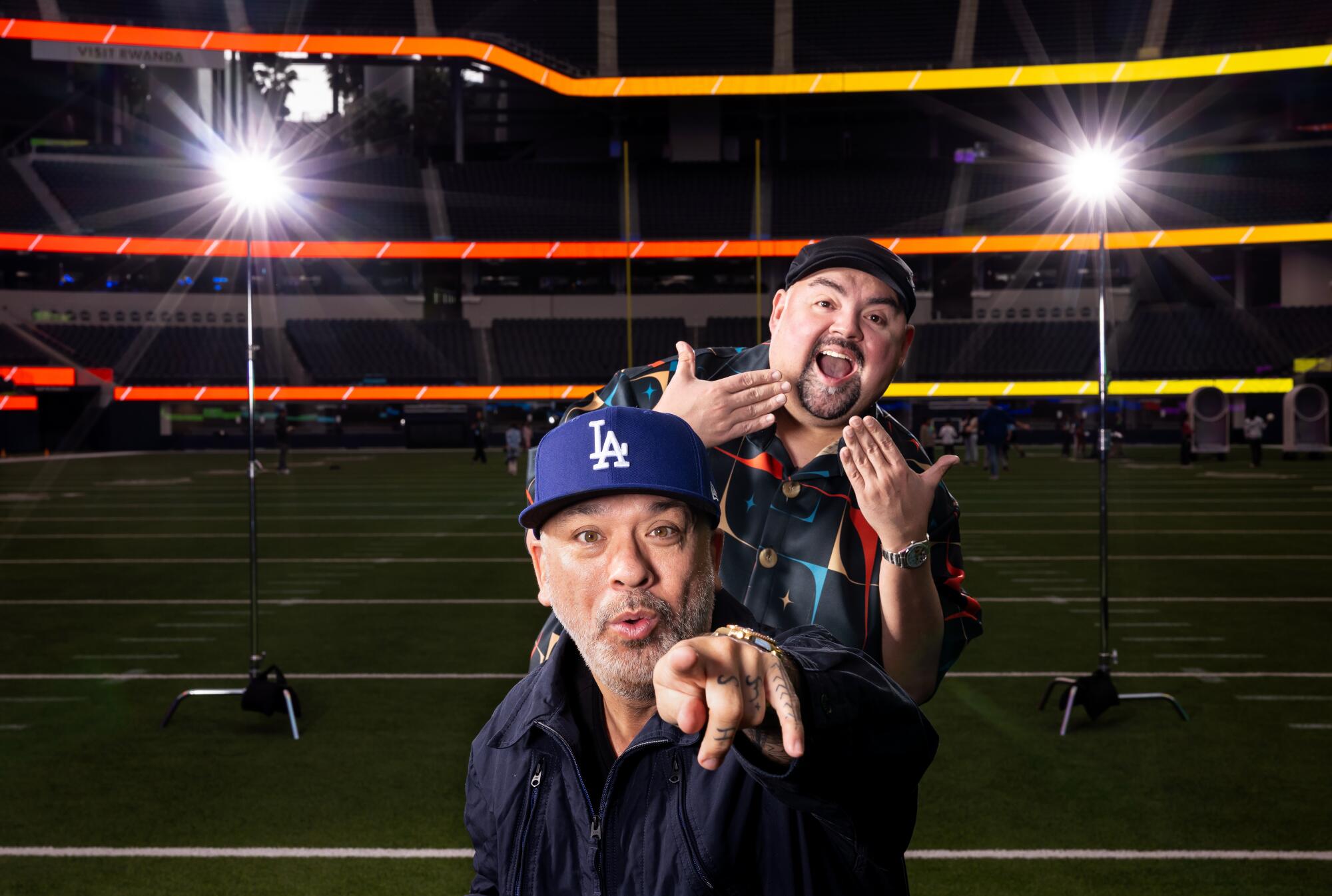
Nearly 70% of tickets for Koy and Iglesias’ SoFi show sold within days, making this the largest stadium stand-up performance to date.
(Christina House/Los Angeles Times)
“The fact that we’ve known each other as long as we have is wild … we’ve known each other since we both had hair,” Iglesias, 49, says as they both lift up their caps in unison, laughing and exposing their shiny bald heads.
On March 21, this stadium will be filled with more than 70,000 guests as the pair takes center stage at the Super Bowl of comedy — the largest stadium stand-up show to date. Koy and Iglesias are now part of a small fraternity of comics, including Kevin Hart, Dane Cook, Bill Burr and Larry the Cable Guy, who’ve sold out stadiums across the country.
The one-night-only show, which won’t be televised or recorded as a special, is meant to be one giant party for comedy fans who’ve supported Koy and Iglesias since their early days. The comics will be passing the mic back and forth throughout the night, which will feature special guests, surprise moments and plenty of other unplanned interruptions that will make for a roughly four-hour show. Though the L.A. comedy scene tends to exist in the shadow of Hollywood, this feat managed by two of its biggest names puts a historic spotlight on stand-up.
“It’s more sweet because it’s taken so long,” Iglesias said. “This wasn’t an overnight thing. Nowadays, everybody wants everything so fast. Between the two of us, we’ve got about 60 years of comedy experience.”
“It’s insane. I can’t explain it,” Koy adds, staring up at the stadium’s glass roof, preparing to crack it with decibels of laughter. “Every time we come in here and look up, I’m like, ‘There’s going to be a stage here the size of the end zone.’ We took the stage from the arenas that we normally play and injected steroids into it.”
For comedians who’ve witnessed their ascent, which now literally includes hands and feet cemented in front of TCL Chinese Theatre and a star for Fluffy on the Hollywood Walk of Fame, the journey has been incredible to watch.
“It’s huge for stand-up, it used to be just in dingy clubs and bars and always something small and intimate and kinda like an afterthought,” said fellow comedy star Tiffany Haddish, a longtime friend to both Koy and Iglesias. “To be honest I never thought comedy would be this big.”
Jay Leno, a confidant to Iglesias and the man who inspired him to start his own insane car collection and offered Koy his first late-night appearance on “The Tonight Show,” agrees that a show like this is a huge step for comedy.
“My attitude when I came to this town was if you can’t get in through the front door, go in the back door,” Leno said. “And they didn’t do it the traditional way, they got to where they are as comedians, one audience member at a time.”

For the two L.A. comedians, the historic milestone represents decades of work and signals comedy’s arrival in mainstream entertainment venues.
(Christina House/Los Angeles Times)
When the pair of arena-selling comics announced last year they’d be joining forces to perform at SoFi, the task of filling the massive concert venue and football stadium seemed laughable. But within a week, it clearly wasn’t a joke. Nearly 70% of the tickets were sold just days after going on sale. Now, weeks before the gig, the show is completely sold out with more seats being added. If there’s one person who is not necessarily surprised, it’s Iglesias. By his calculations — including his ability to sell out Dodger Stadium twice for the filming of his 2022 Netflix special, “Stadium Fluffy,” and Koy’s ability to sell out the Forum a record-setting six consecutive times (more than any other comedian) — the math checked out.
“At a certain point it’s like we’ve been doing [huge stand-up shows] for so many years, it becomes normal,” Iglesias said. “What do you do to change things? What do you do to grow? The worst thing that happens is it fails. But at least we know we tried it. Then we know what our ceiling is. But as of now, this isn’t the ceiling.”
Despite the logic, looking at the stadium’s massive seating chart during an initial meeting with the venue made the task feel akin to climbing Mt. Everest.
“SoFi is the size of like five Forums. That seating chart on a wall was the most discouraging thing I could possibly look at,” Koy said. “And then looking at the amount of money it was gonna cost us even before we sell one ticket. Me and Gabe should’ve been looking at that and been like, ‘What … are we thinking? Hell nah we ain’t doing this … !’”
It took more than a little convincing from Iglesias to get Koy on board. “[Jo] does not like change. I had to break down the math for him and I pushed it a lot,” Iglesias said. “And I’m glad we did because now that it’s sold out, the hard part is over. We just have to show up and deliver a kick-ass show. And then we can both celebrate after, crack a couple bottles and I know I’m taking a week off after that.”
Unlike a typical arena show, which takes several months to coordinate, their big night at SoFi required a full year of planning. The production and stage will be three times the size of the comedians’ normal stages and will be managed by the same team that produces stadium shows for acts like Los Bukis and Bad Bunny.

“It’s more sweet because it’s taken so long,” Iglesias said. “This wasn’t an overnight thing. Nowadays, everybody wants everything so fast. Between the two of us, we’ve got about 60 years of comedy experience.”
(Christina House/Los Angeles Times)
“It’s almost like a chessboard,” Iglesias said. “You got to do a bunch of moves in order to pull something like this off, it’s not just we’re gonna do it. This took a lot of planning, a lot of coordinating.”
When asked how the tickets could’ve possibly moved so fast, outside of typical avenues of good marketing and promotion, Koy says it was really comedy fans making a statement of support for them and for stand-up.
“There’s no such thing as marketing on this one, to me it’s a phenom,” he said, noting the pride both he and Iglesias have to see the excitement and support from local fans, especially Filipino and Latin communities across L.A. that have been a major part of their respective fanbases. “That type of reaction and that response to us saying we’re gonna be at SoFi is almost like a bragging right and it’s ‘our night, we’re gonna be there, I don’t care where we’re sitting.’”
The SoFi gig was conceived in February of 2024 during Koy’s sixth sold-out show at Kia Forum. In the hoopla of Koy breaking his own audience record at the venue, Iglesias crashed the show, presented his friend with a plaque and laid down the gauntlet in front of 17,500 fans. When Iglesias asked Koy if they should contemplate performing “across the street” together, the crowd erupted with excitement.
“Our agents and managers were like, ‘Are you sure you wanna do that?’’’ Iglesias said. “I think they missed a couple bonuses. But at the end of the day, it’s part of history.”
“That’s what’s beautiful about Gabe, he’s not scared to take on those big risks,” Koy said. “But the whole thing was a risk. We gotta alter our tour dates and sacrifice other opportunities to make this happen.”
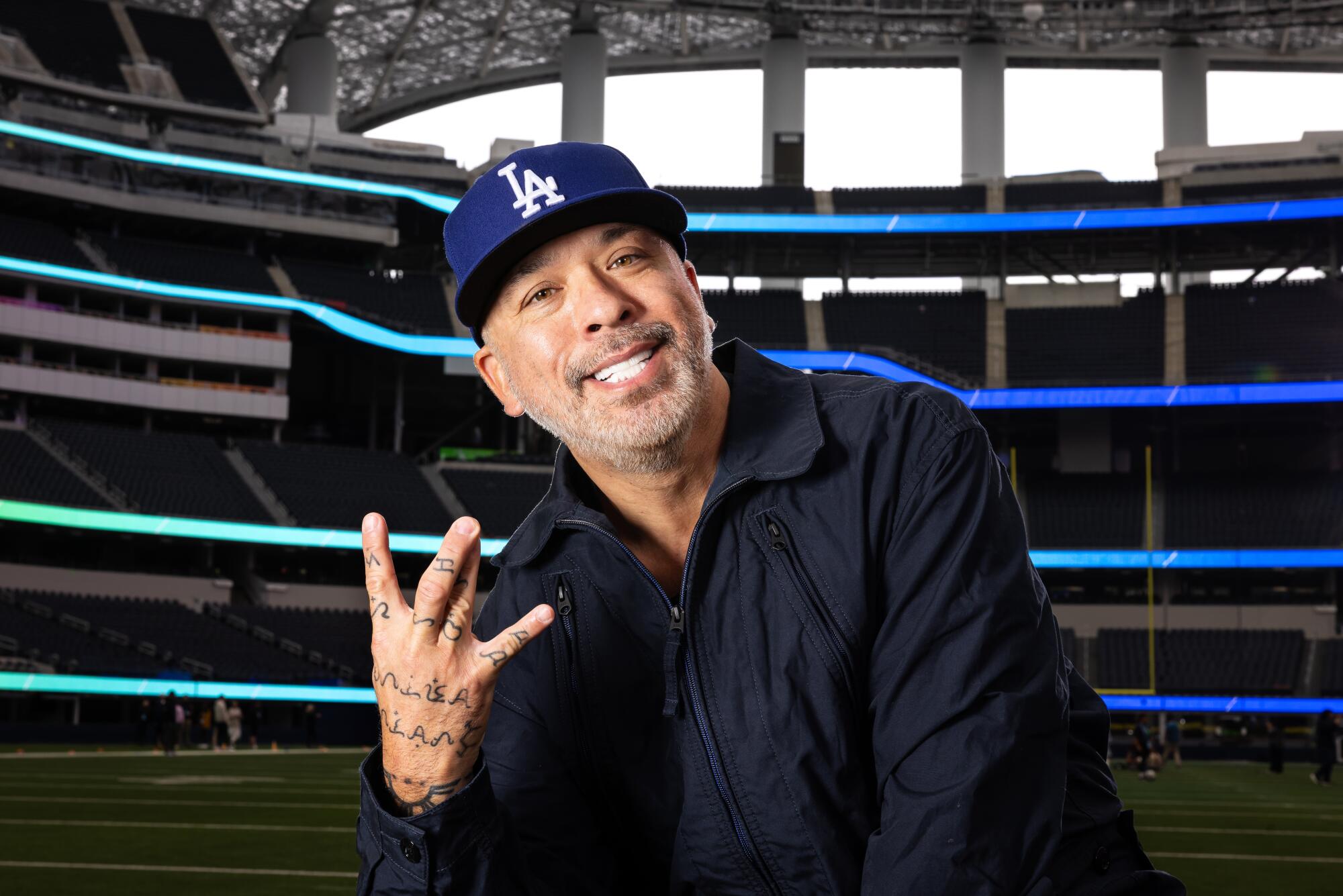
“Every time we come in here and look up, I’m like, ‘There’s going to be a stage here the size of the end zone,‘” Koy said about the upcoming SoFi show on Mar. 21. “We took the stage from the arenas that we normally play and injected steroids into it.”
(Christina House/Los Angeles Times)
For Koy, a life of comedy was a risk inspired by his heroes while growing up in Tacoma, Wash. He traces it back to being 15 and seeing Eddie Murphy perform at Climate Pledge Arena during his “Raw” tour in Seattle. He remembers taking a panoramic look at the sold-out crowd roaring in the darkness before the leather-suited legend even took the stage. “I’m like, ‘Wait a minute, this guy got this many people in here?’ I just thought that was the most impossible thing,” Koy remembers. “And now I get to share this moment with my son and let him walk with me and let him see that this is possible.”
When Koy was moving up the comedy ranks under his real name Joseph Glenn Herbert, the thought of calling himself a comedian felt like a pipe dream. Koy, the son of a white father and Filipina mother, saw comedy as a way to channel an overactive personality and need to make people laugh into a career. Going from coffee shop open mics in Tacoma to clubs and casinos in Las Vegas in 1989, Koy scratched out a living doing random jobs to move to L.A. in 2001 with hopes of making it big.
Working at a bank or Nordstrom Rack offered some stability as he drove up and down Sunset Boulevard in his battered Honda Prelude with one broken headlight, looking for a way forward to pursue his passion. Haddish, his longtime friend, spent years working with Koy, who served as her mentor at the Laugh Factory. Between sets on stage, the two would often take breaks to fantasize about fame.
“Jo and I would sit outside of the Laugh Factory and have these conversations and we’d be eating hot dogs wrapped in bacon and we’d be dreaming about being in a big movie, playing big theaters and helping people heal through laughter,” Haddish said. “Now here we are.”

“At the end of the day, this is a big stamp. And I think it also lets other comics know, ‘Hey, man, step up your game. Let’s grow this,’” Iglesias said.
(Christina House/Los Angeles Times)
Pulling off a show of this magnitude is jaw-dropping to think about, Iglesias said, even after having achieved a similar feat just a few years ago at Dodgers Stadium where he filmed his special over the course of two shows. He also set a record for fines incurred by a performer for going over his allotted time slot (a hefty $250,000 for not leaving the venue until 4 a.m.). The SoFi gig leaves him only one shot to get it right. This time around, Iglesias feels infinitely less pressure despite the bigger venue.
“[Dodger Stadium] for me was grueling,” Iglesias said. “I didn’t know what to expect, I didn’t know how it was gonna go. Every day we were pulling our hair out trying to figure it out. Fortunately we were still able to pull it off and we learned a lot from it. This time around, believe me when I tell you the stress of this show is not even there.”
Iglesias, a native of Long Beach, has spent over 30 years rising up the comedy ranks. Among his accomplishments are seven major comedy specials, a TV show (“Mr. Iglesias”) and becoming the first Mexican American comic with a top-grossing worldwide tour. Like Koy, who also has seven major specials, Iglesias went through a lot of metamorphosis on stage prior to finding his calling as a gregarious, fun-loving comedian with a penchant for doing cartoon-ish voices.
Leno says one of the key factors in Fluffy’s mass appeal is his likability.
“The great thing about Gabriel is that the kindness comes across, there’s not a mean spirit in his body,” he said. “There’s a lot of comics who are really funny but people don’t like them because they think they’re mean-spirited. … When you watch Gabe even when he does something that’s not fall-down hysterical, you smile because you like him. … I find him a joy to watch.”
Much of what Iglesias learned about marketing himself was inspired by the WWE. The costumes, witty banter and theatrics of the wrestling ring influenced his consistent look and even allowed the name “Fluffy” to become his calling card.

Comedians Gabriel Iglesias, aka, “Fluffy,” in front, and Jo Koy are photographed at SoFi Stadium in Inglewood on February 10, 2026, ahead of their March 21st show.
(Christina House/Los Angeles Times)
“There is a certain level of pandemonium, as they say in wrestling, that’s needed to get people excited,” Iglesias said. “Then there’s the marketing and the way that you do it — so I did study wrestling a lot.”
Handing the kingdom of SoFi over to the court jesters for a night is a feat worthy of celebration.
“At the end of the day, this is a big stamp. And I think it also lets other comics know, ‘Hey, man, step up your game. Let’s grow this,’” Iglesias said. “And it’s not, ‘Step up your game,’ like we’re competing with each other. It’s more so like, ‘Let’s elevate the game of comedy.’”
Right now Koy feels plenty elevated, as though he’s floating every time he enters the stadium and looks up at the stands — like the night he saw Eddie Murphy all those years ago.
“You should’ve heard the whispers me and Gabe had to ourselves walking out of the stadium tunnel, like, ‘Yo, is this really happening?!’” Koy said with a megawatt smile. “Coming from an open mic night at a coffee house, never in my wildest dreams did I say, ‘Someday, a football stadium’ … we’re literally living our dreams right now.”

Entertainment
Sigh. Again? ‘Love Island USA’ confirms another contestant fired over apparent use of racial slur

It seems “Love Island USA” producers pulled one bombshell aside for a chat, one that has led to her firing from the hit reality dating series.
Contestant Alannah Keyser’s time in Fiji has officially come to an end as she faces backlash for apparently using a racial slur in a video and social media comments that recently resurfaced on social media. “Love Island USA” streamer Peacock confirmed to The Times on Friday that Keyser, a film student at USC from Miami, will no longer appear on the series. She is the second contestant Peacock dismissed this season over a racial slur scandal.
Keyser made her “Love Island USA” debut last week as one of the six women hopeful to strike up a connection with the male contestants in Casa Amor, testing the men’s relationship with their partners back in the villa. Keyser appeared to pair up with contestant Zach Georgiou. In her debut episode, she informed Georgiou she had a brief romance with his older brother Charlie, a previous “Love Island USA” contestant.
“Love Island USA” parted ways with contestant Alannah Keyser after she used a racial slur in social media comments and posts.
(Ben Symons / Peacock)
She faced allegations of racism amid her first “Love Island USA” episode when a social media user surfaced screenshots of Keyser allegedly using the N-word on Snapchat and Instagram. A user on X (formerly Twitter) also published video of Keyser seemingly saying the slur as she sings along to Roddy Ricch’s “The Box” at a party. Some viewers — and other contestants on the series — also observed that Keyser interacted less with the Black men on the series in her debut episode.
A source familiar with “Love Island USA” production said the controversial video and posts only became public on social media after Keyser’s first episode and that the posts were not viewable during the series’ vetting process. Peacock confirmed Kesyer’s firing hours after the U.S. Sun reported her exit and minimized screen time. “Producers were disappointed and embarrassed that this has become another mishap,” a source told the outlet.
Keyser did not immediately respond to a request for comment via social media.
Keyser is the fourth “Love Island USA” contestant in two years to face scrutiny for her past use of racial slurs. Earlier this month, Peacock pulled beauty technician Vasana Montgomery from its Season 8 lineup before the season started. Last year, contestant Cierra Ortega prematurely left the villa as she faced criticism for her past social media posts that included a slur for Chinese (and, more generally, Asian) people. A month before that, contestant Yulissa Escobar was dismissed by the season’s second episode amid social media outcry over her use of the N-word.
Those three contestants have since publicly apologized for their posts.

Perhaps there’s a certain irony in a story about a fireworks factory mostly keeping away from explosive drama. Yoshitoshi Shinomiya‘s lowkey feature directorial debut A New Dawn is at the very least visually captivating, comprised of lush and rather hypnotic production design. The story is small scale focusing on a trio of friends who try to save a fireworks factory in their hometown, but the imagery feels expansive and lush. A New Dawn begins with a beautiful and vaguely familiar display of this beauty: the flowing, painterly imagery of its opening sequence recalls Shinomiya’s work on the flashback sequence in Makoto Shinkai‘s your name., immediately showing that the film’s visuals might transcend its small town drama.
A background artist himself on films by Makoto Shinkai as well as the similarly resplendent Pompo: The Cinéphile, it makes sense that this history would be felt in the background works of A New Dawn. They’re dense with detail, rich with almost luminous color and illustrative texture. Shinomiya, who also wrote and storyboarded the film, veers away from the photorealism associated with someone like Shinkai through some impressionist touches – like the splotches of green paint which represent treelines – which sometimes turns into outright abstraction like when a character begins to run through the space. Sometimes there are swaying, morphing textures in the background as splotches of paint subtly shift around. On a more intimate level, the cluttered and characterful interior spaces tell a story too. This is a long-winded way of saying A New Dawn looks really, really good.
It’s not just in the tableaux of its countryside habitats and ramshackle living spaces carved out of abandoned warehouses, but there’s a sense of invention permeating through A New Dawn‘s various experiments with visual languages of animation. The most prominent is an incredibly charming stop motion animated sequence using a cardboard diorama and real human hands invading the shot in a creative reflection of a drunken character’s perspective. Even though it broadly still looks “anime” through its character design, there are also smaller details which work to set A New Dawn apart from its contemporaries, touches like its occasional lineless artwork or the way rain is defined through smudged black brushstrokes.
It’s in the screenwriting where A New Dawn begins to feel more run of the mill. Its story about the constant chasing of the majesty of a fabled firework “Shuhari” feels both familiar in its premise but also a little bit alienating in its structure. The importance of the firework itself never feels clear – the moment its mystery is unravelled hardly feels like a revelation as a result, something amplified by how the writing often obfuscates what anyone is talking about. The whole story feels a little distancing, and despite the allure of the background art and design of the spaces the characters inhabit, the people themselves feel constantly at arms length.
It almost pulls things back with its climax – the detonation of the “Shuhari” goes a long way in justifying the circular conversations about its nature and origins – a painted streak of light launches into the sky before turning into something otherworldly, suddenly tripling down on the film’s captivating exaggerations.
Entertainment
Review: They’re finally too old for it in the middling clip reel ‘Jackass: Best and Last’

The best weapon in the “Jackass’” arsenal isn’t the taser, the beehive or the booby-trapped latrine. It’s the explosion of relief when a prank ends, often in humiliation, always with hoots and claps. The first film, 2002’s “Jackass: The Movie” was slow to discover that carnage without camaraderie is painful; several injuries limped off-screen in horrified silence. Laughter heals, except for the brain hemorrhage that Johnny Knoxville suffered in 2022’s “Jackass Forever” when, dissatisfied by the clobbering he took from a bull, requested a second ramming that knocked him out cold.
Hence “Jackass: Best and Last,” the goon squad’s alleged final film, is underwhelmingly tame. Shot quickly by stalwart director Jeff Tremaine this spring, half of it is a clip reel of past hits, like the time fan favorite Steve-O slingshotted into the sky in a port-a-potty. The rest is scraps of hastily assembled chaos, the most elaborate of which is a puppet show in which veterans Ehren McGhehey, Dave England and Jason “Wee Man” Acuña dangle helplessly from strings, trying to recite cue cards while being pummeled by tropical fruit. “A pineapple!” Wee Man moans.
I’m no sadist. They’ve suffered plenty for our amusement. Still, it’s a shame that for the first time in two and a half decades of cringe comedy, the guffaws feel forced.
Acknowledging the Jackasses’ age, if not maturity, are a couple skits about prostate and rectal checkups. (The gnarliest involves clear pants, colonoscopy prep liquid and a game of Twister.) Modern technology enters the arena with a nimble-fingered robot. If the team had invested any actual energy into brainstorming this entry, they’d have played paintball with a sniper drone. At least for the sake of torch-passing, someone should have thought of something for the newish members introduced in “Jackass Forever” to do besides stand around and applaud.
These fresher faces — Jasper Dolphin, Rachel Wolfson, Zach Holmes — prove brave and resilient when allowed to participate. Only one of them, Sean “Poopies” McInerney, a surf bro so gullible that I’m not sure he’s capable of informed legal consent, fits into “Best and Last” like a well-worn punching bag. (When Poopies yelps that “my mind is getting to me” while wearing a shock collar around a sensitive area, people snort because, as sweet as he seems, the only thing rattling inside his cranium is a moth.) Early on, Poopies gets swollen lip injections that, someone claims, will last the whole movie. You expect his trophy wife pout to be a running sight gag. But his disfigurement never even gets another closeup.
“Jackass” started with a bang. In January of 1998, Knoxville, then a 26-year-old aspiring actor, strapped on a cheap bulletproof vest padded with a stack of “Hustler” magazines and fired a gun point-blank into his chest. His dumb derring-do went viral on VHS tapes, earning him an MTV show and five feature films. Watching that Rosetta Stone-cold stupid footage here, you’re struck not only by his audacity, but by the scene’s excruciating comic pacing. As there’s only one bullet in the pistol, empty chambers click multiple times before the bullet finally fires. Logically, you know Knoxville will live long enough for his hair to turn fright-wig white. Yet the lizard brain making you gawk is shrieking.
Do not attempt any of the stunts you’re about to see, the prefatory caution blares. Absolutely. The thing is, no one else could. “Best and Last’s” flashbacks are a walloping reminder that Knoxville is inimitable: a telegenic and extroverted entertainer with a charisma he wields like a skunk aims its stink. Upset him at your own risk. Like Buster Keaton before him, Knoxville has an uncanny awareness of how his death-defying escapades appear on camera. Even in that near-suicidal early segment, note how Knoxville stays on his feet, enduring agony with a magician’s “Ta-da!” He might have given himself a bruise the size of a baseball but he’s focused on the audience’s delight.
Over the years, the visuals dramatically improve, from snuff film aesthetics to confidently silly splendor. “Jackass Number Two,” released in 2006, expended major energy on a musical homage to Old Hollywood that nodded to Keaton and bathing beauty Esther Williams who, in MGM’s “Million Dollar Mermaid,” plunged 50 feet into a pool and broke her neck. By 2010’s “Jackass 3D,” which riffed on classic cartoons with Knoxville strapping himself onto an Acme-style red rocket, one could admit they went to see a Jackass movie for the cinematography with even more sincerity than if Knoxville claimed he bought “Hustler” for its life-saving properties.
The new movie doesn’t have any artistic ambition. The charitable excuse for its reliance on old material is that the gang wanted one more film that summed up their entire legacy — from the impact of seeing them age to the opportunity to include departed colleagues Ryan Dunn, who died in 2011, and Bam Margera, fired in 2020. The other explanation is it’s a cash grab made for pennies. Still, Steve-O strives for memorable moments, gathering the gang in a generic office building corridor to watch him take off his pants and pop out a ping-pong ball. There’s a lot of nudity but the setting feels half-assed.
“Best and Last’s” intro splat-tacular, typically a highlight of each film, hinges on the posse standing still on a moving floor. But the monochrome staging — white walls, white ground — looks almost like CGI, the antithesis of their appeal, and it takes us a minute to understand what’s actually going on. Worst, it lacks both suspense and surprise, that no-they-aren’t–oh-god-they-are drama that once elevated the franchise to the peak of pure cinema.
There is — and I mean this — existentialism in witnessing a person embrace shame and terror. Actors have won Oscars without achieving the transcendence of, say, misery glutton McGhehey in “Jackass Forever,” bound to a chair and coated in salmon and honey, realizing that his friends have released a bear into the room. Meryl Streep could never do that (and wouldn’t have to). McGhehey’s sole path to stardom is that he did.
Not everything in a “Jackass” movie needs to be that sublime. One of my few genuine howls in “Best and Last” came in a three-second rehash of someone stepping on a rake; another was the percussion Chris Pontius makes with his swinging nethers before attempting a naked Fosbury flop. There’s a great accidental gag in a cut bit from the original MTV pilot when a deputy pulls up to arrest Knoxville and forgets to put her car in park. Yet the snippet I keep thinking about is a throwaway beat in a new skit when McGhehey willingly gets into the wrong chair again and, once freed, attacks Knoxville who coolly knees him in the nuts. Everyone chuckles.
Once, in anthropology class, my professor lectured on an insular island tribe that cackled whenever someone got hurt. Schadenfreude was the community’s way to vent tension. I thought of that village throughout “Best and Last,” especially during Knoxville’s nonchalant disarmament of his pal. Team Jackass has stayed united even while at each other’s throats. In bad times, they’ve borne each other’s struggles with sobriety and mental health. In good, they’ve seen the inequality of success that’s left Knoxville in a better financial position to retire than the rest.
While “Best and Last” is a whiff, I can forgive this band of bozos’ urge to make it. No one seems happy to still be zapping themselves with electrodes. They just want to rally together for the final time to choke out one last laugh.
‘Jackass: Best and Last’
Rated: R, for extremely dangerous stunts and crude material throughout, graphic nudity, pervasive language and sexual material
Running time: 1 hour, 32 minutes
Playing: Opening Friday, June 26 in wide release
-

 World3 minutes ago
Shipping giant warns Strait of Hormuz chaos is ‘new normal’ as Tehran shifts 4M barrels
-

 Politics10 minutes ago
Jacob Frey praises Somali community as Minnesota faces renewed scrutiny over fraud investigations
-

 Sports18 minutes ago
J.T. Poston posts a 12 on a single hole at Travelers Championship in stunning meltdown
-

 Technology25 minutes ago
Midjourney’s wild body scanner scans you in water
-
 Business28 minutes ago
Why tech stocks are getting hammered
-
Entertainment33 minutes ago
Sigh. Again? ‘Love Island USA’ confirms another contestant fired over apparent use of racial slur
-
 Politics43 minutes ago
Commentary: This California bill is so bad it has me agreeing with a Trump Republican
-
 Sports55 minutes ago
Wife, kids of Dodgers’ Miguel Rojas in Caracas when earthquakes hit Venezuela

