Science
Space shuttle Endeavour's giant orange external tank begins final journey

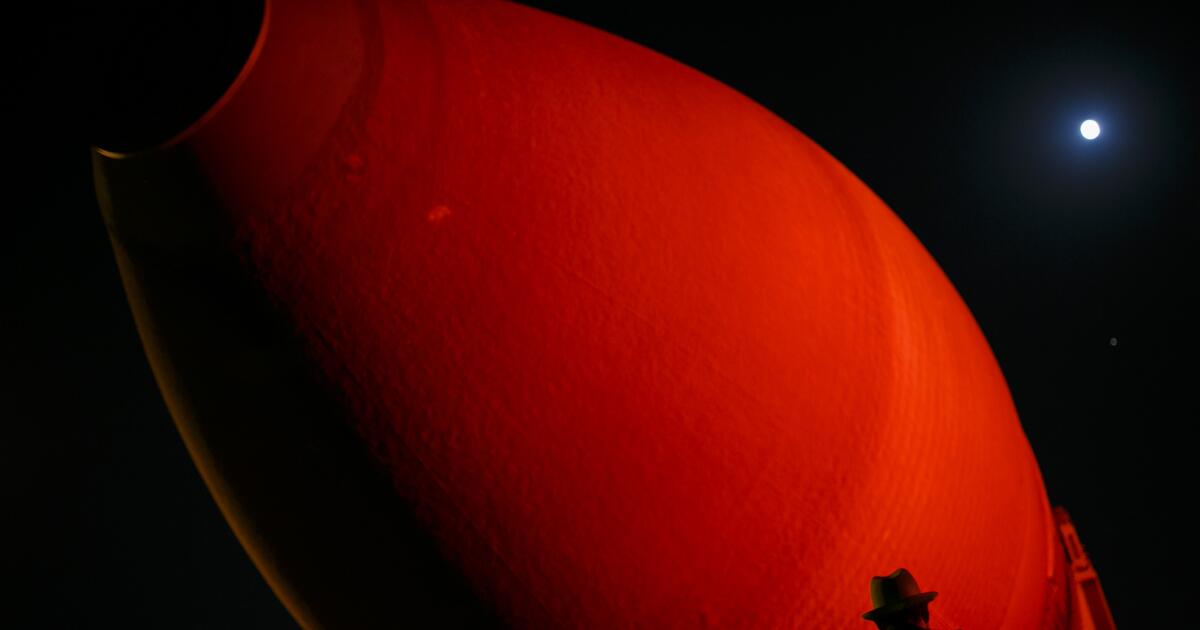
At long last, the final journey of the last space shuttle ever built, Endeavour, and its giant orange external tank are expected to begin this month — the capstone to a historic journey to an ambitious museum exhibit in Los Angeles.
It’ll be a momentous occasion for the California Science Center, the state-run museum just south of downtown L.A., which is building the 20-story Samuel Oschin Air and Space Center to house Endeavour. Anticipation has been building for more than a decade for the new museum wing, after NASA’s decision in 2011 to send Endeavour to L.A. and the orbiter’s cross-country journey in 2012, flying over the Hollywood sign before undertaking a three-day journey through city streets to its new home.
Unlike any other exhibit showcasing a retired space shuttle, Endeavour in L.A. will be configured in a full-stack arrangement, pointing to the stars, as if ready for launch.
Barring any weather delays, starting next week, the 65,000-pound, 154-foot-long giant orange external tank is expected to be moved and then lifted up from its current horizontal position into a vertical orientation, where it’ll be attached to the solid rocket boosters that have already been installed.
Then, no earlier than the end of the month, the space shuttle orbiter itself, Endeavour, will then be lifted from its horizontal position to its vertical position, and be attached to the external tank. It’ll be the first time a shuttle designed for space has been assembled vertically outside of a NASA or Air Force facility.
Jeffrey Rudolph, president of the California Science Center, at the groundbreaking of the Samuel Oschin Air and Space Center in 2022.
(Irfan Khan / Los Angeles Times)
The operation will be a sight to see, and the key moments of the lift of the external tank and Endeavour will be streamed online by the California Science Center. The cranes that will lift the spacecraft are quite tall — the tallest of which will be about the height of City Hall.
“Show time!” said Jeffrey Rudolph, president of the California Science Center.
The prelude to the external tank’s big lift is scheduled for Jan. 10, when the it will be moved by self-propelled modular transporters — similar to the ones used to move Endeavour through city streets in 2012 — down State Drive to the new museum wing’s construction site. The journey will take about two hours, past the science center and the Exposition Park Rose Garden.
Then, on the evening of Jan. 11 and into the next morning, the external tank is to be lifted, starting sometime after 10 p.m. Because the move is taking place outdoors, any significant winds could lead to delays in the big move, and the museum doesn’t want a very big thing swinging off a crane in significant winds.
“The trend, at least in December, was for the winds to die down about 10 p.m. and pick back up about 4 a.m. Assuming that holds into early January, we’ll try taking advantage of that six-hour window to lift the tank and get it in to the pit,” said Dennis Jenkins, project director for the Samuel Oschin Air and Space Center.
The orange external tank will be attached to the twin solid rocket boosters, already installed, at the Samuel Oschin Air and Space Center construction site at the California Science Center.
(Luis Sinco / Los Angeles Times)
Two cranes will be used initially to lift up the external tank from its horizontal position. Then, the external tank will be slowly turned upright to a vertical orientation, and one of the cranes will be disconnected. The other crane will then lift the tank into its final position.
The external tank will then be attached to components that were installed in recent months — the twin solid rocket boosters, which began to be installed in a months-long process that started over the summer. At liftoff, the white rocket boosters were set underneath the shuttle’s wings and produced more than 80% of the lift.
The 15-story orange external tank, the last of its kind in existence, arrived in Los Angeles in 2016, on a journey by sea through the Panama Canal and into Marina del Rey, before also lumbering through the streets to the Science Center. During launches, the external tank carried propellants — liquid oxygen and liquid hydrogen — that powered the space shuttle’s three main engines to help bring the shuttle into orbit.
After the external tank is put into position, work will begin to move Endeavour out of its existing exhibit space, the temporary hangar known as the Samuel Oschin Space Shuttle Endeavour Pavilion, where the orbiter had been on display for about 11 years, until it closed on New Year’s Eve.
The hangar is being dismantled to make way for Endeavour’s move. Later this month, Endeavour will begin to be moved out of the hangar, on the western edge of the science center, Rudolph said.
It’ll first be rolled onto the lawn just north of the Los Angeles Memorial Coliseum and south of the Natural History Museum of Los Angeles County.
Then, the orbiter will move down State Drive. The move will be tricky: At one point, Endeavour will need to be jacked up — to avoid striking a building — moved and then jacked back down for the rest of the journey.
An architectural drawing showing the design of the future California Science Center’s Samuel Oschin Air and Space Center, which will house the space shuttle Endeavour, just next to the Los Angeles Memorial Coliseum.
(ZGF via the California Science Center)
Weather permitting, before the end of the month, Endeavour will undertake its own lift into place. Hopefully, that lift will also be a one-night operation.
Once Endeavour is in place, the rest of the museum will be built around it, followed by the time it will take to install exhibits. It could be a few years before the new museum is open to the public.
The shuttle project, estimated to cost $400 million, will reshape the skyline around the California Science Center, whose roots stem from 110 years ago as a site for exhibiting agricultural and industrial projects. The site became the California Museum of Science and Industry in 1951, and reopened as the California Science Center in 1998.
The new aerospace museum wing is named for Samuel Oschin, the late Los Angeles businessman and philanthropist, whose name is also on the Griffith Observatory planetarium and the Cedars-Sinai Medical Center cancer institute. Financial contributions that came from the Mr. and Mrs. Samuel Oschin Family Foundation have been transformational to building the new museum wing, which broke ground in mid-2022.
The space shuttle’s arrival in California was a homecoming for Endeavour, which rolled off Rockwell International’s production line in Palmdale in 1991, replacing Challenger, which exploded shortly after launch in 1986, killing the seven aboard. Southern California played a crucial role in the shuttles’ development, which pumped hundreds of millions of dollars into the economy and became a source of pride for the region’s aerospace industry.
Endeavour flew 25 missions in space before its final flight in 2011, eight years after another shuttle, Columbia, disintegrated on reentry in 2003, and the shuttle fleet was set for retirement.
Among Endeavour’s most notable missions was successfully repairing the Hubble Space Telescope and helping complete construction of the International Space Station.



Scientists have long dreamed of discovering the alchemy by which chemicals can be turned into life. On Wednesday, a team at the University of Minnesota announced that it had taken a major step toward that vision.
Blending together dozens of ingredients, the researchers have synthesized simple cells that feed, grow, reproduce and compete with one another for food. If these cells are not yet fully alive, they have most of the hallmarks of life.
“Life is not binary,” said Kate Adamala, a synthetic biologist who led the research. “That’s why I’m hesitant to call this ‘alive.’ There’s no clear line, as much as we would love it to be.”
Until now, scientists had never mastered the recipe for a cell that can perform so many functions, said John Glass, a synthetic biologist at the J. Craig Venter Institute in La Jolla, Calif., who was not involved in the study.
“It is dazzling that she has put these things all together,” he said.
Drew Endy, a synthetic biologist at Stanford University, said, “It’s a cell that was built, not born. It’s constructed, but it does what cells do.”
Dr. Adamala named her creation SpudCell, after its potato-like appearance. Rather than patent it, she and Dr. Endy are organizing a community of scientists to focus on making SpudCells more fully alive and adapting them to new kinds of experiments.
They and their colleagues have founded a nonprofit research organization that Dr. Endy estimates will spend hundreds of millions of dollars on the effort in the next decade. Hundreds of scientists are expected to join.
“We’re going to remember this moment,” said Roseanna Zia, a computational biologist at the University of Missouri who was not involved in the project.
Dr. Adamala and her colleagues posted a 190-page account of their work online. The research is under review for publication in a scientific journal.
Scientists hope synthetic cells can tell them things about life that natural cells cannot, including such basic questions as how many genes are necessary for a minimal form of life.
But synthetic cells also might someday be engineered to do things that natural cells can’t, like making new kinds of medicine or drawing large amounts of carbon dioxide from the atmosphere. In theory, engineered SpudCells might produce a vast range of proteins that natural cells cannot be coaxed to make, or even toxic chemicals like rocket fuel.
Now, “we can think about doing chemistry that we’re barely getting our heads around,” Dr. Glass said.
The trouble with life as we know it: mysterious, messy complexity. Our own DNA contains tens of thousands of genes, as well as millions of molecular switches turning those genes on and off. Scientists barely have a clue as to what many of those pieces of DNA are doing. Often a gene that they think they understand turns out to be performing other jobs than scientists expected.
One way to sidestep this intricacy is to simplify.
In the 1990s, a team led by the late biologist Craig Venter began studying a microbe that had fewer than 1,000 genes. The team, now led by Dr. Glass, went on to strip the microbe’s genome down to 525 essential genes.
In a 2016 paper, the team reported it didn’t know what a third of those genes were doing. Dr. Glass and his colleagues have spent the last decade trying to solve the puzzle, and they still can’t say what 56 of them do.
“There are still significant tasks that every cell has to do that we don’t know,” Dr. Glass said.
Other researchers tackled the problem from the opposite direction. Instead of working from the top down, they moved from the bottom up, seeking to combine lifeless molecules to produce a living cell.
Since the 1990s, several labs have bitten off small pieces of this problem. Some of them have perfected recipes to make hollow bubbles from oily molecules. Others have found ways to encapsulate simple genetic molecules inside those bubbles.
But scientists struggled to put these pieces together into more complex systems, let alone something that could be called a cell.
In recent years, Dr. Adamala took on one of the fundamental challenges: cell division. A natural cell divides with the help of proteins that lock together into a ring anchored to its inner wall. The ring winds itself tighter, pinching the cell in two.
Other proteins act like winches, moving DNA and other molecules into the forming cells, so that they have the ingredients necessary to keep living.
At first, Dr. Adamala tried building a simpler version of the natural system. But then she decided not to mimic real cells at all.
Biophysicists had found that if they stuck proteins on a membrane, they created pressure that made the membrane bend. Dr. Adamala and her team created bubbles that could snag proteins floating around them. When a bubble collected enough proteins, its surface began bending inward until it popped in two.
While the idea was simple, getting it to work in the lab required a year of experiments. “But once it works, it works,” Dr. Adamala said.
That success prompted the team to try to build a synthetic cell in its entirety.
The first step was to create a broth of the molecules necessary for a cell to operate. The recipe ultimately included about a hundred kinds of proteins and simple molecules required for crucial chemical reactions, such as making new proteins from genes.
The researchers also provided their synthetic cell with genes borrowed from a virus and the ubiquitous microbe Escherichia coli. They picked 36 genes for basic jobs like copying DNA.
After mixing these ingredients together into a soup, the scientists added the building blocks of membranes. They spontaneously joined together into bubbles, each engulfing some of the soup.
Many of these bubbles ended up encasing the right mix of genes, proteins and other molecules, and they started carrying out the chemical reactions seen in real cells.
As the new cells floated in flasks, Dr. Adamala and her colleagues added food. The cells slurped up small molecules through channels on their surfaces.
The scientists also put in small bubbles loaded with proteins and other molecules that were too big to fit through the channels. By bumping and fusing into one of these bubbles, the cell could feed on the treats inside.
As the cells fed, they grew. And in just a few hours, they were big enough to divide.
The scientists added a special protein to the flasks, which latched onto the surface of the cells and forced them to bend inward. Once the cells split in two, the pair of new cells kept growing.
Now the SpudCells grew, fed and reproduced. As it turned out, the cells even had a rudimentary ability to evolve.
Dr. Adamala and her colleagues created a mutant version that bound more tightly to the snack-filled bubbles floating around it. To test it, they created a 50-50 mixture of original and mutant SpudCells.
The cells competed for five generations for food. Eventually the mutants outnumbered the originals, suggesting that they were outcompeting the originals for food.
“That’s the shake-the-ground accomplishment here,” said Dr. Zia. Scientists will be able to put various synthetic cells in competition with one another and rapidly develop more sophisticated ones.
For all this evidence of life, SpudCell still has some major shortcomings. For starters, it can’t make the molecular factory that produces new proteins, called a ribosome. The cells can carry all the genes they need to build ribosomes, but for some reason the parts don’t come together.
For now, Dr. Adamala and her colleagues have to feed ready-made ribosomes to SpudCells. This solution has an expiration date, though: SpudCells can keep making proteins through five to 10 generations before they fail as their ribosomes become defective.
“I don’t want to say it dies, but it stops working,” Dr. Adamala said.
When Dr. Adamala showed SpudCell to Dr. Endy last year, he was so awestruck that he decided to help her found Biotic, the nonprofit organization intended to create a community of SpudCell researchers.
“I’m pouring my life’s work into this,” Dr. Endy said. One of the first tasks for Biotic will be to make it easier for other scientists to create SpudCells.
Dr. Adamala can create a fresh batch of them in her own lab in about a day. But that’s only because she has freezers full of purified proteins and an intimate understanding of each step of her recipe. Biotic expects to offer scientists easier recipes and provide the required ingredients.
Dr. Endy hopes that the open-source tools will encourage scientists to collaborate on building new kinds of SpudCells with more of the defining features of life, such as the ability to make their own ribosomes and to divide indefinitely.
“It’s completely doable,” said Dr. Glass.
Biotic researchers are already planning their first meeting, in September in Philadelphia. High on their list of priorities will be formalizing plans to safeguard this area of research.
For now, the synthetic cell can only survive a few generations on a special lab diet. But future versions may be more robust, raising the possibility that someone might someday use SpudCells unethically, perhaps even to make a weapon.
Dr. Endy argues that an open-source research community will be better prepared to prevent that from happening. “We can have these conversations now, as opposed to waiting for somebody else to do it, and then we’re just all reacting,” he said.
Dr. Endy likens SpudCells to a biological version of the Wright flyer, the crude plane that the Wright Brothers used to make the first sustained controlled flight in 1903, ushering in the age of airplanes.
“The Wright flyer flying for 12 seconds doesn’t get you a 737,” Dr. Endy said. “This is just the beginning.”

For the next five years, the Environmental Protection Agency has indicated it will not require public water utilities to test for microplastics or pharmaceuticals in drinking water, according to a proposed rule published in the Federal Register.
On Friday, the EPA submitted a list of chemicals it plans to test for under the Unregulated Contaminant Monitoring Rule, a mandatory testing program used to collect information about concerning chemicals in drinking water that could be harming human health. It did not include microplastics or pharmaceuticals.
The omissions come after announcements by EPA Administrator Lee Zeldin earlier this year that his agency was designating microplastics and pharmaceuticals priority contaminants for testing.
“This is a direct response to the concern of millions of Americans who have long demanded answers about what they and their families are drinking every day,” he said at an April news conference with Health and Human Secretary Robert F. Kennedy Jr. at EPA headquarters.
Zeldin’s announcement was seen at the time as a move to placate the increasingly disgruntled Make America Healthy Again contingent of Trump supporters.
Now the agency says it has no validated or standardized method to test for the plastic particles in drinking water, and wouldn’t be able to develop one before December, when testing is required to begin.
Among the 33 chemicals the EPA will require water utilities to test for are seven PFAS, or forever chemicals, and three pesticide residues.
It will be five years before the EPA proposes another list.
The EPA did not respond to a request for comment.
The agency noted in its proposed rule that it will collaborate with other federal agencies to “evaluate risks and exposures” of microplastics for future monitoring.
Environmentalists reacted with frustration and resignation. They pointed out that the European Union has developed methods to test for the tiny plastic particles, which have been found in people’s blood, brains and lung tissue. California has one in the works.
“The California water board has spent a lot of time and money on how to measure in drinking water,” said Judith Enck, a former EPA regional administrator and president of the anti-plastic environmental group Beyond Plastics. “EPA should give them a call.”
California was required by a 2018 state law to establish a protocol for local water utilities to test for the particles in drinking water. The state has not yet begun reporting its results, but protocols were established in 2021. Blair Robertson, a spokesman for the State Water Resources Control Board, said it’s not “a fully validated, end-to-end regulatory method” yet.
At the April meeting, Zeldin announced that he would place microplastics on what is known as the Contaminant Candidate List, which acts as a preliminary “watch list” of unregulated, priority contaminants in drinking water. Like the mandatory monitoring list, it is updated only every five years. The most recent list was published on April 2 — the day he made his announcement.
“Americans have been ignored as they sound the alarm about plastics in their drinking water,” Zeldin said during the announcement. “That ends today by placing microplastics on the contaminant candidate list for the first time ever. EPA will follow the science, will pursue answers and will hold ourselves to the highest standards to protect the health of Americans.”
There appears to be no clear association between these two lists, although the contaminant list is supposed to inform the monitoring list. Seventy-five chemicals and four chemical groups (microplastics, pharmaceuticals, PFAS chemicals, and disinfection byproducts) were listed on the 2026 contaminant list. Only seven of those chemicals were also on the proposed monitoring list (as well as seven PFAS chemicals).
When Zeldin announced microplastics as “‘a priority contaminant for regulation,’ and called it ‘a historic action on microplastics,’ he made it seem like the administration was going to take microplastics seriously,” said Mary Grant, water policy director for the environmental group Food & Water Watch.
“By not including them, they made it clear they don’t actually have plans to immediately address this crisis by getting the real-world monitoring data that we need right now to really start correcting ourselves,” she said.
Craig Davis, senior director of plastics chemistry at the American Chemistry Council — the nation’s largest trade group for chemical companies — said that while his organization supports microplastic research, it also agrees with the EPA’s decision not to include them in the monitoring list.
“National drinking water monitoring should be based on validated, standardized methods that can produce reliable and comparable data,” said Davis in a statement. He said “limited” national monitoring resources should be focused where data can produce “actionable public health information.”
The public has 60 days to comment once the plan is published in the Federal Register.

The number of Angelenos who went to the hospital with throat pain and concerns about smoke inhalation spiked as a fire burned through the massive Lineage cold storage warehouse in Boyle Heights this month, The Times has learned.
The blaze burned for eight days beginning June 17 and involved solar panels, insulation foam and other industrial materials.
During that time, more than three times as many people went to emergency departments within 10 miles of the warehouse mentioning the fire or smoke inhalation compared with the two weeks prior, according to data from the Los Angeles County Department of Public Health obtained through a public records request.
The agency also noted a near doubling of patients mentioning throat pain within five miles of the fire June 21 — 1.9 times the baseline levels.
Usually, fewer than 50 people go to the emergency room each day for throat pain, and fewer than 20 people for smoke inhalation, the department said.
The hospitalization data was tracked through the department’s syndromic surveillance project, which monitors trends in what people report when they come to emergency departments in L.A. County, as well as diagnosis codes noted by providers. The system is not as comprehensive as full patient health records, and clinicians may not always include key words about “fire,” “smoke” or other circumstantial information in their diagnoses, the public health department said.
As such, it “cannot capture the true number of [emergency department] visits related to symptoms from the fire and likely underestimates the true burden of fire related symptoms,” the department said.
Perhaps unexpectedly, the department said it did not note a substantial increase in asthma, acute respiratory symptoms or chronic obstructive pulmonary disease-related emergency department visits during the fire.
But even these preliminary findings are concerning, experts said. The fire is believed to have started on the solar array on the roof of the 500,000 square-foot building, which housed 85 million pounds of frozen food. It then reached an ammonia line, prompting two brief shelter-in-place orders for nearby residents.
Over the next week, the fire continued to burn through dense insulation foam within the building’s walls and other unknown industrial materials, blanketing much of L.A. in acrid smoke. Residents in downtown L.A., northeast L.A., Burbank, the San Gabriel Valley and many other parts of the city and county reported seeing and smelling the fumes.
The South Coast Air Quality Management District issued multiple warnings about unhealthy levels of PM 2.5, or fine particulate matter. The city and county opened two smoke respite shelters in the immediate area so that people could breath cleaner air.
It is still unclear what exactly was in the smoke that people breathed in. Industrial fires release far more materials than the burned wood smoke that is emitted during wildfires.
“The makeup of the smoke can include toxic chemicals, fine particles and other serious risks to lung health depending on fire conditions and what is burned,” Will Barrett, assistant vice president for nationwide clean air policy at the American Lung Assn., said as the fire was burning. Children and elderly people are particularly at risk.
David Eisenman, director of the UCLA Center for Public Health and Disasters, said urban industrial fires also can represent a hazard that standard PM 2.5 warnings don’t always address. Those advisories are “blunt instruments” that don’t adequately capture emissions from burning man-made goods — or convey that the source of pollution may include burning batteries or toxic refrigerants, he said.
The fact that initial numbers don’t show a spike in asthma attacks is “somewhat reassuring,” Eisenman said. But “people may have gone to their primary care doctors, which this would not capture. This data deserves follow up.”
The air district and the U.S. Environmental Protection Agency deployed air monitors to assess particulate matter, airborne toxic metals and other harmful compounds during the early days of the blaze. The air district said it didn’t find significant levels of air toxics during the first two days of the fire, although it did record significantly elevated concentrations of particulate matter within the plume downwind.
Some of the measurements it took with mobile monitors, which are five-minute snapshots, also showed increased bromine and chlorine, which often are found when buildings burn and were at levels “below short-term health-based exposure thresholds,” the air district said. It began continuous PM 2.5. monitoring at two nearby elementary schools on the third day.
The L.A. Fire Department said it detected low-levels of toxic hydrogen fluoride on the second day of the fire, which can be a byproduct of burning lithium-ion batteries.
Lineage, the tenant-operator of the warehouse, said no concentrations of ammonia were detected in the air at any time.
“There’s no doubt this fire has had a huge impact on the local community, and we are committed to showing up in every way we can,” company officials wrote in a statement last week. They said Lineage worked closely with the Fire Department during the blaze and delivered masks, air purifiers and other supplies to the community, and will work to ensure the fastest cleanup possible.
The long-term health effects of the fire and its smoke probably won’t be known unless researchers conduct a follow-up study, said Eisenman of UCLA.
For example, there may have been delayed pulmonary effects from the hydrogen fluoride and burning insulation foam that — when combined with the elevated PM 2.5 levels in a dense urban environment — produced health effects that didn’t show up in the emergency room data.
“They will show up in increased primary care office visits and exacerbations of chronic disease over the next few weeks,” he said. “So from a public health standpoint, this fire is not over.”
-

 South Dakota3 minutes ago
Transparency, data protection laws take effect July 1
-

 Tennessee5 minutes ago
More than 1K Williamson County residents without power amid heat wave
-

 Texas11 minutes ago
SCHEELS CEDAR PARK
-
Utah18 minutes ago
Lakers trade for center Walker Kessler from Utah, make their big swing with rush of signings
-

 Vermont21 minutes ago
In Post-pandemic Vermont, The High-end Destination Wedding Industry Has ‘exploded’
-

 Virginia26 minutes ago
Virginia’s Clean Slate Law takes effect, sealing records of certain convictions, offenses
-

 Washington33 minutes ago
Where can you watch fireworks in Washington DC on the Fourth of July?
-

 Wisconsin36 minutes ago
9-year-old drowns at western Wisconsin water park, sheriff says

