Politics
After week of war and political upheaval, Trump remains defiant as ever

In recent days, tensions over the U.S. war in Iran have steadily mounted.
Polls have shown the campaign is widely unpopular. An entire flank of Trump’s MAGA base has criticized it as a clear departure from the “America First” mantra Trump has long espoused. Leaders within the Trump administration have pushed against claims it was about regime change, framing it instead as a necessary response to imminent threats.
Trump, meanwhile, has struck a decidedly defiant tone — offering few of the reassurances or rationalizations that past presidents have offered in the initial stages of war, and sounding more unbothered than embattled.
He has lamented American casualties but also seemed to shrug them off — along with additional deaths he expects to come and potential attacks on the U.S. homeland — as the simple cost of war, saying, “Some people will die.”
He has ignored concerns the war will turn into another unending Middle East quagmire, while openly flirting with taking over Cuba too.
Undermining his administration’s own messaging that the war is not about regime change, Trump wrote in a social media post Friday that there would be “no deal” with Iran without “UNCONDITIONAL SURRENDER” and new Iranian leadership “ACCEPTABLE” to him.
Sticking a thumb in the eye of his “America First” defectors, he said the U.S. and its allies are going to “work tirelessly” to make Iran “economically bigger, better, and stronger than ever before,” adding, “MAKE IRAN GREAT AGAIN (MIGA!)”
In the last week, Trump has instigated or been forced to navigate a stunning cascade of political threats. In addition to attacking Iran, he fired his Homeland Security secretary in charge of his signature immigration campaign, faced newly detailed allegations — which he denied — that he sexually assaulted a child alongside Jeffrey Epstein, saw his attorney general subpoenaed by fellow Republicans in Congress, and watched American jobs numbers drop as gas prices spiked.
And yet, Trump has also managed to avoid complex questions about those issues — the most pressing before his administration — and despite Democrats and some of his own supporters lashing out over them.
“I’ve seen a lot of Presidents fall short of their promises but I’ve never seen any President just doing the opposite of everything promised on purpose. Prices, Epstein, wars. Just absolutely racing to betray his voters,” Sen. Brian Schatz (D-Hawaii) wrote on X.
“This is Israel’s war, this is not the United States’ war. This war is not being waged on behalf of American national security objectives, to make the United States safer or richer,” said Tucker Carlson, one of Trump’s longtime allies.
Carlson said Trump committed U.S. forces to fighting in Iran for no other reason than because Israeli Prime Minister Benjamin Netanyahu “demanded it,” even though it “certainly wasn’t a good idea for the United States” and the Trump administration had “no real plan” for replacing the Iranian leadership it has now toppled.
The White House defended Trump’s actions across the board in statements to The Times on Friday.
On Iran, it said Trump “is courageously protecting the United States from the deadly threat posed by the rogue Iranian regime — and that is as America First as it gets.” On departing Homeland Security Secretary Kristi Noem and Atty. Gen. Pam Bondi, it said Trump “has assembled the most talented and competent cabinet in history,” and “continues to have faith in his Administration.”
On the economy, they said the Trump administration “is doing its part to unleash robust, private sector-led economic growth with tax cuts and deregulation,” and that Trump “has already initiated robust action” to control oil prices even amid the Iran war. And on the Epstein files, they said the latest claims unveiled “are completely baseless accusations, backed by zero credible evidence.”
Trump has also spoken out in defense of his handling of the various crises facing his administration — but not nearly with the sort of detail and solemnity that wartime presidents usually speak, experts said.
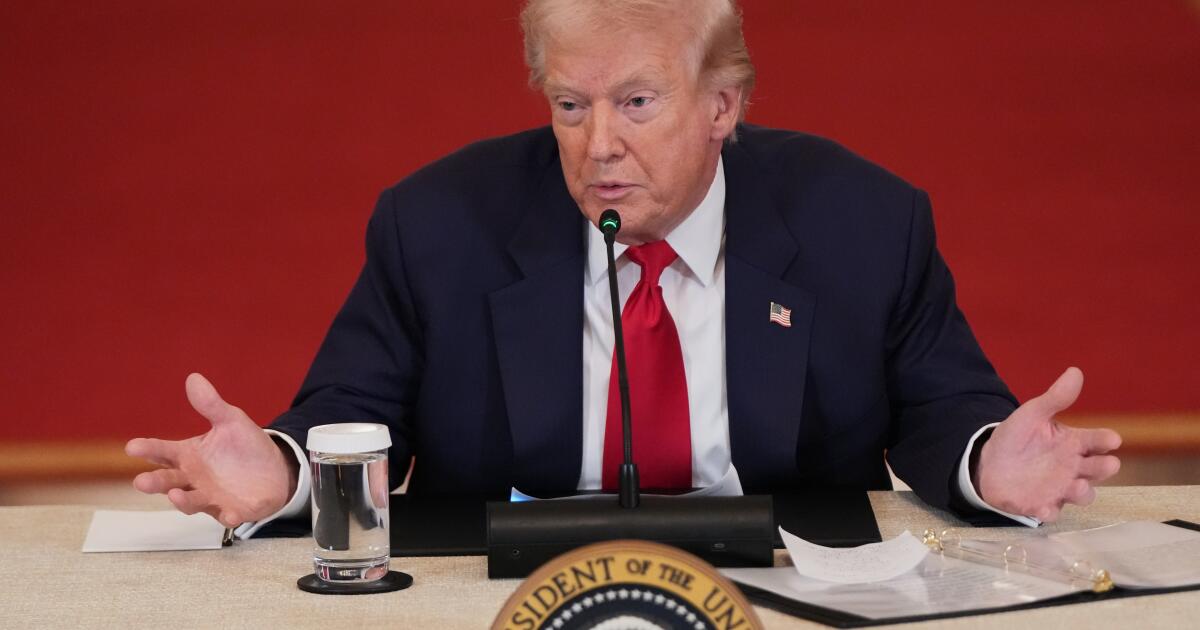
At his only public event on Friday — a nearly two-hour round-table with national leaders and sporting officials about college athletics — he ridiculed members of the media who asked about Iran and Noem.
“What a stupid question that is to be asking at this time,” he said, when asked about reports that Russia was helping Iran target and attack Americans there. “We’re talking about something else.”
When pressed as to why he was spending so much time talking about college sports when so much else is going on in the country and the world, Trump briefly talked about Iran — saying “people are very impressed by our military” and that the U.S. is now “more respected than we’ve ever been” — before concluding the event.
Jennifer Mercieca, a political historian and communications professor at Texas A&M and author of “Demagogue for President: The Rhetorical Genius of Donald Trump,” said she was surprised Trump didn’t make a stronger case for going to war in Iran during his recent State of the Union speech, and that he hasn’t been more aggressive about making the case for war since, including by using traditional language about bolstering American values around the world.
“In comparison to other presidents in a similar situation trying to lead a nation into war, that is surprising to me — and unusual,” she said.
Also unusual is the low public support for the war, Mercieca said, given that, since World War II, there has generally been high public approval for U.S. war efforts at their start.
Mercieca said she wonders if there is a correlation between Trump’s not providing a more vigorous rationale for the war and the low public approval for it — or perhaps between the low approval and the brash descriptions of the war as a merciless campaign of destruction and vengeance from others in the administration, such as Secretary of Defense Pete Hegseth.
She said Hegseth and others have shown a “lack of decorum, a lack of honor or dignity [in] their way of behaving, especially when we’re talking about warfare and human lives.”
Jack Rakove, a Stanford University professor emeritus of history and political science, said Trump’s posture is fitting with his character since he first entered politics and before, as he “can never take responsibility for anything that appears to be a mistake” and is “obsessed with the idea of appearing tough and tough-minded.”
Rakove said he does not believe, as some critics have suggested, that Trump launched the war in Iran specifically to distract from the Epstein files, which as of Thursday included newly released FBI descriptions of several interviews in which a woman accused Trump and Epstein of sexual assault in the 1980s when she was a child. Her accusations have not been verified.
But Rakove said he does wonder to what degree Trump is consciously pushing chaos in order to ensure that no one detrimental issue for him politically captures the public’s attention for too long.
Mercieca said Trump has always been “uniquely good at controlling the public conversation,” but that power has been tested recently by the Epstein files — which have held the public’s attention despite his repeatedly saying that “we should move on from that, that we should stop talking about it, that he’s been exonerated.”
She said Trump’s instinct in the current moment to push ahead aggressively despite waning support for his economic policies, his immigration policies and his war in Iran could be related to his desire to return people’s attention to his agenda, but is also in line with his long-held desire to go down in history — including by making big moves.
“I think he’s very much trying to leave his mark on the White House, I think he’s trying to leave his mark on the nation, I think he’s trying to leave his mark on the world, and I think war is a way that leaders have traditionally done that throughout history,” she said.



NEWYou can now listen to Fox News articles!
He wasn’t on the ballot, but President Donald Trump was a winner in Louisiana’s GOP Senate runoff election.
That’s because Trump-backed Rep. Julia Letlow defeated state Treasurer John Fleming to capture the Republican nomination, The Associated Press reported on Saturday.
Six weeks after denying Trump-targeted GOP Sen. Bill Cassidy a third six-year term in the Senate, a majority of Republican voters in the solidly red Gulf Coast state backed Letlow. Her victory in the runoff is seen as another victory for Trump as he works to fill the halls of Congress with loyal lawmakers for his final two years in the White House. And it’s another sign of the power of a Trump endorsement in Republican primaries.
Five years after he voted to convict Trump in his second impeachment trial, Cassidy was sent packing.
WATCH: CASSIDY DETAILS NEW BEHIND CLOSED DOORS CLASH WITH TRUMP
Sen. Bill Cassidy of Louisiana fist bumps a supporter during a campaign stop at a gun retailer and firing range in Baton Rouge on May 15, 2026, the eve of the state’s Senate primary. (Paul Steinhauser/Fox News)
Trump reacted to Letlow’s victory in a Truth Social post, calling Saturday’s result “great news.”
“Julia Letlow WON in Louisiana, beating conclusively a very strong and smart opponent,” Trump wrote. “Congratulations to Julia. She will be a truly GREAT Senator!”
Letlow, who was backed by Trump even before she entered the race in January, finished first in the primary, double digits ahead of Fleming, with Cassidy in third place. Since no candidate cracked 50% of the vote, Letlow and Fleming advanced to the runoff for the Republican nomination and Cassidy became the first elected Republican senator to lose renomination since Sen. Richard Lugar of Indiana in 2012.
Trump, celebrating Cassidy’s defeat, said on social media that “it’s nice to see that his political career is OVER!”
Cassidy, in a speech to supporters after conceding, took a jab at Trump, saying, “When you participate in democracy, sometimes it doesn’t turn out the way you want it to. But you don’t pout, you don’t whine. You don’t claim the election was stolen… You don’t manufacture some excuse.”
President Donald Trump stands with Rep. Julia Letlow during the Congressional Ball at the White House Grand Foyer in Washington, D.C., on Dec. 11, 2025. (Alex Wong/Getty Images)
Letlow, who was backed by Louisiana Gov. Jeff Landry, a top Trump ally, won her congressional seat in 2021, after her husband, Luke Letlow, died five days before being sworn into the U.S. House after his 2020 election victory for the seat she now holds. She highlighted her support from Trump throughout her Senate campaign.
Fleming, who spent eight years in Congress before serving as a White House deputy chief of staff during Trump’s first term, argued he was the most conservative candidate in the GOP Senate primary.
DEMOCRACY ’26: STAY UP TO DATE WITH THE FOX NEWS ELECTION HUB
Letlow will be considered the clear frontrunner in the midterm election against either farmer Jamie Davis or Navy veteran Gary Crockett, who are facing off in the Democratic Party runoff.
The brute force of the president’s endorsement power has been on display in GOP primaries over the past two months, with his candidates ousting incumbents he targeted in showdowns in Indiana, Kentucky and Texas, as well as the Louisiana primary.
But Trump’s endorsement streak in statewide and congressional Republican primaries was snapped three weeks ago when his last-minute endorsement of Republican Rep. Randy Feenstra of Iowa in the race to succeed retiring GOP Gov. Kim Reynolds wasn’t enough to propel the three-term congressman to victory.
Feenstra was narrowly edged by Zach Lahn, a businessman, farmer and former political strategist who was backed by the political wings of MAHA — the acronym for the Make America Healthy Again movement aligned with Trump’s Health Secretary Robert F. Kennedy Jr. — and Turning Point USA, the powerful conservative organization co-founded by the late Charlie Kirk.
Zach Lahn raises his fist in celebration after defeating his primary opponent in Iowa’s GOP gubernatorial race on Tuesday, June 2, 2026. (Zach Lahn for Governor via Facebook)
The president rebounded three weeks ago in South Carolina, as Trump-backed Lt. Gov. Pam Evette finished first in the GOP gubernatorial primary and longtime Trump ally Sen. Lindsey Graham won a majority of the vote in the Republican Senate primary, and avoided a runoff.
Graham, who was endorsed by Trump, was facing primary challenges from five candidates, including conservative businessman Mark Lynch, who took aim at the senator over his support for the war in Iran. Lynch was backed by some MAGA leaders who have been critical of the president.
Two weeks ago, Trump-backed candidates won two of the three top races in Georgia and Alabama, with the one setback coming against a billionaire businessman who shelled out over $100 million of his own money to boost his campaign.
Rep. Barry Moore, a House Freedom Caucus member and longtime Trump supporter who was endorsed by the president, comfortably defeated rival Jared Hudson, a former Navy SEAL sniper who was supported by some top names on the right, in solidly red Alabama’s GOP Senate runoff.
In battleground Georgia’s Republican Senate runoff, an 11th-hour endorsement by Trump helped boost Rep. Mike Collins, a MAGA champion, to victory over former college football coach Derek Dooley, who was backed by popular conservative Gov. Brian Kemp.
TRUMP’S ENDORSEMENT FAILS TO SAVE MAGA CANDIDATE AS BILLIONAIRE ADVANCES IN KEY GOVERNOR RACE
Collins will face Democratic Sen. Jon Ossoff in the general election in a race that’s among a handful that will likely decide if the GOP holds its slim majority in the chamber in the midterms.
CLICK HERE TO DOWNLOAD THE FOX NEWS APP
But in Georgia’s GOP gubernatorial runoff, the candidate Trump backed, Lt. Gov. Burt Jones, who was also endorsed by Kemp this past weekend, was defeated by billionaire businessman Rick Jackson, who ran as an outsider.
On Tuesday, Trump-backed first-time candidate Anthony Constantino, a businessman and former boxer, defeated Robert Smullen, a retired Marine Corps colonel and New York Assembly member who had the backing of the state party, in the upstate New York race to succeed retiring GOP Rep. Elise Stefanik.
Meanwhile, in South Carolina’s Republican gubernatorial runoff, Trump couldn’t lose.
That’s because, besides backing Evette, he also gave a last-minute endorsement to state Attorney General Alan Wilson, who ended up winning the showdown in a landslide.

WASHINGTON — Asylum seekers may be turned away without a hearing at the southern border, the Supreme Court ruled Thursday in a historic retreat from the promise of relief for those who say they are fleeing persecution.
The justices split over whether this was a simple dispute over legal wording or a moral question involving desperate families.
Siding with the Trump administration, the court’s conservatives said the Refugee Act of 1980 offers a right to seek asylum to migrants who “arrive in the United States” but not those who are turned back when they approach a border crossing or a port of entry.
“This case presents a straightforward question” that turns on the word “in,” said Justice Samuel A. Alito Jr. “In ordinary speech, no one would say that a person ‘arrives in’ a place — for example, a house, a city, or a country — before the person enters that place.”
The liberal dissenters agreed with immigration rights lawyers who saw this as a nonsensical reading of the law.
Justice Sonia Sotomayor said the asylum law arose from the “international moral reckoning that followed the Holocaust and World War II.”
She cited the infamous voyage of the MS St. Louis in 1939. More than 900 Jewish refugees attempted to flee persecution in Nazi Germany by setting sail aboard the ship, which was turned away from Cuba and the United States.
Most of the passengers were returned to Europe, and several hundred died in the Holocaust, she said.
“Congress passed the Refugee Act in 1980 because it did not want this country to repeat the mistakes of its past. Yet if the refugees on the M.S. St. Louis were to walk up to a port of entry on our southern border today, the majority’s interpretation would allow immigration officers to refuse even to consider their asylum applications by physically blocking them from stepping foot onto U.S. soil,” Sotomayor wrote.
Justices Elena Kagan and Ketanji Brown Jackson agreed.
The decision upholds a turn-back policy that began in 2016 as an emergency response to a surge of Haitian immigrants at the San Ysidro border crossing.
The Department of Homeland Security said these asylum seekers must wait on the Mexican side of the border until they could return for a scheduled interview. The policy was extended to other border crossings, but it was challenged as illegal in federal court in San Diego.
Last year, a divided 9th Circuit Court of Appeals ruled that those restrictions were illegal if they prevented migrants from applying for asylum.
“To ‘arrive’ means ‘to reach a destination,’” wrote Judge Michelle Friedland. “A person who presents herself to an official at the border has ‘arrived.’”
She said the “government’s reading would reflect a radical reconstruction of the right to apply for asylum because it would give the executive branch vast discretion to prevent people from applying by blocking them at the border.”
The 2-1 decision upheld a federal judge’s ruling in San Diego for migrants who had filed a class-action suit and said they were wrongly denied an asylum hearing.
But Solicitor Gen. D. John Sauer urged the Supreme Court to review and reverse the appellate ruling, noting 15 judges of the 9th Circuit joined dissents that called the decision “radical” and “clearly wrong.”
The administration argued federal immigration law “does not grant aliens throughout the world a right to enter the United States so that they can seek asylum.”
From abroad, they may “seek admission as refugees,” Sauer said, but the government may enforce its laws by “blocking illegal immigrants from stepping on U.S. soil.”
Defenders of the asylum system denounced the decision.
“We believe that today’s ruling violates international law, as well as the express intent of Congress,” said Erika Pinheiro, executive director of the migrant support organization Al Otro Lado, which led the legal fight. “For decades, the United States has allowed individuals and families who are fleeing persecution, torture and death to ask for protection at U.S. borders.”
“Cruelty is not a substitute for real solutions. Blocking people from seeking asylum at official ports of entry will do nothing to fix our broken immigration system,” said Rebecca Cassler, senior litigation attorney at the American Immigration Council. “It only makes things more chaotic and dangerous for vulnerable families.”
The Federation for American Immigration Reform applauded the decision.
“Our immigration laws are written to be pro-enforcement, not anti-enforcement,” said Christopher J. Hajec, deputy general counsel of FAIR. “Because of this, courts that hamstring enforcement are often forced to violate basic logic, as the 9th Circuit did here. We are pleased the Supreme Court saw that the lower court’s reading would make immigration law incoherent, and reversed.”
Politics
Jeffries welcomes Democratic Socialists into the fold as critics warn party is revealing ‘exactly who it is’

NEWYou can now listen to Fox News articles!
House Minority Leader Hakeem Jeffries publicly embraced a new crop of congressional nominees Saturday, including three Democratic Socialists of America-backed candidates whose primary victories have fueled fresh debate over the Democratic Party’s leftward shift ahead of the 2026 midterms.
The powerful New York lawmaker’s post highlights the challenge facing the top House Democrat as he works to unite his party ahead of the general election. If Democrats take back the House in November, Jeffries is expected to become the next speaker. That means he’ll likely be leading a Democratic caucus with more self-described Democratic Socialists than ever before. So far, more than a dozen Democratic Socialists of America-backed candidates have won or advanced in primaries across the country this election cycle.
In a post on X, Jeffries wrote, “Congratulations to our Democratic nominees,” before listing the party’s congressional candidates from across New York. Among those recognized were Brad Lander, Claire Valdez and Darializa Avila Chevalier, all of whom are affiliated with or backed by the Democratic Socialists of America and secured victories in closely watched Democratic primaries last week.
House Minority Leader Hakeem Jeffries has called Trump official Bill Pulte a “malignant clown.” (Aaron Schwartz/Bloomberg)
“From public servants to union organizers to community activists, the path is different but the work is the same,” Jeffries wrote. “We must decisively address the affordability crisis and crush far-right extremism!”
RISING SOCIALIST STARS ON TRACK TO CONGRESS: WHO ARE DARIALIZA AVILA CHEVALIER, BRAD LANDER AND CLAIRE VALDEZ?
Lander, Chevalier and Valdez all received backing from New York City Mayor Zohran Mamdani, whose endorsements helped cement the growing influence of the Democratic Party’s progressive wing in New York politics. Lander and Chevalier defeated Jeffries-endorsed incumbents Reps. Dan Goldman and Adriano Espaillat in their respective Democratic primaries. Jeffries did not endorse in the race won by Claire Valdez, which was an open seat.
Now, as Democrats turn their attention to the general election, he appears to be rallying behind the party’s nominees as they try to win back the House in November.
The socialist candidates have also faced scrutiny over resurfaced social media posts, support for defunding the police and anti-Israel rhetoric, positions that have put them at odds with many in the Democratic Party.
Socialist New York congressional nominees Darializa Avila Chevalier (L), Claire Valdez (C) and Brad Lander. (Michael M. Santiago/Getty Images; Michael Nagle/Bloomberg via Getty Images; Adam Gray/Bloomberg via Getty Images)
Chevalier has faced scrutiny over resurfaced social media posts, including one in which she called to “literally abolish the border.”
She has also faced renewed scrutiny over past social media posts targeting leading Democrats, including calling former President Joe Biden a “war criminal,” attacking former Vice President Kamala Harris and rebuking Sen. Bernie Sanders over Israel.
Like Chevalier, Valdez and Lander, who is Jewish, share her sentiment that Israel is committing “genocide” in Gaza.
LIBERAL MS NOW WRITER CALLS MAMDANI PRIMARY SWEEP A ‘GENUINELY SCARY NIGHT FOR NEW YORK CITY JEWS’
Jeffries’ decision to publicly congratulate the three nominees quickly drew criticism.
The Republican Jewish Coalition blasted Jeffries’ congratulatory message, warning Jewish voters that these candidates are not the Democrat “fringe” but the new faces of the party.
“To Jewish Democrats: your party is telling you EXACTLY who it is,” the Coalition wrote. “These future members of Congress, who @hakeemjeffries is welcoming with open arms, want to: Abolish prisons and borders. Defund the police. Downplay 9/11,” rattling off other serious controversies stemming from the candidates.
Jamie Metzl, a former National Security Council and State Department official and lifelong Democrat, blasted Jeffries for congratulating the nominees.
New York City Mayor Mayor Zohran Mamdani speaks at a news conference Thursday in Manhattan. (Spencer Platt/Getty Images)
“When I first read this post, I assumed it was from a spoof account. I am deeply concerned that it appears to be all too real,” Metzl wrote. “To welcome these nominees without acknowledging and criticizing their self-declared sympathies for U.S.-designated terrorist organizations, their calls to abolish the police, their stated desire to dismantle Western civilization, and their blatant anti-Americanism is to sacrifice the core principles of the Democratic Party.”
Metzl accused Jeffries of putting his bid to become House speaker ahead of the Democratic Party’s principles.
“I understand your ambition to become Speaker should Democrats retake the House, but you should not sacrifice the principles of our party to advance your own political aspirations,” Metzl wrote.
Democratic leadership has been in the hot seat this week facing questions from the media about how to reconcile support for the New York slate of socialist candidates, particularly after Valdez’s supporters were seen shouting “you’re next” at a television screen showing Jeffries on Tuesday night.
“They’re gonna eat you next Congressman – and replace you with one of their own,” conservative commentator Meghan McCain posted on X.
“This is funny,” conservative commentator Robby Starbuck posted on X. “Hakeem still doesn’t realize that the communists are going to eat him alive. Clearly not a student of history. Bless his heart.”
CLICK HERE TO DOWNLOAD THE FOX NEWS APP
In a CNN appearance on Friday, Jeffries said, “I think that what happens in a handful of primaries in one of the bluest cities in the country is not in any way indicative of what needs to happen in November, where we need to reelect every single frontline Member, common sense Democrats, authentically committed to making life better for the American people, opposing these extreme Republicans who have been nothing but a reckless rubber stamp for Donald Trump’s agenda.”
“And at the same period of time, make sure that we flip red seats blue, including in New York-17, where we have a combat veteran, incredibly patriotic American Cait Conley, who came out of a primary on Tuesday as well and is an incredibly strong candidate. She will defeat Mike Lawler in New York in November.”
-

 Massachusetts4 minutes ago
Battenfeld: AG Andrea Campbell’s errors sting Massachusetts voters
-

 Minnesota11 minutes ago
Anti-ICE organizers shift focus to defend democracy from Trump assault
-
Mississippi14 minutes ago
A new law could create a list of immigrants illegally living in Mississippi. Advocates are alarmed
-

 Missouri19 minutes ago
Missouri parent groups organize with school funding concerns
-
Montana26 minutes ago
Montana Lottery Powerball, Lotto America results for June 27, 2026
-

 Nebraska29 minutes ago
Five-Star Forward Dawson Battie Returning to Nebraska for Official Visit
-

 Nevada34 minutes ago
Nevada National Security Site Museum hosts Cold War history presentation
-

 New Hampshire41 minutes ago
Nashua resident charged over chats seeking access to children

