Northeast
On this day in history, August 13, 2004, iconic American chef Julia Child dies

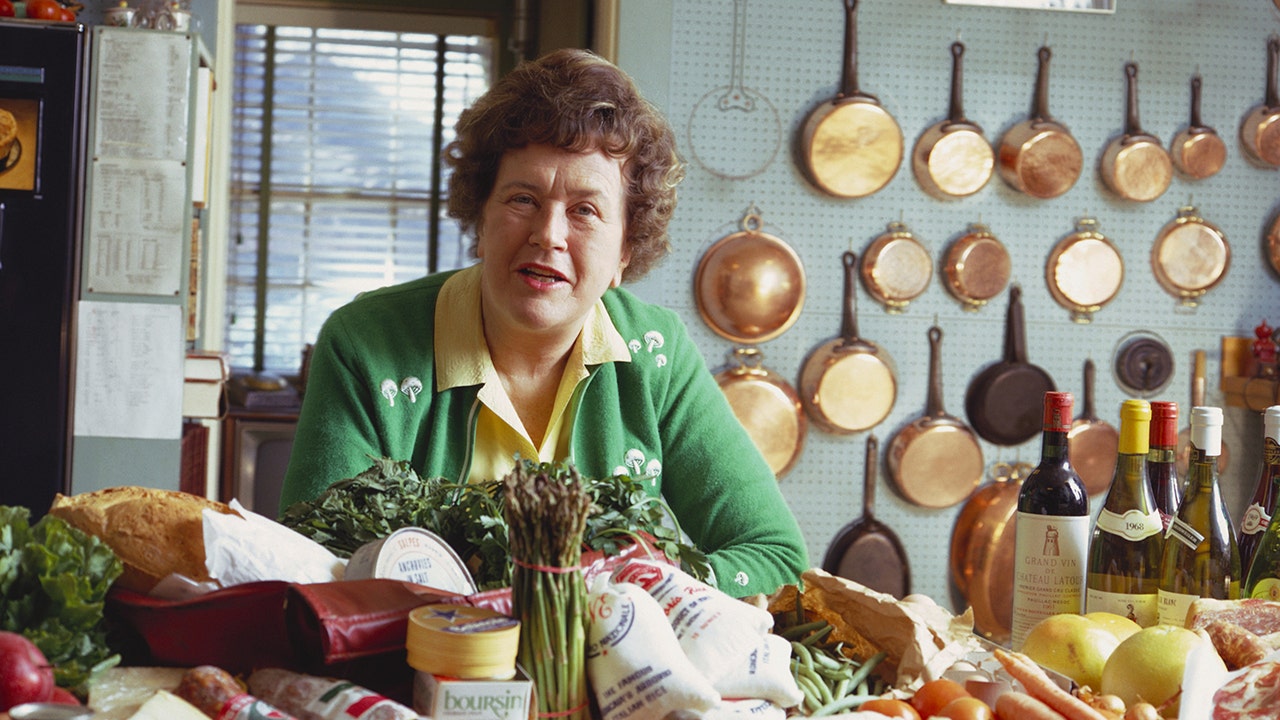
American cooking expert, television personality and cookbook author Julia Child died on this day in history, Aug. 13, 2004, in Santa Barbara, California.
Known for her promotion of traditional French cuisine, especially through her programs on public television, Child taught millions of Americans how to cook and helped elevate the nation’s culinary standards, according to NPR.
Child started her kitchen revolution in 1961 when she published, along with co-authors Simone Beck and Louisette Bertholle, the classic, “Mastering the Art of French Cooking,” the same source indicated.
ON THIS DAY IN HISTORY, AUGUST 12, 1990, ‘SUE’ THE TYRANNOSAURUS REX IS DISCOVERED
With over one million copies sold and a 40th anniversary edition published in 2001, the book is still considered the definitive classical French cookbook in the English language, according to The Spokesman-Review.
Her subsequent cookbooks included “The French Chef Cookbook”; “Mastering the Art of French Cooking, Vol. II,” with Beck; “From Julia Child’s Kitchen”; “Julia Child & Company”; “Julia Child & More Company”; and “The Way to Cook,” in October 1989.
Portrait of American chef, author, cooking teacher, author and TV host Julia Child (1912-2004) in her kitchen, Cambridge, Massachusetts, 1972. (Hans Namuth/Photo Researchers History/Getty Images)
Child had a goal of promoting classic cooking methods and ideologies.
“In spite of food fads, fitness programs and health concerns, we must never lose sight of a beautifully conceived meal,” Child is quoted as saying in “The Way to Cook.”
Child was 51 when she debuted on television as “The French Chef.”
ON THIS DAY IN HISTORY, INFLUENTIAL ‘WALDEN’ BY HENRY DAVID THOREAU IS PUBLISHED
This groundbreaking series began in 1963 and continued for 206 episodes, the same source noted.
Child, who had a towering 6-foot 2-inch frame and a distinct warbling voice, ended each show with “Bon appétit,’” noted Britannica.com.
Julia Child, ebullient French chef, as she prepares a dish for a TV audience in New York for her cooking series; her new cookbook was published about two weeks after her show’s premiere. Viewer mail told her that a lot of people learned to cook by watching her program. (Getty Images)
Child was born in Pasadena, California, on Aug. 15, 1912, as Julia Carolyn McWilliams, and grew up in a life of wealth and privilege, said the National Women’s History Museum.
Her father was a banker and landowner, while her mother hailed from the Weston family, proprietors of the Weston Paper Company in Massachusetts, the same source recounted.
Child graduated from Smith College.
Following World War II, she married Paul Child, whom she had met while working for the Office of Strategic Services in India.
“We must never lose sight of a beautifully conceived meal.”
Paul Child worked for the U.S. Foreign Service, and in 1948, the couple was posted to Paris for his work.
ON THIS DAY IN HISTORY, MAY 3, 1937, MARGARET MITCHELL’S CIVIL WAR SAGA ‘GONE WITH THE WIND’ WINS PULITZER
“It was in Paris that Child began to take cooking seriously, and enrolled in the famous Le Cordon Bleu cooking school,” noted The National Women’s History Museum.
The couple returned to the U.S. in the 1960s and settled in Cambridge, Massachusetts.
A portrait of American chef Julia Child (1912-2004) shows her standing with a cut of meat in her kitchen, late 20th century. (Bachrach/Getty Images)
At this time, Child was approached by television executives to host a cooking show, “The French Chef,” based on her book, the same source chronicled.
More than two decades after the last show was filmed, the series remained a hit for PBS and cable, noted multiple sources.
MEET THE AMERICAN WHO CONJURED UP ‘LEGEND OF SLEEPY HOLLOW’: WASHINGTON IRVING, FIRST US CELEBRITY AUTHOR
Child’s candid autobiography, “My Life in France” (co-written with a grandnephew, Alex Prud’homme), was published in 2006, according to Britannica.com.
For more Lifestyle articles, visit www.foxnews.com/lifestyle
In 2009, Nora Ephron used that volume as half of the story she told in the hit movie, “Julie & Julia,” which starred Meryl Streep as the popular chef, the same source said.
Child received the Presidential Medal of Freedom in 2003 from President George W. Bush.
Child received several honors, including a Peabody Award (1964), an Emmy Award (1966) for her television work and a National Book Award in 1980 for her book, “Julia Child and More Company,” published by Knopf.
Child also received the Presidential Medal of Freedom in 2003 from President George W. Bush.
In 2007, Child was inducted into the National Women’s Hall of Fame.
In addition, select items from her kitchen and cooking implements were put on display at the Smithsonian Institution in Washington, D.C, according to Britannica.com.
Child died just two days before her 92nd birthday, on Aug. 13, 2004.
Read the full article from Here

Boston, MA
Where to watch Boston Red Sox vs Los Angeles Angels: TV channel, start time, streaming for July 4


What to know about MLB’s ABS robot umpire strike zone system
MLB launches ABS challenge system as players test robot umpire calls in a groundbreaking season.
The 2026 MLB season has surpassed the quarter mark, and after each team’s first 40 games, there’s plenty of reasons to tune in all summer long.
Chicago White Sox slugger Munetaka Murakami has already proven doubters wrong by launching 17 home runs, Pittsburgh’s Paul Skenes consistently looks like the best version of himself on the mound and Milwaukee ace Jacob Misiorowski is throwing harder than any starter in the majors.
The MLB action continues on Saturday as the Boston Red Sox visit the Los Angeles Angels.
Here’s everything you need to know to tune in for the first pitch.
See USA TODAY’s sortable MLB schedule to filter by team or division.
What time is Boston Red Sox vs Los Angeles Angels?
First pitch between the Los Angeles Angels and Boston Red Sox is scheduled for 9:38 p.m. (ET) on Saturday, July 4.
How to watch Boston Red Sox vs Los Angeles Angels on Saturday
All times Eastern and accurate as of Saturday, July 4, 2026, at 6:35 a.m.
- Matchup: BOS at LAA
- Date: Saturday, July 4
- Time: 9:38 p.m. (ET)
- Venue: Angel Stadium of Anaheim
- Location: Anaheim, California
- TV: NESN and Angels.Broadcast Television
- Streaming: MLB.TV on Fubo
Watch MLB all season long with Fubo
MLB regional blackout restrictions apply
MLB scores, results
MLB scores for July 4 games are available on usatoday.com . Here’s how to access today’s results:
See scores, results for all of today’s games.

Ohio black bears
A third sighting of 2026 confirms black bears are back for good in Ohio.
If you see a black bear near Pittsburgh, give it space, and don’t let your pet bother it.
That’s the advice Allegheny County’s parks department gave locals after a bear was spotted in a lake north of Pittsburgh, with the department issuing a warning in partnership with Allegheny County Police Department on June 16.
Here’s what to know about the bear sighting and bears around the Pittsburgh area.
When, where was black bear spotted near Pittsburgh?
A black bear was spotted in North Park Lake in McCandless Township in Allegheny County just north of Pittsburgh.
Allegheny County Parks didn’t say when the bear was seen, but they posted about the sighting on Facebook on June 16, saying the Pennsylvania Game Commission had been notified and was monitoring the situation.
What should you do if you spot a black bear in Pittsburgh area?
After a black bear was spotted in North Park Lake, Allegheny County Parks and Allegheny County Police Department put out a joint statement warning residents not to bother bears.
If you see a bear, you should use caution and give it “plenty of space,” according to the county parks department. Don’t approach it, and don’t try to interact with it. If you have a pet with you, keep them controlled on a leash.
“The best thing you can do is view wildlife from a safe distance and allow it to move through the area undisturbed,” the parks department said.
The state also bans residents from feeding bears.
How common are black bears in Pittsburgh area?
Bears inhabit forested areas across more than three-quarters of Pennsylvania, though they’ve been spotted in every county, according to the state game commission. The bears seen in large urban centers and agricultural areas, like the southeastern corners of the state and parts of the western border, are generally transient, as those areas don’t have enough woods to create a good habitat.
The population of bears statewide is estimated to be about 19,000 and is managed through regulated hunting to reduce the risk of more frequent human-bear conflicts. Hunters harvested 2,873 black bears in 2026, with Tioga County reporting the most harvests. Allegheny did not rank among the counties with the top 10 most bears harvested.
Black bears are also not uncommon across the border in Ohio. The state set a record with more than 500 sightings in 2025, according to a report from the Ohio Department of National Resources, with the department finding “consistent evidence” that female black bears live in the northeast corner of the state.
Finch Walker is the Pittsburgh Connect Reporter for the USA TODAY Network. Contact Walker at FWalker@usatodayco.com. Instagram: @finchwalker_. X: @_finchwalker.

Connecticut State Parks announced that several parks, recreation areas, and beaches are closed on Friday after reaching capacity.
As of 1 p.m., the following are closed due to the parking lots being full:
- Rocky Neck State Park
- Millers Pond State Park
- Hammonasset Beach State Park
- Mount Tom State Park
- Gardner Lake State Park
- Squantz Pond State Park
- Silver Sands State Park
- Pattaconk Recreation Area (Cockaponset State Forest)
- Scantic River State Park, Powder Hollow
- Satan’s Kingdom State Park
Connecticut continues to face excessive heat heading into the holiday weekend.
For a full forecast, head here.
-

 World4 minutes ago
Nabatieh recovery begins amid ongoing southern Lebanon tensions
-
 News27 minutes ago
Reflections on America’s 250th birthday
-

 Los Angeles, Ca2 hours ago
Man hospitalized in critical condition from L.A. car fire
-

 Detroit, MI2 hours ago
Which Lions player has the most to prove in 2026?
-

 San Francisco, CA2 hours ago
Lettuce | SF Jazz | Music in San Francisco
-

 Dallas, TX2 hours ago
WATCH: Australia soccer fans take over Walmart near Dallas Stadium
-

 Miami, FL3 hours ago
MDSO: Man killed in hit-and-run in northwest Miami-Dade; driver sought
-

 Boston, MA3 hours ago
Where to watch Boston Red Sox vs Los Angeles Angels: TV channel, start time, streaming for July 4

