Northeast
New York girls' basketball coach cited for harassment after pulling player's hair during state final

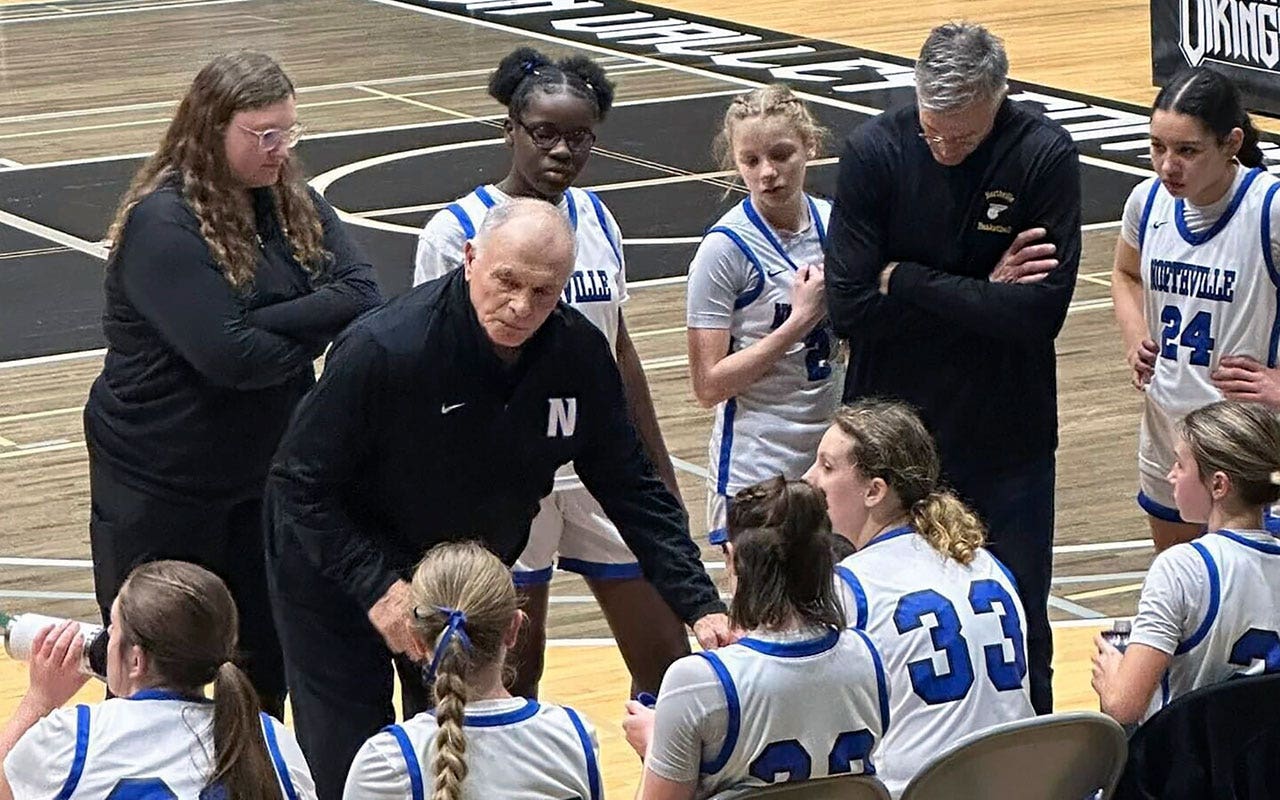
A New York high school girls’ basketball coach, who was fired over the weekend for pulling the hair of one of his players after a loss in the state championship game, was cited this week for harassment in the second degree, according to officials.
Jim Zullo, 81, was fired from his job as head coach of the Northville High School girls’ varsity basketball team on Sunday after he was caught on video pulling the hair of a player, Hailey Monroe, after the Falcons lost the Class D state final to La Fargeville Central School on Friday night.
Jim Zullo, left, coaches Northville High School girls at Hudson Valley Community College in Troy, New York, on March 4, 2024. (Sam Zullo via AP)
The Northville Central School District released a statement announcing the decision, and said it was “deeply disturbed” Zullo’s actions.
“We hold our coaches to the highest standards of professionalism, sportsmanship, and respect for our student-athletes, and this behavior is completely unacceptable. The District is committed to ensuring that this type of behavior has no place within our programs, and we will continue to uphold the values of respect and integrity that our athletes, families and community expect and deserve.
“This individual will no longer be coaching for the Northville Central School District,” the statement continued. “We assure the public that this matter is being taken extremely seriously, and the District is actively addressing it. The District will be following up with the affected players and their families to provide support and outline the actions we are taking in response to this incident.”
The incident occurred when both teams lined up for the post-game ceremony, which included handshakes between the players and an award presentation at Hudson Valley Community College in Troy.
FATHER AND SON PAY TRIBUTE TO LATE MOTHER’S MEMORY BY COACHING IN BASKETBALL STATE SEMIFINALS
On Monday, the Hudson Valley Community College Department of Public Safety released a statement confirming that Zullo met with officers and was issued an appearance ticket for harassment in the second degree.
He will be due back in court at a later date.
Zullo issued a statement over the weekend apologizing for his actions.
Jim Zullo was issued an appearance ticket for harassment in the second degree by the Hudson Valley Community College Department of Public Safety on Monday. (iStock)
“I deeply regret my behavior following the loss to La Fargeville Friday night in the Class D state championship game. I want to offer my sincerest apologies to Hailey and her family, our team, the good folks at Northville Central Schools and our community,” he said in a statement obtained by WNYT.
“As a coach, under no circumstance is it acceptable to put my hands on a player, and I am truly sorry. I wish I could have those moments back. I am grateful for the opportunity to have coached girls basketball at Northville the past two years, especially last season, which was a difficult time for our family. I am super proud of every one of these young women and what they accomplished. I know each of them will go on to do great things and I wish them well.”
Zullo had previously won a state championship with the Shenendehowa High School boys’ basketball team in 1987 and had advanced to the state final in each of his two seasons with the girls’ team at Northville.
He took the job there in 2023 at the urging of his wife, who was battling cancer at the time. She passed away during that season.
The Associated Press contributed to this report.
Follow Fox News Digital’s sports coverage on X, and subscribe to the Fox News Sports Huddle newsletter.
Read the full article from Here


When Americans think of the beverage that fueled the American Revolution, they usually picture black tea — but it turns out that green tea was just as popular.
The Founding Fathers and their contemporaries drank both types of tea, Bruce Richardson, the Kentucky-based founder of Elmwood Inn Fine Teas, told Fox News Digital.
British subjects “were as likely to be drinking green tea as black tea, whether you were in Jane Austen [era] England … or you were in colonial Boston,” he added.
“There were five teas, all from China, because that was the only country that was exporting tea,” Richardson said. “And of those five different teas, two of them were green and three of them were black.”
Richardson, a tea historian who works as the tea master at the Boston Tea Party Ships & Museum, said the five types of tea dumped into Boston Harbor in protest of the Tea Act of 1773 included three black varieties — Bohea, Souchong and Congou — as well as the green teas Hyson and Singlo.
Bohea, the most common and least expensive black tea of the era, was often made from older tea leaves harvested after the highest-quality leaves of the season had already been picked.
Most of the tea dumped into Boston Harbor was Bohea, Richardson said — and it was so ubiquitous that he compared it to the way Kleenex has become synonymous with tissues today.
“It was so common that often teapots at the time, or some that I’ve seen, would say Bohea on the side of the teapot,” he said. “If they wanted tea, they’d say, ‘I’ll have a cup of Bohea.’ It was that common.”
Not only did colonial Americans distinguish between green and black tea, they even stored them differently.
“They still wanted their tea time, but they didn’t want to support the British government.”
“The well-to-do people would have a tea caddy – a wooden, beautifully made tea caddy to store their tea in,” he said.
“It was kept under lock and key. And in that tea caddy, [there] would be two compartments, one for green tea and one for black tea.”

Merchants often favored black tea because it held up better during the long voyage from China to Europe and onward to the American colonies, Richardson said.
“The green tea was what China had always drunk,” he said.
“And so they were exporting that as well, but they found that the black tea actually made the voyage better than the green teas.”
Even after many colonists swore off British tea, they kept the ritual of drinking it — or at least a close substitute.
Many patriots brewed so-called “Liberty Teas” made from ingredients such as dried apples, blueberries, chamomile and herbs grown in their gardens.
“They still wanted their tea time, but they didn’t want to support the British government,” Richardson said.


-

 Virginia2 minutes ago
New Virginia laws starting July 1: Pay transparency, rent rules and more
-

 Washington9 minutes ago
Concert News: The Washington Chorus Celebrates 65th Anniversary During 2026-2027 Season
-

 Wisconsin12 minutes ago
Wisconsin Unveils Culver’s Uniform Patch in New Video Ahead of 2026 CFB Season
-

 West Virginia17 minutes ago
Putnam County man identified as victim in homicide investigation – WV MetroNews
-

 Wyoming24 minutes ago
Free Crow Culture Program at Fort Phil Kearny
-

 Crypto27 minutes ago
UK investors sue Binance in London for £150 million
-

 Finance32 minutes ago
What the Supreme Court’s campaign finance ruling means for the 2026 election
-

 Fitness39 minutes ago
I pushed myself too hard at the gym – and ended up in the hospital

