New York
Can a Second-Home Tax Work in New York? The Numbers Don’t Add Up Yet.


A push to tax multimillion-dollar second homes in New York City has been billed by Gov. Kathy Hochul and Mayor Zohran Mamdani as a civic mandate for the ultrawealthy to contribute more to society.
But as leaders in the State Capitol seek to incorporate the tax proposal into the state budget, the lofty rhetoric has been undermined by confusing information flowing from Ms. Hochul’s office about how such a tax would work.
The problems start with the numbers and the math.
To raise $500 million for the city, Ms. Hochul initially said the so-called pied-à-terre tax would apply to 13,000 homes, a number that her staff pulled from a 2023 report by the city comptroller. Now, aides to Ms. Hochul are saying that the 13,000 figure was an early estimate requiring more analysis and was subject to change.
The governor’s team had first said the tax would be based on second homes with an assessed value of $5 million or more. But there is very little correlation between a property’s assessed value — a specific and complex measure calculated as part of the property valuation process — and actual market value.
The city does not use sales comparisons or recent listings to value condos and co-ops. Under a state law passed in the 1980s, the city is required to compare the units to rentals of similar size and age, assessed on the potential income that rental might bring in. There are not great rental comparisons for the highest-end condos and co-ops, dragging down their assessments; in some cases, these condo buildings are even compared to rental buildings with rent-regulated units.
An analysis of city records conducted by Marketproof, a real estate data analysis firm, found just three residential properties in New York City with assessed values of $5 million or more.
One of the three was the notoriously expensive penthouse bought in 2019 by the billionaire financier Kenneth Griffin for $238 million.Its assessed value, according to city records, is just under $7 million. Another condo, on the 57th floor of another Midtown luxury building, sold in December for more than $21 million, but it has an assessed value of around $1.3 million.
Jennifer Goodman, a spokeswoman for the governor, declined to offer specifics about the pied-à-terre tax proposal, saying this week that they were still being negotiated. The governor’s office said that they had wrongly described at first how the tax might work, and it is not going to be based solely on the assessed value of properties.
Instead, Ms. Goodman said, apartments subject to the tax would be determined by “a model that captures properties worth over $5 million through the use of various mechanisms such as comparable sales data where applicable.”
That raises another set of problems, as there is no official and consistent measure of how much properties in New York City may actually be worth on the market.
Building that kind of information is possible, but has not typically been done before by the city, said Kael Goodman, the president and chief executive of Marketproof.
“To get from doable on a technical basis, to doable on a practical basis — those two things are not the same,” Mr. Goodman said.
To demonstrate how such a tax could work, Marketproof created its own model analyzing more than 1.14 million tax parcels. Since there’s currently no official way to tell if a particular unit is a pied-à-terre, the company used a proxy: the subset of properties where the property tax bill was sent to a different address, indicating the owner didn’t live in the unit.
Then it looked at transactions recorded in city property records to find the units with market values over $5 million.
Marketproof estimates about 6,380 properties would be affected.
That analysis shows that certain well-known features of the city skyline, many clustered around Central Park — Central Park Tower, 432 Park Avenue, One57, 220 Central Park South, 15 Central Park West — would be potentially subject to the tax surcharge, representing huge sources of revenue for the city. The 280 units in just those five buildings might owe more than $100 million in taxes annually.
Still, it may be challenging to make this all work. Unlike many suburban cities and neighborhoods, where it is relatively easy to find the market value of single-family homes based on comparable sales on any given street, it’s difficult to compare values across condos and co-ops.
“That would be crossing a gap not previously crossed,” Mr. Goodman said. “That would be opening up a conversation among property owners that previous government officials have been unable to have a successful conversation about. They’ve just been unsuccessful in doing it because it’s way too complicated.”
It’s not clear whether the state or the city would have the capacity to come up with these valuations every year, and how public officials would deal with the expected legal challenges to any valuations.
A report about the tax released on Thursday by the New York City comptroller, Mark Levine, found that the city Finance Department would most likely have to audit property owners’ claims about who lives or doesn’t live in any apartment. The report noted that “lapses” in the auditing capacity and accuracy “would reduce revenues and multiply taxpayers’ appeals and lawsuits.”
The report also said that it might be difficult to categorize condos and co-ops that were owned by out-of-towners but were being rented out to city residents, or units that were owned by limited liability companies or trusts, among other potential pitfalls.
“Each of these decisions can shift collections by tens of millions of dollars,” the report said.
So far, those details remain murky, even with senior city administration officials meet daily with state leaders, according to City Hall.
A senior aide to the governor said that state officials were not overly concerned about the complexities of determining market values. Negotiations were continuing over how much of the specific methodology would be written into the legislation, or decided later by the city.
A bigger concern, the aide said, was how officials would determine whether any given property was being used as a second home.
The negotiations come as Mr. Mamdani and other elected officials clamor for Ms. Hochul to increase taxes to fund an expanded safety net and help the city close a multibillion-dollar deficit. A coalition of powerful unions, including several that endorsed the governor’s re-election campaign, has also signed on, sending a letter last week to her and legislative leaders pleading for tax hikes on the wealthy.
On Tuesday, Mr. Mamdani and his sometimes political adversary, Council Speaker Julie Menin, said they would delay announcing an update to the city budget so they could jointly push for the state to reduce a tax credit that primarily benefits wealthy business owners, which they said could end up raising a billion dollars in revenue for the city.
Both this plan and the second-home tax proposal would need to be included in the state budget, which is still be negotiated and is now a month overdue. Ms. Hochul remains committed to the tax on second homes, but appeared unlikely to support other new taxes.
“Hochul is running out of excuses to not tax the rich in her final budget,” said Grace Mausser, a co-chair of the New York chapter of the Democratic Socialists of America.
The D.S.A. is a close ally of Mr. Mamdani, who is a member, and both have aggressively called on the city’s wealthiest businesses and residents to shoulder a heavier burden. They have even named specific billionaires like Mr. Griffin, who they say are a drain on the city and its finances.
Mr. Griffin, who has spent close to $95 million on real estate purchases in the city since the beginning of 2025, pushed back on these assertions, saying his companies and activity creates tens of thousands of jobs for the city.
“You can win political points by making an example of Ken Griffin, and they seem to have done that. Kudos to them for winning some political points,” Mr. Goodman said. “But achieving the tax goals is a different thing.”



Welcome to Day 2 of the Metropolitan Diary challenge, part of our celebration of the column’s 50th anniversary. On Day 1, we gave you tips for identifying your New York City story. Today, we’ll help you write it. (Missed Day 1? It’s not too late to start.)
What makes for a good Diary? It’s simply a good story that happens to be set in, and capture, the essential New York-ness of the city. While this isn’t a full writing course, we do have guidance on the kinds of elements that the submissions we publish include. They typically have: a beginning, middle and end; sharp details; catchy dialogue; a bit of surprise; some humor, warmth or emotion. But there is no formula, so flouting these loose rules can be worthwhile.
Don’t worry if you don’t think of yourself as a “writer.” Focus on being a “storyteller.” Pretend you are telling your story to the person who’d most appreciate it, using whatever conversational language or pacing that would hold their attention. Do it out loud if you want, maybe give that person a call and tell them your story (or tell it to them again). Then write it down.
That’s the big picture. For more tips, read on.
Here is an example of a published Diary that we (and readers) really liked, and a few thoughts on why that may help crystallize yours.
Unacceptable
Dear Diary:
I went to a new bagel store in Brooklyn Heights1 with my son.
When it was my turn to order, I asked for a cinnamon raisin bagel with whitefish salad and a slice of red onion.2
The man behind the counter looked up at me.
“I’m sorry,” he said. “I can’t do that.”3
— Richie Powers
One of this item’s best qualities is that it is short and snappy. Only 53 words! Although we will use stories of up to 300 words, many don’t need to be that long and the column doesn’t work if we don’t have a mix of long, medium and short, so we are always looking for stuff like this. Here’s another one!

At Attention
Dear Diary:
It was December 1967. I had just finished basic training at Fort Dix in New Jersey and was traveling to Boston in uniform. For reasons I no longer recall, I stopped in New York City on the way.1
Walking on the Upper East Side2 in a snowstorm, I spied another man in a uniform. He was older, and his cap bore the familiar gold band that identified him as an officer.
I rendered a snappy salute. It was not returned. 3The uniform was unfamiliar, so I guessed he was a foreign officer. Military courtesy still required me to salute.
A little farther down the street, I encountered another officer and offered another salute that went unacknowledged.4 His uniform was strange to me as well.
The third time it happened, the man I saluted ignored me while holding the door for a couple 5on their way into a large apartment building.
I realized I had been saluting doormen.6
— Stephen Salisbury
To get your storytelling muscles going, think through or jot down the answers to some of these questions.
Let’s start with setting the scene.
- When and where in the city did this happen? Is this place well-known?
- Was there anything particular about that point in your life that’s relevant?
- What did you see, hear, smell? Was there something notable about the weather?
Now, let’s move to the middle, the meat of the story.
- Did you have an exchange with someone?
- What details are important to how events unfolded, especially in setting up the ending?
And now, the end.
- What’s the resolution? Is there a punchline?
- Does the story end with a sense of shared humanity or some other warm feeling that lingers? You don’t need to name it. A good description will often allow readers to feel it too.
- Why has this experience stayed with you?
- Lines like “and that’s why I love New York” are almost always unnecessary.
That’s it. Keep your story simple and use the kind of plain language you use in conversation. You are sketching a moment in time. The details are important. Let them move the story along. Have fun and good luck.
Once you’re done, read through what you’ve got. What details are less important and can be left out? (Remember, there is a strict 300-word limit.)
Write your Metropolitan Diary however you like, on paper, on your phone or wherever! When you’re happy with what you’ve written, put your diary entry into the box below, fill out your information and submit it. You might just hear from me about including it in a future column.
This is the official submission form, so make sure to double-check your work before hitting submit.
That’s it! Submit your Metropolitan Diary.
By transmitting your submission, you grant The New York Times Company a perpetual, royalty-free license to use the submission in any medium. They may be edited, and may be republished and adapted in all media. You may reprint your story elsewhere after it appears in The Times.

65.
In or about and between December 2023 and April 2024, both dates being approximate and inclusive, within the Eastern District of New York and elsewhere, the defendants MALIK BEASLEY, also known as “Beas,” “Bease,” “MB” and “5,” WILLIAM BROWN, also known as “Willo,” EDWARD DAVIS, also known as “Ed,” “ED” and “E Davis,” ROBERT GORODETSKY, also known as “Rob,” ERNESTO PLASCENCIA, also known as “Ernie,” “Erny,” “Ernie P” and “Erny P,” and PAOLO ZAMORANO, also known as “PZ,”
together with others, did knowingly and intentionally conspire:
(a)
to conduct one or more financial transactions in and affecting
interstate commerce, which transactions in fact involved the proceeds of specified unlawful activity, to wit: (i) wire fraud, in violation of Title 18, United States Code, Section 1343 and (ii) sports bribery, in violation of Title 18, United States Code, Section 224, knowing that the property involved in the transactions represented the proceeds of some form of unlawful activity, and with the intent to promote the carrying on of the specified unlawful activity, contrary to Title 18, United States Code, Section 1956(a)(1)(A)(i);
(b)
to conduct one or more financial transactions in and affecting interstate commerce, which transactions in fact involved the proceeds of some form of unlawful activity, to wit: (i) wire fraud, in violation of Title 18, United States Code, Section 1343 and (ii) sports bribery, in violation of Title 18, United States Code, Section 224, knowing that the property involved in the transactions represented the proceeds of some form of unlawful activity, and knowing that the transactions were designed in whole and in part to conceal and disguise the
19

How can people possibly afford to live in one of the most expensive cities on the planet? It’s a question New Yorkers hear a lot, often delivered with a mix of awe, pity and confusion.
We surveyed hundreds of New Yorkers about how they spend, splurge and save. We found that many people — rich, poor or somewhere in between — live life as a series of small calculations that add up to one big question: What makes living in New York worth it?
Weixun Hu enjoys what might sound like the ultimate professional perk. New Yorkers pay some of the country’s highest taxes on their income, more than $12,000 on average per person between state and local governments. But Mr. Hu’s income tax this year? $0.
That’s because Mr. Hu, 32, who was born in Guangzhou, China, conducts social development research at an international organization, where most employees are exempt from national income taxes or reimbursed for the cost. His gross and net income are one in the same; he earns roughly $110,000 after his insurance and pension contributions.
Mr. Hu became one of New York City’s 3.1 million foreign-born residents nearly three years ago, after reassignment from a post in Bangkok in the summer of 2023. But he quickly ran into a hurdle: finding an apartment with no credit history, no tax returns and no one to co-sign a lease.
“It sounds very cool that you don’t pay taxes,” Mr. Hu said. “It also creates a lot of problems.”
He discovered that many of his co-workers landed in a handful of pricey residential developments including Stuyvesant Town. Yet renting there felt worlds apart from Thailand’s capital city, where a luxury studio in a high-rise condo with a rooftop infinity pool and premium gym might run $600 per month.
So he found a studio in Long Island City, Queens, where he has in-unit laundry and falls asleep to the sound of waves hitting the shore near Hunters Point South. His employer subsidizes $700 of his $3,900 rent, and utilities and internet cost about $150 monthly.
“It’s much better value compared to renting in Manhattan,” he said.
Saving for Tomorrow
A good deal of young adults in New York City don’t know how to drive, and expect to remain renters for most of their lives. Not Mr. Hu.
He puts away $2,000 or so a month into a high-yield savings account, aspiring to buy a car. His sights are set on a Mazda CX-5. But he expects he’ll need to pay upfront in cash, another consequence of lacking a credit or tax history — and it’ll take about three more years to build up enough.
Eventually, he wants to own a home. “I know most people in New York City don’t care,” he said. “But for me, it’s very important.”
Mr. Hu also supports his parents in their retirement, sending about $3,000 every three months. As their only child, he feels both a sense of guilt for living about 8,000 miles from home — and an obligation to pay them back for their sacrifices.
“People will say, ‘Oh, you’re single. You don’t have a wife. You don’t have kids,’” he said. “‘So all your money is yours.’”
“And I’m like, ‘Excuse me, my parents are still alive.’”
In other ways, though, Mr. Hu fits the profile of an everyday bachelor: He rarely cooks meals at home. “My oven is basically storage space.”
Rather, he searches for affordable deals on Too Good To Go, a popular app where restaurants sell excess food at a discounted price. His No. 1 spot is Chinese Musician in Greenpoint, which offers a three-course meal for $9.
Sometimes, Mr. Hu does the $16 tonkotsu ramen at Nishida Sho-ten on 49th Street for lunch, an $8 lamb over rice meal for dinner from the halal truck in front of Bellevue Hospital or a hot dog for $3.25 from Gray’s Papaya. He’ll swing by the Dollar General in Astoria to stock up on his favorite drink, Coca-Cola Orange Cream.
And he saves up for an upscale dining experience every couple of months. He recently feasted at the Michelin-starred chef Daniel Boulud’s steakhouse, La Tête d’Or, where he spent roughly $300 and ordered what he called the standout filet mignon.
The Lions Over the Knicks
For any sports buff, it’s an incredible time to live in New York City.
But for Mr. Hu, ticket prices to see the Knicks play at Madison Square Garden felt “a little bit off-putting” — and that was even before their championship run. So he started religiously following basketball at Columbia, going to games that often run $10 to $12 on the Morningside Heights campus.
Yankees games, where a 400-level seat might run $45, are a no; he opts to watch the Columbia Lions up close at Robertson Field in Inwood without charge.
He is willing to spend up to about $300 on some singular sports showdowns. He can still recall how Kylian Mbappé flew down the field at MetLife Stadium during a Real Madrid match against Borussia Dortmund last summer.
Typically, though, he elects for low- or no-cost events like this spring’s edition of the Madison Avenue Gallery Walk.
And he regularly joins free lectures at the Asia Society, where he has a complimentary membership through his employer, and at local universities like N.Y.U., where he’s met the minds behind two of his favorite video games, The Elder Scrolls and Monument Valley.
A Sense of Wanderlust
Ever since Mr. Hu can recall, he’s felt a magnetic pull to experience the world. And few things embody such a yearning as aviation.
He sometimes goes to Canarsie to watch planes land at Kennedy International Airport, studying the way pilots pull up the nose of their aircrafts and slow the descent before touching down. He’s even found others who share his passion on walks in the neighborhood.
And traveling draws him even closer to his hobby.
He spent $4,400 on a trip to Guangzhou last June to fly for the first time in an Airbus A380, the only full-length double-deck aircraft in the world. Qatar Airways is one of the few airlines that still has an active fleet — so Mr. Hu arranged his trip by way of Doha.
“Some people treat it as bragging,” he said. “But no, it’s just to admire such an incredible machine that’s very rare to be seen these days.”
“It’s a weird, niche hobby, but I’m happy spending my money on it.”
As a young man living in his seventh country — after Belgium, China, Italy, Poland, Thailand and the United Kingdom — he appreciates that as “a foreigner in this city, you don’t have to worry about whether you stand out.”
He’s relished exploring from Crown Heights to Jackson Heights, taking the train to a random stop and popping into bodegas to chat up the owners. He considers Staten Island — and its Chinese Scholar’s Garden in Snug Harbor where adult admission costs $5 — to be a hidden gem.
And when he boarded the U.S.S. Bataan during a past Fleet Week, he felt obliged to tell a Marine that he was Chinese. “He said: ‘Oh, no worries at all. Everybody can be an American’.”
“To be honest, I still don’t think it’s a value option for the money,” Mr. Hu said of New York City. “But there’s something so unique, and I think it’s that inclusiveness.”
“You don’t need to go to the world,” he said. “The world comes to you.”
We are talking to New Yorkers about how they spend, splurge and save.
-
 Politics56 seconds ago
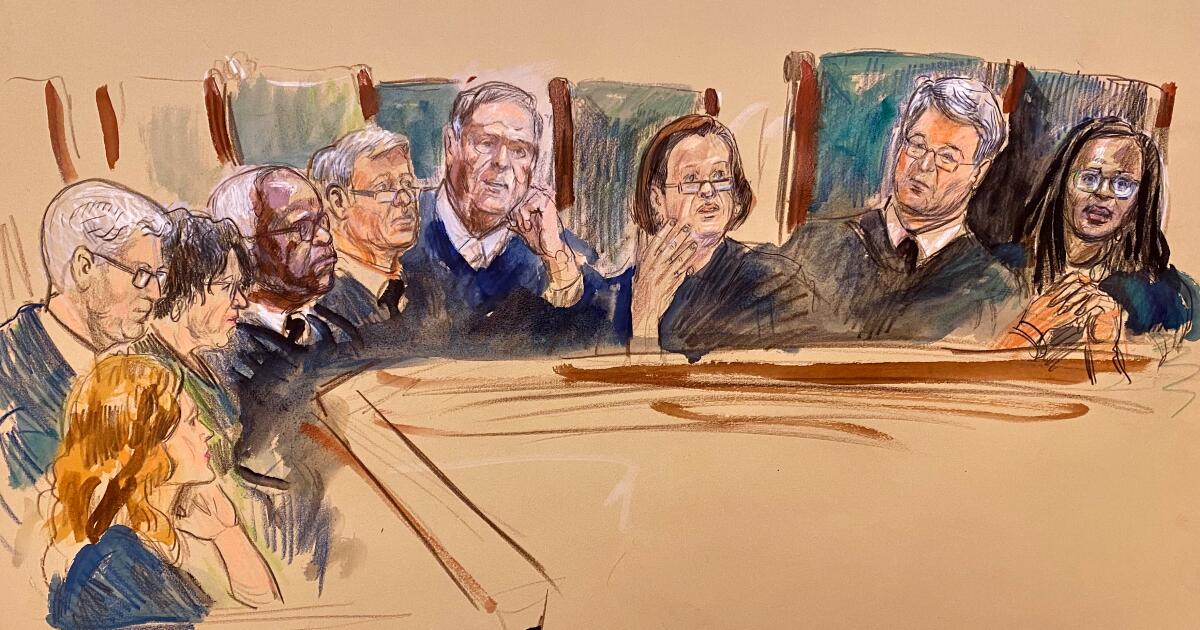
How Roberts led a fractured Supreme Court to wins for the right and defeats for Trump
-
 Science6 minutes ago
Contributor: Alcohol should be stigmatized like smoking
-
 Sports13 minutes ago
Thousand Oaks native Claire Liu finally reaches Wimbledon’s third round, will face Coco Gauff
-

 World21 minutes ago
Could water become a flashpoint between Islamabad and New Delhi?
-
 News46 minutes ago
Ukraine latest / Limits of military might / Can major powers regain dominance? : Sources & Methods
-

 Los Angeles, Ca2 hours ago
Juvenile charged with murder after 4-month-old Claremont infant thrown to her death
-

 Detroit, MI2 hours ago
Silence from Jalen Duren’s camp is what the Pistons want to hear
-

 San Francisco, CA3 hours ago
Jury deadlocked on 2 counts for Golden Gate Bridge pro-Palestinian protesters

