Northeast
Meet the American who defined a new national identity, Noah Webster, New England patriot armed with the pen

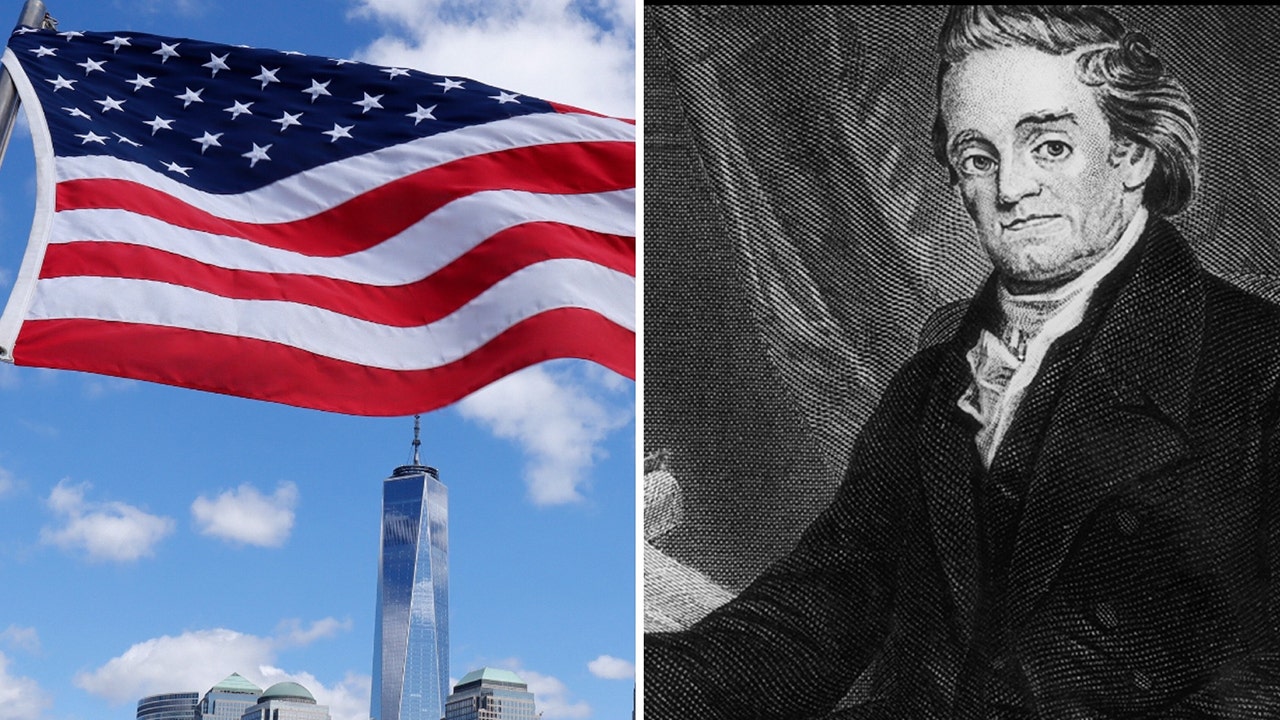
Noah Webster fought for American independence with words, not swords.
His mighty pen defined the identity of a sprawling, proud and ambitious new United States.
The New England native’s impact on our national heritage proved far greater than just the American-English dictionary that still bears his name.
“Webster was very much in the truest sense of the word a patriotic American,” Peter Sokolowski, “dictionary ambassador” and editor at large for Merriam-Webster, based in Massachusetts, told Fox News Digital.
MEET THE AMERICAN WHO GAVE US NASHVILLE HOT CHICKEN, THORNTON PRINCE, MAN OF MANY PASSIONS
“He believed the new political America also needed a new cultural America, that there had to be cultural identity as distinct from Britain as our new political identity was distinct from Britain.”
Webster was an outspoken advocate of American independence.
American philologist, lexicographer and journalist Noah Webster (1758-1843), circa 1800. (Archive Photos/Getty Images)
The lexicographer was pen pals with Founding Fathers John Adams, Ben Franklin, Alexander Hamilton and the new nation’s greatest swordsman, George Washington.
Webster has been dubbed “The Forgotten Founding Father,” most notably in the 2012 biography of that name by Joshua Kendall.
“Webster was very much in the truest sense of the word a patriotic American.”
He was also known as “The Schoolmaster of the Republic” — a testament to the remarkable success of his spelling book, ubiquitous in American schoolrooms throughout the 19th century.
Webster ensured that a nation, now 340 million strong and rooted in almost every language on the planet, has a common way to communicate.
American English has proven to be a powerful force uniting the world’s most dynamic and diverse immigrant nation.
Noah Webster, the schoolmaster of the Republic, circa 1886. (HUM Images/Universal Images Group via Getty Images)
The word “immigrant” was actually one of the 12,000 new words first used by Americans — and first defined by Webster.
“Now is the time, and this [is] the country,” Webster wrote in 1789 in his “Dissertations on the English Language,” dubbed America’s linguistic Declaration of Independence.
“Let us then seize the present moment, and establish a national language, as well as a national government.”
Willing to fight, ‘but I must write’
Noah Webster Jr. was born on Oct. 16, 1758, in what’s now West Hartford, Connecticut.
Noah Webster Sr. was a farmer and descendant of John Webster, an Englishman who became one of the first settlers of Hartford in 1636.
Mother Mercy Steele was the great-great-granddaughter of Pilgrim leader William Bradford.
Noah Webster was born in West Hartford, Connecticut, in 1758. His schoolhouse spelling book sold an estimated 100 million copies, while he defined 70,000 words — thousands unique to the United States — in his 1828 “American Dictionary of the English Language.” (Kerry J. Byrne/Fox News Digital)
The younger Webster apparently had little appetite for farm life.
“I wish to enjoy life, but books and writing will ever be my principal pleasure,” Webster wrote years later in a letter to George Washington. “I must write; it is a happiness I cannot sacrifice.”
HOMESCHOOLED CHILDREN PAY TRIBUTE TO MEDAL OF HONOR RECIPIENT FR. EMIL KAPAUN AT ARLINGTON NATIONAL CEMETERY
Webster was a teenager when the American Revolution began. He spent much of the war years as a student at Yale in New Haven, Connecticut.
The bookish boy proved willing to sacrifice all for the cause of independence.
British forces marched south through New York in the summer of 1777, leaving a path of “terror and devastation,” according to period reports.
Washington crossing the Delaware, near Trenton, New Jersey, America, Christmas 1776. From English and Scottish History, published 1882. (Universal History Archive/Universal Images Group via Getty Images)
Webster Sr. was the captain of the local militia and gathered his men to meet the British forces. Webster Jr. joined the 60-mile march.
The British were defeated and turned back by colonial troops led by fellow Connecticut native, and, at the time still-American hero, Benedict Arnold, before the West Hartford group could join the fight.
“The little band of militia men from the West Division of Hartford … were most willing to fight and die for their country.”
“The little band of militia men from the West Division of Hartford returned home without firing a shot, but were most willing to fight and die for their country,” Jeffrey Mainville, executive director of the Noah Webster House, told Fox News Digital via email.
Webster’s prolific pen began shaping the new nation with his “Sketches of American Policy,” written in 1785.
A book of American spelling containing the rudiments of the English language, for use in American schools, written by Noah Webster and published in Philadelphia in 1804. (MPI/Getty Images)
“Virtually every educated man in America who participated in the affairs of government read Webster’s Sketches,” Harlow Giles Unger wrote in his biography, “Noah Webster: The Life and Times of an American Patriot.”
Webster made his biggest impact on the new nation, however, in the schoolroom with his spectacularly successful textbook, commonly known as the “Blue-Backed Speller,” first published in 1783.
MEET THE AMERICAN WHO GAVE THE NATION OUR THANKSGIVING ORIGIN STORY: PILGRIM EDWARD WINSLOW
The schoolbook “taught children how to read, write, spell and pronounce words for over 100 years,” says the National Museum of Language in College Park, Maryland.
The “Blue-Backed Speller” was, by many reports, the bestselling book in America of the 19th century, after The Bible, with estimates of total sales as high as 100 million copies.
Statue of Noah Webster at Blue Back Square in West Hartford, Connecticut. The area is named for Webster’s influential schoolbook text, the “Blue-Backed Speller.” (James Leynse/Corbis via Getty Images)
The windfall from the textbook afforded Webster the opportunity to pursue his true passion: defining the language of the new nation.
The immigrant nation
Webster’s collection of words expanded with the breathless expansion of the new United States.
The “Blue-Backed Speller” was published in the same year that the British crown recognized American Independence with the Treaty of Paris in 1783.
Webster began exercising his power to define the national lexicon with his “Compendious Dictionary of the American Language.”
Sacagawea guiding the Lewis & Clark expedition. The epic journey from St. Louis to the Pacific Ocean and back ended in 1806, the same year that Noah Webster published his first dictionary. (Getty Images)
It expanded American English with 5,000 new words and was published in 1806 — the same year that Lewis & Clark returned from expanding the nation’s sense of identity all the way to the Pacific Coast.
Among new American words defined for the first time by Webster: “skunk,” “chowder” and, most profoundly, “immigrant.”
“He was on top of the word ‘immigrant’ almost from the get-go.”
“Immigrate” existed as a verb. But it was first used as a noun in spoken American English vernacular in 1789, according to “dictionary ambassador” Sokolowski.
Webster defined “immigrant” as “one who removes into a country.”
“He was on top of the word ‘immigrant’ almost from the get-go,” said Sokowlski, marveling at the speed at which Webster discovered, defined and published the new word with limited technology.
Immigrants representing four countries, Poland, Norway, Germany and Russia, look from Ellis Island toward the promised land, New York, New York, circa 1913. (Underwood Archives/Getty Images)
“He collected words the way all the lexicographers did,” said Sokolowski. “He used little slips of paper.”
With that rudimentary system, Webster published his staggering landmark “American Dictionary of the English Language” in 1828.
MEET THE AMERICAN WHO CREATED THE KENTUCKY DERBY, MERIWETHER LEWIS CLARK JR., BORN OF PIONEERS
It spelled and defined 70,000 words, 12,000 of which had never appeared in British English dictionaries — further distancing the new nation from its former colonial master.
Webster was singularly responsible for many of the differences between British English and American English spellings today: colour became color; analyse became analyze; and defence became defense, among other notable examples.
Noah Webster wrote his first dictionary in 1806, adding 5,000 words “to the number found in the best English compends,” he wrote. (Library of Congress)
Brits travelled — but Americans traveled.
Yet Americans don’t travel too far today to find proof of their distinct form of English.
Canada still uses traditional British spellings of words that America changed 200 or more years ago, despite the two nations sharing common pop culture, pro sports and a 5,525-mile border.
For more Lifestyle articles, visit www.foxnews.com/lifestyle
“We had a revolution, and they didn’t,” Joseph Janes, an associate professor at the University of Washington Information School in Seattle, told Fox News Digital.
He added, “Webster feels very deeply about America as a concept and as a country distinct from everywhere else.”
The word terrorism, in the news every day today, was first defined in American English by Noah Webster in 1841. Israel Defense Forces image shows a Hamas militant walking around a residential neighborhood at an undisclosed location in southern Israel on Oct. 7, 2023. (Israel Defense Forces via AP)
Webster added his last words to the dictionary in 1841, at 82 years old.
Among the newcomers that year: feminism and terrorism.
Feminism was essentially a synonym for feminine, notes Sokolowski — while terrorism referred specifically to the horrors of the French Revolution.
‘Superiority of her literary improvements’
Noah Webster died on May 28, 1843. He was 84 years old.
His legacy is best kept today at the Noah Webster House in West Hartford, a saltbox-style colonial where the educator was born and raised. It’s now a National Historic Landmark and open to the public.
Noah Webster (1758-1843) was an American lexicographer, author and editor. From a 19th-century engraving by Kellogg after Morse. (Universal History Archive/Getty Images)
“He had no real ability to look this far and see what America would become,” Noah Webster House executive director Jeffrey Mainville told Fox News Digital.
“But the fact is that he took a path to document a truly American language and culture.”
MEET THE AMERICAN WHO MADE US FLIP FOR HAMBURGERS, LOUIS LASSEN, DANISH IMMIGRANT STREET-WAGON COOK
The Noah Webster House celebrates its patriotic son with an online game show each spring called “Webster’s War of the Words.”
The landmark works with the American Legion to distribute Webster’s dictionary to local schoolchildren today.
Blue Back Square in West Hartford is a popular retail and residential development in West Hartford, the name a nod to Webster’s influential spelling primer.
The Noah Webster House in West Hartford, Connecticut. “America’s Schoolmaster” and dictionary namesake was born here on Oct. 16, 1758. (Kerry J. Byrne/Fox News Digital)
Webster’s other achievements are almost too numerous to mention.
He was tapped by Alexander Hamilton to edit his Federalist newspaper in New York City in the 1790s and served in the Connecticut House of Representatives in the early 1800s.
Webster moved to Amherst, Massachusetts in 1815, helping to found Amherst College six years later.
He helped establish intellectual property law with the U.S. Copyright Act of 1831. The rights to his dictionary were purchased by brothers George and Charles Merriam after Webster’s death.
Noah Webster, right, helped shape the destiny of our powerful new nation with language. (Gary Hershorn/Getty Images; Archive Photos/Getty Images)
The Merriam-Webster Dictionary is published today in Springfield, Massachusetts, just 30 miles from where America’s patriot with a pen was born and where he began capturing the language of the ambitious new nation.
“Let us then seize the present moment, and establish a national language, as well as a national government.”
The Merriam-Webster archives house a remarkable treasure trove of collected knowledge, said Sokolowski. There are 16 million slips of paper with individual words, some of which date back to Webster’s original 18th-century curiosity and research.
To read more stories in this unique “Meet the American Who…” series from Fox News Digital, click here.
“This country must, in some future time,” Webster wrote in 1783, “be as distinguished by the superiority of her literary improvements as she is already by the liberality of her civil and ecclesiastical constitutions.”
Read the full article from Here


On Friday, May 1, Bravo posted a mid-season preview to YouTube, giving fans a glimpse at the drama still to come during the franchise’s first season in the Ocean State.

Which ‘Real Housewives of Rhode Island’ stars want to do Season 2?
Reporter Paul Edward Parker asks cast members of the “Real Housewives of Rhode Island” if they’re up for another season of the Bravo TV show.
Paul Edward Parker
Enjoying “The Real Housewives of Rhode Island” so far? Buckle up – it’s about to get even juicier.
On Friday, May 1, Bravo posted a mid-season preview to YouTube, giving fans a glimpse at the drama still to come during the franchise’s first season in the Ocean State. As expected, the season will continue to follow major developing plotlines, including the fallout from Rulla Pontarelli’s reported husband’s affair and the strained relationship between Rosie DiMare and Kelsey Swanson.
However, the trailer also hints that the season will take some unexpected twists and turns, with new arguments rising between friendly cast members and personal issues coming to a head for many of the women.
Here’s a sneak peek at the rest of Season 1 of “The Real Housewives of Rhode Island.”
What happened in ‘The Real Housewives of Rhode Island’ mid-season preview?
According to the mid-season preview, the rest of “The Real Housewives of Rhode Island” Season 1 will include many more fights between the cast members. Swanson and DiMare’s screaming matches will continue, with the trailer showing DiMare telling Swanson “Everyone in f***ing Rhode Island knows you f*** married men.”
Surprisingly, disagreements will also rise between LizMcGraw and Alicia Carmody, as well as McGraw and Jo-Ellen Tiberi. McGraw is shown telling Tiberi to get out of her face, with Tiberi storming after her yelling “what did I do?”
Meanwhile, Ashley Iaconetti will continue to struggle under the financial and emotional burden of Audrey’s, with her and husband Jared Haibon discussing their decision to renew the lease or not. After her breakup, Swanson will have to decide if her new man is worth giving up her financial comfort, while Tiberi will finally have a tough conversation with her mother.
As for Pontarelli, it seems that Tiberi will make good on her episode five promise of finding concrete proof of Brian Pontarelli’s reported affair, with multiple housewives discussing video proof in the trailer. After Pontarelli reveals to the group that Brian was arrested for tracking her, the trailer ends with the question looming over everyone’s heads: “Rulla, what are you gonna do?”.
How to watch ‘The Real Housewives of Rhode Island’
Want to see how all the drama unfolds? “The Real Housewives of Rhode Island” will air every Sunday at 9 p.m. on Bravo.
Watch ‘The Real Housewives of Rhode Island’ on Peacock
Episodes will be available for next-day streaming each Monday on Peacock.

This commentary is by David Balto, an antitrust commentator and a former assistant director for policy and evaluation in the Bureau of Competition at the Federal Trade Commission and trial attorney in the Antitrust Division of the Department of Justice.
Supporting small businesses over big companies is in Vermonters’ DNA. The Green Mountain State was the first state to ban roadside billboards, and our tax code is written to support mom-and-pop shops over large corporations. Montpelier is the only state capital without a McDonald’s or a Starbucks. So why, days after a federal jury sided with Vermont Attorney General Charity Clark and more than 30 other states, ruling that Ticketmaster and its parent company Live Nation were operating an illegal monopoly, is the state Legislature advancing a policy that will help this corporation invade our state while undercutting our attorney general’s antitrust suit?
Live Nation, which owns and operates some of the largest music venues across the country, and Ticketmaster, which controls roughly 80% of the country’s initial ticket sales, merged in 2010. Since then, ticket prices are up 120%.
Since the merger, Live Nation-Ticketmaster has used tactics like the “velvet hammer” — withholding concerts from venues they do not control or work with — to consolidate power. Then they force fans to pay sky-high fees, from marking up parking passes to forcing venues to only sell water from a brand Live Nation owns. In internal messages, employees even bragged about how they “gouge” fans and joked they were “robbing them blind.”
It’s no surprise that, after a decade and a half of antitrust violations, the Live Nation-Ticketmaster monopoly made $25 billion last year.
Now, the company, which doesn’t own any venues in Vermont, appears poised to establish a foothold in the Green Mountain State with the help of a well-intentioned but poorly executed bill working its way through Montpelier.
Lawmakers are considering legislation that would cap the price of event tickets being resold at no more than 10% above face value. The measure was recently approved by the House and is currently moving through the Senate.
On its face, the idea sounds appealing: Cracking down on excessive markups should be a win for fans. But the fact that Live Nation-Ticketmaster, which was just found to be operating an illegal monopoly that harmed fans, venues and artists, has supported price caps like those proposed in H.512 in Washington, D.C., California, New York, Minnesota and Ontario should give Vermonters pause.
This billion-dollar corporation doesn’t support ticket resale price caps because it’s good for fans. The company advocates for this policy because the caps don’t apply to “primary” ticket sales: the original point of sale, of which Ticketmaster controls 80%. Instead, the price caps would only apply to resale marketplaces — hitting the only companies that compete with the Live Nation-Ticketmaster monopoly.
Less competition means more power and higher profits for Live Nation-Ticketmaster.
In most states, price caps would consolidate Live Nation-Ticketmaster’s control and allow it to raise ticket prices even further. In Vermont, H.512 may be the final ingredient it needs to enter the state, and, to quote its executives, “boil the frog” — using monopoly power to slowly squeeze out our independent music venues.
With this legislation moving through the Statehouse, Live Nation-Ticketmaster is already establishing a foothold in the Green Mountain State. Earlier this month, it announced a partnership with CashorTrade, a Vermont-based ticketing platform.
But Live Nation-Ticketmaster doesn’t even need to operate in our state to benefit if Vermont passes this law. If Vermont, which prides itself on pushing back against corporate power, enacts resale price caps, we hand Live Nation-Ticketmaster a powerful talking point to advance its power grab in additional states. We become a critical data point; an example of what “good policy” looks like.
H.512 includes some real, positive policies that help venues and consumers, but the price cap provision that came along for the ride squarely benefits Live Nation-Ticketmaster. Vermont can, and should, have the former without the latter.
Vermont needs to stand up to this corporate bully. If any state knows how to, it’s this one.

When activists gathered last week outside a townhouse in Brooklyn, ready to block law enforcement officers from carrying out an eviction, they were there to fight back against something larger than just one case: the nefarious practice of deed theft, which appears to be on the rise in New York City.
The protest and the ensuing arrests of several people, including the local city councilman, underscored just how fraught the topic is, particularly in historically Black areas of the city that are now rapidly gentrifying. Mayor Zohran Mamdani last week created an office dedicated to fighting deed theft.
But while the episode, in the Bedford-Stuyvesant neighborhood, reflected concerns about a very real problem, the specifics of the case involving the townhouse are anything but clear.
The office of the attorney general, Letitia James, said the case was not an example of deed theft. (When asked about that determination, Ms. James herself said, “It emanated from deed theft”; a spokesman later clarified that she had been referring to the protest and not the case.)
The fact that a woman, Carmella Charrington, was living in the home, which her father had partly owned for decades, is not in dispute. Neither are the facts that an eviction case against Ms. Charrington began nearly two years ago and that she was recently jailed in connection with a separate civil case related to custody of her father, who is 84 and a ward of the State of Georgia.
Still, comments from a number of high-profile city leaders have been confusing and contradictory. The councilman who was arrested, Chi Ossé, has said deed theft took place. So have State Senator Jabari Brisport; Brad Lander, the congressional candidate and former comptroller; and a host of others.
What is the truth? Public records reveal a sad and complicated saga involving several court cases and law enforcement agencies, and spanning generations and at least two states.
What Is Deed Theft?
The term “deed theft” is used to describe fraudulent behavior that can result in longtime homeowners’ losing the rights to their homes. The New York State attorney general’s office received more than 500 complaints of deed theft in New York City last year, more than in the previous two years combined.
The practice can involve thieves misrepresenting themselves as brokers or lenders and tricking someone into signing documents that transfer ownership. Many thieves target older people, sowing confusion over complicated property records or exploiting their trust.
After taking control of the home, the new owner could look to sell it for a profit, rent it out at a high rate, or take out a loan against the property to buy something else.
A Jointly Owned Townhouse
The home at the center of the current debate, at 212 Jefferson Avenue, is a three-story brownstone that was built in 1909, according to Landmarks Preservation Commission records.
At some point in the 1980s, it was owned by two people, property records show: Allman Charrington, Ms. Charrington’s father, and Gertrude Keene, Ms. Charrington’s great-aunt.
Ms. Keene later transferred her share of the property to Clinton Morrison, her son, who in turn passed it to his children when he died.
As recently as 2024, the property was owned jointly by several Morrison children and Mr. Charrington, according to the records.
A Court-Appointed Guardian
In 2020, with Mr. Charrington’s health declining, two of his daughters, including Carmella, filed a petition in probate court in Fulton County, Ga., asking for a court-appointed guardian and conservator to manage his affairs “by reason of mental disability,” according to court records. (Mr. Charrington traveled frequently between New York City and Georgia, where some of his relatives lived.)
Ms. Charrington asserted in the filings that she wanted to be the conservator, saying that her father’s wife, Karen Charrington, was not looking after his best interests. Court records indicate that Mr. Charrington’s wife had signed his property into her name and transferred thousands of dollars out of his bank account. His wife insisted that she had not acted nefariously, but she agreed to return the money and restore the deed, the records show.
Ultimately, the court appointed a lawyer, Luanne Bonnie, in 2021 to be Mr. Charrington’s conservator and to help him manage his property. The court records say that the parties agreed to Ms. Bonnie’s appointment.
Conflict Brews Between Owners
Court records filed in Brooklyn show that in 2019, the Morrison family wanted to sell the Bedford-Stuyvesant home, putting them at odds with Mr. Charrington. Mr. Charrington fired back in court papers that he wanted to be reimbursed for money he had spent over the years on property taxes and maintenance. Both parties failed to show up at court dates and the case was never resolved.
But several years later, with Mr. Charrington under a conservatorship, the probate court in Georgia gave Ms. Bonnie permission to sell the property. In an October 2022 order, Judge Barbara J. Koll said that at least a dozen possible buyers had shied away in previous years because of “the legal difficulties surrounding the existing tenants of the property.” The property had been for sale since 2018, the judge said; it is unclear who listed it, given Mr. Charrington’s opposition.
Property records show that the home was sold in January 2024 to a limited liability company called 227 Group, about which not much is publicly known.
Ms. Charrington, 54, who grew up on the block — in the townhouse and another relative’s home across the street — called the sale fraudulent and unlawful.
She asserts that her father was taken advantage of, and says she brought him to New York in November 2023, without the permission of the state of Georgia, and put him into hiding. She also says that Ms. Bonnie was “unlawfully appointed” and had not followed the proper procedures before agreeing to the sale.
“I think that everything will be able to be peeled back and things will become more concrete,” Ms. Charrington said in an interview. “We want to expose them. I’ve been screaming out for two years that this is deed theft.”
But a lawyer for the Georgia Department of Human Services said in a March 2025 court filing that Ms. Charrington and other relatives had “essentially kidnapped” her father, and were “detaining him against his will.”
Ms. Charrington is still living in the townhouse. It remains unclear where Mr. Charrington is, but his daughter said he was staying with friends and relatives in the New York City area.
She recently posted a video of her father on social media, in which he says he is safe and wants to be left alone.
A Mysterious L.L.C.
According to records filed with the New York Secretary of State, 227 Group is associated with the investors Simon Blitz and Daniel Gazal. Property records list one of its leaders as Andrew Kastein, who is also associated with the investment group P11 Management.
One point of intrigue is that the property records appear to show that 227 Group shares an address with another limited liability company, Brooklyn Gates. That company is linked to a group of investors known to target properties in gentrifying, historically Black and Latino neighborhoods like Bedford-Stuyvesant.
An investigation by the news website The City found that while Brooklyn Gates’s practices were largely legal, the company had ended up displacing “dozens of longtime city residents.”
Property records indicate that Brooklyn Gates had moved to buy the townhouse at 212 Jefferson Avenue from the Morrison children in 2021. Video and photographs that Ms. Charrington provided to The New York Times show a man, who Ms. Charrington said is one of the owners of Brooklyn Gates, trying to gain entrance to the property, and then leaving when Ms. Charrington threatens to call the police. The contract was later canceled, and the sale did not go through.
Through a spokesman, 227 Group denied any association with Brooklyn Gates, saying it had been made aware that the property was for sale by a lawyer for the Morrisons and Ms. Bonnie.
The company said in a statement that it had never interacted directly with the Morrison family or with Ms. Bonnie. It also said it does not share an address with Brooklyn Gates, and that the fact that the property records show the same address for both entities stemmed from a filing error.
“We are weighing our legal options against those who are spreading the false and malicious ‘deed theft’ narrative,” the statement reads.
The company said Ms. Charrington had continued “to illegally occupy the property rent-free for over two years” and had prevented representatives of the company from gaining access to it.
A Neighborhood Watch, and a Protest
Before the protest, neighbors and activists had been keeping watch outside the home for months in case officers showed up to evict Ms. Charrington. But the conflict last week involving Mr. Ossé, who said he sustained a concussion after officers wrestled him to the ground for blocking the gate, put a public spotlight on her story.
The announcement of the city’s new office to fight deed theft — though it was already planned when the protest took place — also fueled interest in the case.
And Mr. Ossé has continued to publicly push Gov. Kathy Hochul to issue a moratorium on evictions in cases where deed theft is suspected.
“The community has come together in a way that shows that they are scared,” said William McFadden, Ms. Charrington’s son, who also lives at the Bedford-Stuyvesant house. “How did so much deed theft happen under our noses?”
-

 Rhode Island6 minutes ago
Real Housewives of Rhode Island midseason preview gets even juicier
-

 South-Carolina11 minutes ago
1 injured in motorcycle crash near Carolina Forest
-

 South Dakota17 minutes ago
South Dakota’s budget is ahead of revenue targets
-

 Tennessee23 minutes ago
Heading to the the Tennessee Renaissance Festival? What to know
-

 Texas30 minutes ago
Small plane crash in Texas Hill Country leaves five dead
-

 Utah36 minutes ago
‘It’s past the eleventh hour’: Utah and other Colorado River states call for mediation as current plans near expiration
-

 Vermont41 minutes ago
A Vermont bill meant to help music fans could do the opposite – VTDigger
-

 Virginia48 minutes ago
Developers seek to revive data center next to Virginia battlefield