Northeast
Harris risks losing crucial battleground state due to Biden's gas export pause, as Dems plead to change course

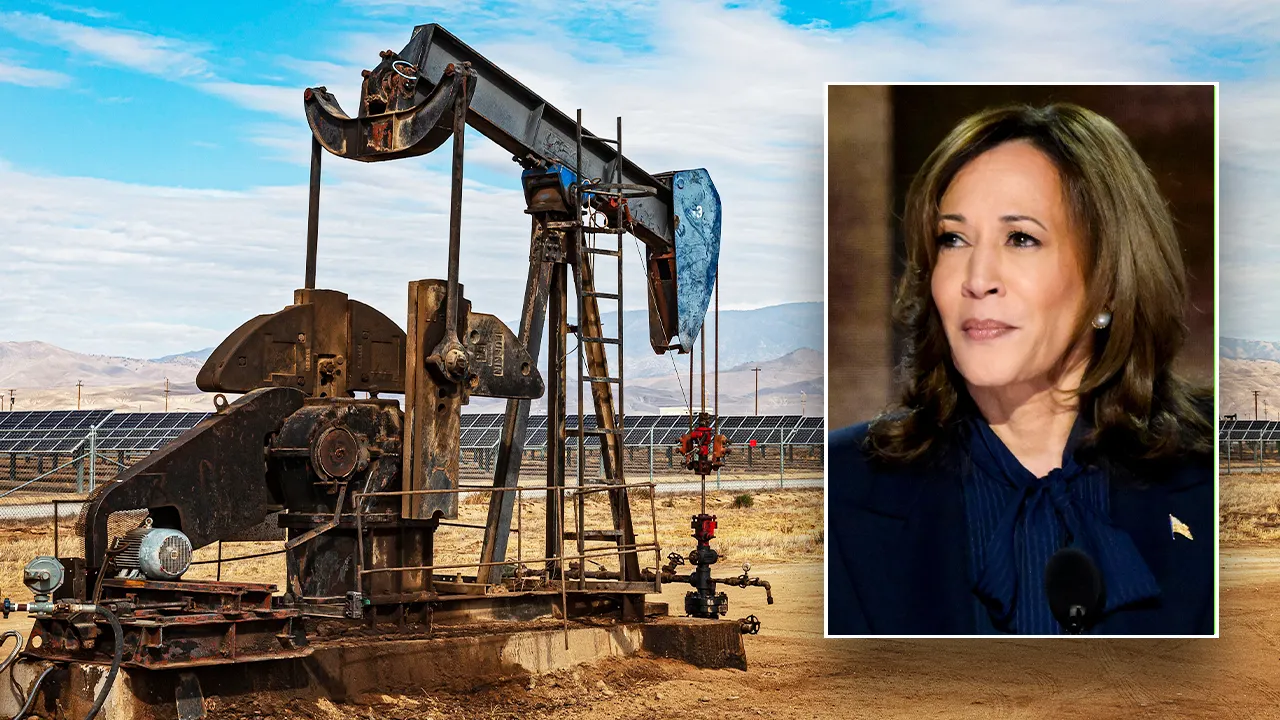
Vice President Kamala Harris is facing growing pressure from within her own party to lift the Biden administration’s pause on liquified natural gas (LNG) exports amid growing fears that the moratorium could cost the Democratic Party presidential nominee the crucial battleground of Pennsylvania — a natural gas powerhouse.
Pennsylvania’s 19 electoral votes are considered critical to winning the White House. Its reputation as a slightly left-leaning swing state, which former President Donald Trump carried by a razor-thin margin of just 0.7% in 2016, is complicated somewhat by its status as a major producer of fossil fuels.
“It’s obvious that the pathway to the presidency goes through Pennsylvania,” Amanda Eversole, the chief operating officer of the American Petroleum Institute, told Fox News Digital.
FOX NEWS MEDIA PROPOSES TRUMP-HARRIS PRESIDENTIAL DEBATE IN PENNSYLVANIA
Kamala Harris and a lone pumpjack near Bakersfield, California. (Getty Images)
The chorus of Democrats now criticizing the moratorium is something of an about-face from January, when the Biden administration first ordered its temporary halt on new LNG exports, citing a need to better evaluate the environmental and economic impacts of such projects.
Now, nine months later and less than a month away from Election Day, Harris is under pressure from some Democrat lawmakers and industry leaders to lift the pause completely.
Critics of the pause argue that removing or delaying U.S. LNG supplies from the market deprives European buyers of a cleaner, lower-emission form of energy — forcing some countries to turn to Russian gas or coal instead.
It could also affect U.S. relationships, American energy leadership and investments in massive domestic projects in the years ahead.
Pennsylvania is the second-largest producer of natural gas in the U.S., behind Texas. Its gas reserves are contained behind shale rock and must be extracted by fracking — a technology viewed as controversial at best by many on the left and one that Harris has only recently endorsed.
FOX NEWS POWER RANKINGS: THE BIGGEST SURPRISES COME AFTER OCTOBER
The fossil fuel industry supports more than 423,000 jobs in Pennsylvania, and contributes more than $75 billion to its economy, according to estimates from PwC. Therefore, the future of the LNG industry carries outsize importance to most voters, industry group leaders and former DOE officials told Fox News in a series of interviews.
In fact, Pennsylvania’s Democratic Senate delegation, Sens. Bob Casey and John Fetterman, were among the first lawmakers to criticize the LNG pause following Biden’s announcement earlier this year. Their counterparts in the House have also followed suit as they seek reelection in competitive districts.
Meanwhile, Dave McCormick, the Republican candidate hoping to flip Casey’s seat this fall, has lambasted the Democrat incumbent for failing to do enough to protect energy interests in the state. A spokesperson for Casey’s office pointed Fox News to the senator’s earlier letters and remarks opposing the LNG pause.
A recent poll published by API this month found that 85% of voters in Pennsylvania wanted to hear more from both Harris and Trump about their energy polices.
To date, Harris has declined to comment on whether she will lift the LNG pause, and neither the campaign nor the White House responded to Fox News’ requests for comment.
The Asia Vision LNG carrier ship sits docked at the Cheniere Energy Inc. terminal in Sabine Pass, Texas. (Lindsey Janies/Bloomberg via Getty Images)
FOX NEWS POLL: VOTERS CITE HIGH PRICES AS BIGGEST MOTIVATOR TO VOTE
If Harris does intend to break with Biden or push for an end to the pause and unleash more production, API’s Eversole said Harris needs to make that clear — and fast.
“If she, in fact, is going to be different from the Biden administration,” Eversole said, “then specifically how?”
Rhetoric, she said, is not enough. Especially when private investors in the U.S. have also backed out of some projects in recent months, citing regulatory uncertainty.
“We need to get shovels in the ground,” Eversole said. “We need to be able to build more infrastructure, can move safely, move our product, and we need to be able to make long-lived investments.”
Read the full article from Here



FSU softball focuses on rival Florida. Here’s its approach on Wednesday
Here’s how Lonni Alameda and Florida State softball are preparing for its rivalry matchup against Florida. First pitch is at 6 p.m.
Jazzy Francik returned to the site of one of the toughest outings of her career and delivered a dominant performance.
The Florida State sophomore tossed her third career no-hitter and powered the Seminoles to a 10-0 win over Boston College in six innings Saturday at Harrington Athletics Village, moving FSU within one win of clinching the ACC regular-season title.
Francik (19-2) was in control from the first pitch, striking out six and allowing only one baserunner on an infield error in the fifth inning. She needed just 67 pitches to complete the no-hitter, the third of her career and one of the most efficient outings of her season.
Florida State’s offense gave its ace plenty of support, collecting 12 hits and scoring 10 runs. After a scoreless first inning, the Seminoles broke through in the second with three runs on RBI doubles by freshmen Haley Griggs and Makenna Sturgis.
FSU added four more runs in the fourth inning behind a two-run double from Jaysoni Beachum and an RBI single by Ashtyn Danley. The Seminoles put the run-rule into play in the sixth, scoring three times on an RBI single from Sturgis, an RBI double by Isa Torres and a sacrifice fly from Danley.
Beachum, Torres, Sturgis and Danley each drove in two runs as Florida State continued to pressure Boston College despite several highlight-reel defensive plays from the Eagles.
Francik and the Seminole defense sealed the no-hitter in the bottom of the sixth to end the game early.
Florida State is one win away from securing at least a share of the ACC regular-season championship. A sweep of Boston College on Sunday would clinch the title outright.
How to watch FSU vs. Boston College Game 2
- Date: Saturday, May 2
- Time: 4 p.m.
- Where: Harrington Athletics Village, Brighton, Massachusetts
- TV/Stream: ACC extra
Peter Holland Jr. covers Florida State athletics and Big Bend Preps for the Tallahassee Democrat. If you like to pitch a story on a high school athlete, don’t hesitate to get in touch with him via email at PHolland@Gannett.com or on X @_Da_pistol.

Outrage is building in a quiet Pittsburgh neighborhood.
Residents say they were blindsided by a plan to convert the former Fraternal Order of Police lodge on Banksville Road into a reentry center. The building could be turned into housing for up to 100 federal inmates, officials said.
Dismas Charities, an organization that operates federal halfway houses across the country, is behind the proposal. But neighbors say this isn’t the place.
“What will these people be doing when they’re not in the halfway house? Will they be law-abiding citizens and respect our community and its members?” questioned Judi Perry, a Shady Crest resident.
Concerns range from safety to proximity. Some fear the risk of repeat offenses, even though the facility is designed for rehabilitation. Residents point to past incidents tied to similar programs, including a case in Kentucky where an inmate left a facility and killed a police officer.
“We need to be better educated about how this facility would operate, what the parameters are for the people who stay there, and maybe, if we had more information, it would comfort us,” Perry said.
Inside a recent Pittsburgh Planning Commission presentation, Dismas Charities pitched the facility as a second-chance model.
“Over the past five years, we’ve had almost 40,000 residents participate in our programs nationally, and the rate of recidivism is .08 percent,” a Dismas Charities representative said at the meeting.
But that message isn’t landing here. Petitions are already circulating with hundreds of signatures collected. Neighbors say this fight is just beginning.
“We have preconceived notions about these people who were convicted and committed a crime. We don’t know what their crime was, and so maybe our concerns are exaggerated. But in general, you don’t like the idea of that facility being so close to our community,” Perry said.
A decision could come soon, as the commission is set to take this up in the coming days. If approved, it would still need additional sign-off before any inmates move in.

A strongly worded memo raised new questions about how much work Department of Children and Families (DCF) staff were doing from home, and whether that level of teleworking was hurting child protection.
Telework expanded during the pandemic and later became part of the state’s labor agreement, allowing some DCF employees to work remotely up to 80% of the week.
While social workers continued to handle court appearances, home visits, and foster placements in person, they were allowed to start and end most workdays at home. Staff must reapply for telework permission every six months and face losing that privilege if performance slips.
Concerns over the workflow quickly followed. The state’s Office of the Child Advocate (OCA) warned that extensive teleworking could be undermining case practice and supervision inside an agency already struggling with high turnover and many inexperienced workers.
In a critical letter sent Thursday, the Child Advocate suggested that telework should be limited unless workers met specific, data‑driven performance standards, citing the loss of in‑office collaboration, supervision, and real‑time support.
NBC Connecticut Investigates also spoke exclusively with a longtime former DCF employee who remained in the child welfare field. That former worker said telework simply did not function on multiple levels at DCF, describing widespread belief among current staff and those in the judicial system that bringing people back into the office was a necessary step toward restoring the agency.
Lawmakers from both parties echoed those concerns. House Minority Leader Vincent Candelora (R) said staff working remotely were missing daily interaction, training, and support, instead operating in silos. House Speaker Matt Ritter(D) said the newly formed oversight committee was expected to examine the policy.
Those warnings were backed up by troubling findings. According to the OCA’s report, a review of in‑home cases in 2024 and 2025 found face‑to‑face interactions did not happen in about 40% of cases—something the OCA called alarming and in need of urgent attention.
As scrutiny over DCF intensified, teleworking became the latest flashpoint in a broader debate over accountability, supervision, and whether the systems meant to protect vulnerable children were being stretched too thin.
-

 Detroit, MI24 minutes ago
Where to watch Detroit Pistons vs. Orlando Magic Game 6 NBA playoffs: Live stream, start time, TV channel, odds for Friday, May 1
-

 San Francisco, CA36 minutes ago
Chonkers the Gigantic Steller Sea Lion Draws Crowds to Pier 39
-

 Dallas, TX42 minutes ago
Dallas firefighter injured in early‑morning house fire expected to recover
-

 Miami, FL48 minutes ago
Max Verstappen: Red Bull Miami updates have “almost halved” gap to F1 frontrunners
-

 Boston, MA54 minutes ago
Jazzy Francik tosses no-hitter as FSU softball run-rules Boston College
-

 Denver, CO60 minutes ago
Hundreds targeted by Denver text scam show up for fake court hearing
-

 Seattle, WA1 hour ago
Seahawks rookie minicamp tryout players revealed
-
 San Diego, CA1 hour ago
County homelessness drops by 1%, but unsheltered numbers drop by double-digits