Northeast
D-Day in key battleground: Special election to determine if Democrats or Republicans control State House

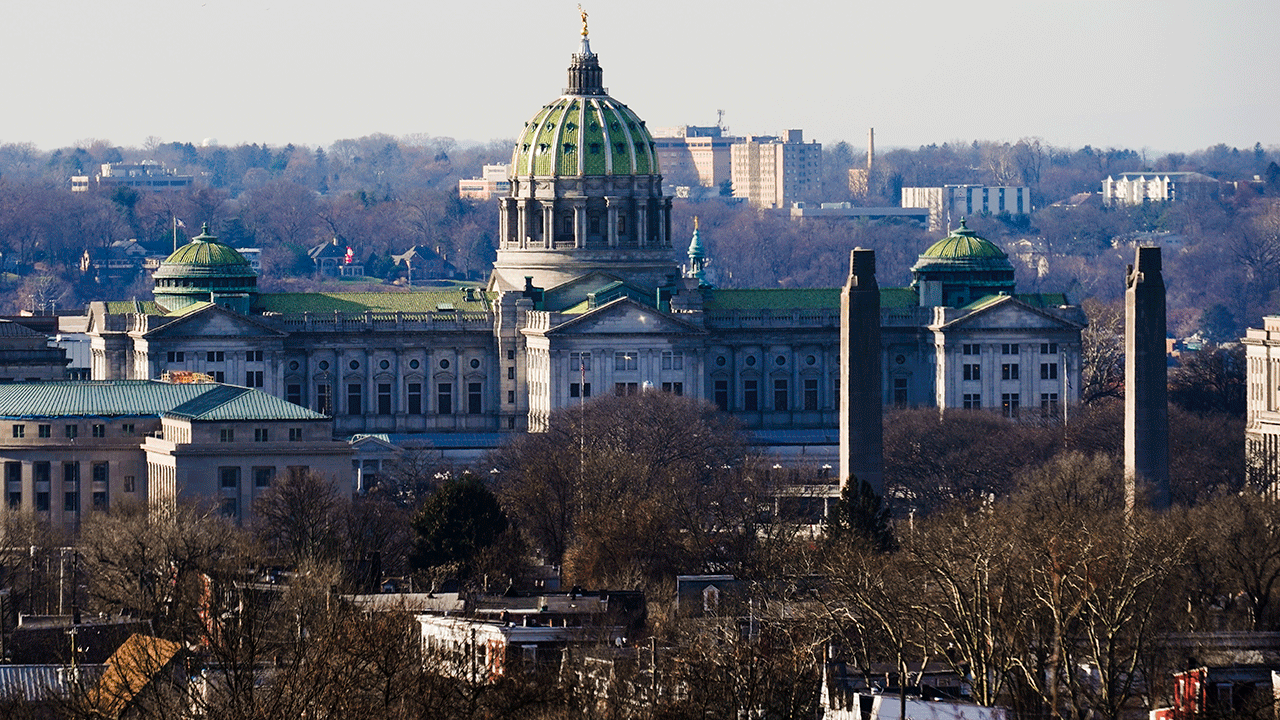
It’s Election Day in a western Pennsylvania legislative district in a race that will determine whether the Democrats regain control of the battleground state’s lower chamber or if Republicans win back the State House majority.
The Pennsylvania State House is currently deadlocked, with Democrats and Republicans each controlling 101 seats.
Democrats lost their razor-thin majority in January after the death of state Rep. Matt Gergerly.
Voters in District 35, located southeast of Pittsburgh, on Tuesday are choosing between Democratic candidate Dan Goughnour, a police officer, Republican Chuck Davis, a fire chief, and libertarian Adam Kitta.
DEMOCRATS FAR FROM THRILLED ON POSSIBLE BIDEN POLITICAL REEMERGENCE
The Pennsylvania State Capitol (AP Photo/Matt Rourke/File)
If Democrats end up winning the election – the district leans blue – it will be the fifth time this year they’ve come out on top in a special legislative election with a state majority up for grabs.
It comes as the Democratic Party tries to emerge from the political wilderness after November’s stinging election setbacks, when the party lost control of the White House and U.S. Senate and fell short in its attempt to win back the U.S. House majority from the GOP.
POLL POSITION: DEMOCRATIC PARTY’S NUMBERS PLUNGE TO ALL-TIME LOWS
And recent polling indicates the Democratic Party brand is in need of repair.
The party’s favorable rating sank to all-time lows in separate national polls conducted this month by CNN and NBC News. Those numbers followed a record low for Democrats in a Quinnipiac University survey in the field in February.
Additionally, the latest Fox News National poll, which was released last week, indicated congressional Democrats’ approval rating at 30%, near an all-time low. And Democrat activists are irate over their party’s inability to blunt President Donald Trump’s agenda.
“State Democrats have been overperforming in specials this year because voters trust them to put working families’ needs above the chaos and dysfunction fueled by Trump and Republicans in Washington,” said Democratic Legislative Campaign Committee President Heather Williams in a statement.
In a sign of the local election’s importance, Democratic National Committee Chair Ken Martin stopped by the district last month.
“Sending Dan to Harrisburg isn’t just about what it means for this community,” Martin said in a statement to Fox News. “It sends a signal to Pennsylvanians. It sends a signal to Democrats around the country that we’re willing to fight for our values at every single level.”
Democratic National Committee Chair Ken Martin speaks with Fox News Digital on Dec. 12, 2024, in Washington. (Fox News – Paul Steinhauser)
While Democrats are favored in the special election, Republicans have also put resources into the race.
“No matter who looks good on paper, you’ve got to have the election,” Pennsylvania House Rep. Jamie Barton, who leads the state House GOP’s campaign arm, told the AP. “We’re not taking anything for granted.”
On the side of Pennsylvania, voters will be heading to the polls to fill a vacant state Senate seat.
GOP state Sen. Ryan Aument stepped down in December to work as state director for newly elected U.S. Sen. Dave McCormick, a fellow Republican.
Republican Josh Parsons, a Lancaster County commissioner, Democrat James Andrew Malone, the mayor of East Petersburg, and libertarian Zachary Moore are running to succeed Aument in state Senate District 36, a red-leaning seat in Lancaster County, Pennsylvania.
Regardless of the election results, the GOP will continue to control the state Senate, where they currently hold a 27-22 majority.
Read the full article from Here


When Americans think of the beverage that fueled the American Revolution, they usually picture black tea — but it turns out that green tea was just as popular.
The Founding Fathers and their contemporaries drank both types of tea, Bruce Richardson, the Kentucky-based founder of Elmwood Inn Fine Teas, told Fox News Digital.
British subjects “were as likely to be drinking green tea as black tea, whether you were in Jane Austen [era] England … or you were in colonial Boston,” he added.
“There were five teas, all from China, because that was the only country that was exporting tea,” Richardson said. “And of those five different teas, two of them were green and three of them were black.”
Richardson, a tea historian who works as the tea master at the Boston Tea Party Ships & Museum, said the five types of tea dumped into Boston Harbor in protest of the Tea Act of 1773 included three black varieties — Bohea, Souchong and Congou — as well as the green teas Hyson and Singlo.
Bohea, the most common and least expensive black tea of the era, was often made from older tea leaves harvested after the highest-quality leaves of the season had already been picked.
Most of the tea dumped into Boston Harbor was Bohea, Richardson said — and it was so ubiquitous that he compared it to the way Kleenex has become synonymous with tissues today.
“It was so common that often teapots at the time, or some that I’ve seen, would say Bohea on the side of the teapot,” he said. “If they wanted tea, they’d say, ‘I’ll have a cup of Bohea.’ It was that common.”
Not only did colonial Americans distinguish between green and black tea, they even stored them differently.
“They still wanted their tea time, but they didn’t want to support the British government.”
“The well-to-do people would have a tea caddy – a wooden, beautifully made tea caddy to store their tea in,” he said.
“It was kept under lock and key. And in that tea caddy, [there] would be two compartments, one for green tea and one for black tea.”

Merchants often favored black tea because it held up better during the long voyage from China to Europe and onward to the American colonies, Richardson said.
“The green tea was what China had always drunk,” he said.
“And so they were exporting that as well, but they found that the black tea actually made the voyage better than the green teas.”
Even after many colonists swore off British tea, they kept the ritual of drinking it — or at least a close substitute.
Many patriots brewed so-called “Liberty Teas” made from ingredients such as dried apples, blueberries, chamomile and herbs grown in their gardens.
“They still wanted their tea time, but they didn’t want to support the British government,” Richardson said.


-

 San Francisco, CA11 minutes ago
Headlines, June 30 – Streetsblog San Francisco
-

 Dallas, TX14 minutes ago
LIVE | Ivory Coast, Norway meet for World Cup knockout match at Dallas Stadium
-

 Miami, FL19 minutes ago
Every Dolphins head coach’s start in Miami from worst to best
-

 Boston, MA26 minutes ago
Historian clears up one of the biggest myths about the Boston Tea Party
-
Denver, CO29 minutes ago
Nemanja Jokic, the older brother of\u00a0Denver …
-

 Seattle, WA34 minutes ago
3 Seahawks Rookies Who Must Step Up Right Away
-

 San Diego, CA41 minutes ago
Adobe Falls: The elusive waterfall that briefly returns after San Diego rains
-

 Milwaukee, WI44 minutes ago
Steve Czaban returns with new home in Milwaukee sports-talk radio

