You have reached your maximum number of articles. Log in or create an account FREE of charge to continue reading.
By entering your email and pushing continue, you are agreeing to Fox News’ Terms of Use and Privacy Policy, which includes our Notice of Financial Incentive.
Please enter a valid email address.
Pennsylvania Sen. Bob Casey is invested, through several mutual funds, in the same Chinese fentanyl manufacturer that he recently claimed a company that was led by Republican candidate Dave McCormick was “profiting off people’s pain” by investing in.
The senator’s campaign claimed McCormick “saw a way to get even richer” in the fentanyl crisis, in an ad released earlier this month slamming the company he led, Bridgewater Associates, for investing in Humanwell. The ad connected the Chinese company to deaths from fentanyl occurring in Pennsylvania, noting that “nearly all” fentanyl starts in China.
Advertisement
However, Casey, through his investments, owns shares in a mutual fund that owns stock in the Chinese company as well, according to publicly available financial disclosures.
Through his ownership of shares in a college savings plan, which is invested in the Massachusetts College Portfolio, a mutual fund managed by Fidelity, Casey is invested in Humanwell. But, his ultimate stake in the company is minimal.
BALANCE OF POWER: TRUMP CAMPAIGN SLAMS SEN TESTER AS ‘RADICALLY OUT OF TOUCH’ AFTER ABORTION AD ROLLOUT
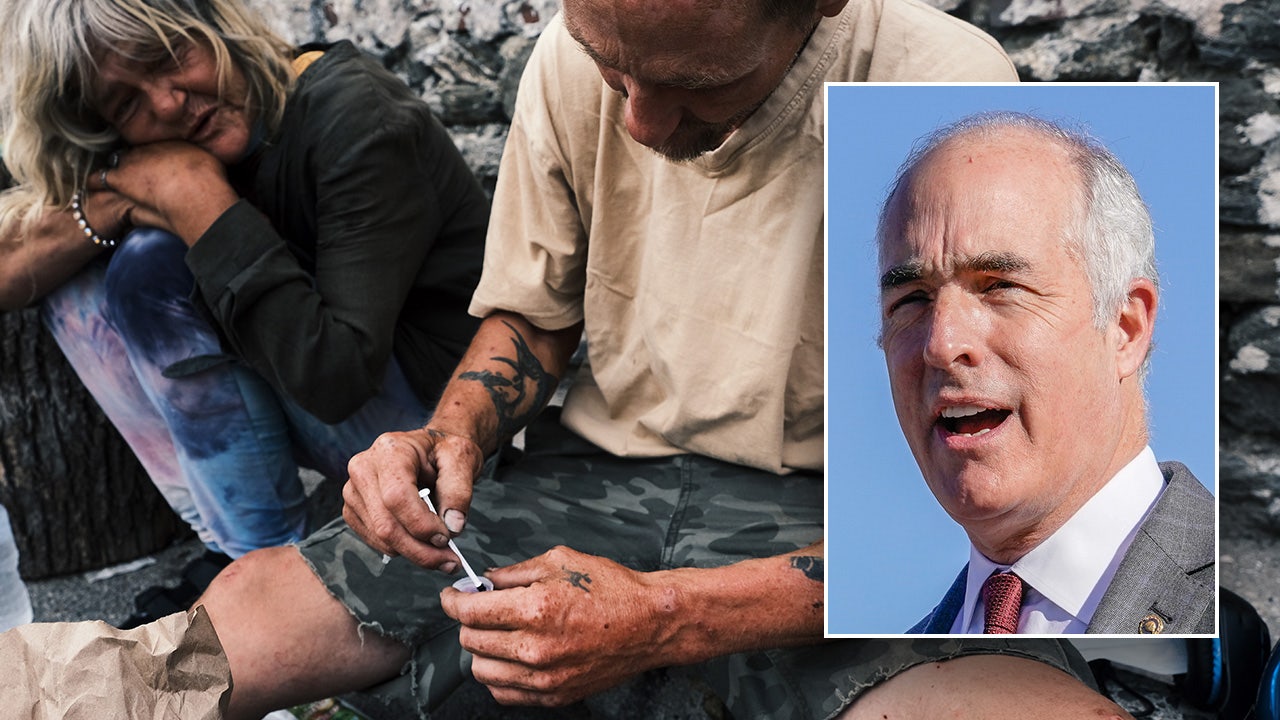
Sen. Bob Casey was revealed to own stock in the same Chinese company that he attacked his opponent for investing in.(Getty Images)
Maddy McDaniel, a spokesperson for the Pennsylvania Democrat’s campaign, told Fox News Digital in a statement, “David McCormick will say anything to try and cover up how he sold out Pennsylvanians for profit, but the facts are clear: he directly invested millions in Chinese fentanyl and profited off Pennsylvanians’ pain. David McCormick decided to invest in a Chinese fentanyl company and Bob Casey never did.”
Advertisement
As of 2021, Bridgewater Associates had a nearly $1.7 million investment in Humanwell across seven different hedge funds, according to publicly available records with the Department of Labor (DOL). McCormick was CEO of Bridgewater from 2020 to 2022.
“With his ad, Bob Casey has put his own hypocrisy and lies on display, and it’s proof of why Pennsylvanians are so tired of career politicians,” McCormick said in a statement to Fox News Digital. “Casey has had 18 years to secure our border and prevent fentanyl from killing 100,000 Americans last year alone – under his weakness, this crisis has worsened beyond imagination.”
Casey is also invested through mutual funds in Jiangsu Nhwa Pharmaceutical and Sinopharm Group, which are similarly involved in the manufacturing and wholesale of Chinese narcotics, respectively.
‘FEEL BETRAYED’: TOP CONSERVATIVE GROUP BLASTS VULNERABLE DEMS ON INFLATION IN MULTIMILLION-DOLLAR AD BLITZ’:
Bundles of blue pills containing fentanyl intercepted at the border.(U.S. Customs and Border Protection)
Advertisement
Humanwell, as a pharmaceutical manufacturing company, produces medical-grade opiates. It is not one of the Chinese companies that has been singled out by the U.S. as a producer of lethal fentanyl precursor chemicals that are transported illegally through the southern border.
According to the Drug Enforcement Administration (DEA), “illicit fentanyl, primarily manufactured in foreign clandestine labs and smuggled into the United States through Mexico, is being distributed across the country and sold on the illegal drug market.”
Overdose deaths due to synthetic opioids have risen substantially, with the primary cause being illicitly manufactured fentanyl, per the DEA.
BLINKEN PRESSURED TO FREEZE AFGHANISTAN AID AFTER REVELATION NEARLY $300M COULD HAVE GONE TO TALIBAN
McCormick accused Casey of lying about him and slammed the Democrat for failing to stop fentanyl trafficking over the border.(Getty Images)
Advertisement
Pennsylvania is shaping up to be one of the most important states in the 2024 election, potentially deciding the presidential race and which party will control the Senate. And one particularly pressing issue in the state is the rapid increase in overdose deaths and substance abuse.
In 2022, Pennsylvania had the 14th-highest drug overdose death rate in the country. There were a total of 5,169 deaths from drug overdoses, per the Centers for Disease Control and Prevention (CDC).
‘NEVER HEARD OF HIM’: HARRIS VP PICK WALZ HAS LITTLE NOTORIETY AMONG TRUMP-VANCE VOTERS IN PA
A map shows which states have higher rates of overdose deaths.(Centers for Disease Control and Prevention)
Following Casey’s ad hitting McCormick on investing in Humanwell, the Pennsylvania Republican cut his own ad, claiming, “Bob Casey is lying about me.”
Advertisement
“I never made any investments in the makers of illegal fentanyl, ever,” he said. “Bob Casey is too weak to close the border and too weak to tell the truth.”
Casey’s Pennsylvania Senate seat is considered “Lean Democratic” in the 2024 election, according to nonpartisan political handicapper the Cook Political Report. In a recent poll by the New York Times and Siena College, Casey led McCormick 51% to 37% among likely voters and 50% to 36% among registered voters.
Get the latest updates from the 2024 campaign trail, exclusive interviews and more at our Fox News Digital election hub
BOSTON (WHDH) – Celtics star forward Jayson Tatum responded to the team’s shocking trade of forward Jaylen Brown to the Philadelphia 76ers on Wednesday, reflecting on the near decade they spent together in Boston.
Tatum posted a tribute to Brown on his Instagram story Friday afternoon, writing, “9 years! Forever grateful for all that we accomplished together, for pushing me to be a better player. From first round exits to winning a chip together I’m thankful for it all. Nothing but love and respect for you as a player and as a person! Looking forward to see how you attack this next chapter of your career and wish you nothing but the best for you! Continue to be special.”
The trade will become official Monday once the league-wide moratorium is lifted. The Celtics will welcome nine-time NBA All-Star Paul George, who they received from the 76ers, as well as new signings Mitchell Robinson and Mike Conley Jr.
(Copyright (c) 2026 Sunbeam Television. All Rights Reserved. This material may not be published, broadcast, rewritten, or redistributed.)
Advertisement
Join our Newsletter for the latest news right to your inbox
We break down when Pittsburgh fireworks cross from fun into illegal
In Pennsylvania, it’s easier than ever to buy consumer fireworks, but using them inside Pittsburgh city limits is where the law tightens up.
In Pennsylvania, it’s easier than ever to buy consumer fireworks, but using them inside Pittsburgh city limits is where the law tightens up. For this week’s “Is It Legal?” series, the key distinction is that purchase and possession are generally allowed under state law, while where and how you launch them is restricted by local rules and safety regulations.
In Pittsburgh, residents can’t legally set off fireworks in public spaces like streets, sidewalks, parks or right-of-way areas. They’re also not supposed to launch them near buildings or vehicles, or in any way that directs fireworks toward people or property.
Advertisement
In rowhouse neighborhoods and dense blocks, that effectively rules out most front yards, alleys and tight backyards, because they sit too close to homes and parked cars to meet the distance and safety requirements. On top of that, noise and nuisance ordinances can come into play, especially late at night, giving police grounds to respond when fireworks are reported as a disturbance or hazard.
Officials stress that fireworks are explosives, not toys, and point to common risks: injuries from misfires, fires on roofs or in yards, and the impact on pets, older neighbors and veterans with PTSD. That’s why they consistently urge residents to skip DIY backyard launches and attend permitted, professional shows instead, where licensed operators, fire crews and safety plans are already in place.
More: Is it legal? Boating rules on Pittsburgh’s three rivers
More: Is it legal? What boaters can and can’t do on Pittsburgh’s rivers
Advertisement
More: Is it legal? Exploring ‘The Pittsburgh Left’
So, when viewers ask “Is it legal?” the answer is nuanced: Buying fireworks is broadly legal under state law, but setting them off in most Pittsburgh neighborhoods — especially in public spaces or close to buildings — is often not, and can quickly lead to citations or police visits rather than a celebration.
This article by Gabby Sartori was created with the assistance of Artificial Intelligence (AI). Journalists were involved in every step of the information gathering, review, editing and publishing process. Learn more.
The AGANORSA Leaf Aniversario Connecticut is now available in a new vitola, one that also comes in a metal tube.
It’s the second different toro for the line, though it will be difficult to confuse the two cigars. The AGANORSA Leaf Aniversario Connecticut Toro, the existing cigar, is a 6 1/4 x 52 box-pressed toro. The new AGANORSA Leaf Aniversario Connecticut Tubo is a 6 x 52 round toro. Blend-wise, the line uses an Ecuadorian Connecticut-seed wrapper over Nicaraguan tobaccos grown by AGANORSA. The line is made at the company’s factory in Nicaragua.
The AGANORSA Leaf Aniversario Connecticut Tubo has an MSRP of $19.99 and comes in boxes of 10 cigars.
Advertisement
“The Aniversario Connecticut Tubo offers a perfect combination of elegance, convenience, and flavor,” said Terence Reilly, vp of sales & marketing for AGANORSA Leaf, in a press release when the cigar was announced in March. “It’s an ideal cigar for both longtime fans of the brand and smokers discovering Aganorsa for the first time.”
Charlie Minato
I am an editor and co-founder of halfwheel.com/Rueda Media, LLC. Previously, I started TheCigarFeed, one of the two predecessors blogs of halfwheel. I have written about the cigar industry since 2010, covering everything from product launches to regulation to M&A. Beyond writing, I handle a lot of the behind-the-scenes stuff from weighing cigars to coordinating the tech. Outside of work, I enjoy playing tennis, watching boxing, falling asleep to the Le Mans 24, wearing sweatshirts year-round and eating gyros. echte liebe.