Northeast
Authorities identify father, 2 sons killed by Pennsylvania Amtrak train

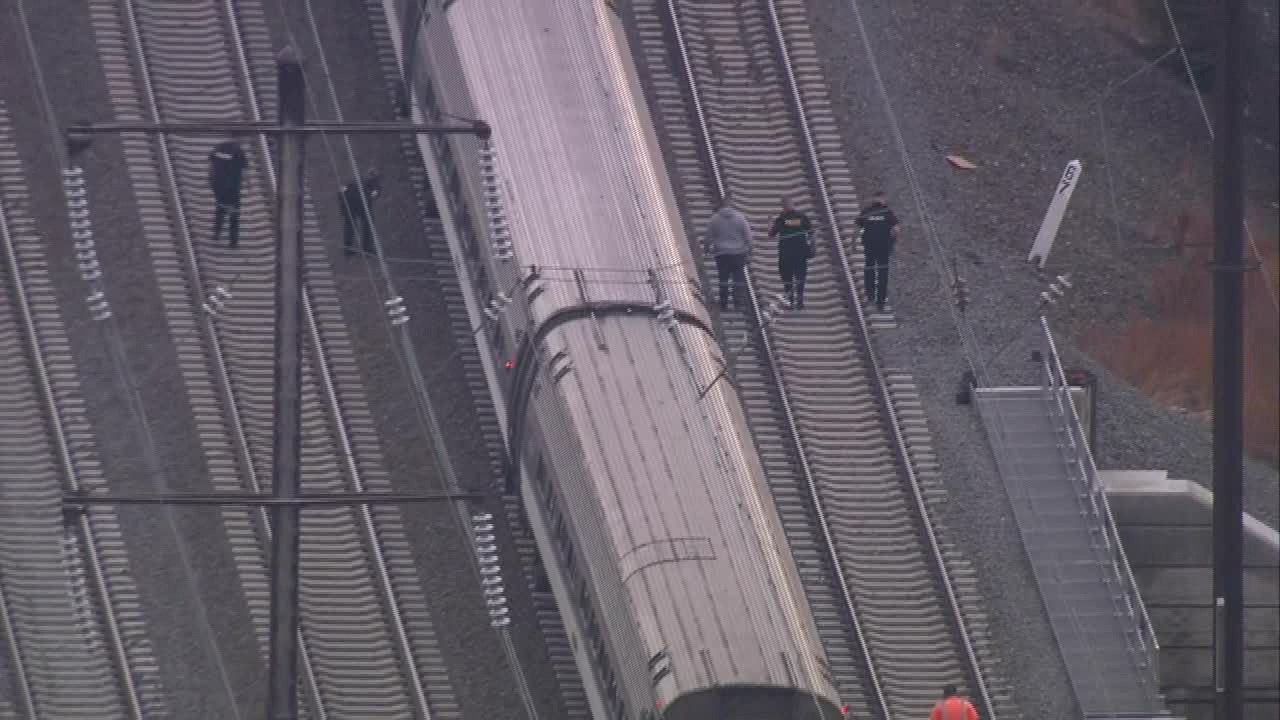
Officials have identified the three people killed in a tragic Amtrak train incident near Philadelphia, Pennsylvania Thursday night as a father and his two adult sons.
The Bucks County Coronor’s Office identified the family members as Christopher Cramp, 56, David Cramp, 31, and Thomas Cramp, 24.
Three people were struck by a train and killed on Thursday. (FOX 29)
3 FAMILY MEMBERS STRUCK AND KILLED BY AMTRAK TRAIN NEAR PHILADELPHIA: POLICE
Bristol Borough Police Chief Joe Moors told Fox News Digital officers were called to an area near the rail line at about 6 p.m. Thursday after receiving reports of people on the tracks.
As an officer was walking toward the family members at about 6:10 p.m., the train hit and killed them, Moors said.
Moors previously told Fox News Digital it appeared the three men heard the train and could not get off the tracks in time.
They were all hit at the same time, according to Moors.
The crash happened in Bucks County, where another person was killed one day prior by an Amtrak train. (FOX 29)
UNIVERSITY OF SOUTH CAROLINA STUDENT, 21, KILLED IN HIT-AND-RUN CRASH INVOLVING ILLEGAL IMMIGRANT: DHS
The coroner’s office on Friday determined Thomas Cramp, the youngest of the two sons, took his own life.
However, the manner of death for Christopher and David was ruled an accident.
The train, which was traveling from Boston, Massachusetts, to Richmond, Virginia, was carrying 236 passengers and crew.
TRANSPORTATION SEC SEAN DUFFY SLAMS BLUE STATE GOVERNOR, SAYS CRIMINALS ‘CONTINUE TO TERRORIZE’ CITY RESIDENTS
There were no reported injuries to train passengers, crew or police.
Amtrak Police are leading the investigation, in coordination with the Bristol Borough Police Department.
The train service is shut down while authorities investigate the Bucks County crash. (FOX 29)
The tragedy came just one day after another person in the same county was struck by an Amtrak train near Cornwells Heights Station.
The Wednesday crash delayed train service in all directions for an hour.
There were no reported injuries to the 232 passengers or crew onboard, according to Amtrak.
Amtrak is working with the Bensalem Police Department to investigate.
Read the full article from Here


Welcome to Day 2 of the Metropolitan Diary challenge, part of our celebration of the column’s 50th anniversary. On Day 1, we gave you tips for identifying your New York City story. Today, we’ll help you write it. (Missed Day 1? It’s not too late to start.)
What makes for a good Diary? It’s simply a good story that happens to be set in, and capture, the essential New York-ness of the city. While this isn’t a full writing course, we do have guidance on the kinds of elements that the submissions we publish include. They typically have: a beginning, middle and end; sharp details; catchy dialogue; a bit of surprise; some humor, warmth or emotion. But there is no formula, so flouting these loose rules can be worthwhile.
Don’t worry if you don’t think of yourself as a “writer.” Focus on being a “storyteller.” Pretend you are telling your story to the person who’d most appreciate it, using whatever conversational language or pacing that would hold their attention. Do it out loud if you want, maybe give that person a call and tell them your story (or tell it to them again). Then write it down.
That’s the big picture. For more tips, read on.
Here is an example of a published Diary that we (and readers) really liked, and a few thoughts on why that may help crystallize yours.
Unacceptable
Dear Diary:
I went to a new bagel store in Brooklyn Heights1 with my son.
When it was my turn to order, I asked for a cinnamon raisin bagel with whitefish salad and a slice of red onion.2
The man behind the counter looked up at me.
“I’m sorry,” he said. “I can’t do that.”3
— Richie Powers
One of this item’s best qualities is that it is short and snappy. Only 53 words! Although we will use stories of up to 300 words, many don’t need to be that long and the column doesn’t work if we don’t have a mix of long, medium and short, so we are always looking for stuff like this. Here’s another one!

At Attention
Dear Diary:
It was December 1967. I had just finished basic training at Fort Dix in New Jersey and was traveling to Boston in uniform. For reasons I no longer recall, I stopped in New York City on the way.1
Walking on the Upper East Side2 in a snowstorm, I spied another man in a uniform. He was older, and his cap bore the familiar gold band that identified him as an officer.
I rendered a snappy salute. It was not returned. 3The uniform was unfamiliar, so I guessed he was a foreign officer. Military courtesy still required me to salute.
A little farther down the street, I encountered another officer and offered another salute that went unacknowledged.4 His uniform was strange to me as well.
The third time it happened, the man I saluted ignored me while holding the door for a couple 5on their way into a large apartment building.
I realized I had been saluting doormen.6
— Stephen Salisbury
To get your storytelling muscles going, think through or jot down the answers to some of these questions.
Let’s start with setting the scene.
- When and where in the city did this happen? Is this place well-known?
- Was there anything particular about that point in your life that’s relevant?
- What did you see, hear, smell? Was there something notable about the weather?
Now, let’s move to the middle, the meat of the story.
- Did you have an exchange with someone?
- What details are important to how events unfolded, especially in setting up the ending?
And now, the end.
- What’s the resolution? Is there a punchline?
- Does the story end with a sense of shared humanity or some other warm feeling that lingers? You don’t need to name it. A good description will often allow readers to feel it too.
- Why has this experience stayed with you?
- Lines like “and that’s why I love New York” are almost always unnecessary.
That’s it. Keep your story simple and use the kind of plain language you use in conversation. You are sketching a moment in time. The details are important. Let them move the story along. Have fun and good luck.
Once you’re done, read through what you’ve got. What details are less important and can be left out? (Remember, there is a strict 300-word limit.)
Write your Metropolitan Diary however you like, on paper, on your phone or wherever! When you’re happy with what you’ve written, put your diary entry into the box below, fill out your information and submit it. You might just hear from me about including it in a future column.
This is the official submission form, so make sure to double-check your work before hitting submit.
That’s it! Submit your Metropolitan Diary.
By transmitting your submission, you grant The New York Times Company a perpetual, royalty-free license to use the submission in any medium. They may be edited, and may be republished and adapted in all media. You may reprint your story elsewhere after it appears in The Times.

Watch CBS News
Pittsburg, PA
Trash pickup schedules adjusted in Pittsburgh-area communities due to impending heat wave

Several communities in the Pittsburgh area have adjusted their trash pickup times as the region is bracing for a heat wave with temperatures and heat indexes expected to be near 100 degrees this week.
The hottest temperatures of 2026 are expected this week and by Tuesday afternoon, temperatures are anticipated to reach into the 90s. This, coupled with extremely high humidity levels, means the heat index — also known as the “feels like” temperature — will flirt with triple digits.
In Mt. Lebanon, trash and recycling pickup routes will begin earlier than normal to help keep workers safe amid the extreme heat.
“All trash and recycling should be placed at the curb the night before your scheduled collection day, as collection times may occur earlier than usual,” a notice posted on municipality’s Facebook page said.
Shaler Township said that it received an update from County Hauling that collection crews will begin their routes earlier than normal this week as well.
“Please place all trash and recycling at the curb the night before your scheduled collection day,” the township said.
In Robinson Township, trash collection will begin at 5 a.m. on Tuesday, one hour earlier than normal.
People are being asked to have their trash and recycling at the curb at least one hour prior to their normal pickup time.
Pleasant Hills Borough said it had adjusted its trash pickup schedule for earlier in the day on Friday to “help reduce employee exposure to hazardous temperatures.”
“This temporary adjustment is being made in the interest of employee health and safety,” the borough said. “We kindly ask that you help notify your residents that all trash and/or recycling should be placed at the curb the night before their scheduled collection day, as collection times may occur earlier than usual.”
In Brentwood Borough, Noble Environmental will begin earlier collection on pickup routes as well.
People are being asked to place their trash and recycling at the curb the night before their scheduled collection day.
The borough added that collection days are not changing, only the start time of the pickup routes.
“Thank you for your cooperation as crews work safely during this week’s heat wave,” the borough said.
The Library Volunteer Fire Company said that trash pickup in South Park Township is being moved earlier on Thursday.
“We kindly ask Township residents to place trash and recycling at the curb the night before Thursday, July 2nd pickup, as collection times may occur earlier than usual,” the notice said.
-
World2 minutes ago
Pope issues last-ditch appeal, begs breakaway traditionalist group to back off bishop consecrations
-
 Lifestyle40 minutes ago
How should we behave online? : It’s Been a Minute
-

 Technology50 minutes ago
After a great start, DC’s new cinematic universe is already slowing down
-

 World55 minutes ago
UK asylum seekers could have to pay government $13K before applying for settlement
-

 Politics1 hour ago
Fetterman unleashes on ‘dirtbag’ wing of Dems after far-left victories: ‘Orgy of socialism’
-

 Health1 hour ago
Doctors thought man had brain cancer — they found live tapeworms instead
-

 Sports1 hour ago
Paraguay stuns four-time World Cup champions Germany in penalty shootout after controversial call
-
 Business1 hour ago
Comcast is spinning off NBCUniversal media and entertainment assets


