Connect with us

News

Wall Street stocks drop as investors fret over US economic slowdown

Published

on

Wall Street stocks drop as investors fret over US economic slowdown

Stay informed with free updates

Wall Street stocks fell on Monday, deepening the recent sell-off triggered by investor concerns over the impact of President Donald Trump’s policies on the US economy.

The S&P 500 index tumbled 2.1 per cent, after falling 3.1 per cent last week in its worst weekly performance in six months, as big US banks ditched their previous bullish forecasts for stocks this year.

The Nasdaq Composite, which has been hit by a sell-off in big tech stocks in recent weeks, was down 3.8 per cent, dragged down by a fall of nearly 9 per cent for Tesla.

Advertisement

The carmaker’s shares surged following Trump’s election victory in November but have now given up all of those gains, losing more than 50 per cent of their value since their December high.

The latest falls, which also dragged down markets in Europe and Asia, came after the president on Sunday declined to rule out a recession or a rise in inflation as he dismissed business concerns over lack of clarity on his tariff plans.

Markets were being driven by “concerns about a growth scare or stagflation tied to rapidly changing Washington policy,” said Lisa Shalett, chief investment officer at Morgan Stanley Wealth Management.

Some content could not load. Check your internet connection or browser settings.

US Treasuries rallied on Monday, as investors sought safe haven assets. The 10-year yield, which falls as prices rise, was down 0.11 percentage points at 4.21 per cent.

Advertisement

The Vix index, known as Wall Street’s fear gauge, climbed to 27, the highest level since mid-December.

Investors are concerned that Trump’s on-off trade war is hurting the US economy, with Friday’s disappointing jobs numbers the latest in a run of weak data.

Retaliatory tariffs from China on about $22bn of US goods, including agricultural exports, came in to effect on Monday.

Over the weekend, Treasury secretary Scott Bessent provided little in the way of reassurance to worried investors as he acknowledged signs of US economic weakness. “Could we be seeing that this economy that we inherited starting to roll a bit? Sure,” he told CNBC.

Trump and Bessent seem to be prepared for “some pain to reorientate the economy”, said Deutsche Bank’s Jim Reid. “Taken at face value, these quotes suggests that their pain level is higher than most would’ve believed a few weeks ago.”

Advertisement

The equity market falls of recent weeks mark a sharp reversal from the mood late last year and earlier this year, when hopes of deregulation and tax cuts under Trump fuelled a market rally.

Instead, duties on goods from trading partners such as Canada, Mexico, China and the EU have led investors to rein in their bets and driven many into cutting risk.

The S&P could drop almost 20 per cent from its current level if “growth falls off more significantly and recession becomes likely,” said Morgan Stanley’s chief US equity strategist Michael Wilson in a note to clients on Monday. “We are not there, but things can change quickly.”

JPMorgan believes the index could fall as low as 5,200 — a near-10 per cent drop from current levels — due to “trade uncertainty”, while analysts at Citi believe the fallout from Trump policies can push the S&P down to 5,500 points. In December, an average of 10 global banks expected the index to climb roughly 10 per cent in 2025 to about 6,550 points.

“The US exceptionalism trade has been experiencing turbulence over the last weeks,” said Dubravko Lakos-Bujas, a strategist at JPMorgan, adding that policy uncertainty has risen sharply at a time of a “budding growth scare” and “crowded investor positioning”.

Advertisement

In Europe, where shares have outperformed the US this year, the Stoxx Europe 600 index was down 1.4 per cent, dragged down by banks and technology shares.

Germany’s Dax, which hit a string of record highs last week after the country agreed a historic spending package, fell 2 per cent. 

Chinese consumer prices fell in February for the first time in 13 months, in the latest sign of weakness for the world’s second-largest economy. The CSI 300 index closed down 0.4 per cent, while the Hang Seng index dropped 1.9 per cent, although it is still up around 19 per cent this year.

Additional reporting by Ian Smith

Advertisement

News

Former Olympian pleads not guilty in reflecting pool vandalism charges

Published

on

Former Olympian pleads not guilty in reflecting pool vandalism charges

Former U.S. Olympian David Hearn (left) walks with his attorney Norman Eisen to speak to reporters and protesters gathered after his arraignment at the Superior Court of the District of Columbia in Washington, D.C. on Thursday.

Finn Gomez/Getty Images


hide caption


toggle caption

Advertisement

Finn Gomez/Getty Images

Former U.S. Olympic canoeist David Hearn pleaded not guilty to damaging the Lincoln Memorial Reflecting Pool in D.C. Superior Court Thursday morning.

Federal prosecutors charged Hearn with a single count of destruction of property causing more than $1,000 in damage to the pool.

Hearn has previously claimed, which his attorneys repeated during a short press conference outside the court, that he simply touched the water in the pool out of curiosity.

Advertisement

The Trump administration had just completed a $14 million renovation of the pool.

But shortly after the work finished, peeling paint and algae gathered in the water. The remodel has been largely criticized as a massive failure and waste of taxpayer dollars.

Superior Court Judge Carmen McLean released Hearn on his own recognizance. His next hearing is scheduled for Aug. 5.

Norm Eisen, one of Hearn’s attorneys, spoke to reporters outside of court following the hearing. He said the administration is using Hearn as a “scapegoat … for their own failures.”

“It is not a crime to touch the reflecting pool, to touch water in the United States of America,” he said.

Advertisement

Prosecutors say there is a host of evidence against Hearn.

This is a developing story.

Continue Reading

News

Three more people charged with damaging Reflecting Pool after Trump’s multimillion-dollar restoration | CNN Politics

Published

on

Three more people charged with damaging Reflecting Pool after Trump’s multimillion-dollar restoration | CNN Politics

Three more people have been criminally charged with destruction of property at the Lincoln Memorial Reflecting Pool.

Officers say they detained Cameron Thiers, Sophie Dennison-Gibby and Justin Carreno one Saturday afternoon in June and described in court documents witnessing them peeling and removing pieces of blue paint from the Reflecting Pool.

One officer “witnessed Carreno reach down into the reflecting pool and pull up a piece of the blue paint,” according to the court documents.

The officer who detained Dennison-Gibby “found 1 additional piece of the reflecting pool liner” in her purse, the documents said.

All three incidents were recorded on the officers’ body worn cameras, they said in the court documents.

Advertisement

Several “partnering law enforcement agencies assigned to the Reflecting Pool” working with US Park Police were involved in detaining the two men and one woman — including officers from Texas, Oklahoma, Montana and California.

One of the officers said in court documents that Thiers “admitted to removing a piece of blue sealant from the Reflecting Pool and still had it in his hand when I made contact with him.”

The three defendants were arraigned in court Wednesday and pleaded not guilty to the misdemeanor charges of destruction of property with a value less than $1,000. The judge ordered them to stay away from the Reflecting Pool.

Lawyers for Thiers and Dennison-Gibby declined to comment. CNN has reached out to Carreno’s attorney.

If found guilty of destruction of property, the defendants could be fined up to $1,000 and face a maximum of 180 days behind bars.

Advertisement

The New York Times first reported that three additional people had been charged with damaging the Reflecting Pool.

President Donald Trump has repeatedly claimed that vandals caused major damage to the pool by gashing the lining after his administration spent more than $14 million on renovations, though he has not provided evidence to support that claim. The officers who charged Carreno, Thiers and Dennison-Gibby did not accuse them of gashing the lining.

Former Olympic canoeist David Hearn was indicted by a grand jury in Washington, DC, last week for allegedly damaging the Reflecting Pool. Hearn — unlike Carreno, Thiers and Dennison-Gibby – was charged with destruction of property with a value of more than $1,000 which carries a maximum penalty of 10 years in prison, if convicted. He is set to be arraigned in court Thursday.

Crews began draining the Reflecting Pool over the weekend to make repairs, according to Interior Secretary Doug Burgum, for the second time in three months.

The move comes after weeks of problems – algae blooms, green-hued water, a chipping bottom and the administration’s allegations of vandalism – that have plagued the iconic landmark, making its woes the subject of national interest.

Advertisement
Continue Reading

News

Supreme Court financial disclosures reveal how their books add to their income

Published

on

Supreme Court financial disclosures reveal how their books add to their income

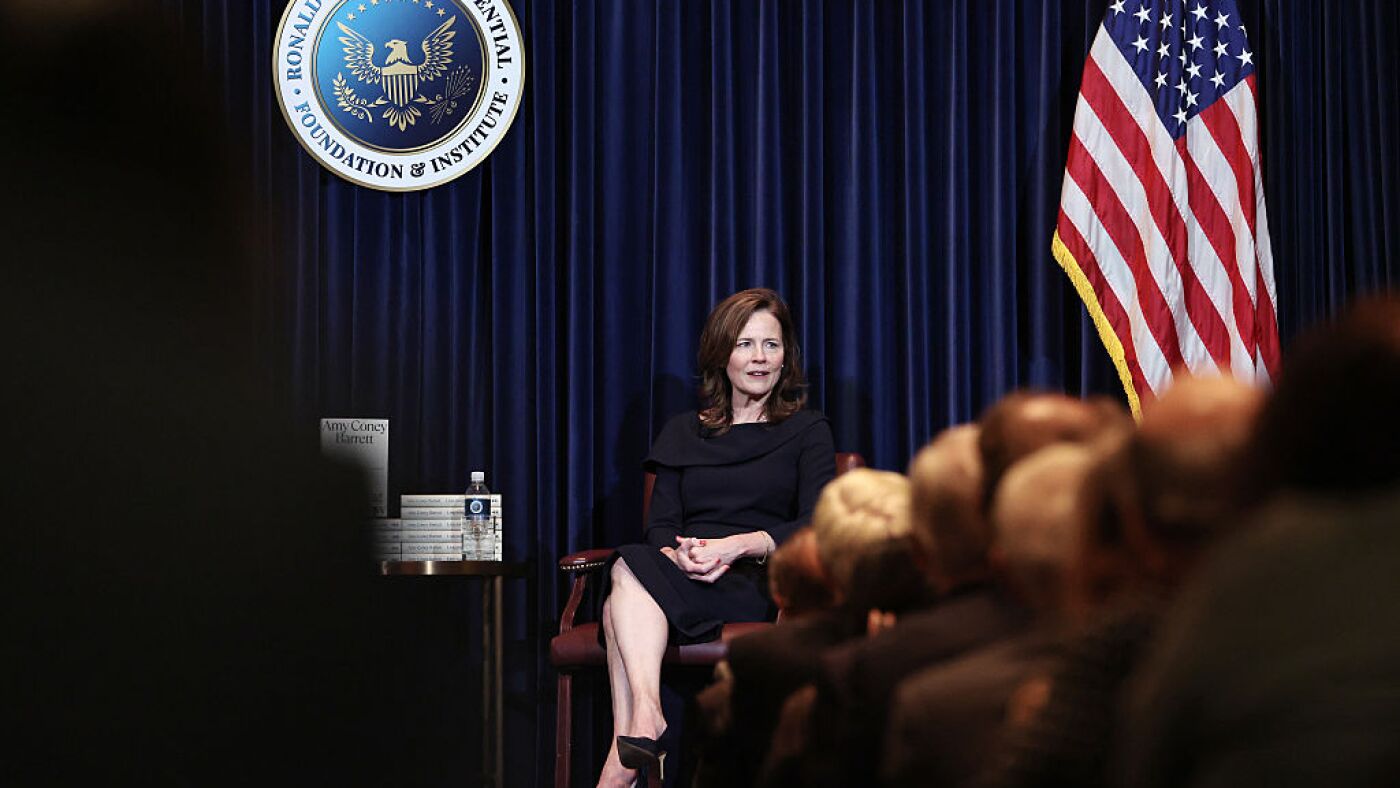
Supreme Court Justice Amy Coney Barrett speaks at the Reagan Library on Sept. 9, 2025, in Simi Valley, Calif. Barrett discussed and signed copies of her new book, Listening to the Law: Reflections on the Court and Constitution.

Mario Tama/Getty Images


hide caption


toggle caption

Advertisement

Mario Tama/Getty Images

Even as the Supreme Court was handing down one legal thunderbolt after another last week, the justices were quietly releasing their annual financial reports. Justice Samuel Alito was the only sitting justice to request an extension, which he has done for 15 years. The disclosures do not give a complete account of the justices’ total income and wealth, but they give insights into their concertgoing, guest professorships and even their involvement in youth sports.

In addition to their salaries, much of the justices’ reported income came from their book deals. Justice Ketanji Brown Jackson led the pack earning more than $1.1 million last year for a total of roughly $4 million since her memoir, Lovely One, was published in 2024.

Justices Sonia Sotomayor, Neil Gorsuch, Amy Coney Barrett and retired Justice Anthony Kennedy also reported income from published books. Earnings from their books ranged from $849,000 for Barrett, to $300,000 for Gorsuch and $88,000 for Sotomayor, whose books include her 2013 autobiography and five children’s books. Justice Clarence Thomas, who previously earned $1.5 million for his 2007 memoir, listed no publisher payments last year, and Justice Brett Kavanaugh, one of 13 co-authors of a 2016 legal treatise, also received no payments last year. Kavanaugh is said to be working on a memoir but he listed no payments for the anticipated book. Alito does have a book coming out in the fall, but with his financial report still outstanding, there is no data on how much he was paid for the work in 2025.

Advertisement

The only two sitting justices who have not written books are Chief Justice John Roberts and Justice Elena Kagan.

Many justices also earned income from teaching at law schools. Roberts reported income from New England Law, located in Boston, and Gorsuch reported teaching income from George Mason University in Virginia. Thomas taught classes at Catholic University in Washington, D.C., and Barrett and Kavanaugh taught at Notre Dame Law School. Barrett graduated from the school and began teaching there 23 years ago; Kavanaugh has family connections to Notre Dame.

Continue Reading
Advertisement

Trending