News
Trump’s Shrinking Ambitions on China


When President Trump campaigned in 2024, he promised a trade agenda that would hit China harder than any other economic partner, expanding on actions he had taken in his first term.
Mr. Trump talked about imposing a tariff of 60 percent or more on the country, and proposed stripping China of the preferential trade relations given to it when it joined the World Trade Organization. The rest of the world would be subject to tariffs too, but they would be much lower, at 10 or 20 percent.
More than a year into Mr. Trump’s first term, the picture looks dramatically different. Though U.S. tariffs on China are higher overall when the tariffs from Mr. Trump’s first term are added in, other countries have faced punitive levies that were nearly as high, and higher for some products.
The Trump administration has saved its most caustic criticism for allies in Europe and Canada, while approaching China with more cautiously. And as Mr. Trump heads to Beijing this week for a summit with the Chinese leader Xi Jinping, expectations for its outcomes are limited.
Rather than pushing China for broader structural changes to its economy, as Mr. Trump’s aides did in his first term, the focus now is largely on maintaining stable relations between the countries, while restoring or increasing U.S. sales of products like airplanes, ethanol, soybeans, beef and sorghum.
The remarkable shrinking of Mr. Trump’s Chinese ambitions is the result of the events of the last year, when China responded to Mr. Trump’s tariffs by cutting off the supply of rare earth minerals and magnets needed by American companies making everything from cars and weaponry to power tools.
Facing the prospect of shuttered U.S. factories and widespread economic damage, the Trump administration appears to have given up the idea of a more ambitious deal with China — widely acknowledged as America’s most problematic trading partner — even as it presses less troublesome partners more aggressively than ever before.
Myron Brilliant, a senior counselor at DGA-Albright Stonebridge Group, a consulting firm, said this week’s summit in Beijing would be “high on strategic distrust and high on symbolism but low on ambition.” Last year was a tumultuous period for U.S.-China relations, he said, and both sides “are in risk management now.”
“Each side seeks stability, and deliverables will be largely short-term in nature,” he said. Mr. Brilliant said the outcomes could include agricultural and airplane purchases, and agreements to curb fentanyl exports.
U.S. officials have talked about the creation of a new “board of trade” that would oversee the agreed purchases, which could run to tens of billions of dollars. Others have suggested the meeting could result in lower tariffs on more general products, to spur their sales.
While Mr. Trump’s global tariffs have been repeatedly struck down by the courts, the administration is preparing two new trade investigations that are likely to result in more levies on dozens of countries this summer, including China. Chinese officials are expected to press U.S. officials to keep those tariffs low.
Analysts said Chinese officials also appeared likely to push for the relaxation of U.S. technology controls or a change in U.S. posture on Taiwan, a self-governing island that China claims as its own.
Kurt Campbell, a former U.S. deputy Secretary of State, said the Chinese side would be looking, wherever possible, to get the United States to relent on economic actions like tariffs. But the most important priority for China is to get Mr. Trump to depart from traditional approaches when it comes to Taiwan.
“If there are deals to be made on Chinese substantial purchases of agricultural or beef products, pork or Boeing, they will expect things in return for that,” he said.
U.S. officials have said they don’t expect to see any changes with regard to policy on Taiwan. In a briefing with reporters Sunday, Anna Kelly, a spokeswoman for the White House, said that Mr. Trump had refocused U.S.-China relations “on what matters most, rebuilding the safety, security and prosperity of Americans.”
“During this visit, President Trump will continue doing what he has done over the past year, rebalancing the relationship with China and prioritizing reciprocity and fairness to restore American economic independence,” she said.
Despite Mr. Trump’s aggressive talk during the campaign, his advisers say his goal was never a decisive decoupling with China. Instead, he envisioned his trade threats as a way to push Beijing into a bigger trade deal that would tilt the balance in the relationship to benefit the U.S. economy and help ensure global peace.
The problem was the execution. When Mr. Trump tried to force China into making concessions last year by threatening extreme tariffs, the tactic backfired, forcing the U.S. to pare back its goals.
“They did move to be more aggressive on China,” Mary Lovely, a senior fellow at the Peterson Institute for International Economics, said of U.S. officials. “What happened was China decided to invoke its significant choke-points of its own and countered the U.S. in ways that it hadn’t done before.”
“I have no idea why they didn’t anticipate that,” she added.
As the situation escalated again last fall, top officials including Scott Bessent, the Treasury secretary, and Jamieson Greer, the trade representative, assembled a list of actions they could take to strike back, including restrictions on things like software, semiconductor manufacturing equipment and visas, that might force Beijing to back down.
But ahead of a meeting with Mr. Xi in South Korea in October, the president told his advisers instead to try to push for a truce. The United States ended up shelving a variety of actions on China, including a delay in the imposition of a sweeping technology restriction that would affect Chinese companies, and new fees on Chinese ships aimed at building up the U.S. shipbuilding industry.
In recent months, the United States and China have maintained a tentative truce. Many exports of Chinese rare earths have resumed to companies not linked to the military, though U.S. companies remain intensely concerned about their longer-term access to minerals. The administration has taken steps to try to increase the domestic supply of rare earths, including creating a critical minerals stockpile, but U.S. industry remains heavily reliant on China for the materials that will be critical to the U.S. economy going forward.
After Mr. Trump met Mr. Xi in South Korea, both sides talked enthusiastically of meetings to come between the leaders in the following year. A meeting was planned for April, but then rescheduled for May because of the Iran conflict.
Christopher Padilla, a former trade official in the George W. Bush administration, agreed that there would likely not be “a lot of big outcomes.” He added, “They’re going to agree we buy some of this, they buy some of that, and then they’ll have a party and call it a day.”
U.S. officials say their talks will result in a fairer trade relationship with China, and argue that they still have an edge. But the Chinese government seems more determined than ever to match any offensive U.S. measures step for step, in ways that could be deeply harmful for the U.S. economy.
China has issued regulations in recent months to investigate and punish foreign companies that stop using Chinese suppliers in response to foreign pressure. And after the United States penalized several Chinese refineries for purchasing Iranian oil, the Chinese government took the unorthodox step of ordering its companies not to comply with the sanctions.
Ms. Lovely of the Peterson Institute said China had been building out the legal foundation for measures to counter foreign sanctions for a decade. “Now they feel confident enough to use them,” she said.



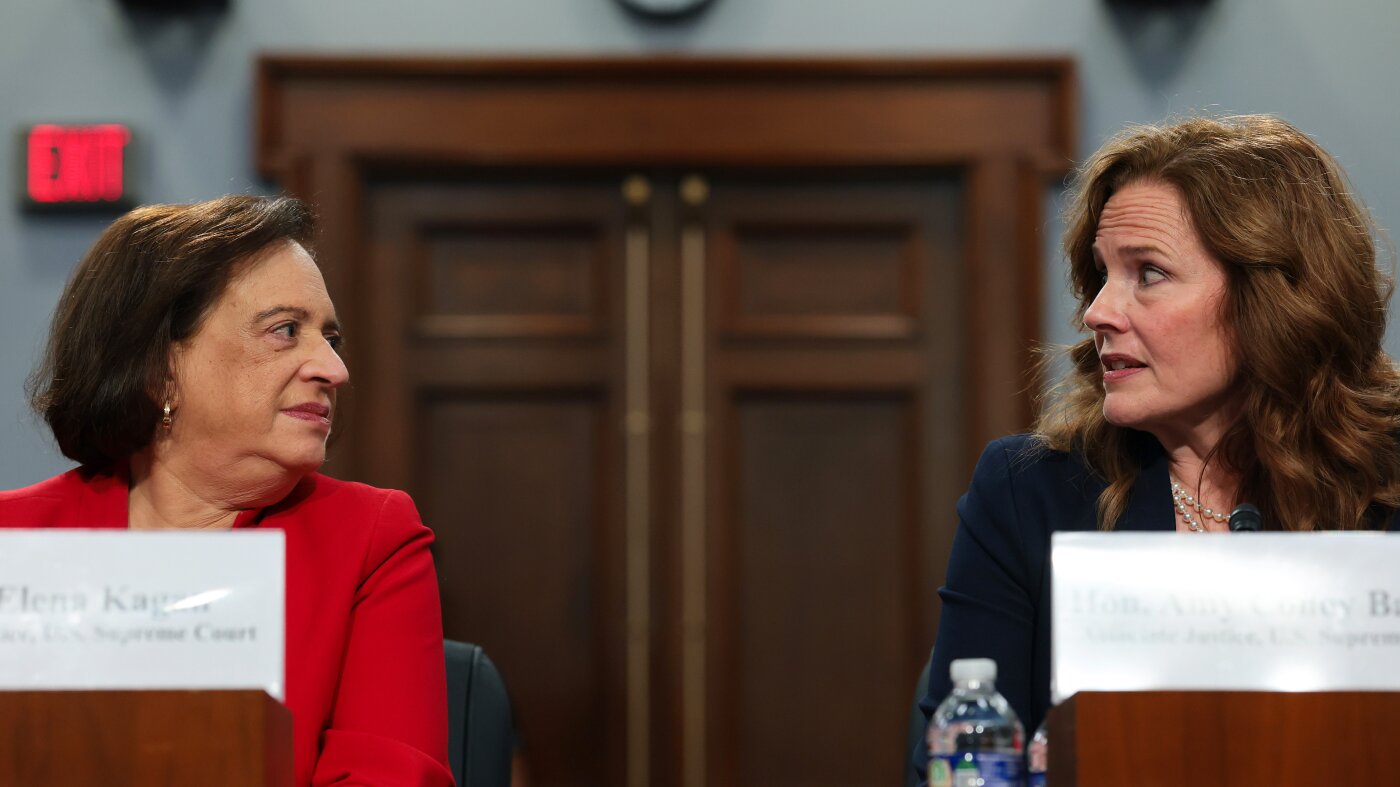
Supreme Court Justices Elena Kagan and Amy Coney Barrett testify before the House Appropriations Committee on Capitol Hill on July 14, 2026 in Washington, D.C.
Anna Moneymaker/Getty Images
hide caption
toggle caption
Anna Moneymaker/Getty Images
The Supreme Court did something Tuesday that it has not done in seven years. It sent two of the justices to Capitol Hill to testify about the court’s budget request for the coming year. The budget has grown dramatically in recent years because of the equally dramatic rise in the number and intensity of threats to the justices’ safety.
Designated as the court’s representatives were Justice Elena Kagan, appointed by President Obama, and Justice Amy Coney Barrett, appointed by President Trump.
As Kagan pointed out in her testimony, it was Republican Darrell Issa and Democrat Elijah Cummings who insisted that the court beef up its security ten years ago after Justice Antonin Scalia died in his sleep on a hunting trip, with no security anywhere nearby to respond quickly.

“They said, kind of like, we think you’re crazy, you know, that that you have less security than director of the Office of Personnel Management does,” she recounted the Congressmen as telling the Court, “and we think that you have to do better.”
Before that, the justices basically had little to no security. They drove their own cars to work; went to the movies and shopped at supermarkets unaccompanied, and did their private travel on their own. And frankly, they liked it that way, because having security is personally invasive.
In recent years, however, the court has undertaken major changes, including continually expanding the court police force to protect the justices and their homes at all times, and funding additional cybersecurity measures.
And yet, as Justice Kagan pointed out, the Court’s $207 million budget request is less than one tenth of one percent of the entire federal budget.
The justices spoke at length Tuesday about how rising threats impacted their lives. Justice Barrett came prepared with two harrowing stories. First was the day she brought home a bullet-proof vest.
“My 12-year-old son was standing in the doorway of my bedroom and he wanted to know what it was,” she testified, “and I didn’t know how to respond. I didn’t expect that performing this service was going to put me in the position of explaining to my children what a bulletproof vest was and why I had to wear one.”
She also described how just six weeks ago, her house was swatted, with local police responding to a fake emergency call. Local police could have stormed her home, but for the fact that her own security detail was there to prevent it.
Indeed, threats have deeply affected judges across America. After U.S. District Court Judge Esther Salas’s 20-year old son was murdered by a gunman seeking to kill her, many federal judges have reported receiving packages bearing the name of her slain son. Those threats, Justice Barrett testified, “are meant to intimidate and they’re meant to harass.”
Sen. Jack Reed (D-R.I.), asked questions about President Trump’s furious response to adverse rulings in the tariff and birthright citizenship cases, and whether Trump’s heaping insults on the court could play a role in jeopardizing the safety of some justices. Kagan had a two-part reply.
“Criticism is fair game. I mean, go for it. You know, life in the big city is that you’re subject to all kinds of criticism. But intimidation is a different thing entirely. And when political figures of any stripe are trying to intimidate judges,” she said, “that’s where we really have crossed the line.”
The hearings were not confined to issues of safety. Congresswoman Rosa De Lauro (D-Conn.) asked about the Supreme Court’s ethics requirements, noting that members of Congress and the executive branch are limited to gifts under $50, while the Supreme Court has no such limit.
She is supporting a bill that would impose upon the Supreme Court the same restrictions on receiving gifts that apply to Congress. And she called for an enforcement mechanism for the ethics rules adopted by the Supreme Court itself.
But Justice Kagan, who said she favors an enforcement mechanism, added that creating such a system is “hard.” After all, as she noted, “you wouldn’t want either the President or Congress” imposing a system on the court because that could well lead to compromising the independence of the judiciary.
One idea that Kagan seemed to like would be to create a panel of distinguished retired judges to enforce the court’s ethics code. But Justice Barrett seemed unpersuaded.
“Who selects the judges? How is the panel composed? There’s just a lot of complexity,” that hasn’t been worked out, she said. The disagreement between the two was, if anything, illustrative of just how hard it was to get the court to finally agree on even the relatively porous ethics code it voluntarily adopted in 2023.
The Justices were also questioned about the court’s emergency docket, dubbed by critics “the shadow docket.” These cases were extremely rare until the Trump administrations.
The critical difference between the emergency docket and the so-called merits docket is that emergency docket appeals often leapfrog over the lower courts, allowing the high court to decide cases without full briefing and argument, and inevitably without much, if any, explanation.
Critics, including Justice Kagan, have often criticized these unsigned and unexplained emergency docket orders for making it difficult for lower courts to know what the law is. Some have in fact accused the court of inviting the Trump administration to treat the docket like a fast-pass to getting policy rubber-stamped.
Questioned by Senator Chris Van Hollen (D-Md.), Kagan observed that part of the reason for the Court’s increasing use of the emergency docket comes from the fact that “we’ve granted a number of these…And when people know that relief is available, there are a lot of smart lawyers out there in the world who are going to say, ‘Why don’t we take our shot at that?’” In other words, the court’s own behavior may have invited the existing problem to metastasize.

Mexico has begun filing criminal complaints with state prosecutors in the United States over the deaths of its citizens in U.S. immigration custody and during enforcement operations, the foreign mini

Maine ICE shooting caught on security camera
Surveillance footage from two local businesses shows a white car driving in circles at a street intersection.
MEXICO CITY, July 13 (Reuters) – Mexico has begun filing criminal complaints with state prosecutors in the United States over the deaths of its citizens in U.S. immigration custody and during enforcement operations, the foreign ministry said on Tuesday.
Mexico’s government has also sent cease-and-desist letters to U.S. detention centers where Mexican nationals have died, the ministry added in a statement.
The filings follow the deaths of at least 14 Mexican nationals in ICE custody and several others during arrest operations, including the recent fatal shooting of a Mexican citizen by an ICE agent in Houston.
President Claudia Sheinbaum announced Mexico’s intention to escalate its response to the deaths last Friday, as she claimed that the government “cannot turn a blind eye to the Mexicans who have died.”
In addition to the measures in the U.S., Mexico’s foreign minister also contacted the United Nations High Commissioner for Human Rights regarding the deaths of Mexican nationals in ICE custody.
Mexico expects the U.N. office to gather information from U.S. authorities, analyze the events and “refer the case to the relevant special procedures of the Human Rights Council,” the statement added.

Michelle Mildenberg Lara for The Marshall Project
This much is undisputed: On Nov. 2, 2023, a guard and a prisoner at a federal penitentiary in California got into it over a straw sunhat that the officer had confiscated. The man — identified in court records by his initials, J.M. — walked out of the office, as Officer Sandra Munagay followed him. When he stopped and turned around, Munagay “cocked back … and punched me in my face,” he said in an interview. That is on camera. Munagay admitted to the assault and pleaded guilty this January to falsifying records about it.
But the more severe harm came after, J.M. said, in a hallway without security cameras. As Munagay kicked and hit him, she shouted to other officers that J.M. had attacked her. According to a lawsuit, at least three other guards then rushed in, forced him into a blind spot, and pinned him face-first to a wall. With J.M.’s hands cuffed, he says an officer then sexually assaulted him with an unknown object.
That night, J.M. was transferred to another prison, where a nurse noted bleeding and tenderness in his rectum, medical records show. That gave J.M. more proof than most people behind bars in his situation.

But guards still had near-total control over whether he could file a complaint, or someday sue over what happened to him. J.M. knew they could destroy his paperwork, claim it got lost, or simply deny him the forms he needed. And like he had experienced in other federal prisons, he says, they might punish him for even trying to speak out.
It’s the same dilemma presented to anyone who faces violence in federal prison: Try to file an administrative grievance and risk opening yourself up to retaliation — or stay quiet, endure the abuse, and forgo your chance to someday bring your case to court.
Under federal law, people in prison must go through the facility’s own grievance process before they can attempt to sue. That gives prison staff a “chokehold over access to the courts,” said Colin Prince, a civil rights attorney and former federal defender who is representing J.M. in his lawsuit.
“The guards functionally have power over whether a prisoner can sue them for their own misconduct,” he said. “The entire system is layer upon layer of bureaucratic insulation against accountability. It simply prevents prisoners from getting access to the courts.”
An attorney for Munagay said he and his client declined to comment. A spokesperson for the Bureau of Prisons, Randilee Giamusso, said she could not discuss individual cases or ongoing litigation.
An investigation by The Marshall Project and NPR found that less than 2% of grievances filed in federal prison in 2023 were granted. A majority were rejected for procedural errors or “administratively closed” for other reasons. The findings were based on a federal database, published by the Data Liberation Project, containing nearly 1 million federal prison grievance cases dating back to 2000.
But that data only includes instances where incarcerated people were able to file a complaint at all. An unknown number of cases, especially those involving physical and sexual violence, go unreported, as the same officers accused of abuse can silence those trying to seek help, according to court records, lawsuits, and interviews with attorneys, incarcerated people, advocates and former bureau officials. A recent report by the Government Accountability Office found that fear of retaliation was a major impediment to reducing and reporting sexual abuse in federal prisons.
Prison officials said bureau policy prohibits retaliation of any kind, and that they review and investigate allegations of abuse. In an email, Giamusso wrote that the remedy system is “a safeguard intended to foster resolution within the system, not a barrier to court access.” She noted that remedies related to sexual abuse can be submitted in other ways, such as “third-party reporting and [Prison Rape Elimination Act]-specific channels.”
But many prisoners disagree. “The grievance system is a joke,” said Jimmy Hodge, who was released from federal prison in early 2025. Hodge says he was abused in multiple federal penitentiaries, but was frequently blocked from filing complaints about it. “If you’re grieving over abuse, they’re going to harass you, they’re going to assault you, but you’re never going to get relief.”
Since the passage of the Prison Litigation Reform Act 30 years ago, which required incarcerated people to file grievances before attempting to sue, the rate of civil rights cases filed from prison has dropped significantly.
Lawmakers at the time were concerned about “frivolous” lawsuits from prisons overwhelming federal courts. Politicians pointed to one case where a person had allegedly sued over whether he received chunky or creamy peanut butter. (The case was actually about not getting a $2.50 refund for peanut butter returned to the commissary, which is the equivalent of hours of prison labor.)
“People talk a lot about prisoners filing frivolous lawsuits,” said professor Margo Schlanger of the University of Michigan Law School, who has studied prison litigation across the U.S. “But a huge number of prisoner cases are about really, really serious matters. They’re about abysmal medical care and awful conditions and failures to protect them from harm by staff or by other prisoners. They’re about sexual violations.”
Attempts to significantly reform the law have gone nowhere, Schlanger said. “Having a system that stands in the way and says, ‘You know what, because you filed that grievance after three days instead of after two, you are out of luck and out of court’ — that is a shocking betrayal of justice.”
People who are blocked from filing grievances can sometimes convince a court that the remedy system was unavailable and their lawsuit should proceed. But that is a high bar that may require documentation and the help of an attorney, which many people filing from prison don’t have.
As is, the law fails to account for all the ways prison staff can thwart someone’s attempts to follow the remedy process, attorneys say.
To submit a complaint, someone must obtain a form from their counselor or another prison employee and then return the completed form to staff. According to bureau rules, an incarcerated person must file on their own behalf, unless it is regarding sexual abuse — whether they are in the infirmary or solitary confinement or have a disability. They can receive assistance with their filing from “trained inmate aides,” someone on the outside or a staff member, Giamusso wrote.
For people in isolation, filing a complaint is even harder. “You can’t just walk over to a box on the wall that says grievances and put it in the slot,” said attorney John Boston, co-author of the “Prisoners’ Self-Help Litigation Manual.” “You’ve got to hand it to the correctional officer. And that right there is a prescription for mischief.”
Multiple people in federal prison said officers refused to provide the forms they needed. “I have had difficulty in obtaining the initial grievance form because the unit counselor who issues the forms was friends with the officer whom the complaint was about,” wrote Erick Hobbs, now incarcerated in federal prison in North Carolina. According to Giamusso, if someone can’t get a form, they can ask for help from any staffer, “proceed to the next step in the remedy process, or report concerns through alternative channels.”
Even if you can get a form, there’s no guarantee the paperwork will be filed. “I have had officers doing a ‘random shakedown’ of a cell, and remedy papers go missing,” wrote William Batton, from a federal prison in Massachusetts. Many said prisoners were often transferred to a new facility and lost their paperwork in the process. That halts a case, as any appeal requires copies of every previous response and filing.
People in federal prison have just 20 days after an incident to file a complaint. Those regarding sexual abuse are supposed to be exempt from deadlines, under the federal Prison Rape Elimination Act. There is no such exemption for physical violence.
“People who are the most hurt are often the least equipped to describe it and file a grievance promptly,” Schlanger said. “Requiring them to very speedily figure out exactly what they’re complaining about can be a very, very high hurdle.”
By the time J.M. was assaulted in California, he had served time in some of the country’s most notorious federal prisons. In 2020, he was held at Big Sandy penitentiary in Kentucky, where officers had an unofficial policy: If someone requested protective custody because they feared other prisoners, guards would beat the person asking for help. Then the guards worked together to cover up the attacks, according to court records. Six staff members at Big Sandy were convicted for their role in the abuse.
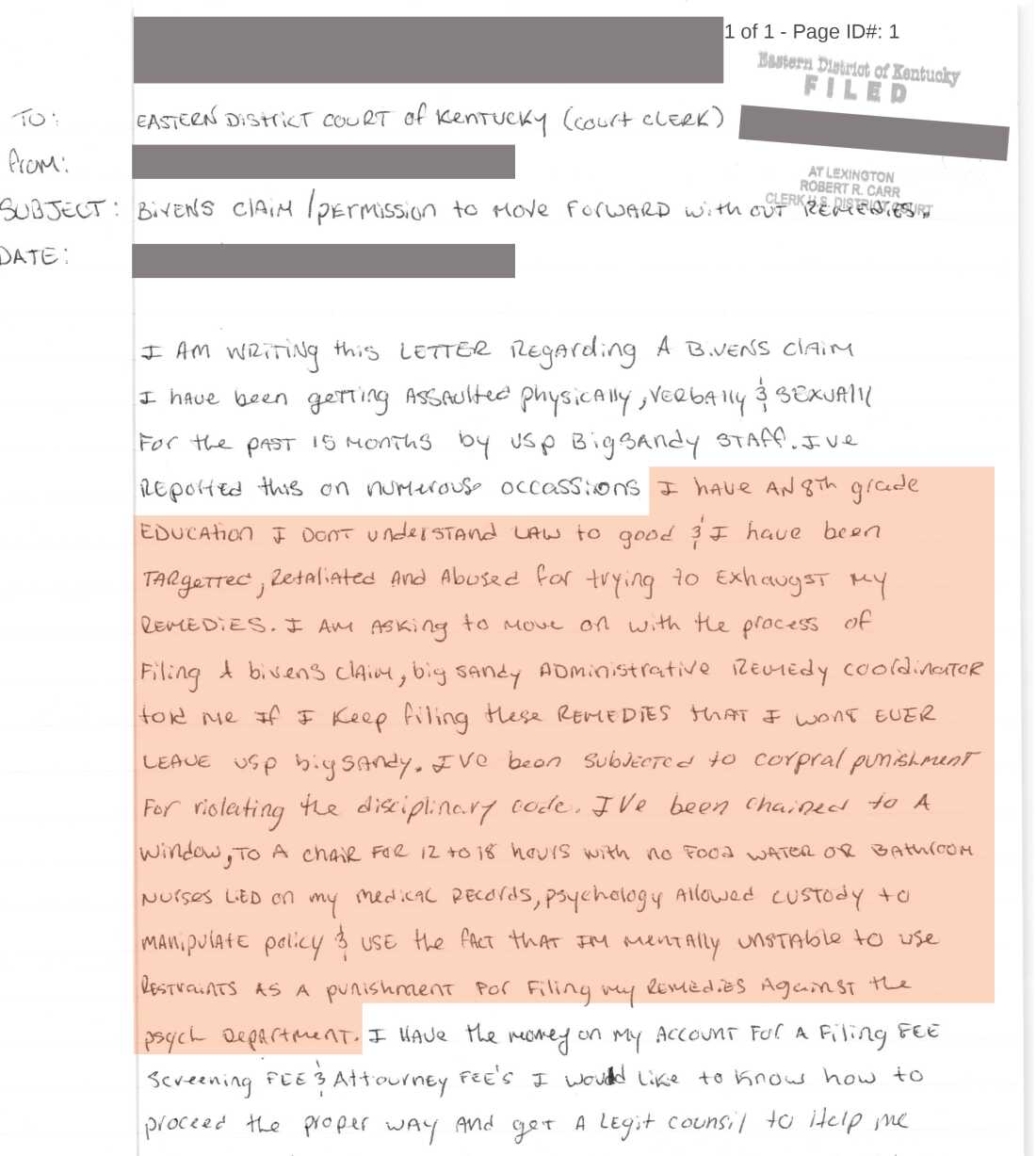
J.M. tried to report the abuse he received at Big Sandy penitentiary in 2020 to the Eastern District Court of Kentucky. The highlighting and redactions were done by The Marshall Project.
PACER
hide caption
toggle caption
PACER
When J.M. tried to report the abuse he said he suffered at the hands of Big Sandy staff, it only brought more mistreatment. “I have an 8th-grade education, I don’t understand law,” he wrote to a federal court in 2020. “I have been targeted, retaliated and abused for trying to exhaust my remedies. Big Sandy [staff] told me if I keep filing these remedies that I won’t ever leave.” In his letter, J.M. described being chained to a chair for 12 to 18 hours at a time with no “food water or bathroom.”
“Nobody should get chained to no bed for … hours for filing a piece of paper, no matter what,” J.M. said in a recent interview.
His plea to the court, like several others filed from Big Sandy at that time, went nowhere.
In one case reviewed by The Marshall Project, an incarcerated man reported being pepper-sprayed, choked, beaten with a baton and repeatedly called racial slurs by Kentucky officers who were later convicted. He tried multiple times to file grievances about the attacks but received no response before he was transferred to another prison, according to a legal complaint. When he sued in court, his case was thrown out: He hadn’t completed the final two levels of the bureau’s remedy process.
By 2021, J.M. was transferred from Big Sandy to Thomson penitentiary in Illinois, then one of the most violent federal prisons in the country. Bureau officials closed the high-security Special Management Unit there in 2023, after an investigation by The Marshall Project and NPR exposed a culture of abuse and multiple homicides.
In his legal complaint, J.M. said officers at Thomson also refused to provide him with grievance forms. In a survey of over 120 people who had been held at Thomson, conducted by legal advocacy group The Washington Lawyers’ Committee, many reported the same interference. “I’m gonna break your fucking hands since you like to write us up,” one man said he was told, after an officer confiscated his stamps and legal documents.
There are supposed to be other avenues for incarcerated people to report their abuse. But in a setting where no communication is truly anonymous, and the fear of retaliation is prevalent, even reaching out to the Inspector General felt risky, J.M. said. And it was hard to trust another government agency. “It’s like being in a house, and your mother or father is abusing you,” he explained. “And then you go and try and tell your mother or father, ‘Y’all abusing me.’ It didn’t make sense.”
In the U.S. Government Accountability Office report, published in May, investigators found that most surveyed prisoners said they could experience retaliation from staff if they reported sexual abuse. Less than half said they would feel comfortable reporting to the warden or a corrections officer. And many of the surveyed people didn’t know they had other options to report a sexual assault, like calling a rape crisis center or asking a family member to report on their behalf. The bureau agreed with the recommendations laid out in the report.
Fear of being targeted can hide systemic problems. At FCI Dublin in California, which closed in 2024 over widespread sexual abuse, officers frequently punished people for trying to file complaints, said Aron Laureano, who spent two years at the facility.
“They made it literally impossible for anybody to say anything,” she said. The first time Laureano filed a grievance, an officer came to her cell and quoted from her written complaint in front of everyone. “And that’s why they got away with it for so long.”
According to a federal lawsuit, officers retaliated against Laureano by placing her in solitary confinement, taking away her visits and phone calls, and confiscating her property. In one bizarre form of punishment, Laureano said, an officer made her walk around the prison yard, gather the eggs and baby hatchlings of geese who were roosting on the grounds, and stuff them in a trash bag.
Laureano came home from prison in 2024. “You went from one monster to another,” she said of navigating her time at Dublin. “You didn’t have anywhere to go. And I think that’s the worst feeling in the world. I told myself I would never put myself in a predicament like that again, ever.”
After the 2023 assault at Atwater penitentiary in California, J.M. was transferred to a different federal facility and locked in solitary confinement for making threats, insolence, and refusing to obey an order. In her official retelling of the incident, Officer Munagay had claimed that J.M. “walked toward me in an aggressive way” and that she “feared for [her] life.”
What happened with Munagay and the other officers followed J.M. to the new facility. “Everybody knew about the situation, it was funny to them,” he said of the guards there. “I had officers come and tell me, ‘Hey, drop the case, she’s got three kids.’” Staff also began threatening him, according to J.M.’s complaint. They told other prisoners he was a snitch, he said, and locked him in four-point restraints for hours, where each limb was chained to a concrete slab.
It wasn’t just the guards he was worried about. J.M. had seen employees turn prisoners against each other, he said, as payback for writing someone up. “If I file a remedy … my unit team is going to come … take everybody’s stuff, trash everybody’s cells, and say, ‘We’re doing this because [J.M.] complained,’” he said. “Now the other inmates are mad, ‘Oh, it’s your fault.’ Your life is in danger.”
Federal prison policy required J.M. to file his complaint at the institution level first, unless it was regarding a “sensitive” issue. Then he could mail a claim directly to the regional director. J.M. didn’t have enough postage, so he fashioned a fishing line out of plastic wrappers, and used it to trade food for stamps with other men on the tier.
His grievance was rejected. The bureau did not consider his issue “sensitive,” according to a federal database, and required him to file again at the prison level. When J.M. went to file an appeal, prison staff seized and destroyed his paperwork, his lawsuit says.
“He had been assaulted, isolated, trapped, and could not tell anyone who would listen,” his complaint states. “By mid-January 2024 … JM was expressing ‘suicidality’ to the mental-health department because he could not ‘participate’ in the ‘Administrative Remedy Process.’”
Nearly six months after his attack, prison staff dropped the disciplinary charges against J.M., as video footage showed Munagay had punched him. Federal prosecutors filed criminal charges against Munagay six months later. In June, she was sentenced to four months in prison. J.M.’s lawsuit is ongoing.
No charges have been filed regarding the sexual assault J.M. says he experienced. In 2024, there were 32 allegations of sexual abuse by staff reported at Atwater penitentiary.
J.M. has since been moved to another federal penitentiary out of state. His struggles with the grievance system continue. He’s trying to appeal a grievance he filed about not receiving his allotment of postage stamps, but he doesn’t have enough stamps to mail the paperwork.
“I’m resilient. I’m not going to give up just because other people failed,” he said about his commitment to keep trying to use the system. “I’m going to keep filing no matter how small or big the situation is, and hopefully something will change. These are the rules I gotta follow. This is the only way I got to fight.”
-

 Los Angeles, Ca53 minutes ago
Southern California hits hottest day of its extreme heat warning
-

 Detroit, MI1 hour ago
Steve Yzerman out as Detroit Red Wings GM, moves to senior advisor role
-
 San Francisco, CA1 hour ago
Supervisors urge California to expand S.F. speed-camera program
-

 Dallas, TX2 hours ago
Five teens injured after crashing carjacked vehicle during Dallas police chase
-

 Miami, FL2 hours ago
Tokyo-style Neapolitan pizza is coming to Miami, led by legendary pizzaiolo chef Bun
-

 Boston, MA2 hours ago
SEE THE GOOD: Roxbury center reminds young adults ‘You got this’ – Boston News, Weather, Sports | WHDH 7News
-
Denver, CO2 hours ago
Five Points affordable housing building honors Dr. Justina Ford | Rocky Mountain PBS
-

 Seattle, WA2 hours ago
Seattle weather: Hot and sunny day Wednesday, highs in the 80s


