News
‘Songs from the Hole’: The story behind JJ’88’s documentary and visual album


Actors gaze up to the sky during JJ’88’s “ROOT” in the hip-hop artist and former inmate’s documentary and visual album Songs from the Hole. Before the song starts, protagonist and producer James “JJ’88” Jacobs describes meditating on his and others’ redemption while incarcerated and in solitary confinement.
Courtesy of Netflix
hide caption
toggle caption
Courtesy of Netflix
“‘I’m dangerous,’ they said.”
Through tears over the phone, James Jacobs, the hip-hop artist who goes by the stage name of JJ’88, tells his father that the hearing to reduce his sentence was denied. In April 2004, a 15-year-old Jacobs shot and killed an 18-year-old at a party in Bellflower, Calif. At the time he received the letter rejecting his request for a resentencing in 2020, he had lived more years in prison than outside of it.
“They don’t believe me. They don’t believe who I am,” he continues. “They said that all the work that I’m doing, my art and my advocacy work … they said that it’s not real. They say I am a clear and present threat to the community.”
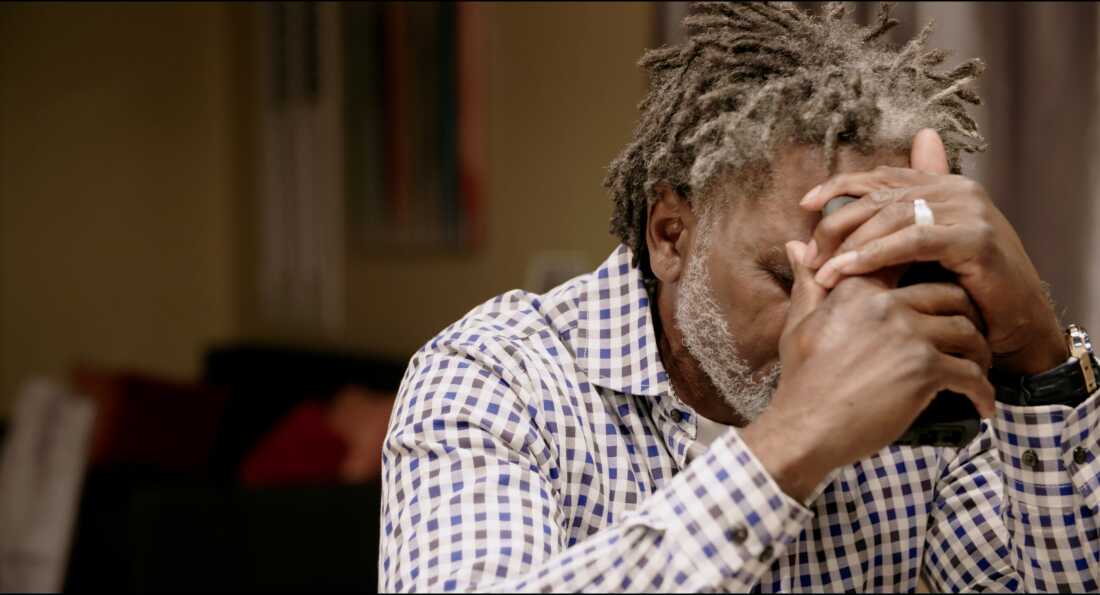
In 2020, Jacobs was denied a hearing to reduce his prison sentence. His father, pictured here, grapples with the news while trying to comfort his son.
Courtesy of Netflix
hide caption
toggle caption
Courtesy of Netflix
As his father tries to comfort him, an automated voice cuts in: “You have 60 seconds remaining.”
Filmmaker and director Contessa Gayles was in the room with Jacobs’ father as he received that call.
“I remember, too, after that moment, obviously being incredibly concerned for you and your well-being,” Gayles tells Jacobs during an interview with NPR, “but I hesitated, for a long time, to ask you if you wanted to continue with the film. … I just was too afraid for your answer.”
The pair had been working with Jacobs’ producer on a documentary and visual album together. But he said he did want to continue.
“I’ve seen hard moments in film before, I’ve seen hard moments talked about in music — really hard moments — and this was one of the hardest moments in my life,” Jacobs says. “I love [Shakespeare’s] Titus Andronicus — it’s a tragic story, and I remember reading that and I was, like, ‘this is art too’ — it doesn’t always have to be this fairytale Disney ending that I was used to, as a kid and as a fan of films. Some stories end in, ‘this guy found spiritual enlightenment but died in prison.’ That’s the wisdom of the world, I guess. That’s the wisdom of our universe. I couldn’t argue with it, so I was comfortable [with continuing the film].”

Actor Miles Lassiter, as “kid James,” wears antlers in Songs from the Hole. Jacobs says it’s the image he’s asked about most often. “These antlers, along with being [for the song] ‘Most Hunted,’ are very gun-hunting, violent-culture — the experience, as a Black man, was that [Black men] were being hunted like deer, like buck in this country. And early references of Black men in this country — we were called Bucks. And so I thought — we [Jacobs and Gayles] thought — it was fitting … that this character represented the coming-of-age through antlers and the symbolism of being hunted with antlers on his head.”
Courtesy of Netflix
hide caption
toggle caption
Courtesy of Netflix
Songs from the Hole follows Jacobs’ story as he reflects on his coming-of-age within California’s state prison system, finds healing in an unlikely place and contemplates forgiveness. After meeting and befriending Gayles when she was on assignment for CNN at California’s Correctional Training Facility, commonly known as Soledad State Prison, in 2017, Jacobs and his producer, Richie Reseda, reached out with an ambitious idea: to direct and bring to life the visual album that Jacobs had written entirely from solitary confinement. The request reached Gayles at an important moment of her career: when she was ready to pursue independent filmmaking.

Gayles says she was inspired, during the making of Songs from the Hole, by the 2014 film Boyhood. “I was just thinking about representations that we have of white childhood and the plethora that exists of those depictions, and that often, with storytelling around Black people — Black young people — it’s very limited in scope. And so I was just meditating on, ‘[Richard] Linklater spent 12 years making [Boyhood] about white childhood,’ and I was just saying in my head, ‘we deserve to have as much space to be as indulgent and wide-ranging with how we tell the stories of Black childhood.’”
Courtesy of Netflix
hide caption
toggle caption
Courtesy of Netflix
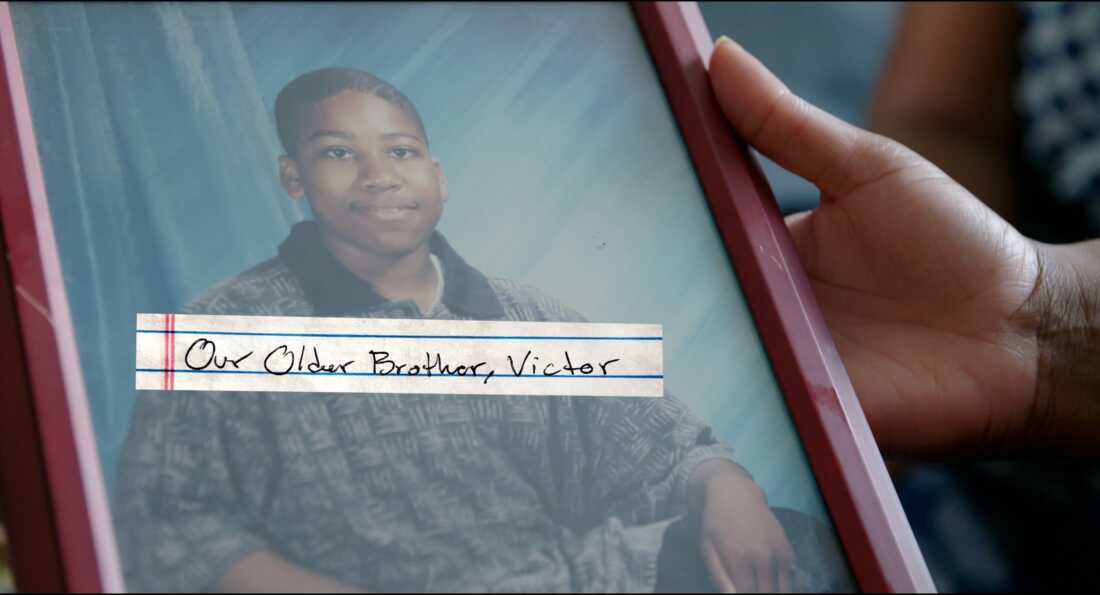
Reneasha Jacobs holds a photograph of her and James’ older brother, Victor Benjamin. Benjamin was shot and killed on April 19, 2004.
Courtesy of Netflix
hide caption
toggle caption
Courtesy of Netflix

Actors reenact a memory from Jacobs’ childhood in Songs from the Hole. In the film, Jacobs says, “Memories are crucial in maintaining your sanity in prison. I remember — maybe accurately or inaccurately — but I remember things from my childhood and relive them, sitting on that bunk, and it reminds me that I was a person and I am a person before being incarcerated.”
Courtesy of Netflix
hide caption
toggle caption
Courtesy of Netflix
![Actor Myles Lassiter portrays young Jacobs lying in the bed of a pickup truck, holding a toy gun, during the song, "Most Hunted." Jacobs says the visual was important to him because "in the song itself, I mentioned ... a couple of references to 'Friday,' one of them being during the hook, 'the government launched four drones. Still, I need a Glock to walk Smoke home. I'm not a man with it. I'm a man without it.' And those lines kind of hint toward quotes from the film 'Friday,' which is where Craig [played by Ice Cube] is in the room with his father. He just discovered that his father just discovered that he owns a gun. And [his dad] says, "Back in my day, we would use these," [referencing his fists]. Are you a man or are you not?" And [Craig] says, 'I'm a man without it. I'm a man without this gun.' And I knew when I first saw that, that I was like, 'I'm a man without a gun, but in this world, they don't see a man unless I have a gun."](https://npr.brightspotcdn.com/dims3/default/strip/false/crop/3840x2076+0+0/resize/1100/quality/50/format/jpeg/?url=http%3A%2F%2Fnpr-brightspot.s3.amazonaws.com%2F73%2Fbf%2F5306a1244a41b25fddca6158fdfd%2Fsfth-most-hunted-truck-bed.jpg)
Actor Myles Lassiter portrays a young Jacobs lying in the bed of a pickup truck, holding a toy gun, during the song, “Most Hunted.” Jacobs says the visual was important to him because “in the song itself, I mentioned … a couple of references to ‘Friday,’ one of them being during the hook, ‘the government launched four drones. Still, I need a Glock to walk Smoke home. I’m not a man with it. I’m a man without it.’ And those lines kind of hint toward quotes from the film ‘Friday,’ which is where Craig [played by Ice Cube] is in the room with his father. He just discovered that his father just discovered that he owns a gun. And [his dad] says, ‘Back in my day, we would use these [referencing his fists]. Are you a man or are you not?’ And [Craig] says, ‘I’m a man without it. I’m a man without this gun.’ And I knew when I first saw that, that I was like, ‘I’m a man without a gun, but in this world, they don’t see a man unless I have a gun.’”
Courtesy of Netflix
hide caption
toggle caption
Courtesy of Netflix
Throughout its production, the visual album quickly evolved into a documentary, heavily inspired by Beyoncé’s Lemonade. Where Beyoncé added poetic interludes between songs, in Songs from the Hole, the audience learns about Jacobs’ story and how his music spiritually liberates him while simultaneously being among the reasons officials cited for not considering his request for resentencing.

Gayles uses messages Jacobs wrote while in solitary to portray his vision for the album. When asked about the decision, Galyes says, “We really made use of 88’s handwriting because it was so much a part of his process.” She said she also felt “it would be more impactful to have the audience experience 88 in a similar manner to his loved ones … which is primarily over phone calls and letters.”
Courtesy of Netflix
hide caption
toggle caption
Courtesy of Netflix
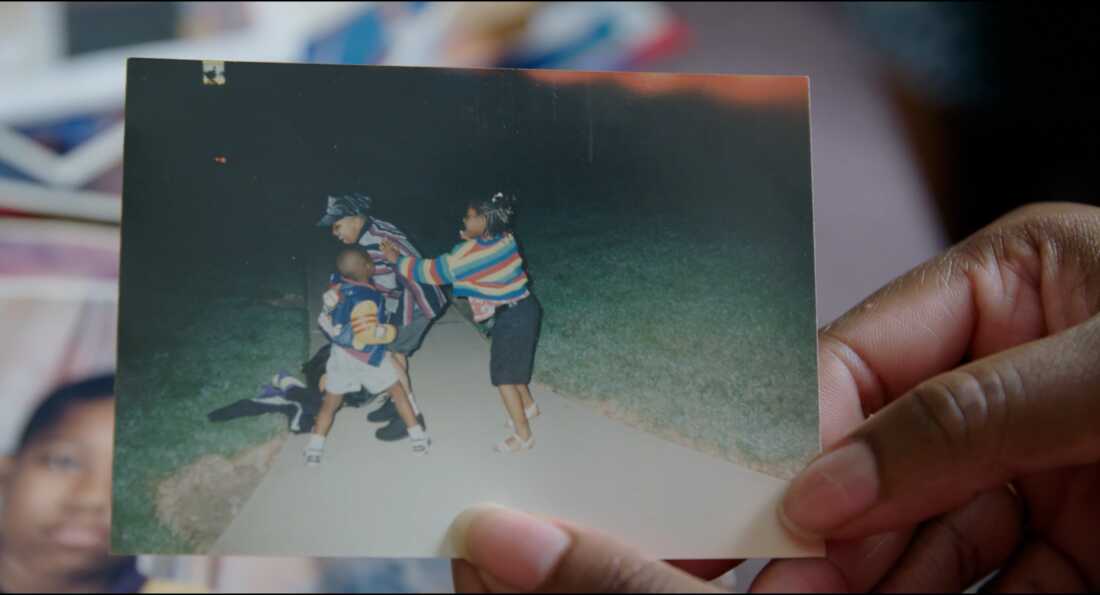
Reneasha Jacobs, James’ older sister, holds an old photograph of herself and her two brothers from when they were kids. James shot and killed someone on April 16, 2004. Three days later, their older brother was murdered.
Courtesy of Netflix
hide caption
toggle caption
Courtesy of Netflix
The film relies heavily on Jacobs’ letters and recorded phone calls, through which he, Gayles and Reseda talk about the album’s production. The letters consist of scripts, shot lists and lyrics. Through the calls, Jacobs serves as the film’s narrator, speaking about his life and the symbolism of the imagery he’d dreamt up in solitary. The film explores cultural themes that touch on Black boyhood, familial relationships, growing up in the church, crime, forgiveness and redemption.
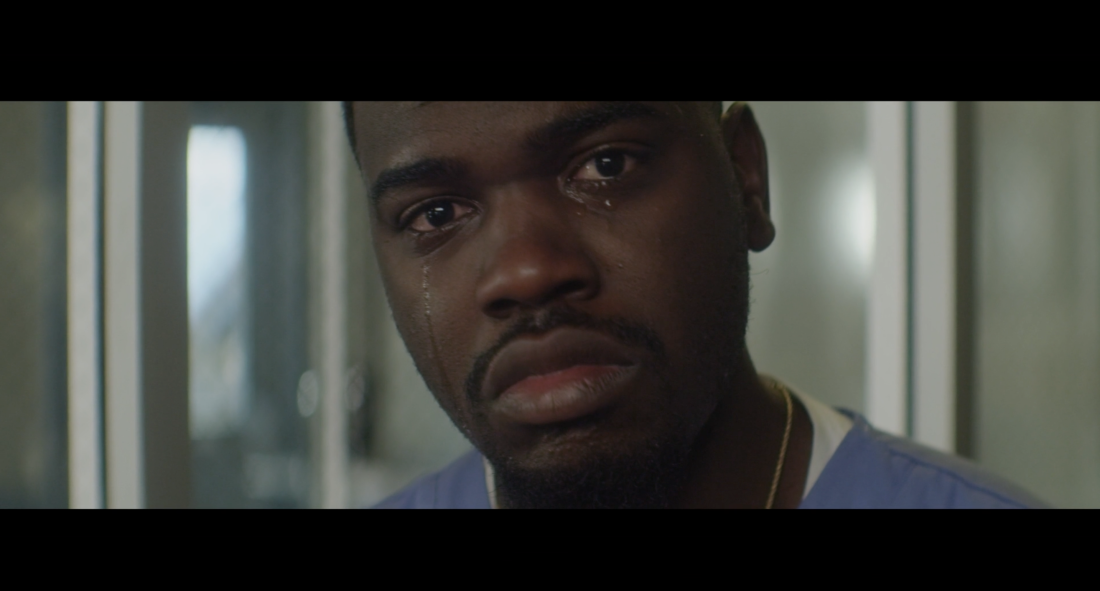
Actor Devonte Hoy depicts Jacobs forgiving the man who murdered his brother. In the film, Jacobs says, “Tears start coming down my face. And I said, ‘Man, you killed my brother.’ And the first thing out of his mouth was, ‘I’m sorry for what I took from you, bro.’ … And I just told him, ‘Man, I forgive you. If you want my forgiveness, you have it.’ And I got up and left.”
Courtesy of Netflix
hide caption
toggle caption
Courtesy of Netflix
Jacobs was released in 2022, after serving 18 years in prison.
Now, with the film streaming on Netflix and the team holding screenings in prisons across the country, Jacobs says he hopes the parole board commissioners who kept him locked up think differently about him if they see the film.
“If only you understood me, you’d see my humanity,” he says in the film.
“I would absolutely love to show this film to the commissioners that told me I was a danger to society,” he told NPR. “I would love it. I can’t wait to catch word that they watched it so that I can see — let’s talk again; I don’t even have to go to board, but I would love to talk to you now.”

Hoy depicts an older Jacobs talking to his father through glass during a visitation. In the film, Jacobs says he had just finished writing two verses of his song “Steel Grave,” and rapped both verses over the phone for his dad. When he finished, Jacobs says his father asked him, “What happens to the character? You just described he was in this dark world. Does he ever come out?”
Courtesy of Netflix
hide caption
toggle caption
Courtesy of Netflix
Songs from the Hole is currently streaming on Netflix. Find more of JJ’88’s work at linktr.ee/jj_eightyeight and on Instagram, at @jj_eightyeight, and more of Contessa’s work on her website, ContessaGayles.com, or on Instagram, at @contessagayles.

News
“It’s blood money”: Family of exonerated man in Texas yogurt shop murders speaks out after settlement

The widow and the daughter of Maurice Pierce, one of the four men wrongfully accused in the 1991 Texas yogurt shop murders, have confirmed they signed a multimillion-dollar settlement with the city of Austin.
Kimberli and Marisa Pierce spoke with correspondent Erin Moriarty in a new episode of the podcast “48 Hours: Case by Case.” Moriarty has reported on the yogurt shop murders for over 30 years.
Maurice Pierce’s widow Kimberli made clear that their priority has never been financial compensation. “It’s blood money for us. He died for this money,” Kimberli Pierce said. “It’s about the reform and the changes that need to happen, not only in Austin, but apparently across the country.”
They also went into great detail about what they believe happened when Maurice Pierce was shot and killed by police in 2010.
Maurice Pierce was one of four men, along with Michael Scott, Robert Springsteen and Forrest Welborn, who were wrongfully accused in the murders of four teenage girls in Austin on Dec. 6, 1991. Eliza Thomas, Amy Ayers, and sisters Jennifer and Sarah Harbison were tied up, shot and left inside the yogurt shop as it was set ablaze.
The four men were exonerated in February after investigators linked another man, Robert Eugene Brashers, to the killings. The city of Austin subsequently offered a $35 million settlement. Because Maurice Pierce died in 2010, his share of $10 million will go to Kimberli and Marisa Pierce.
Eight days after the killings, 16-year-old Maurice Pierce was arrested at a mall, carrying a .22, the same caliber handgun connected to the crime. Kimberli Pierce said police told Maurice Pierce that his gun was the murder weapon. He responded by mentioning his friend Forrest Welborn. Maurice Pierce was then wired up and sent to speak with Welborn, but investigators ultimately determined that Welborn and the others knew nothing about the murders, and no charges were filed at that time.
Marisa Pierce has said there was no evidence when her father was questioned, “only a detective and a narrative, a narrative so completely false. It feels evil.”
Nearly eight years later, in 1999, all four men were arrested after Scott and Springsteen confessed to the murders. They later recanted, saying they had been coerced. Springsteen and Scott were tried and convicted, but later those convictions were overturned on constitutional grounds. A subsequent DNA test excluded all four men. Maurice Pierce was never convicted but spent three years in jail before his release in 2003.
Kimberli Pierce said her husband came home a hardened man. She believes police continued to harass Maurice and their family after his release. In 2010, Maurice Pierce was stopped for a routine traffic stop, fled on foot, and was shot and killed by an Austin police officer who said Pierce had stabbed him with a knife.
Marisa and Kimberli Pierce told “48 Hours” that they intend to review the circumstances surrounding the night of Maurice Pierce’s death. Marisa Pierce revealed in new, emotional detail that she was on the phone with her father at the time. She believes he panicked and was only trying to get away, not to hurt anyone. She described her father’s last breaths: “And in those last moments, he had just said I’m sorry, I don’t think you’re gonna see me again, and I love you.”
“48 Hours” reached out to the Austin Police Department about the Pierces’ allegations of harassment and their questions about Maurice Pierce’s death in 2010. The police department said they had no additional comment.
For the Pierce family, the settlement is a starting point, not an end point. They have put forward seven proposed reforms they hope the city of Austin will approve, including appointing a child advocate whenever a minor is questioned, prohibiting deceptive interrogation tactics, educating juveniles about their rights and establishing accountability measures to address tunnel vision in police investigations.
In a statement shared with “48 Hours,” the Pierces wrote: “Real justice is not only about acknowledging harm after the fact but about creating safeguards that prevent future families from enduring the same pain.”
This year, Maine nearly became the first state to pass a statewide moratorium on new data centers. But before the law could take effect, supporters of an A.I. data center project in the small town of Jay rallied to fight the ban — and won. So why do residents there want one? We traveled to Jay to find out.

The U.S. Supreme Court
Drew Angerer/AFP via Getty Images
hide caption
toggle caption
Drew Angerer/AFP via Getty Images
The U.S. Supreme Court on Thursday handed the Trump administration a tool that could make it far more difficult for asylum seekers to enter the United States.
Asylum is a form of legal protection available to people fleeing persecution in their home countries if they meet certain criteria. Under U.S. law, an asylum seeker who “arrives in” the U.S. is entitled to apply for asylum and generally cannot be removed from the country until their asylum application is processed.
By a 6-3 vote, the high court ruled that federal law allows the government to stop asylum seekers from physically setting foot in the country, effectively keeping them from applying for asylum.
The Obama administration was the first to try stemming the flow of asylum seekers that way. But the lower courts blocked the policy on grounds that it violated federal law by denying asylum to people who otherwise would have qualified for it, had they been permitted to literally put one foot over the border.
The Trump administration, however, sought to revive the policy, contending that the lower court’s ruling “deprives the Executive Branch of a critical tool for addressing border surges and preventing overcrowding at ports of entry.” And on Thursday, the Supreme Court agreed.
Writing for the majority, Justice Samuel Alito ruled that because asylum seekers are not in the U.S. when they are turned away at the border, they did not “arrive in” the country. Therefore, he continued, the legal protections for asylum seekers have not kicked in.
Writing for the liberal dissenters, Justice Sonia Sotomayor noted that Border Patrol agents speak with all immigrants at legal entry points and speaking with an agent is effectively the first step in “arriving in” the U.S.
-

 Alabama1 minute ago
Best downtowns in Alabama? These 10 towns made the list
-

 Alaska6 minutes ago
Lavrov Challenges Rubio: Kremlin Says Trump-Putin Reached Deal as Moscow Questions Washington’s Neutrality
-

 Arizona13 minutes ago
Central Arizona is home to the ‘World’s Oldest Rodeo.’ Here’s what to see and do there
-

 Arkansas16 minutes ago
Sanders announces Medicaid work requirement soft launch for Arkansas ARHOME recipients
-

 California21 minutes ago
Newsom urges a national ‘billionaires’ tax’ while fighting one in California
-

 Colorado28 minutes ago
Avalanche Re-Signs Kulak | Colorado Avalanche
-
 Connecticut31 minutes ago
40 Years, Zero Accountability: The Union Deal That’s Been Emptying Connecticut’s Wallet
-

 Delaware36 minutes ago
Major bills loom as Delaware lawmakers face final day of session

