News
Poland's president visits Donald Trump as allies eye a possible return


Republican presidential candidate former President Donald Trump walks with Poland’s President Andrzej Duda at Trump Tower in midtown Manhattan in New York on Wednesday, April 17, 2024.
Stefan Jeremiah/AP
hide caption
toggle caption
Stefan Jeremiah/AP

Republican presidential candidate former President Donald Trump walks with Poland’s President Andrzej Duda at Trump Tower in midtown Manhattan in New York on Wednesday, April 17, 2024.
Stefan Jeremiah/AP
Former President Donald Trump met Wednesday in New York with Polish President Andrzej Duda, the latest in a series of meetings with foreign leaders as Europe braces for the possibility of a second Trump term.
The presumptive Republican nominee hosted Duda at Trump Tower, where the two discussed the war in Ukraine and Duda’s push to boost NATO members’ defense spending, according to a readout from Trump’s campaign. Duda, who has long expressed admiration for Trump, is also a staunch supporter of Ukraine and has encouraged Washington to provide more aid to Kyiv amid Russian’s ongoing invasion. That funding has been held up by Trump allies in Congress.
As he arrived, Trump praised the Polish president, saying, “He’s done a fantastic job and he’s my friend.”
“We had four great years together,” Trump added. “We’re behind Poland all the way.”
Following the almost 2 1/2 hour meeting, Duda said only that it was a “friendly meeting in very nice atmosphere.”
His aide, Wojciech Kolarski, also in attendance, described it as an “excellent meeting” of “two friends who reminisced on the time when for four years they cooperated while holding presidential offices,” a time that was “very fruitful for Polish-U.S. relations.”
Duda is the latest foreign leader to meet with Trump in the weeks since he locked up the Republican nomination. U.S. allies across the world were caught off guard by Trump’s surprise 2016 win, forcing them to scramble to build relationships with a president who often attacked longstanding treaties and alliances they valued. Setting up meetings with him during the 2024 campaign suggests they don’t want to be behind again.
Even as he goes on trial for one of the four criminal indictments against him, Trump and Democratic President Joe Biden are locked in a rematch that most observers expect will be exceedingly close in November.
While some in Poland worried the visit might damage the country’s relationship with Biden, Sen. Chris Murphy, D-Conn. — a Biden ally and a major voice in his party on foreign affairs — said such meetings make sense.
“The polls are close,” he said. “If I were a foreign leader — and there’s a precedent attached to meeting with candidates who are nominated or on the path to being nominated — I’d probably do it too.”
Murphy noted that former President Barack Obama did a lengthy international tour and met with foreign leaders when he first ran for the White House. So did Mitt Romney, the former Massachusetts governor, who challenged Obama in 2012 and whose trip included a stop in Poland’s capital, Warsaw.
Duda’s visit comes a week after Trump met with British Foreign Secretary David Cameron, another NATO member and key proponent of supporting Ukraine, at the former president’s Florida estate.
In March, Trump hosted Hungarian Prime Minister Viktor Orbán, an autocrat who has maintained the closest relationship with Russia among European Union countries. Orbán shared a montage of footage of the visit on his Instagram feed, which included an image of him and his staff meeting with Trump and the former president’s aides in a scene that looked like an official bilateral meeting.
Trump also met briefly in February with Javier Milei, the fiery, right-wing populist president of Argentina who ran a campaign inspired by Trump, complete with red “Make Argentina Great Again” hats. Milei gave Trump an excited hug backstage at the annual Conservative Political Action Conference outside Washington, according to video posted by a Trump campaign aide.
Biden administration officials have been careful not to weigh in publicly on foreign leaders’ meetings with Trump, acknowledging he has a real chance of winning the race.
While some officials have privately expressed frustration with such meetings, they are mindful that any criticism would open the U.S. to charges of hypocrisy because senior American officials, including Secretary of State Antony Blinken, meet frequently with foreign opposition figures at various forums in the United States and abroad.
Security and policy officials monitor the travel plans of foreign officials visiting the U.S., but generally don’t have a say in where they go or with whom they meet, according to an administration official who spoke on the condition of anonymity to discuss protocol.
Trump has been back in his hometown this week for the start of his criminal hush money trial, which has dramatically limited his ability to travel and campaign. While in town, aides have been planning a series of events that began Tuesday evening when Trump, after court adjourned, stopped by a Harlem bodega where a man was killed to rail against crime, and to blast the district attorney who made him the first former president in U.S. history to stand criminal trial.
Duda, a right-wing populist who once proposed naming a military base in his country “Fort Trump,” described the dinner earlier Wednesday as a private get-together between friends at Trump’s former residence while he is in town for meetings at the United Nations, where Duda is to deliver a speech.
“I have been invited by Mr. Donald Trump to his private apartment,” Duda told reporters, saying it was “a normal practice when one country has good relations with another country” to want those relations to be as strong as “possible with the representatives of various sides of the political stage.”
“We know each other as people. Like two, I can say in some way, friends,” said Duda, whose term ends in 2025.
Duda’s visit comes as House Republicans wrangle over a $95 billion foreign aid bill that would provide new funding to Ukraine, including money for the U.S. military to replace depleting weapon supplies. Polish leaders have been urging the House to approve the aid bill and ease domestic concerns.
Many Trump allies in the House are fiercely opposed to aiding Ukraine, even as the country warns that it is struggling amid a fresh Russian offensive. Trump has said he might be open to aid in the form of a loan.
One area where Trump and Duda agree when it comes to the conflict is a desire to push NATO members to increase their defense spending. Duda has called on fellow members of the alliance to raise their spending to 3% of gross domestic product as Russia continues its invasion of Ukraine. That would represent a significant increase from the current commitment of 2% by 2024.
Trump, in a stunning break from U.S. precedent, has long been critical of the Western alliance and has threatened not to defend member nations that do not hit that spending goal. That threat strikes at the heart of the alliance’s Article 5, which states that any attack against one NATO member will be considered an attack against all.
In February, Trump went even further, recounting that he’d once told leaders that he would “encourage” Russia to “do whatever the hell they want” to members that are — in his words — “delinquent.”
Trump’s campaign said the two discussed the NATO proposal during the meeting. The two also discussed Israel and the Middle East, Trump’s 2017 trip to Warsaw, “and many other topics having to do with getting to world peace,” the campaign said in its readout, which described the men as “great friends.”
The visit was met with mixed reaction in Poland, where fears of Russia run high and Duda’s friendly relationship with Trump has been a source of controversy.
Poland’s centrist Prime Minister Donald Tusk, a political opponent of Duda, was critical of the dinner but expressed hope that Duda would use it as an opportunity “to raise the issue of clearly siding with the Western world, democracy and Europe in this Ukrainian-Russian conflict.”


This combination of photos shows Spain forward Lamine Yamal (L) and Argentina star Lionel Messi competing earlier during the World Cup. Spain and Argentina will meet in the 2026 World Cup final Sunday afternoon in East Rutherford, N.J.
Charly Triballeau, Roberto Schmid/AFP via Getty Images
hide caption
toggle caption
Charly Triballeau, Roberto Schmid/AFP via Getty Images
NEW YORK — The final day of a summer of FIFA World Cup fever in North America, and the last of 104 matches, has finally arrived, as the world’s top two ranked national teams — Spain and Argentina — will kick off at 3 p.m. Eastern time for the right to lift the sport’s most coveted trophy.

A crowd of 80,000 people is expected to pack into the stands of MetLife Stadium in New Jersey just outside of New York City, where the cheapest tickets were going for nearly $10,000 on secondary market sites.
For days, wildfire smoke had swept over New York. Then a downpour on Saturday and a flash flood alert. But by Sunday morning, with a sunny forecast calling for clear skies and a high of 80 degrees at kickoff, all of that was in the rearview mirror.
For Spain, a win would mark a meteoric rise for a young and thrilling squad and their 19-year-old phenom Lamine Yamal, who despite an injury to his quad earlier this spring, has flashed greatness throughout the tournament.
Spain has beaten three of the world’s top-ten teams to reach the final — first a 1-0 win over No. 5 Portugal, then a 2-1 quarterfinal win over No. 9 Belgium, and most impressive, a 2-0 win in the semifinal over No. 3 France, whose attack had looked unstoppable until then. Spain has conceded only one goal in their seven World Cup games so far.
Meanwhile, for Argentina, a win would cap a historic and dominant era that has included the 2022 World Cup title, two Copa América trophies and the 2022 Finalissima — all while the team has been led by the global megastar Lionel Messi. “They are an excellent opponent, an excellent national team that has had a spectacular run over the last eight or 10 years since this group came together,” said Spain’s coach Luis de la Fuente on Friday.
Argentina’s road to New York has been paved with improbable wins, one after another. In none of their four knockout games did Argentina hold the lead when the clock reached 90 minutes. Twice they have escaped with a stoppage time game-winner; twice they have escaped after going ahead in extra time.
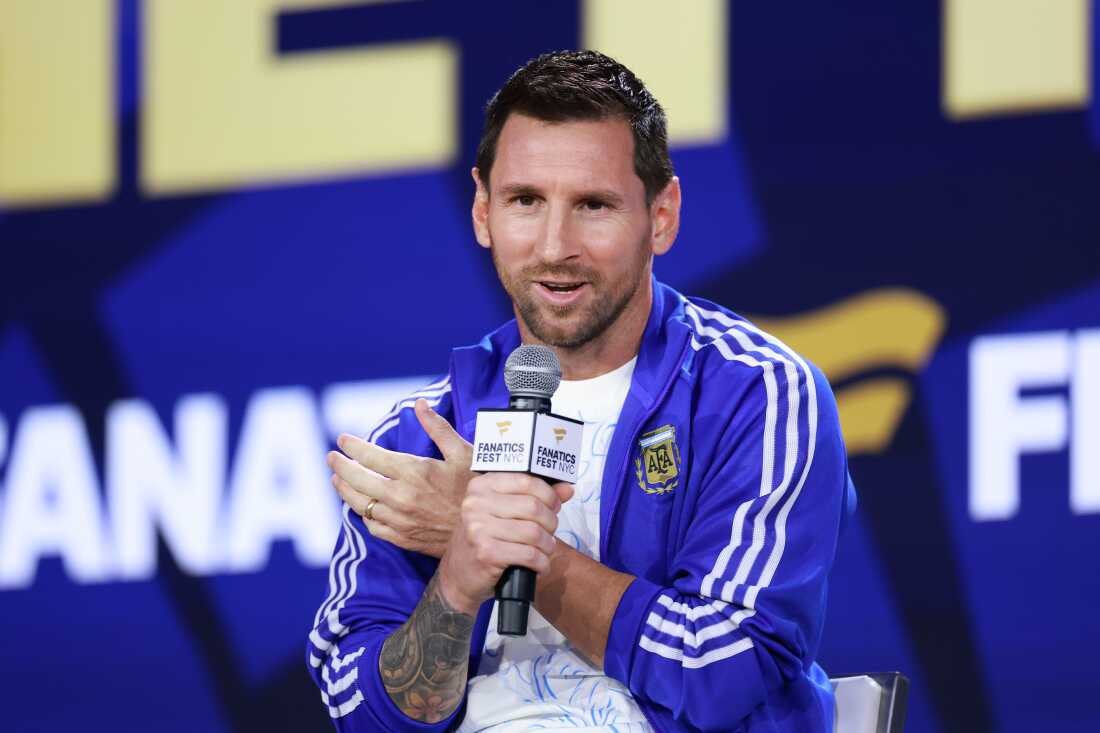
Lionel Messi of Argentina speaks on stage at a fan event in New York City on Friday before Sunday’s FIFA World Cup Final between Spain and Argentina.
Elsa/Getty Images
hide caption
toggle caption
Elsa/Getty Images
At 39 years old, Messi’s performance in this World Cup has been nothing short of unbelievable: His eight goals and four assists — including assists on both crucial late-game goals in the heart-stopping semifinal against England — put him in second place behind only France’s Kylian Mbappé. He scored twice in Saturday’s bronze medal loss to England and now has ten goals.
“Messi is something else. He is an irreplaceable player, a player with extraordinary talent, and above all he is an example,” de la Fuente said. “His attitude and his behavior, at the age he is now and with the World Cup he is having, are truly spectacular.”
Asked Friday whether the final would be Messi’s last time wearing the Argentina shirt, coach Lionel Scaloni smiled and shrugged. “I wouldn’t know what to tell you. I don’t know, because he never stops surprising us,” he said.
The comparisons between Messi, 39, and Yamal, who just turned 19 last week, are irresistible. Both were prodigies in the famed Barcelona academy La Masia who burst into stardom as teenagers in the club’s red and blue stripes. Yamal now wears No. 10 for Barcelona, the number Messi wore until he left the club in 2021.

Sunday’s match is the first head-to-head competition between the two, who are 20 years apart in age. Famously — and improbably — they first met when Yamal was a baby as part of a UNICEF charity calendar photo shoot.
Asked about the photo at a fan Q&A event on Friday in New York, Messi called it “una locura” — a madness. “That’s life,” he said with a smile. “I took a photo when he was a baby, and now the two of us are facing each other in a World Cup final.”
Yamal is a “tremendous” player, Messi added. “At just 19 years old, he is already one of the world’s leading players. He has his entire career ahead of him, and he has a great opportunity to achieve something historic [on Sunday].”
“We’ll do everything we can to make sure it doesn’t happen this time,” he joked.

A drone show takes place displaying the message “FIFA World Cup 2026 The Final” with the graphic representing the host countries of Canada, the United States and Mexico, in front of the Lower Manhattan skyline on Friday in Jersey City, N.J.
Justin Setterfield/Getty Images
hide caption
toggle caption
Justin Setterfield/Getty Images
At every stadium, the songs, cheers and tears of joy from thousands of Argentina fans, as their team has drawn closer and closer to hoisting a second consecutive trophy, has given Argentina’s players even more motivation to finish with a win, they say.
“We have reclaimed something that I think is very valuable: that people stand in front of the television in their Argentina shirt and give each other a hug, a Newell’s fan with a [Rosario] Central fan, and a Boca [Juniors] fan with a River [Plate] fan,” Scaloni said Friday, naming some of Argentina’s most famous domestic clubs and their biggest rivals.
“We see it. We feel it. We keep it in mind,” said Scaloni. “How could it not move you?”

Topline
The National Weather Service is cautioning people in Midwest and Northeast states to monitor local air quality as smoke from hundreds of Canadian wildfires continues to pour over the border and American politicians rail against the country as over 150 fires burn out of control.
People sit near the Brooklyn Bridge as wildfire smoke from Canada causes hazy conditions on July 16, 2026 in New York.
AFP via Getty Images
Key Facts
The National Weather Service issued air quality alerts early Saturday morning due to wildfire smoke spanning portions of Minnesota, Michigan, Indiana, Ohio, West Virginia, Virginia, Maryland, Delaware, New Jersey, New York, Connecticut, Rhode Island, Massachusetts, Vermont, New Hampshire and Maine.
Smoke will continue to affect New York City through the afternoon, according to the National Weather Service, which noted in a statement that “upstream areas in the Midwest and UpperGreat Lakes will likely contend with poor air quality” at least through Sunday.
New York, including New York City, New Jersey, Pennsylvania, Ohio, Connecticut, Rhode Island, Delaware and Maryland dealt with “unhealthy” air and a widespread haze from the smoke on Friday.
The smoke is spilling across borders from roughly 820 wildfires burning in Canada, 156 of which are still designated “out of control.”
President Donald Trump said Friday he would increase tariffs against Canada because of the wildfires, accusing the country of “not properly maintaining their Forests, and Brush.”
Republican members of Congress also slammed Canada’s government for what they perceived as inaction in preventing and stopping the wildfires causing the smoke and poor air quality, with one even calling for sanctions.
Four Michigan Republicans—Reps. John James, Jack Bergman, John Moolenaar and Lisa McClain—said in a letter this week that Canada “has the tools to prevent” the smoke from pouring into the U.S. and “has chosen not to,” and Sen. Bernie Moreno (R-Ohio) said in a post on X that he will table a bill next week to “sanction Canada and the responsible Canadian government officials for this atrocity.”
CRUCIAL QUOTE
“Our constituents are breathing the consequences of this failure right now, and they deserve better than to be told, again, that it will be handled,” the Michigan lawmakers said in their letter.
HOW TO STAY SAFE FROM WILDFIRE SMOKE
Those in states with extreme air quality warnings are being cautioned to limit outdoor activity and, in states with very unhealthy and hazardous warnings, to stay inside altogether with windows closed. Doctors advise anyone with heart or lung disease to stay indoors, and other groups to take precautions. For people who work outside, health officials have recommended wearing an N95 mask, which can filter at least 95% of airborne particles.
WHY IS WIldFIRE SMOKE SO DANGEROUS?
Smoke from wildfires is made of water vapor, pollutants and particulate matter, which can penetrate the lungs and bloodstream, trigger systemic inflammation, exacerbate conditions like asthma and increase the risk of heart attacks and strokes. Smoke also contains a mix of harmful gases, most notably carbon monoxide. Wildfire smoke has been linked to respiratory and cardiovascular health problems, with children and teenagers, older adults, pregnant people and anyone with pre-existing heart or lung conditions at a particular risk.
SHOULD PEOPLE IN WILDFIRE SMOKE STATES WEAR A MASK?
When the Air Quality Index rises to unhealthy levels, masks are recommended for people who must spend time outside. Respirator masks worn correctly may provide some protection against fine particles in the smoke, but they do not help with hazardous gases. Staying inside is considered the safest option, but those who must go outside can mitigate some risk by wearing a mask. N95 or P100 respirators are considered the most effective.
Key background
Scientists say climate change is creating hotter, drier conditions and longer fire seasons, increasing the likelihood of large, intense wildfires across North America. NASA says human-caused warming is driving more frequent and severe wildfire conditions in many regions, and that extreme wildfire activity has more than doubled worldwide over the past two decades. Research shows fire seasons in some areas are now more than a month longer than they were 35 years ago, and those larger fires also produce more smoke, allowing hazardous air pollution to travel hundreds or even thousands of miles and affect millions of people far from the flames.
BIG NUMBER
$394 billion to $893 billion. That’s the annual cost of wildfires in the United States each year, according to the Joint Economic Committee, including direct and indirect deaths and injuries, health impacts from wildfire smoke, income loss, watershed pollution and other factors.
further reading

ICE agents stand guard outside a immigrant detention center in Newark, New Jersey in May 2026. Medicaid officials improperly shared data about millions of people with ICE, who then shared that data with the data analytics firm Palantir, according to new court filings.
Adam Gray/Getty Images
hide caption
toggle caption
Adam Gray/Getty Images
After Medicaid officials improperly shared data about millions of people in January with immigration officials, ICE then shared that data with the data analytics firm Palantir, according to new court filings. Palantir operates an app called ELITE that is used by ICE agents to show the addresses of noncitizens who may be subject to deportation.
That revelation was made public in a motion filed Thursday by more than 20 Democratic attorneys general who sued the Trump administration last year over its data-sharing agreement between the Centers for Medicare and Medicaid Services and ICE.

U.S. District Judge Vince Chhabria in California ruled in December that health officials could share with ICE certain details from Medicaid data about immigrants without lawful status from the states that had sued, such as home addresses, dates of birth and immigration status.
Chhabria, who was appointed by former President Obama, then temporarily paused data sharing between CMS and ICE for immigration enforcement purposes in late May after federal officials admitted CMS had shared data with ICE in January that went beyond what the court order allowed. One dataset of refugees in Minnesota included U.S. citizens, and another that was transferred on Jan. 7 contained data of millions of people, including those in the country legally.

ICE was supposed to delete the improperly shared data. Chhabria set a hearing for August to further clarify his order and clear up ambiguity regarding which categories of noncitizens’ data could be lawfully shared with ICE.
But in recent days, federal officials have admitted to additional instances of improper data sharing.
In a court filing last week, the Justice Department said that CMS again inadvertently reshared with ICE the dataset with millions of names that CMS had first improperly shared with ICE in January. The government said the error occurred during an effort to share data from states not involved in the lawsuit.
Alberto Briseno, a section chief for ICE’s Homeland Security Investigations, wrote in a declaration that ICE personnel deleted the file after it was discovered and it was not used for law enforcement purposes.

Then Briseno revealed that a day later, the agency had done a broader search and discovered that half a dozen users still had a copy of the Jan. 7 dataset.
In that most recent declaration, Briseno said he was not aware of any additional copies of the dataset, but said the recent searches have “highlighted technological difficulties of making a representation that every possible variation of the file has been searched for and located.” He added, “ICE will continue to make good faith efforts to delete any copies that may be found in the future.”
Meanwhile, the Department of Justice is asking the judge to expand his order to allow ICE to receive data on a broader category of noncitizens – to potentially include all immigrants who are not legal permanent residents, citizens or have another form of permanent status.
“ICE’s inability to identify Medicaid records in its possession undercuts any claim that the agency should be entitled to more access to that data,” the Democratic attorneys generals wrote in their motion filed late Thursday.
Their motion continued, “Each successive revelation of a violation of the Order makes it more difficult for Plaintiff States to have confidence in Defendants’ ability to maintain and secure this data in compliance with the Order, and more difficult for Plaintiff States to communicate assurances to Medicaid providers, enrollees (and their counsel), and the public at large about the privacy and confidentiality of their healthcare data.”

Palantir did not immediately return a request for comment about whether the company had deleted the Jan. 7 dataset that ICE had shared after improperly receiving it from CMS. DHS also didn’t immediately return a request for comment about its transfer of data to Palantir.
According to a declaration filed by California deputy attorney general Anna Rich, when plaintiffs asked what federal officials did to ensure Palantir and other contractors had purged the data, defendants responded that the data had been shared over a Microsoft Teams chat and the shared data was deleted from the chat. Rich shared in her declaration a document turned over in discovery from federal officials that shows a redacted transcript of what appears to be ICE personnel asking Palantir to delete the file.
In an April 30 hearing, Chhabria had warned the federal government would not be able to continue using Medicaid data for deportation efforts if it continued improperly sharing the data of citizens and legal immigrants.
“If the federal government cannot be sufficiently careful then it can’t use the information, ok?” Chhabria had said.
-

 Denver, CO56 seconds ago
How much are Denver Broncos worth after Seahawks’ reported $9.6 billion sale?
-

 Seattle, WA7 minutes ago
Seattle Weather: A sunny Sunday, temperatures heating up
-

 San Diego, CA13 minutes ago
Thomas Michael Hardy, Sr. – San Diego Union-Tribune
-

 Milwaukee, WI19 minutes ago
Milwaukee’s Bradford Beach busy during break from wildfire smoke
-

 Atlanta, GA25 minutes ago
Atlanta Falcons a Surprise Leader in NFL Stat
-

 Minneapolis, MN31 minutes ago
9 injured in mass shooting outside Minneapolis nightclub, police say
-

 Indianapolis, IN37 minutes ago
Fever take down Liberty 108-88 to win second straight game
-

 Pittsburg, PA43 minutes ago
Some wildfire smoke lingers on Sunday in Pittsburgh, but sunshine and warmth return

