Politics
Robert F. Kennedy Jr. says he has qualified for California's presidential ballot

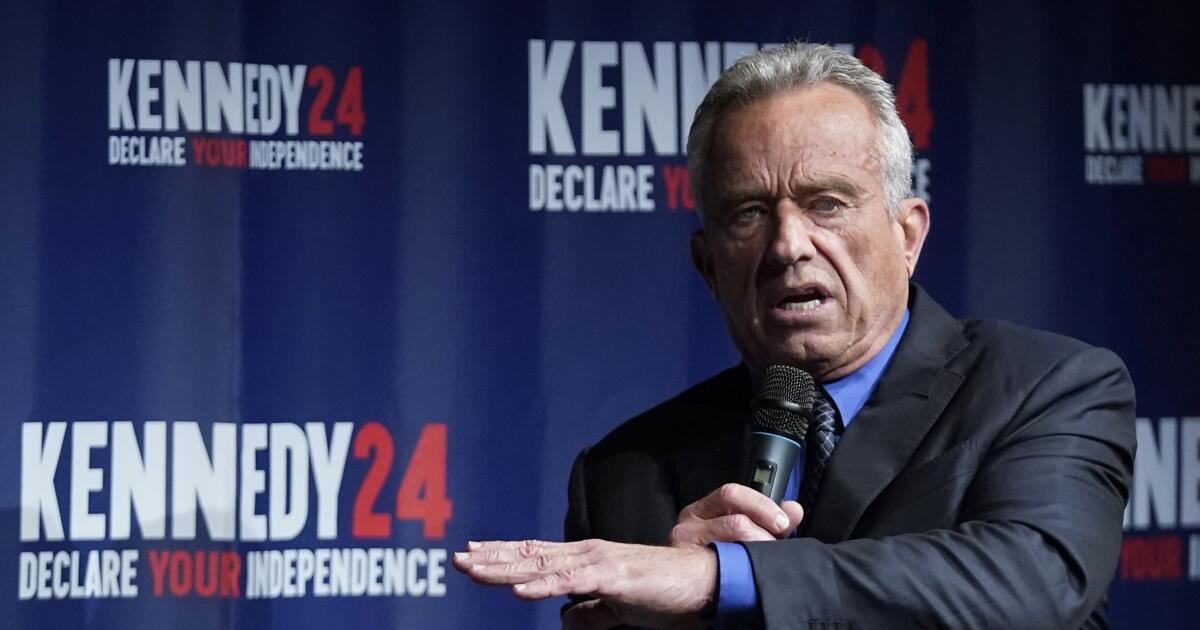
Robert F. Kennedy Jr. said Tuesday that he has qualified for California’s presidential election ballot, giving his third-party candidacy a long shot chance at collecting 54 electoral votes this fall.
If his spot on the ballot is certified by the California secretary of state, which could come in August, he would represent the American Independent Party. The secretary of state’s office confirmed to The Times that Kennedy’s candidacy had been submitted by the party.
The party has a controversial history dating back to 1968, when it nominated Alabama Gov. George Wallace as its candidate for president. He ran opposing desegregation and championing states’ rights. Kennedy’s father, Sen. Robert F. Kennedy (D-N.Y.), was assassinated in Los Angeles the night he won that year’s California presidential primary.
Kennedy says he has qualified for the ballot in California, Hawaii, Michigan and Utah. The political scion has been investing heavily and seeking alternate paths to the ballot since he opted out of running in the Democratic primary late last year. He recently selected California tech lawyer, entrepreneur and political newcomer Nicole Shanahan as his vice presidential running mate.
In a video statement released Tuesday, Kennedy said the AIP was “so impressed by this outpouring of democratic energy and vigor. … So they approached my campaign and offered us their spot on the California ballot. I see this story as a symbol of America’s homecoming .”
He added that he saw Wallace as a “bigot” who “was antithetical to everything my father believed in.”
In recent years, the American Independent Party has been a source of confusion for voters seeking to avoid registering as either a Republican or a Democrat. In California, voters may register as having no party preference, but The Times reported in 2016 that tens of thousands of voters had registered for AIP, many of them in error. Nearly three in four people did not realize they had joined the party, a survey of registered AIP voters conducted for The Times found.
The American Independent Party now exists only in California, but Wallace won 46 electoral votes nationally as its standard bearer in 1968, one of the most successful third-party runs in modern history.
The party now is not segregationist and in recent years officials told the Times that it “is a conservative, constitutionalist party.”
In the past its opposed abortion, and the 2024 March California primary voter guide said that AIP members “are all refugees from the Republican or Democrat parties. We believe the Constitution is the contract America has with itself. Its willful distortion led to the violation of our 10th Amendment guaranteed right to limited government — which inevitably requires oppressive taxation. Its faithful application will lift that burden.”
In a statement Tuesday, AIP state Chairman Victor Moroni said: “We all deserve to find inspiration at the ballot box. Our party is pleased to provide the opportunity for all 22 million voters in California to vote for Robert F. Kennedy Jr. for President. Voters crave a real leader who will unite America.”
The move could have an impact on the presidential race in California, but not enough to change the expected outcome.
A March poll from the UC Berkeley Institute of Government Studies and The Times found President Biden leading former President Trump by 18 percentage points statewide in a head-to-head matchup. That dropped to 12 points when independent and minor party candidates such as Kennedy were included.
In battleground states, Kennedy’s ability to qualify for the ballot could prove pivotal. In Michigan, like in California, Kennedy latched onto a smaller party — the Natural Law Party — that long held a ballot line. His success in these efforts appears to have led Trump to ratchet up his attacks on the Los Angeles resident. The former president said on social media over the weekend that Kennedy was “far more LIBERAL than anyone running as a Democrat.”
In Michigan, recent polls have shown the race essentially tied between Trump and Biden with Kennedy a distant third. Polls in other battleground states show a tight contest but Trump in most cases leading.
Kennedy’s campaign has been on the receiving end of vicious attacks from Democrats who view him as a spoiler with extreme views that could result in another term for Trump. They point to his skepticism of certain vaccines. In a 2021 podcast, Kennedy told parents to “resist” the U.S. Centers for Disease Control and Prevention’s guidelines on vaccinating their children.
Through the years he has repeatedly spread falsehoods about the effectiveness of vaccines, and more recently said the COVID-19 lockdowns were something a totalitarian state would do, likening them to Nazi Germany.


NEWYou can now listen to Fox News articles!
The House has officially shipped a colossal bipartisan housing package to President Donald Trump, and lawmakers are hoping that, at the very least, he doesn’t veto it.
Trump was supposed to sign the 21st Century ROAD to Housing Act last week, but his last-minute decision to ghost the signing ceremony with House Speaker Mike Johnson, R-La., and Senate Majority Leader John Thune, R-S.D., put into question whether the bill was dead.
His refusal to sign the bill, which passed with overwhelmingly bipartisan support in both chambers, was to leverage the Safeguarding American Voter Eligibility (SAVE) America Act, which doesn’t currently have the votes to succeed in the Senate.
WARREN TELLS TRUMP TO ‘SIGN THE DAMN BILL’ AS BIPARTISAN HOUSING PACKAGE REMAINS STALLED IN WASHINGTON
Trump has refused to sign the 21st Century ROAD to Housing Act. (Shawn Thew/EPA/Bloomberg via Getty Images)
Trump appears to be in no hurry to sign the bill, despite Republicans who are hungry for a win in the affordability fight ahead of the midterm elections.
“It’s so unimportant … compared to the SAVE America Act,” Trump told reporters in the Oval Office on Monday. “I think the SAVE America Act is exactly what it says. It’s saving America from crooked elections.”
“Here’s what I would like to sign, much more than a bill that — big deal, it’s a yawn,” he continued. “Some people say it’s wonderful. To me, compared to the SAVE America Act, just about everything is a big yawn.”
GOP INFIGHTING OVER TRUMP’S VOTER ID BILL ERUPTS AS TOP SENATOR CALLS STRATEGY ‘FANTASY’
It’s legislation that is loaded with nearly 60 provisions from both sides of the aisle in both chambers that’s designed to make it easier for homes to be built and for younger Americans to buy their first home. It also includes a ban on hedge funds buying up housing stock that Trump pushed Congress to include during the State of the Union earlier this year.
Sen. Elizabeth Warren, D-Mass., one of the architects behind the bill in the upper chamber alongside Sen. Tim Scott, R-S.C., charged that Congress handed the bill to Trump “on a silver platter.”
“When you ask me what happens next, if he cared about the American people, he’d have already signed the damned thing, and we’d be underway,” Warren said on WCVB’s “On the Record” on Sunday.
But Trump doesn’t have to put his signature on the bill for it to become law.
IRATE REPUBLICANS ACCUSE TRUMP OF HANDING DEMOCRATS A WIN AFTER BLOWING UP HOUSING PACKAGE
The Senate advanced a massive, Trump-backed housing package geared toward lowering the costs of homes and supercharging the housing supply. Sen. Elizabeth Warren, D-Mass., pitched it as legislation to prevent America from becoming a “nation of renters.” (Jemal Countess/Getty Images for Protect Borrowers; Anna Moneymaker/Getty Images)
The Constitution grants presidents the ability to veto a bill within 10 days of it being transferred over to the White House. In that scenario, Congress could override a veto of the housing package.
It’s happened before under the Trump administration. In early 2021, Congress overrode Trump’s veto of the annual National Defense Authorization Act — a massive Pentagon funding authorization package that some House Republicans are trying to use as a vehicle to pass the SAVE America Act.
But during that 10-day period, if Trump doesn’t sign the bill, it would automatically become law. That’s unless Congress completely adjourns, in which case a “pocket veto” could happen. The Senate is currently in recess and the House is scheduled to leave town by week’s end, but neither count as a full adjournment.
CLICK HERE TO DOWNLOAD THE FOX NEWS APP
Johnson, who spent the last few days meeting with Trump at the White House about the housing bill and the SAVE America Act, said: “I hope he does sign it.”
“If he doesn’t, it’s still law,” Johnson said. “We’ll still celebrate it, but he’s trying to make a point, and I think he’s making it very effectively. And the fact that you all ask me every three steps down the hallway illustrates that he has achieved the desired objective, and that is to make SAVE America the number one thing, because if we don’t get that right, everybody’s concerned about what happens next.”

Britain’s culture minister may challenge Paramount Skydance’s takeover of Warner Bros. Discovery — presenting a potential speed-bump to David Ellison’s plan to wrap up his $111-billion deal by September.
Earlier this month, Paramount secured the U.S. Justice Department’s blessing to buy the Warner assets, which include CNN, HBO, Cartoon Network, Animal Planet and the Warner Bros. film and TV studios in Burbank.
Paramount also must win the approval of British and European regulators, who are known for drilling deeply into media matters because of their influence on society.
Britain’s Competition and Markets Authority took a preliminary step this month by opening an investigation into Ellison’s proposed merger.
On Tuesday, Lisa Nandy, Britain’s Secretary of State for Culture, Media and Sport, notified Parliament that she was inclined to intervene in the blockbuster deal.
In a written statement, Nandy cited her ability to weigh in on “public interest grounds,” due to concerns about maintaining a competitive media market in Britain.
“The UK’s move to intervene in the Paramount–WBD deal confirms what we’ve been saying for months. The real regulatory risk was never in the US — it’s in Europe,” Forrester VP Research Director Mike Proulx said Tuesday in a statement.
While Nandy cautioned she has not made “a final decision on intervention at this stage,” she has invited Paramount and Warner Bros. to respond to her concerns by July 6.
June 2026 photo of Culture, Media and Sport Secretary Lisa Nandy arriving at Downing Street for the weekly Government cabinet meeting in London.
(Alishia Abodunde/Getty Images)
Paramount did not offer immediate comment.
The company owns CBS News, children’s channel Nickelodeon and Channel 5, one of the largest over-the-air television broadcasters in the United Kingdom.
Warner Bros. Discovery owns CNN, Cartoon Network and TNT Sports, which broadcasts the Olympics, Champions League and Premier League soccer matches.
“I am conscious that the proposed acquisition is global in nature,” Nandy wrote in her statement. “In reaching this decision, my focus has been, and will remain, on the UK public interest and the range of services available to UK audiences, including Channel 5, TNT Sports, Cartoon Network, Nickelodeon, and CNN International, as well as Paramount+ and HBO Max.”
If Nandy decides to intervene, the Office of Communications, known as Ofcom, would launch an assessment of the deal. Britain’s Competition and Markets Authority also would determine how the merger might reshape the competitive landscape.
Teams from the two companies have been huddling for months to plan for the melding of the two operations as soon as Paramount receives all of its regulatory approvals.
Australia, New Zealand, China, Saudi Arabia, Ukraine, Serbia, France and Italy have already given their approvals to the deal.
Saudi Arabia’s Public Investment Fund is planning to contribute $10 billion to help the billionaire Ellison family pull off the merger, which would make the Saudi royal family a significant, although passive, equity owner. In addition, the royal families of Qatar and Abu Dhabi have agreed to each contribute $7 billion in equity financing.
The Federal Communications Commission must evaluate the foreign ownership stakes due to Paramount’s holding of CBS broadcast licenses. U.S. antitrust regulators already have concluded the combination would not violate federal anticompetition laws.
Approval had been expected because President Trump — who has friendly ties with Ellison and his father, tech billionaire Larry Ellison — favors the deal.
Trump has been eager for changes at CNN.
The U.S. government stopped short of asking Paramount to make concessions or divestitures. Many expect that Paramount may have to reconfigure its children’s television holdings abroad due to the proposed combination of two large players — Nickelodeon and Cartoon Network.
Nandy suggested that Britain also should scrutinize the impact of combining two major streaming services HBO Max, a Warner property, with Paramount+.
HBO programming, including “Game of Thrones,” “Boardwalk Empire,” and “Succession,” has long been popular in Britain.
A coalition of state attorneys general, led by California Atty. Gen. Rob Bonta, also is expected to challenge the deal, in part, due to concerns about news media consolidation. Bonta’s office has said the matter remains under review.
Opposition to the deal has been building in the U.S. for months. A group of Hollywood activists — led by actors Jane Fonda and Mark Ruffalo — have spearheaded a “block the merger” campaign that now has support from more than 5,000 entertainment workers.
The group’s open letter calls on Bonta to take action to thwart the Ellison expansion effort. Paramount’s Chief Legal Officer Makan Delrahim has blasted the campaign, calling it “fear-mongering” and a partisan distortion of antitrust law.
Forrester’s Proulx noted differences in attitudes toward the deal among the various constituencies.
“For US consumers, this merger has become a proxy fight about political influence and control of media,” Proulx said. “In the UK, it’s being treated as a structural competition issue where regulators, not consumers, will decide how this deal plays out and how long it takes.”
Politics
Fetterman unleashes on ‘dirtbag’ wing of Dems after far-left victories: ‘Orgy of socialism’

NEWYou can now listen to Fox News articles!
Sen. John Fetterman, D-Pa., unloaded on his own party on Sunday evening, blasting a series of victories for progressives he called “anti-America.”
“Big night for the dirtbag left,” Fetterman said, referring to New York’s recent primaries, where two members of the Democratic Socialists of America (DSA) won primaries.
“I’ve said the party is becoming an orgy of socialism. Clearly anti-America, anti-Western Civilization,” Fetterman said.
Fetterman’s striking calls give a rare look at how some moderates may view the developments on their far-left flank that have dominated the party’s momentum in recent months, sparking concern that their high visibility is dragging the party further and further left.
FETTERMAN WARNS DEMOCRATS ‘DRIFTING FIRMLY INTO COMMUNISM’ AFTER SOCIALIST PRIMARY WINS
Sen. John Fetterman, D-Pa., speaks to reporters outside the Senate Chamber during votes on Nov. 10, 2025, on Capitol Hill in Washington, D.C. (Andrew Harnik/Getty Images)
His comments come on the heels of a handful of key progressive victories.
In Maine, Graham Platner, a controversial Democratic candidate for U.S. Senate, has attracted controversy for denying knowledge of the meaning behind a Nazi-linked tattoo, for off-color comments about race and calling himself a “communist” in a deleted Reddit post.
In New York, one DSA member, Claire Valdez, won a primary on a platform of abolishing ICE and a Green New Deal-style approach to climate change. Similarly, Darializa Avila-Chevalier, another DSA candidate, beat out incumbent Rep. Adriano Espillat, D-N.Y., a high-ranking Democrat and the chair of the Congressional Hispanic Caucus.
WINNERS AND LOSERS EMERGE AFTER SOCIALIST EARTHQUAKE ROCKS NYC PRIMARIES
Graham Platner, Democratic Senate candidate for Maine, speaks at a primary election night event at the Blue Hill YMCA in Blue Hill, Maine, on June 9, 2026. Platner won the party’s Senate primary after a campaign marked by accusations of past misbehavior and voter concerns. (Graeme Sloan/Bloomberg via Getty Images)
Both Chevalier and Valdez had the backing of New York Mayor Zohran Mamdani, himself a socialist.
The wins have captured national attention and drawn criticisms from Republicans who have pointed to their success as emblematic of the direction of the Democratic Party.
Fetterman, who has not shied away from confrontations, has been one of the few Democrats to express alarm about the kind of candidates carrying the party’s banner.
“I mean, you look at some of the things that people have said. Abolish prison, abolish the border, abolish ICE, I mean these crazy people — I have colleagues in my caucus that refuse to even call this out,” Fetterman said.
FETTERMAN REACTS TO MAMDANI’S REFUSAL TO ACCEPT SUPREME COURT’S IMMIGRATION RULING
U.S. Sen. John Fetterman, D-Pa., walks through the Senate Subway during the Senate War Powers vote on April 22, 2026, in Washington, D.C. (Heather Diehl/Getty Images)
CLICK HERE TO DOWNLOAD THE FOX NEWS APP
“Between P-hustle in Maine and some of the other winners in New York, they should form their own party and run on all the things that they’ve had to delete on social media,” Fetterman said, referring to Platner.
“That’s where our party has moved,” he added.
-

 Los Angeles, Ca57 minutes ago
Los Angeles County man convicted of sex trafficking, abusing woman he was dating
-

 Detroit, MI1 hour ago
Detroit Tigers tee off on New York Yankees with 5 homers in win
-

 San Francisco, CA1 hour ago
Popular brewery shutters San Francisco location amid industry woes
-

 Dallas, TX2 hours ago
Eight arrested after repeated attempts to enter World Cup matches without tickets
-

 Miami, FL2 hours ago
Reports: Heat add potent bench scorer in Tim Hardaway Jr.
-

 Boston, MA2 hours ago
Boston Pops gearing up for major July 4th celebration: ‘You only turn 250 once’ – Boston News, Weather, Sports | WHDH 7News
-

 Denver, CO2 hours ago
Colorado wildfires destroy more than 100 structures, force more evacuations
-

 Seattle, WA2 hours ago
Will Katie Wilson’s endorsements help or hurt Seattle’s position in Olympia?

