Connect with us

News

Judges threatened with impeachment, bombs for ruling against Trump agenda

Published

on

Judges threatened with impeachment, bombs for ruling against Trump agenda

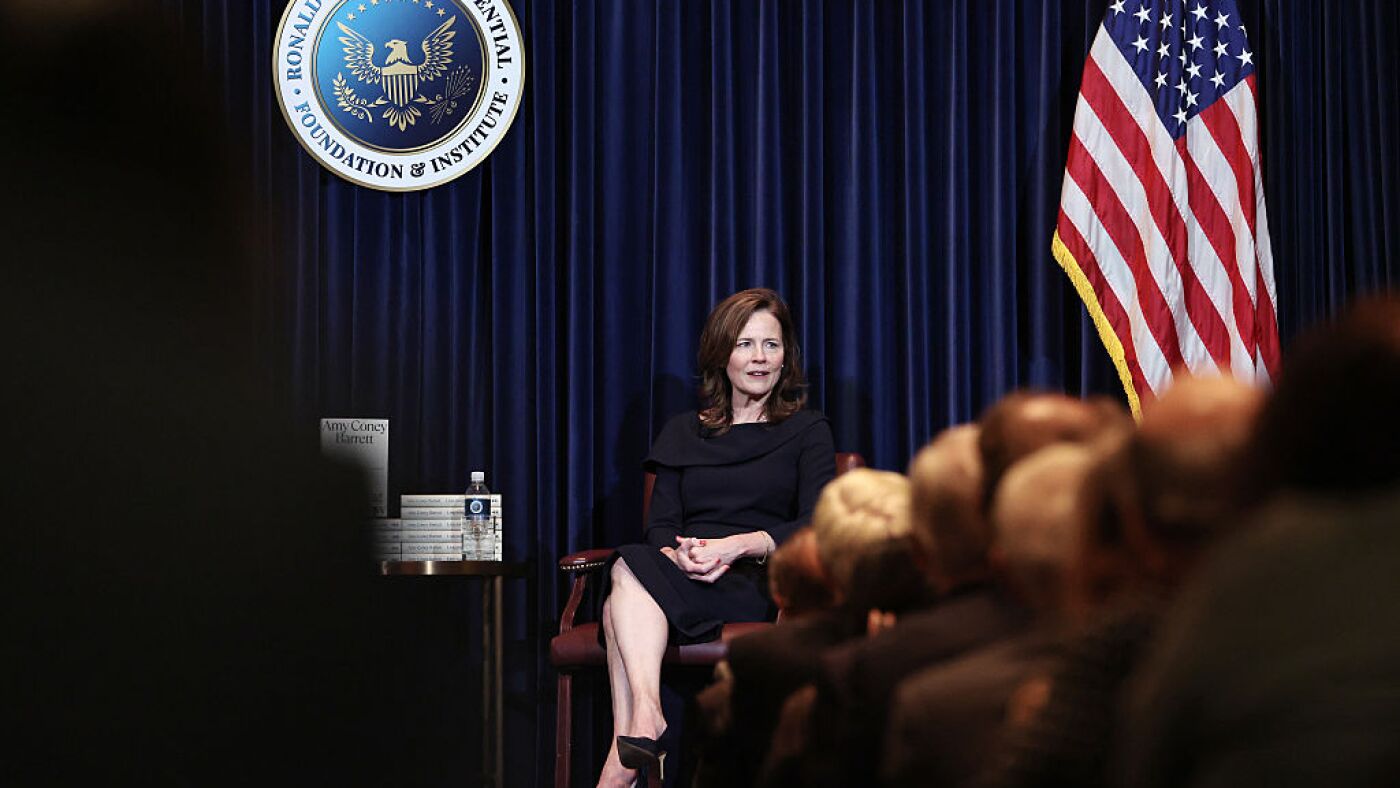
Supreme Court Justice Amy Coney Barrett and retired Supreme Court Justice Anthony Kennedy listen as President Trump addresses a joint session of Congress at the U.S. Capitol on March 4.

Win McNamee/Getty Images


hide caption

toggle caption

Advertisement

Win McNamee/Getty Images

Federal judges who have ruled against the Trump administration this year are confronting a wave of threats, potentially compromising their personal safety and the independence of the judiciary.

The sister of Supreme Court Justice Amy Coney Barrett received a bomb threat earlier this month, and lower court judges who hit pause on some of President Trump’s efforts to dismantle federal agencies and programs have been singled out on social media.

Republican lawmakers close to the president even have proposed impeachment proceedings against a few of those judges, who serve for life.

Advertisement

Elon Musk, who oversees the Department of Government Efficiency making cuts to federal agencies, himself has repeatedly posted on social media about impeaching judges who delay or block parts of Trump’s agenda.

Efforts to undermine the judiciary come at the same time the Trump administration has moved to fire lawyers inside the Justice Department and the Pentagon, penalize private law firms who represented clients Trump does not like, and to back away from participation in the activities of the American Bar Association.

Judge Richard Sullivan, of the U.S. Court of Appeals for the Second Circuit, said in his lifetime four federal judges have been killed in retaliation for their work on the bench.

“This is not hypothetical,” Sullivan, who leads a Judicial Conference panel on security issues, told reporters in a news conference this week. The Judicial Conference is a representative body of federal judges that frames policies for courts. “It’s real. It’s happened before. We have to be certain that it doesn’t happen again,” he said.

The Federal Judges Association, a voluntary group of more than 1,000 judges across the nation, said judiciary plays a “critical role in preserving democracy and a law-abiding society.”

Advertisement

“Judges must be able to do their jobs without fear of violence or undue influence,” the group said in a written statement to NPR.

Early threats

One thing stands out to legal experts: these attacks on judges are coming at a very early stage in the legal process — often, before the Supreme Court weighs in as the final decider.

“We have a system of justice that allows for appeals,” Judge Jeffrey Sutton, chief judge of the Sixth Circuit Court of Appeals, told reporters this week. “That’s typically the way it works. Impeachment is not and shouldn’t be a short-circuiting of that process. And so it is concerning if impeachment is used in a way that is designed to do just that.”

Only 15 federal judges have faced impeachment, mostly for allegations of wrongdoing such as bribery, corruption, or perjury, in the past couple of centuries.

Stephen Vladeck, a law professor at Georgetown University, said the odds of a successful judicial impeachment are pretty low, and to remove a judge from the bench would require a two-thirds vote from the Senate.

Advertisement

“The more that people like Elon Musk are putting on the wall the idea that it’s appropriate to attack these judges for nothing more than ruling against the federal government, the more that we’re normalizing what really are in the main very serious threats to judicial independence,” Vladeck said.

“Jeopardize the Rule of Law”

But Paul Grimm, who spent 26 years as a federal judge, said even the threat of impeachment can amount to intimidation.

“And if you try to intimidate judges, if that’s your goal, so that they do not do their constitutional duty, then you jeopardize the rule of law,” said Grimm, who leads the Bolch Judicial Institute at Duke Law School. “And without the rule of law, every liberty and every right that we cherish as Americans is vulnerable.”

Grimm said he worries a lot about online posts that display the home and work addresses of judges and their adult children, a step that he said “crosses the line.”

Nearly five years ago, an angry litigant shot and killed the son of U.S. District Judge Esther Salas in New Jersey.

Advertisement

And in 2023, a state court judge in Maryland was gunned down in his driveway.

Attacks over rulings

The U.S. Marshals say threats against federal judges have doubled in recent years, according to the most recent data. And those threats have been directed at both Democrat and Republican judges.

Justice Barrett came under withering criticism this month from some right-wing political commentators, after she voted alongside Chief Justice John Roberts and the liberals on the high court against Trump’s effort to freeze foreign aid.

Lower court judges have faced online attacks for their early rulings on Musk’s DOGE team, efforts to restore government web pages, and the freeze on foreign aid.

Advertisement

The Marshals protect judges, but they also report to the U.S. Attorney General, not to the courts themselves. That’s got some members of Congress on alert.

“A judge’s security is dependent in many ways on the Marshals Service who the president appoints to protect the judges, and if a president doesn’t like a decision that’s coming from a judge, theoretically they could pull their security,” Rep. Eric Swalwell, a Democrat from California, said at a congressional hearing this month.

The administration has already yanked protection this year from former military and national security officials who disagreed with Trump in his first term.

Swalwell said Congress should consider giving judges their own security force — one that’s independent from the White House.

Advertisement

News

Woman killed in Atlanta Beltline stabbing identified

Published

on

Woman killed in Atlanta Beltline stabbing identified

Crime scene tape surrounds a bicycle in front of St. Lukes Episcopal Church in Atlanta on May 14, 2026. (SKYFOX 5)

The woman stabbed to death on the Beltline has been identified as 23-year-old Alyssa Paige, according to the Fulton County Medical Examiner.

The backstory:

Advertisement

Paige was killed by a 21-year-old man Thursday afternoon while she was on the Beltline. Officials confirmed to FOX 5 that the stabbing happened near the 1700 block of Flagler Avenue NE.

Atlanta Police Chief Darin Schierbaum said the department was alerted around 12:10 p.m. that a woman had been stabbed just north of the Montgomery Ferry Drive overpass. She was rushed to Grady Memorial Hospital where she later died. Another person was also stabbed during the incident, but their condition remains unknown.

According to officers, the man responsible attacked a U.S. Postal worker prior to the stabbing before getting away on a bike. He then used that bike to flee the scene of the stabbing as well.

Advertisement

The suspect was arrested near St. Luke’s Episcopal Church on Peachtree Street in Midtown around 5:25 p.m. 

What we don’t know:

Advertisement

While officials haven’t released an official motive, they noted the man may have been suffering a mental health crisis.

The Source: Information in this article came from the Fulton County Medical Examiner’s Office and previous FOX 5 reporting. 

AtlantaCrime and Public SafetyNewsInstastories
Advertisement
Continue Reading

News

Man Charged With Posting Bomb Instructions Used in New Orleans Attack

Published

on

Man Charged With Posting Bomb Instructions Used in New Orleans Attack

Federal prosecutors have filed charges against a former Army serviceman they accused of distributing instructions on how to build explosives that were used by a man who conducted a deadly attack in New Orleans on New Year’s Day last year.

The former serviceman, Jordan A. Derrick, a 40-year-old from Missouri, was charged with one count of engaging in the business of manufacturing explosive materials without a license; one count of unlawful possession of an unregistered destructive device; and one count of distributing information relating to manufacturing explosives, according to a criminal complaint unsealed on Wednesday. The three charges together carry a maximum sentence of 40 years in federal prison.

Starting in September 2023, the authorities said, Mr. Derrick was using various social media sites to share videos of himself making explosive materials, including detonators. His videos provided step-by-step instructions, and he often engaged with viewers in comments, sometimes answering their questions about the chemistry behind the explosives.

The authorities said that Mr. Derrick’s videos were downloaded by Shamsud-Din Bahar Jabbar, 42, who was accused of ramming a pickup truck into a crowd on Bourbon Street in New Orleans on Jan. 1, 2025, in a terrorist attack that killed 14 people and injured dozens. Mr. Jabbar was killed in a shootout with the police. Before the attack, Mr. Jabbar had placed two explosives on Bourbon Street, the authorities said, but they did not detonate.

The authorities later recovered two laptops and a USB drive in a house that Mr. Jabbar had rented. The USB drive contained several videos created by Mr. Derrick that provided instructions on making explosives. The authorities said the explosives they recovered were consistent with the ones Mr. Derrick had posted about.

Advertisement

Mr. Derrick’s lawyers did not respond to requests for comment.

Mr. Derrick was a combat engineer in the Army, where he provided personnel and vehicle support, the authorities said. He also helped supervise safety personnel during demolitions and various operations. He was honorably discharged in February 2013.

The authorities did not say whether Mr. Derrick had any communication with Mr. Jabbar, or whether the men had known each other. In some of Mr. Derrick’s videos and comments, he indicated that he was aware that his videos could be misused.

“There are a plethora of uh, moral, you know, entanglements with topics, any topic of teaching explosives, right?” he asked in one video, according to the affidavit. “Of course, the wrong people could get it.”

The authorities also said that an explosion occurred at a private residence in Odessa, Mo., on May 4, and the occupant of the residence told investigators that he had manufactured explosives after watching online tutorials from Mr. Derrick.

Advertisement

Mr. Derrick’s YouTube account had more than 15,000 subscribers and 20 published videos, the affidavit said. He had also posted content on other platforms, including Odysee and Patreon. Some videos were accessible to the public for free, while others required a paid subscription to view.

“My responsibility to my countrymen is to make sure that I serve the function of the Second Amendment to strengthen it,” Mr. Derrick said in one of his videos, according to the affidavit. “This is how I serve my country for real.”

Outside of the income he received through content creation, Mr. Derrick did not have any known employment. He did receive a monthly disability check from Veterans Affairs, the affidavit stated.

Continue Reading

News

The Girls: “This isn’t ringing alarms to y’all?” : Embedded

Published

on

The Girls: “This isn’t ringing alarms to y’all?” : Embedded
Allegations pile up, but Child Protective Services declines to investigate and the school district continues to promote Ronnie Stoner. We include an update at the end of the episode. “The Girls” is a 4-part series from the Louisville Public Media’s investigative podcast, Dig.
Continue Reading
Advertisement

Trending