News
Into the void: how Trump killed international law


‘The old world is dying,” Antonio Gramsci once wrote. “And the new world struggles to be born.” In such interregnums, the Italian Marxist philosopher suggested, “every act, even the smallest, may acquire decisive weight”.
In 2025, western leaders appeared convinced they – and we – were living through one such transitional period, as the world of international relations established after the second world war crashed to a halt.
During such eras, Gramsci more famously wrote, “morbid phenomena of the most varied kind come to pass”. And at present there is no more morbid phenomenon than the crisis of legitimacy for the networks of rules and laws on which the international order was based – the world that the US was central in creating in 1945.
No one can say they were not warned about the wrecking ball that was about to be inflicted on the global order by Donald Trump.
The US secretary of state, Marco Rubio, spelled out with admirable clarity in his Senate confirmation hearing in February how Trump disowned the world his predecessors had made. “The postwar global order is not just obsolete, it is now a weapon being used against us,” he said. “And all this has led us to a moment in which we must now confront the single greatest risk of geopolitical instability and generational global crisis in the lifetime of anyone alive here today.”
The rules-based international order had to be jettisoned, Rubio said, because it had been built on a false assumption that a foreign policy serving core national interests could be replaced by one that served the “liberal world order, that all the nations of earth would become members of the democratic western-led community”, with humankind now destined to abandon national identity and become “one human family and citizens of the world. This was not just a fantasy. We now know it was a dangerous delusion”.
Rubio’s assessment was echoed in the recent US national security strategy, with its warnings of European cultural erasure and determination to back nationalist parties that believe in “strategic stability with Russia”. The US would no longer seek to “prop up the entire world order like Atlas”, the document said.
On paper these sound like relatively coherent statements of “America first”, but in practice Trump’s foreign policy is a mass of confusion in which this formal non-interventionist ideology has clashed with sporadic interventions that uneasily blend notions of global order with the US national interest. There is no linear Trump foreign policy, just a catherine wheel of disconnected explosions thrown out across the night sky. As Donald Trump Jr asserts, as if it were a virtue, his father is the most unpredictable man in politics. The hugely personal nature of US foreign policy gives Washington’s erstwhile allies just enough false hope that the break with America is not real.
Amid this chaos there has been one consistent target for Trump’s contempt: the constraints imposed by international law, and its value system built around national sovereignty, including the prohibition of the use of force to change external borders. In its place Trump pursues “sheer coercive power” – or what has been described as mobster diplomacy, in which shakedowns, blackmail and deal-making are the agents of change.
Faced with the choice, for example, between expelling Russia from Ukraine – something the US undoubtedly has the military means to do by arming Kyiv sufficiently – or forging a profitable relationship with Vladimir Putin in which both sides plunder Ukraine’s considerable material resources, Trump unmistakably wants to choose the latter. Ukraine, it emerges, shall pay any price, bear any burden, meet any hardship, in order to assure the survival and the success of the Trumpian economy. For the EU and Nato this is indeed the moment when every act has the potential to be decisive for the future sovereignty of Europe and the UN charter.
Similarly the sovereignty of Venezuela, sitting on 303bn barrels of crude oil – about a fifth of the world’s reserves – becomes, like that of Greenland, Canada and Mexico, the subject of Trump’s marauding eye. Warned on social media that killing Venezuelan civilians without any due process – as the US has done by bombing numerous boats in the Caribbean and Pacific – would be described a war crime, the US vice-president, JD Vance, was brazen enough to reply “I don’t give a shit what you call it”. The Pentagon has subsequently claimed implausibly that it was permissible in US law to blow up shipwrecked sailors stranded in the water because they were combatants representing a threat to US security.
Meanwhile, the rules of free trade are shredded as Trump deploys the sheer size of the US market to extort not just money from allies, but changes in their domestic policy. A country’s standing in the White House is not judged by any rational criteria, let alone its democratic status, but on a leader’s personal relationship to Trump and his ruling clique – a blatantly monarchical order.
Finally, Israel’s occupation and bombardment of Gaza, with European powers often complicit bystanders, is brutal in itself but also strips bare the supposed universality of international norms. In the words of Majed al-Ansari, the foreign policy adviser to Qatar’s prime minister and a man who has had more dealings with Israel than most in 2025: “We are living in an age of disgusting impunity that is taking us back hundreds of years. We are reduced to giving concession after concession not to stop acts of aggression, but to ask those responsible to kill fewer people, destroy fewer neighbourhoods. We do not even ask them to have respect for international law, but ask to take a step back from going 100 miles away from international law.”
All this has been accompanied by an open assault on the institutions of international law that stand in the way of coercive power. Nicolas Guillou, a French judge at the international criminal court, recently gave an interview to Le Monde in which he spelled out the impact of US sanctions imposed on him in August as a result of the ICC’s issuing an arrest warrant against Benjamin Netanyahu for crimes against humanity.
The sanctions have changed every aspect of his daily life. Guillou explained: “All my accounts with American companies, such as Amazon, Airbnb, PayPal and others, have been closed. For example, I booked a hotel in France through Expedia, and a few hours later, the company sent me an email cancelling the reservation, citing the sanctions.”
For having the temerity to uphold the basics of international humanitarian law and the value of the lives of Palestinian civilians at the international court, which deals with issues such as war crimes and genocide, Guillou said he had in effect been sent back to live in the 1990s. European banks, cowed by the threats of US Treasury officials in Washington, rushed to close his accounts. The compliance departments of European companies, acting as the valets of the US authorities, refused to provide him services.
Meanwhile, European institutions – even signatories to the Rome statute that established the international court in 2002 – look the other way. Major Palestinian human rights groups such as Al-Haq also find their bank accounts closed as they face sanctions for cooperating with the ICC. The judges at the international court of justice, the UN body that deals with intergovernmental disputes, have had to take evasive action to prevent their assets being seized.
The US has left or sought to undermine several other UN bodies, such as the Human Rights Council and Unesco. In total it is estimated to have cut $1bn (£750m) in funding for organisations linked to the UN and fired 1,000 US government staff whose portfolios reinforced major UN functions.
At the UN general assembly, the key site of this year’s disputes between the US and the rest of the world, the US almost relishes its isolation. Other multilateral institutions – the World Trade Organization, the Paris climate agreement structure, the G20 – have become zones of conflict, places where the US can assert its dominance or indifference, either by absenting itself or demanding humiliating fealty from its one-time allies. John Kerry, a former US vice-president, said that under Trump the US was turning “from leader to denier, delayer and divider”.
“When the United States walks away, old excuses find new life. China not only enjoys newfound freedom from scrutiny,” Kerry said: it slowly fills the gap left by the US departure.
Washington’s turning away from international law and its institutions is especially sad because, as Dr Tor Krever, an assistant professor of international law at the University of Cambridge, points out, with Gaza “the language of legality has become the dominant frame of popular and political discourse”.
In a special edition of the London Review of International Law, more than 40 academics have written essays discussing whether this sudden public faith in international law as a harbinger of justice is a load that the law has the capacity to bear. Law cannot be a substitute for politics or settle ideological conflicts in a polarised world. Prof Gerry Simpson, the chair of public international law at the LSE, said he needed to swallow his longstanding doubts about international law’s efficacy “in the face of the enormous faith that had been placed on it, especially by the young”.
The inability to meet new public expectations has led to what Prof Thomas Skouteris, the dean of the law college at the University of Khorfakkan, UAE, describes as “a fin de siècle mood” about international law. Writing in the Leiden Journal of International Law, he argues: “International law’s lexicon – sovereignty, genocide, aggression – has become almost ambient, saturating the political atmosphere with juridical resonance. But ubiquity brings a strange paradox. The more present international law appears, the less decisive it feels. Norms are invoked with greater frequency and intensity even as their capacity to settle disputes or forestall violence seems to weaken. What once promised order increasingly reads as performance.”
The paradox is revealed in its starkest form when rulings of the UN security council or the international courts are invoked by western leaders who, in the next breath, prostrate themselves in front of Trump, caving in to his demands, calling him “daddy”, as Nato’s Mark Rutte did, and sending more lavish gifts to the Sun King and his family.
Very few in 2025 stood up against what the Dutch historian Rutger Bregman called “immorality and unseriousness … the two defining traits of our leaders today”.
Tom Fletcher, the head of the UN humanitarian agency Ocha, was arguably an exception. In May he asked UN diplomats “to reflect – for a moment – on what action we will tell future generations we each took to stop the 21st-century atrocity to which we bear daily witness in Gaza. It is a question we will hear, sometimes incredulous, sometimes furious – but always there – for the rest of our lives … Maybe some will recall that in a transactional world, we had other priorities. Or maybe we will use those empty words: We did all we could.”
His was a genuine howl of despair. Another cry of pain came from Oman’s foreign minister, Badr bin Hamad Al Busaidi. Speaking to the Muscat retreat of the Oslo Forum, an international mediators’ discussion group, he explained: “We are worryingly close to a world in which certain kinds of foreign intervention – if not outright invasion and annexation of territory – are accepted as a normal part of international relations, rather than as illegal violations of our shared international order. How did this happen?”
Al Busaidi claims the problem predated Trump. “Restraint and respect for international law was abandoned in the aftermath of 9/11, with the launch of not one but two foreign interventions, in Iraq and Afghanistan, ostensibly aimed at the elimination of a terrorist threat, but in reality, functioning as explicit projects of regime change.”
Now some on the left welcome the idea that international law’s entry into the limelight has coincided with its loss of credibility. The critics would share the view of the Marxist Perry Anderson, writing in New Left Review, that “on any realistic assessment, international law is neither truthfully international nor genuinely law”.
They argue that US presidents – Democrat and Republican alike – have always in reality exempted themselves from the law’s constraints. The US has never been a signatory to the Rome statute or the UN convention on the law of the sea. Roosevelt was not that interested in forging a club of democracies, but wanted as much to create a law-based stability pact with Russia. Indeed, Prof John Dugard, a member of the South African legal team at the international court of justice, has argued that the Biden team’s choice of the phrase “rules-based order” was a revealing code because it showed the US ambiguity towards international law.
The Russian foreign minister, Sergei Lavrov, has long declared that the US is promoting “a west-centric rules-based order as an alternative to international law”. China’s foreign minister, Wang Yi, made the same criticism in May 2021 during a UN security council debate on multilateralism. “International rules must be based on international law and must be written by all,” he said. “They are not a patent or privilege of a few. They must be applicable to all countries and there should be no room for exceptionalism or double standards.”
For much of the global south too, the rules conceal histories of violence and racial hierarchy. Others see international law with its references to proportionality, distinction and necessity as a futile attempt to soften the essential brutality of war.
It has been left to an older generation to insist there is something precious worth preserving. Take the response of Christoph Heusgen, the outgoing chair of the Munich Security Conference, in the wake of Vance’s speech attacking European values made in February 2025.
Heusgen, who served for 12 years as Angela Merkel’s adviser on security and foreign policy affairs, told the conference: “We have to fear that our common value base is not that common any more … It is clear that our rules-based international order is under pressure. It is my strong belief that this more multipolar world needs to be based on a single set of norms and principles, on the UN charter and the universal declaration of human rights.
“This order is easy to disrupt. It’s easy to destroy, but it’s much harder to rebuild. So let us stick to these values.”
But Ansari, despondent after a year of often fruitless Middle East diplomacy, predicts we are “moving from a world order to disorder”.
“I don’t think we are moving towards a multipolar system. I don’t think we are even moving to a power-based international order. I don’t think we are moving towards any kind of system.
“We are moving into a system where anybody can do whatever they like, regardless if they are big or small. As long as you have the ability to wreak havoc, you can do it because no one will hold you accountable.”


At least two structural columns buckled and failed in a 37-story office tower in Midtown Manhattan on Tuesday, prompting evacuations of nearby streets and buildings. While city officials asserted that the tower was in no danger of collapsing completely, outside engineers said further failures in the structure could not be ruled out.
A pair of columns that failed completely were part of the tower’s existing structure. A New York Times review of images and videos from inside the building has found that several floors were added atop these columns.
City officials said in a news conference on Tuesday that the building was continuing to move, while they simultaneously assured the city that the building would not suffer “total collapse.” “The way this building is constructed, it’s a steel-frame building,” John Esposito, a chief in the Fire Department in New York, said at the afternoon news conference. “So, it would not be a total collapse. It would be more of a localized collapse.” Still, he said, “that remains our concern, that it’s moved.”
Engineers said that the movement itself was cause for concern. In a properly designed steel building, they said, loads should redistribute quickly to surviving structural supports if columns failed.
Joe DiPompeo, a former president of the Structural Engineering Institute at the American Society of Civil Engineers, said that if the structure had been overloaded, he would expect any movement “to happen very quickly,” rather than gradually.
“Generally when a column buckles, it’s a sudden failure,” Mr. DiPompeo said. He said that a full collapse remained unlikely given the redundancies built into the building codes.
Engineers often refer to the most dangerous possibility as a progressive collapse, a process in which structures near the initial failure become overstressed and also fail, potentially bringing down the building if the sequence continues. While unlikely, it cannot be ruled out, Mr. DiPompeo said.
Footage recorded from inside the building shows at least two structural columns appear to have failed completely, Mr. DiPompeo said. Other nonstructural, interior walls — or at least the metal “studs” that were in place to hold them up — also appear to have deformed.
“The only way that really happens is if the floor above them dropped. It looks like the floor above could have dropped a foot or two, which is obviously not a good situation,” Mr. DiPompeo said.
The 37-story building is in the process of being converted from office space into residential units. Four new floors and a large vertical portion were added onto the existing building in recent months. The vertical portion consists of a stack of over a dozen new floors cantilevered out over the existing building below.
Engineers said that there was nothing inherently wrong with adding residential floors or the cantilevered section above the columns that failed, as long as the original structure and the modifications had properly accounted for the added weight and wind loads.
“The cantilever alone doesn’t change anything,” Mr. DiPompeo said, but it does put additional load on the columns underneath — a factor that should have been reflected in the design.
Nathan Berman, managing principal and founder of MetroLoft, the developer overseeing the conversion, said on Tuesday that “this incident is nothing more than a typical construction mishap.”
He said two columns near the northwest corner of the tower had bent under the weight of additions to the building above, most likely because those columns had not been properly reinforced, though he said an investigation would determine the cause. The rest of the columns, he said, “picked up the weight.” He estimated the affected floors above the failed columns had sagged by a maximum of four inches.
Mr. Berman said that he expected the problems to be fixed and the project to be completed with, at most, a slight delay.
On Tuesday evening, installation of temporary shoring was set to begin shortly, in order to help stabilize the 20th and 21st floors of the building.

The Justice Department sent letters warning election officials in all 50 states and the District of Columbia that they could face criminal prosecution over noncitizen voting, a spokesperson for the Justice Department confirmed Tuesday.
The letters, signed by Assistant Attorney General Harmeet Dhillon, who heads up the department’s Civil Rights Division, give states five days to explain how they will comply with federal voter eligibility laws and how they will maintain “clean voter lists.”
“The Department sent these letters to all 50 states and the District of Columbia, asking for voluntary compliance in a timely manner with their obligations under federal law to ensure only citizens vote in federal elections,” a Justice Department spokesperson said in a statement.
Noncitizen voting in federal elections is extremely rare, but Trump and his administration have falsely portrayed it as a widespread issue.
Michigan Secretary of State Jocelyn Benson, Nevada Secretary of State Francisco Aguilar and Utah Lt. Gov. Deidre Henderson are among those who said they received the letters from the Justice Department.
The letters say state election officers “could be criminally prosecuted for aiding and abetting” noncitizen voting. They further specify that any election officer who knowingly retains noncitizens on a statewide voting registration list or who facilitates noncitizens’ receiving and casting ballots could be subject to criminal liability.
“An intentional act that is aimed at diluting the votes of citizens could also constitute a violation” of federal law, the letters said.
Henderson wrote on social media that the threats constitute “truly bizarre behavior.”
“Got another love letter this morning from the DOJ sprinkled throughout with threats of criminal prosecution,” she wrote. “I’m sure I’m not the only chief election officer of a state who is being targeted for following state and federal laws by resisting DOJ’s demands for private voter data that have thus far been ruled illegal by at least a dozen courts.”
The letters are the latest move in the Justice Department’s campaign to assert more federal control over state elections.
While some states have complied with the administration’s demands that they hand over voter roll data, the Justice Department has sued 30 states and Washington, D.C., for resisting. So far, 11 different federal courts have dismissed the Justice Department’s efforts to seize voter rolls.
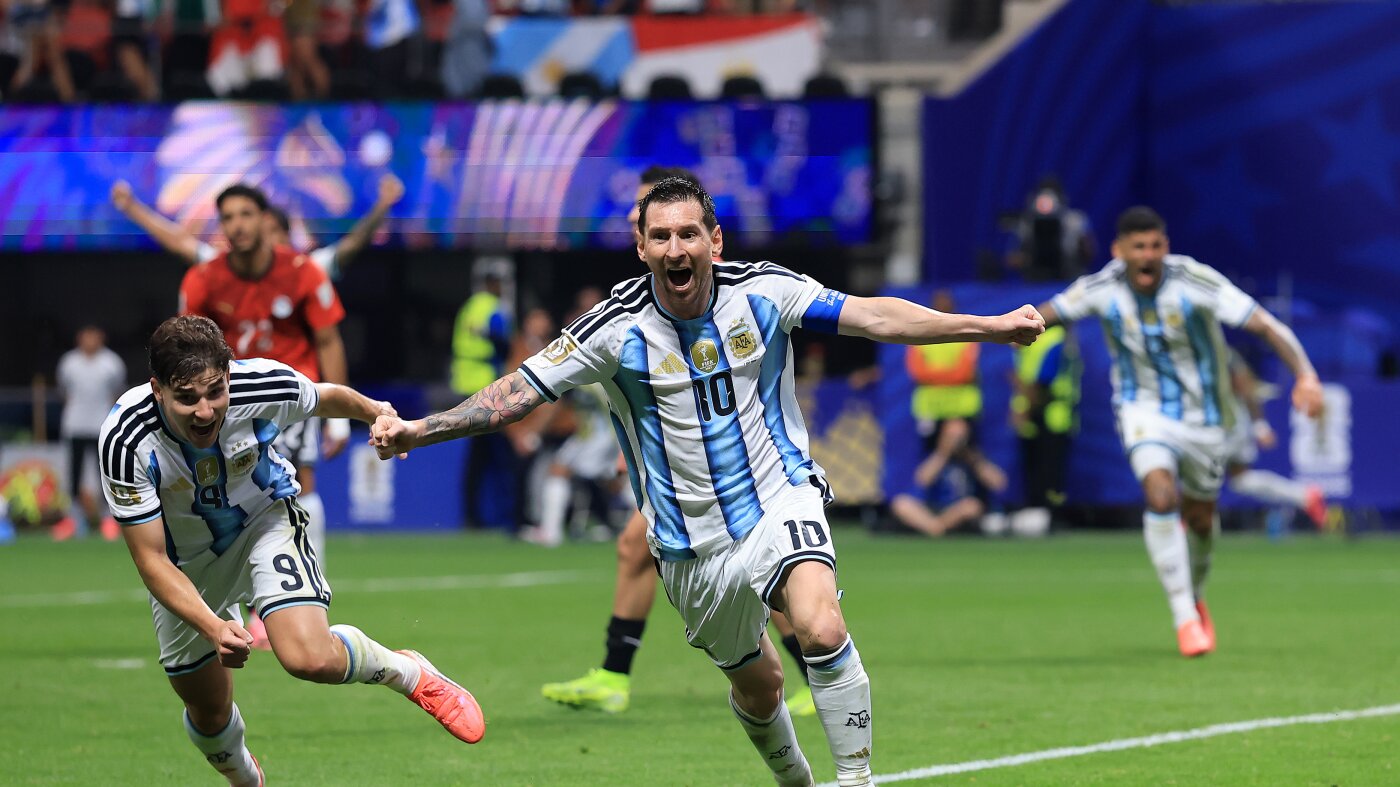
Lionel Messi #10 of Argentina celebrates scoring his team’s second goal during their World Cup match against Egypt in Atlanta on Tuesday.
Elsa/Getty Images
hide caption
toggle caption
Elsa/Getty Images
They looked beaten. And out. Argentina, the defending World Cup champion and No. 1-ranked team, was down 2-0 late against Egypt.

Then, in a span of 13 remarkable minutes, Argentina scored not once, not twice, but three times, capping a comeback for the ages and leaving Egypt stunned and shellshocked.
For much of the game in Atlanta, Egypt was in control, hobbling Argentina early. The Egyptian attack began almost immediately with a stunning header goal delivered by Yasser Ibrahim in the 15th minute. After that, Egypt’s defense closed ranks, making it practically impossible for Argentina to equalize.
It was downhill from there for the Argentines: team captain Lionel Messi failed to convert a penalty kick, and in the 67th minute, Egypt got a second goal from Mostafa Ziko (after an earlier Egyptian goal had been disallowed after a video review). It looked like Argentina was finished. On the brink of elimination.
But no one told the Argentine players that.
In the 79th minute, Lionel Messi began doing his thing. He fired a cross near the Egyptian goal, and Cristian Romero headed it in. Messi was not done. Four minutes later, he powered a shot past the Egyptian keeper. It was his eighth goal of this tournament, the most of any player. The score was 2-2.
Then, in stoppage time, yet another Argentina header and another goal, this time from Enzo Fernandez.
“This is the World Cup for you,” said Messi after the game. “It wasn’t easy to come back from two goals down. But as I always say, this group never gives up. We always try to fight until the end.”
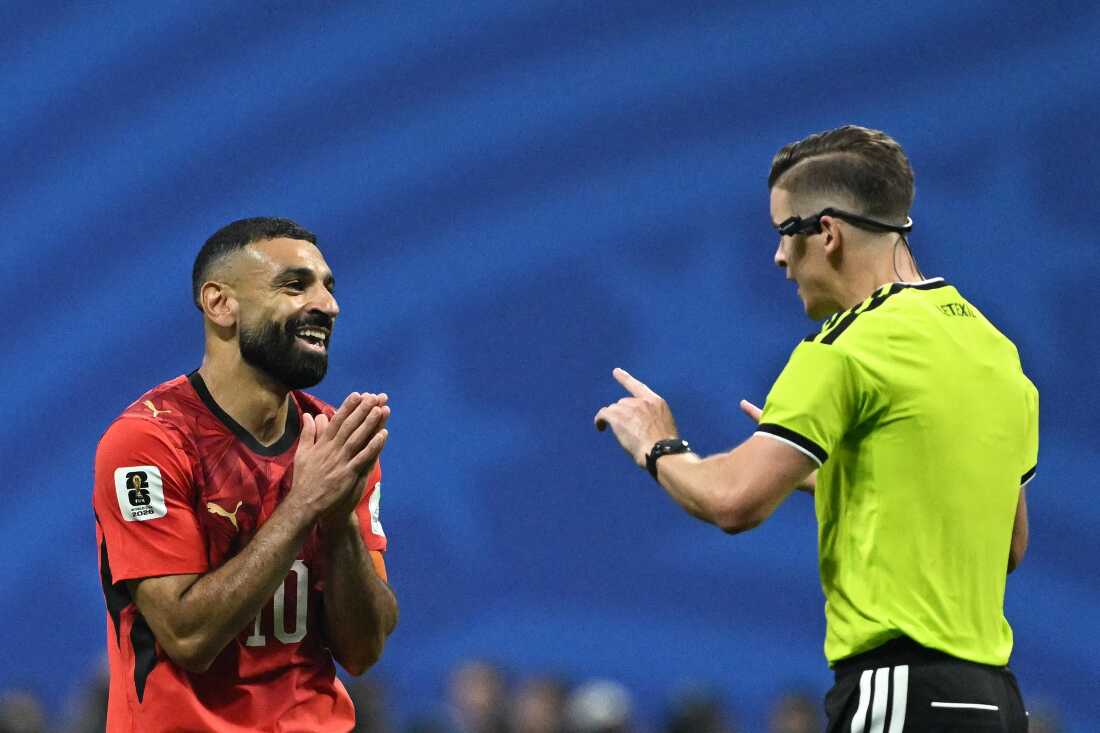
French referee François Letexier speaks with Egypt forward Mohamed Salah during the World Cup Round of 16 match between Argentina and Egypt in Atlanta.
Roberto Schmidt/AFP via Getty Images
hide caption
toggle caption
Roberto Schmidt/AFP via Getty Images
Afterward, Egypt coach Hossam Hassan complained about the French referee and the officiating. “I am not convinced. I am not convinced with this outcome. I’m not convinced with the way things unfolded during this match,” said Hassan in a post-match news conference. “We have been treated unfairly today. We have suffered injustice.”
“We would have deserved to earn this win, but we are leaving with honor, with pride, regardless of this defeat,” said Hossan.
African soccer teams have been the stars of this World Cup. Morocco has yet to lose a game. Cape Verde qualified for the first time in its history and stymied Spain, Uruguay and Saudi Arabia. Argentina barely beat them in a nail-biter of a match.
For Egypt, getting this far in the tournament is historic in itself: it’s the first time the team has made it this far. For Argentina, it was a terrifying yet relieving victory: several players, including Messi himself, cried after the game.
Next, they move to the quarterfinals and will play the winner of today’s Switzerland-Colombia match.
-

 Tennessee4 minutes ago
In-N-Out’s fifth Tennessee location is opening soon. Here’s how many stores are planned
-

 Texas7 minutes ago
Triple-digit heat returns to North Texas before weekend storms bring relief
-

 Utah12 minutes ago
Planned 60-foot long Liberty Arch in Utah sparks patriotism, but also concerns
-

 Vermont19 minutes ago
Vermont offers money to replace diesel vehicles with electric
-

 Virginia22 minutes ago
Virginia reports 10 cases of cyclosporiasis
-

 Washington27 minutes ago
Washington law says to alert the public when doctors are accused of misconduct. It can take months
-

 Wisconsin34 minutes ago
Former Wisconsin judge to be sentenced after conviction in obstructing arrest of Mexican immigrant
-

 West Virginia37 minutes ago
West Virginia town’s entire police force fired after ex-sergeant claims evidence room was broken into

